How Long Does It Take to Buy a Used Car From Start to Finish?
A used car can take a few hours to a few weeks to buy; same-day drive-away is generally realistic only when the car is chosen, financing is approved, and the title and paperwork are ready. Rushing the process can mean overpaying, missing title problems, or getting stuck waiting on lender approval. This guide breaks the purchase into shopping, approval, paperwork, and drive-away time blocks.
This guide is part of our Used car buying timeline: step-by-step from search to keys series.
How long take used table
| Step | Best-case time | Typical time | Delay-prone time | What makes it fast or slow |
|---|---|---|---|---|
| Search and shortlist | 30 minutes to 2 hours | 1 to 7 days | 1 to 3 weeks | Fast when your budget, body style, and mileage limit are set; slow when you browse across many models, trim levels, and locations. |
| Test drive | 20 to 45 minutes | 45 minutes to 2 hours | Half a day | Fast for an on-lot ready unit; slower when the car is off-site, needs fueling, or must be moved from another location. |
| History report and inspection | 30 minutes to 1 hour | 1 to 4 hours | 1 to 3 days | Fast when the report is clean and a shop has a slot; slow when warning lights, worn tires, or brake issues need a mechanic’s review. |
| Financing approval | 30 minutes to 2 hours | 2 to 24 hours | 1 to 3 days | Fast with loan pre-approval and simple income documents; slow when credit verification, lender review, or proof of income is incomplete. |
| Contract signing | 20 to 45 minutes | 1 to 2 hours | 3 to 4 hours | Fast when the price, down payment, and trade-in numbers are settled; slow when add-ons, fees, or corrections need revision in the F&I office. |
| Insurance proof | 10 to 30 minutes | 30 minutes to 1 day | 1 to 2 days | Fast if your insurer can add the VIN immediately; slow if policy changes, coverage limits, or lender requirements need review. |
| Title and registration | Same day for temp tags | 3 to 14 days | 2 to 8 weeks | Fast when the dealer can issue temporary tags and file electronically; slow when DMV queues, out-of-state titles, or tax issues appear. |
| Vehicle handoff | Same day | Same day to 3 days | 1 to 2 weeks | Fast when payment, insurance, and paperwork are complete; slow when the car needs detail prep, transport, or a missing document. |
How long does it take to buy a used car?
A used car can sometimes be bought in a few hours, but the full process often stretches to about one to three days once searching, inspection, financing, and paperwork are included. If the car is already identified, the lender is pre-approved, and the dealer can issue temporary tags, same-day drive-away is realistic.
Same-day purchase: when it is realistic
Same-day buying works best with an on-lot ready unit, a clear history report, no trade-in, and financing already lined up. Cash buyers can move quickly too, but they still need title transfer, identity verification, and insurance proof before the dealer will hand over the keys.
Picture a buyer who finds a sedan on a dealer lot at 10 a.m., already has loan pre-approval, and can email proof of insurance. That sale can often finish the same afternoon if the car passes inspection, the lender approves the final contract, and the DMV process can start with temporary tags.
A typical purchase that takes one to three days
Most buyers need a day or two because they test drive more than one car, compare monthly payment targets, and wait for finance approval or document review.
When the process stretches into a week or more
The timeline stretches when you need a remote purchase, transport from another lot, a trade-in payoff, or out-of-state title work. It also slows when the lender wants more documents, the DMV is backlogged, or the dealer must wait for funds to clear before releasing the vehicle.
What should you do before shopping?
Before shopping, set a monthly payment ceiling, choose the down payment you can part with, and get loan pre-approval if you plan to finance. Gather your driver’s license, insurance information, and any trade-in paperwork so you can move quickly once you find the right used car.
Set a monthly payment target and down payment
Start with the payment you can handle after taxes, fuel, insurance, and maintenance. Then choose how much cash you can put down without draining your emergency fund. That target keeps you from wasting time on cars that look affordable but fail the payment test.
Get loan pre-approval before you start comparing cars
Get loan pre-approval before you compare listings, because it gives you a credit check, rate range, and lending limit before you reach the showroom. It also lets you compare cash and finance offers with a real monthly number, not a guess.
Gather license, insurance, and payment documents
Bring a valid driver’s license, proof of insurance, and a payment method the dealer will accept. If you are paying by cashier’s check, wire, or bank draft, confirm the payee name and exact amount before you arrive. If you are financing, bring income and residence documents the lender may ask for.
How long does each buying step take?
Each phase has its own clock. Search time can take days, while dealership processing may take only an hour or two. The legal drive-away step can be instant in some states with temporary tags, or delayed until registration and title work clear in others.
Search, test drive, and history check
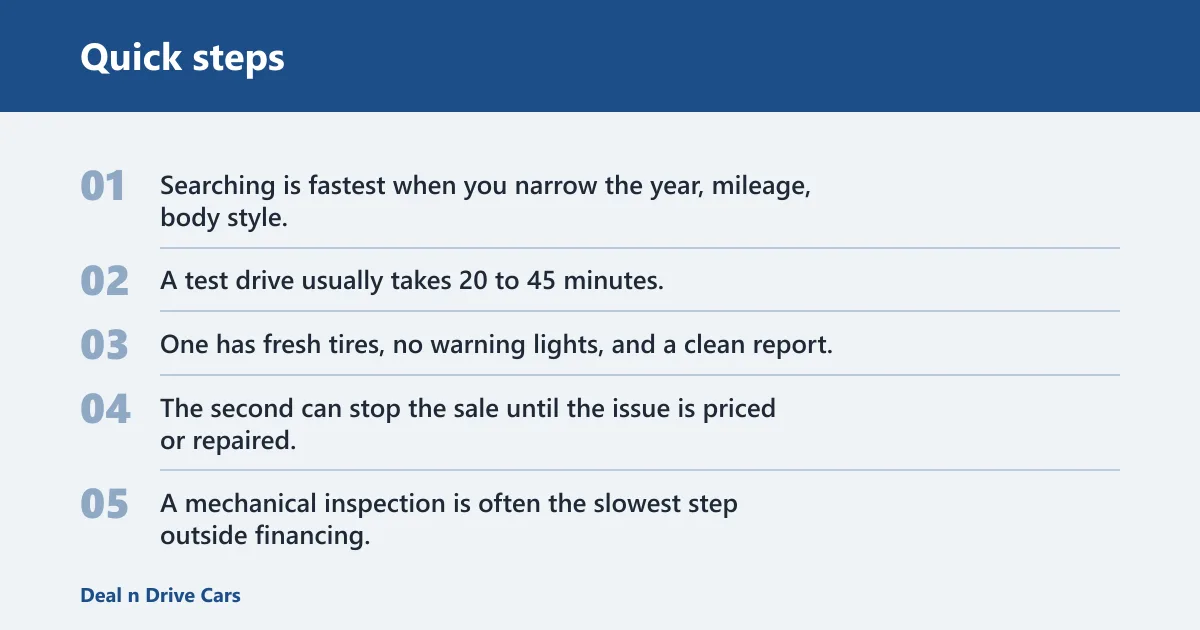
Searching is fastest when you narrow the year, mileage, body style, and price range before you begin. A test drive usually takes 20 to 45 minutes, and a used-car history report takes only minutes to read, but inspection scheduling can add hours or days.
Suppose two SUVs look similar online. One has fresh tires, no warning lights, and a clean report; the other has an illuminated check-engine light and brake wear that needs a mechanic’s opinion. The first car can move quickly. The second can stop the sale until the issue is priced or repaired.
Inspection, appraisal, and trade-in review
A mechanical inspection is often the slowest step outside financing. A quick appraisal for a trade-in may take 15 to 30 minutes, but a payoff amount, equity calculation, or lien release can add more time. Trade paperwork is also harder when the lender still holds the title.
Finance approval and F&I office time
The finance and insurance office handles lender approval, contract signing, and optional product add-ons. With pre-approval and clean documents, this can be finished in under two hours. If the lender wants updated income proof or the buyer reviews service contracts and warranty add-ons carefully, it can take much longer.
Contract signing, title work, and handoff
Contract signing is usually the last in-store step, but it is not the same as legal completion in your state. The dealer still needs title transfer, registration filing, and sometimes temporary tags before you can drive away. That is why “sold” and “ready to leave” are not always the same moment.
Why financing and paperwork slow delivery
Financing and paperwork slow delivery because they depend on third parties: lenders, insurers, DMVs, and title clerks. Cash buyers usually move faster than financed buyers, but even cash can wait if the dealer needs cleared funds or bank draft verification before releasing the car.
Cash vs finance timing
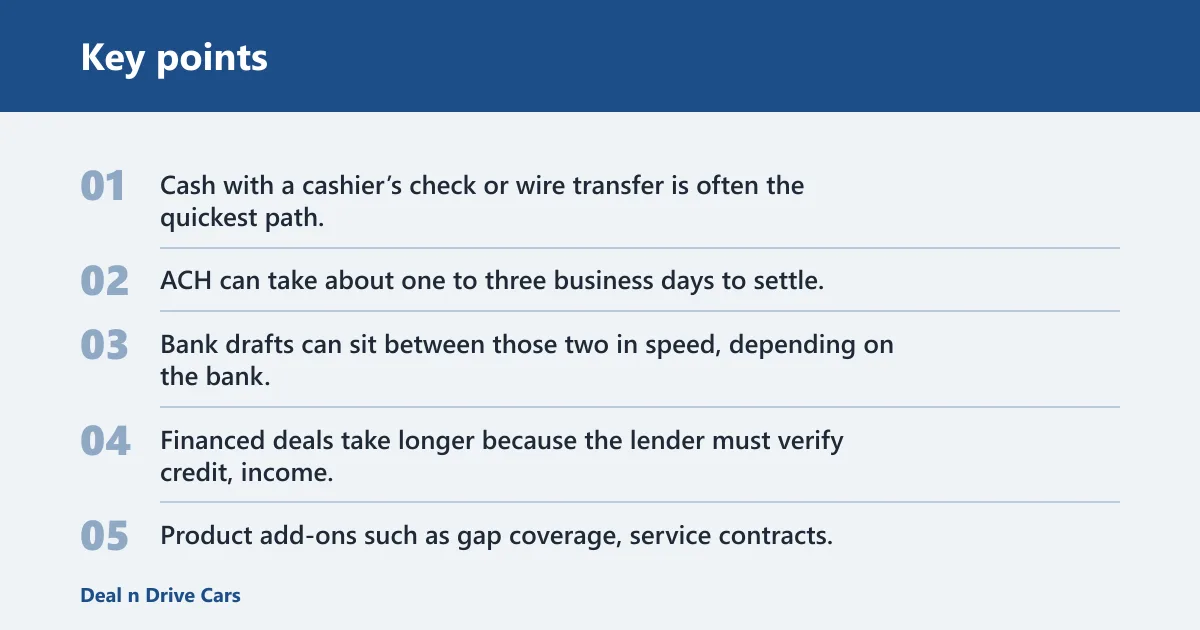
Cash with a cashier’s check or wire transfer is often the quickest path, but the dealer may still need to verify funds. ACH can take about one to three business days to settle, so it is generally slower than a cashier’s check or same-day wire. Bank drafts can sit between those two in speed, depending on the bank.
Credit checks, lender approval, and product add-ons
Financed deals take longer because the lender must verify credit, income, and debt load before final approval.
Title transfer, registration, and temporary tags
Even after signing, the car may need title transfer and registration before it is fully legal to drive long term. Some dealers issue temporary tags the same day, but permanent registration timing depends on state DMV rules, tax collection, and whether the title is already in the dealer’s possession.
What delays a used car the most?
The biggest delays usually come from missing documents, trade-in complications, lender requests, and DMV processing. A used car that looks ready online can stall when insurance proof is not in place, the title is not clean, or the payment method has not cleared.
Missing documents or proof of insurance
Dealers need a driver’s license, insurance proof, and often a signed bill of sale before delivery. If any of those are missing, the sale may be complete but the handoff will wait. Some states and lenders also require specific coverage limits before the car can leave the lot.
Trade-in payoff and lien release delays
Trade-ins slow the process when the payoff amount does not match the dealer’s estimate or the lender still holds a lien. The dealer may need time to confirm equity, request a lien release, and complete trade paperwork. That can turn a same-day deal into a multi-day file.
DMV timing, taxes, and state-specific registration rules
State DMV timing is one of the least predictable parts of the purchase. Some states allow quick temporary tags; others take longer to process title and registration. Taxes and fees may need to be collected at signing, and out-of-state or rebuilt titles can add more delay.
Funds that are not yet available
If payment is coming through ACH or a bank transfer that has not settled, the dealer may not release the car. This is especially common when the buyer assumes a transfer counts as “sent” before the money is actually available. The dealer usually waits for cleared funds, not just a payment confirmation.
Used car purchase speed by payment method
Payment method changes the clock. A cashier’s check or wire transfer can support same-day delivery, while ACH often introduces at least one business-day wait. Trade-ins add another layer because the dealer must balance the new purchase against payoff, equity, and title handling.
Cashier’s check, wire transfer, bank draft, and ACH
A cashier’s check is usually fast if it matches the exact amount and payee name. A wire transfer can also be fast once the bank sends it and the dealer verifies receipt. Bank drafts are commonly accepted, but clearing rules vary. ACH is usually the slowest because it may not settle until the next business day or later.
Cash buyer timing
Cash buyers often finish faster because they do not wait on lender approval. Even so, they still need inspection, contract signing, title work, insurance proof, and sometimes DMV processing. If the dealer requires certified funds, a cash buyer should assume the handoff depends on the bank’s verification window.
Financed buyer timing
Financed buyers usually need the most coordination. Pre-approval helps, but the final lender decision still depends on the exact car, amount financed, and document package. If the buyer changes vehicles, down payment, or term length, the lender may need to re-run approval before delivery.
Trade-in buyer timing
Trade-in buyers often wait longer because two transactions have to close together. The dealer must appraise the old car, confirm any payoff, and account for equity before finalizing the new purchase. If the trade has a lien, lien release timing can become the bottleneck.
Frequently asked questions
How long does it take to buy a used car from start to finish?
Many used-car purchases take about one to three days from first serious search to drive-away, though a ready buyer may finish in a few hours. The total depends on financing, inspection, paperwork, trade-ins, and whether the dealer can issue temporary tags right away.
Can you buy a used car in one day?
Yes, but only if the car is ready, financing is approved or not needed, insurance proof is available, and the title paperwork is clean. One-day deals fail most often when a lender needs more time, the trade-in payoff is unclear, or the DMV step cannot be completed quickly.
How long does a dealership take to process a used car sale?
The dealership side often takes about one to two hours once the car is selected and the numbers are settled.
How soon can you drive a used car home after buying it?
You can sometimes drive it home the same day, especially with temporary tags, insurance proof, and a clean payment method. In other cases, you must wait until funds clear, the title is processed, or the dealer finishes state-required registration steps.
When should you get financing before shopping for a used car?
Get financing before shopping if you want a faster closing, a clearer budget, and less back-and-forth at the dealer. Pre-approval is especially useful if your credit is borderline, you want to compare offers, or you are buying from a private seller who expects fast payment.
What paperwork slows down used car delivery?
The biggest slowdowns are proof of insurance, driver’s license issues, missing bill of sale details, title transfer problems, and incomplete registration forms. Trade-in payoff letters, lien releases, and lender stipulations can also hold up delivery even after the sale is agreed.
What should you do the day before buying a used car?
The day before, confirm your payment method, gather ID and insurance proof, review your pre-approval terms, and decide on your maximum out-the-door price. If you have a trade-in, collect the payoff statement and any lien information so the dealer can work faster.
How many days should you spend shopping for a used car?
For most buyers, one to seven days is enough to compare options without losing momentum. Spend longer only if you are waiting for a specific trim, color, or inspection result. If a car fits your budget and passes your checks, waiting longer usually adds more risk than value.
How long should you wait before buying a used car you found online?
Do not wait long once the car passes your budget and inspection checks, because good used cars can sell quickly. Same-day or next-day contact is often reasonable. If the listing is vague, the title is unclear, or the seller will not answer basic questions, walk away.
What can delay a used car purchase the most?
The largest delays usually come from lender approval problems, trade-in payoff issues, and DMV registration timing. Missing documents can stop delivery immediately, but title or lien problems can hold the car for days or weeks. Those are the cases where patience is usually cheaper than forcing the deal.