What Is a Fair Price for a Used Car?
A fair price for a used car is the local market range for that exact year, trim, mileage, and condition, minus documented repairs, title or history risk, and buyer-paid fees. Start your offer at the low end, not the average. This guide shows how to read live listings, adjust for seller type, mileage, condition, and history, and turn that result into a concrete offer.
This guide is part of our Fair price for a used car: how to know it series.
What fair price means
Fair price is a range, not one number. Build that range from live listings for the same model, then adjust for risk, fees, and seller type. Asking price is only the starting point because it is a seller-stated figure, not a completed sale.
Why asking price is only the starting point
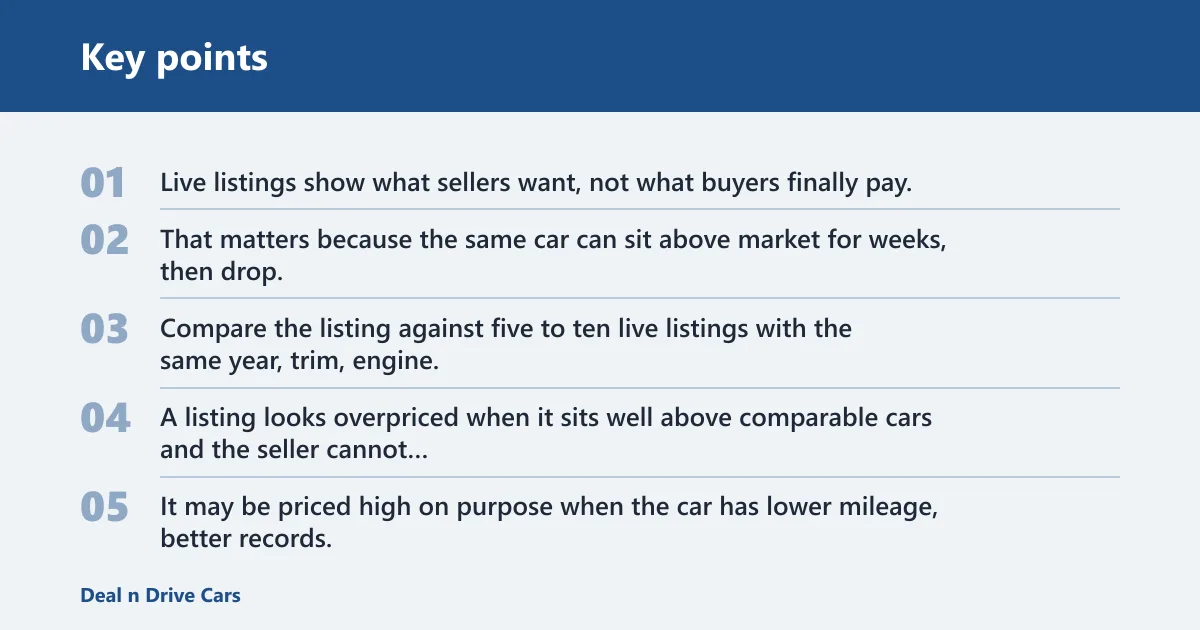
Live listings show what sellers want, not what buyers finally pay. That matters because the same car can sit above market for weeks, then drop, or sell quickly if it is priced tightly. Compare the listing against five to ten live listings with the same year, trim, engine, transmission, and body style.
A listing looks overpriced when it sits well above comparable cars and the seller cannot explain the gap. It may be priced high on purpose when the car has lower mileage, better records, or a stronger trim. The question is simple: does evidence support the gap, or does it rely on guesswork?
Use multiple price types, not one number. The four price types named in valuation guides are trade or auction, part-exchange, private sale, and dealer forecourt. The most accurate valuation comes from combining market research, online tools, professional advice, and history.
📊 Consumer Reports says the average used-car price is just over $27,000. Source: Consumerreports.
What is a good price for a used car?
A good price is usually below the dealer forecourt figure and close to the low end of the local private-sale range, after adjusting for mileage, condition, and paperwork. Dealer offers are usually below private-sale prices, while trade or auction value is the lower floor you can use as a reference.
Private sale price as the baseline
Private sale price is a useful comparison baseline because it usually sits below dealer retail and above trade value. It depends on condition and history. If a car has clean records and presentable condition, a fair offer often sits within that private-sale band, not at the highest asking price you see online.
Dealer forecourt price and why it usually runs higher
Dealer forecourt pricing includes prep, warranty, and margin. That is why it should not be compared directly with private listings. A dealer car can cost more than an equal private car even when the metal is similar, because the seller is bundling reconditioning, business costs, and some level of retail backup into the price.
Trade or auction value as the lower floor
Trade or auction value is useful as a floor price, especially for part-exchange. It is usually below private sale because it reflects wholesale risk and the seller’s need to move stock. If a private seller is asking close to dealer retail while the car has weak records, the gap is hard to justify.
Consumer Reports says the average used-car price is just over $27,000, the average used-car loan interest rate is 11.43 percent, and the average age of cars on the road in the U.S. is nearly 13 years. Those numbers help with context, but they do not settle a local deal on their own.
How to compare similar cars
Compare like-for-like cars: year, trim, engine, transmission, and body style first, then mileage, condition, service history, and seller type. Local listings matter more than a national average because regional supply, rust exposure, and demand can move prices in either direction.
Match year, trim, engine, transmission, and body style
Two cars with the same model badge can be priced very differently if one is a base trim and the other has the stronger engine, automatic transmission, or a better equipment package. If you compare the wrong version, your “fair” price will drift away from the actual market.
Use local listings, not national averages alone
A national average can help with context, especially in 2026 when interest rates and inventory still affect affordability, but it should not replace local research. A market with more supply often prices below the national figure. A tight local market can sit above it for the same car.
Separate live asking prices from sold prices
Most shoppers can only see asking prices, so that is the number you can compare directly. Treat sold-price data as background, not the core of the offer. A fair offer is built from the live market, then adjusted downward for risk and fees that the buyer will pay.
Suppose a 2019 compact sedan with around 50,000 miles is listed at about $16,900 by a dealer and about $15,200 by a private seller in the same city. The dealer car is not automatically overpriced. The question is whether prep, warranty, and dealer margin explain the gap, and whether the condition backs it up.
Fair price calculator
This table turns a listing into an offer range. Start with the comparable-market range, then adjust for mileage, condition, history, and dealer fees. The result is not a single magic number. It is the amount that still makes sense after the risks are priced in.
| Listing price | Comparable-market range | Mileage adjustment | Condition adjustment | History adjustment | Dealer-fee adjustment | Final offer range |
|---|---|---|---|---|---|---|
| $15,500 | $14,800 to $16,200 | +$300 | -$200 | $0 | $0 | $14,900 to $15,900 |
| $19,900 | $18,700 to $20,400 | -$400 | -$300 | -$500 | -$1,200 | $16,300 to $18,000 |
| $12,800 | $12,300 to $13,500 | -$900 | -$600 | -$700 | $0 | $10,100 to $11,300 |
Use the table as a template, not a universal formula. The point is to force each deduction into its own line item so you do not hide a weak history inside a “good deal” or confuse fees with vehicle value.
How do mileage and condition change price?
Mileage and condition both move a used car’s fair price, but they do it differently. Higher mileage lowers value because wear is more likely and future repair risk is higher. Better cosmetic and mechanical condition can support a higher offer, especially when the comparable cars are rough.
Higher mileage versus lower mileage
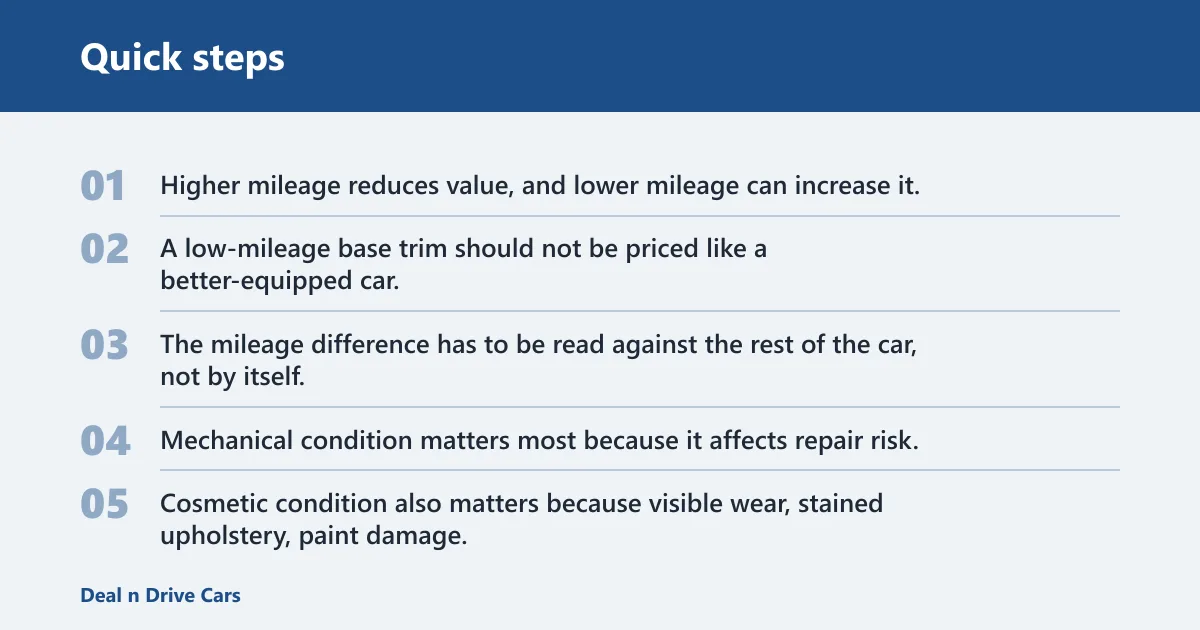
Higher mileage reduces value, and lower mileage can increase it, but only when you compare like-for-like trims and years. A low-mileage base trim should not be priced like a better-equipped car. The mileage difference has to be read against the rest of the car, not by itself.
Mechanical condition and cosmetic condition
Mechanical condition matters most because it affects repair risk. Cosmetic condition also matters because visible wear, stained upholstery, paint damage, cracked trim, and broken switches can signal a car that has been handled hard or neglected. The best price is the one that matches both the visible state and the hidden risk.
Picture two 2020 hatchbacks with the same trim and transmission, but with different mileages. One has 38,000 miles, clean paint, and no warning lights; the other has 74,000 miles, curb rash, and a noisy suspension on the test drive. Even if the mileage gap looks moderate, the second car needs a lower offer because the repair risk is already visible.
Wear, repairs, and warning signs that matter most
Start with the items that affect safety or major repair cost: warning lights, coolant leaks, brake vibration, transmission slip, uneven tire wear, and sloppy steering. Cosmetic flaws matter, but they should not outweigh serious mechanical issues. A car with fresh paint and a glowing check-engine light is still a risky buy.
What does history do to value?
History changes confidence, and confidence changes price. Full service history means every manufacturer-recommended service was done and documented. Partial records are less reassuring, and missing records usually force a lower offer because you cannot price what you cannot verify.
Full service history, partial history, and missing records
Documented servicing can support a stronger asking price because the car has a paper trail. Partial history sits in the middle. Missing history is a warning sign when the seller cannot show invoices or stamps for major work, especially on a car that should have had timing, fluid, or brake work by now.
Vehicle history report checks for accidents, mileage gaps, and finance status
A vehicle history report can flag accident history, mileage records, ownership changes, and finance status. Use it to confirm that the odometer story and title story match the seller’s claim. If the report and the listing disagree, the offer should drop or the deal should stop.
Why rebuilt titles, fleet use, and rental history need separate judgment
Not all history problems are equal. Rebuilt titles, rental use, and fleet use do not affect price in the same way. A rebuilt title can change the risk profile far more than a short rental history. A former fleet car can be honest and maintained, but it still deserves a lower offer if wear is heavier than average.
A common first-timer mistake is treating every history issue as a small discount. That fails fast on odometer gaps or a rebuilt title. Those are not cosmetic notes; they can change the whole deal, and they may be reason enough to walk away.
Does a fair price include dealer fees on a used car?
Not always. A fair vehicle price is the car itself, while document fees, admin fees, prep charges, taxes, registration, and financing costs belong in the out-the-door total. If you compare only the sticker price, you can miss a large gap between the car’s value and the amount you will actually pay.
Document fee, admin fee, and prep charge
Document fees and admin fees are generally transaction costs, not part of the vehicle’s value. Prep charges are more complicated because some dealers fold reconditioning into the forecourt price, while others list it separately. Ask for an itemized breakdown so you can tell what is real car value and what is office overhead.
Which fees belong in the out-the-door total?
Taxes, registration, title work, and other mandatory government charges usually belong in the out-the-door total because they are part of what is needed to complete the purchase. Dealer add-ons and financing products should be evaluated separately. If the seller says a “great price” but the final total jumps after fees, the deal is not great anymore.
How financing costs differ from vehicle price
Financing cost is not the same thing as car price. A low monthly payment can hide a long loan term or a high interest rate, and that does not change the car’s market value. Judge the car first, then decide whether the financing terms still make sense.
When to inspect, negotiate, or walk away
Use a mechanic inspection when the car is higher value, the history is uncertain, or the listing leaves room for expensive hidden faults. Certified pre-owned cars are usually lower-risk than ordinary used cars and are often priced above non-CPO equivalents, but the premium still needs to fit the market and the warranty terms.
When a mechanic inspection is worth the cost
An inspection by a mechanic is separate from valuation. It checks condition, not market demand. It is most useful on expensive cars, cars with weak service records, and cars that show symptoms a quick driveway look will miss. If the seller refuses an independent inspection, that refusal is information.
How certified pre-owned changes the risk and price
CPO cars often sit above similar non-CPO cars because the dealer-backed program lowers some risk and usually adds a tighter buying standard. That does not make every CPO price fair. Compare the premium against the actual coverage, reconditioning, and remaining factory or dealer warranty before agreeing to it.
A simple buy now, negotiate, or walk away decision check
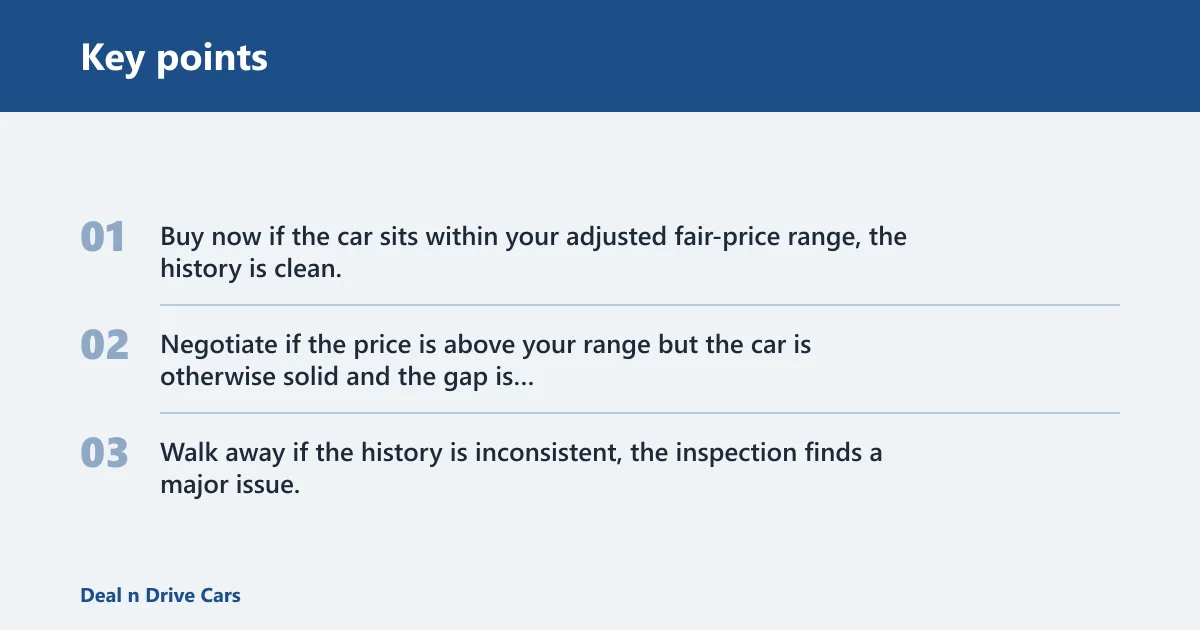
- Buy now if the car sits within your adjusted fair-price range, the history is clean, and the inspection is acceptable.
- Negotiate if the price is above your range but the car is otherwise solid and the gap is explained by trim, records, or fees you can challenge.
- Walk away if the history is inconsistent, the inspection finds a major issue, or the seller will not explain a large price gap.
Frequently asked questions
What is a fair price for a used car?
A fair price for a used car is the local market range for the exact car, adjusted for mileage, condition, history, and buyer-paid fees. It is not a single average. Start with live listings for the same year, trim, engine, and transmission, then move down for risk and up only for evidence.
What is a reasonable price for a used car?
A reasonable price is one that fits the local market, the car’s condition, and the seller type without forcing you to ignore major risk. If the listing is far above similar cars, or if fees push the out-the-door total beyond comparable deals, the price is not reasonable.
What is a fair price to offer for a used car?
A fair offer is usually below the asking price and anchored to the low end of comparable live listings, with deductions for mileage, condition, missing records, and dealer fees. If the car has weak history or visible wear, start lower and let the seller justify any premium.
What is the average price for a used car in 2025?
The same source says the average used-car price is just over $27,000, but that figure does not decide what a specific car should cost in your area. Local supply, trim, mileage, condition, and seller type still matter more than any broad average when you are negotiating.
What is the average price for a used car in 2026?
There is no single 2026 number that settles a deal by itself, because local market conditions still move the price. Use current live listings and the same comparison method instead of leaning on one national average. The useful question is whether this car is fairly priced today in your market.
How do mileage and condition affect a used car’s fair price?
Higher mileage lowers value, lower mileage can raise it, and condition can move the price in either direction depending on the wear. Mechanical problems, cosmetic damage, and warning lights reduce confidence fast. A clean, lower-mileage car can support a higher offer only if the records back it up.
How does accident history affect a used car’s fair price?
Accident history can lower value, but the size of the drop depends on the repair quality, the damage type, and what the history report says. Minor cosmetic repairs do not price the same way as structural damage or an inconsistent odometer record. When the story is unclear, discount the car or walk away.
What is a good price range for a used car?
A good price range is the local comparable-market band after you account for mileage, condition, history, and seller type. For a clean private-party car, that range is often narrower. For a dealer car with higher fees or a CPO premium, the range should widen only if the added value is clear.
What is a fair price for a used car: a fair price?
A fair price for a used car is the price that still makes sense after you compare similar live listings and subtract the real risks. If the seller’s number is higher than the market range, your offer should start lower and reflect what you can verify, not what you hope the car is worth.
What is a good price for a used car: a good price?
A good price for a used car is one that sits near the bottom of the adjusted market range and does not hide fees, weak history, or needed repairs. If the car is clean, documented, and priced against similar listings, a good price can also be a quick one.