What Is a Private Seller When Buying a Used Car?
A private seller is usually an individual selling their own used car directly to you, not through a dealer. That usually means no dealer warranty, and buyer protection, title handling, and fees can vary by location. Miss that difference, and you can lose ground on defects and paperwork problems. This guide explains rights, paperwork, risk, and the checks to make before you pay.
This guide is part of our Private seller cars: how to buy safely and save series.
What is a private seller?
A private seller is usually the person offering the car outside a dealership. In practice, that means a person-to-person used-car sale, where the seller is not acting as a dealer and usually is not offering the same legal remedies that come with a business sale.
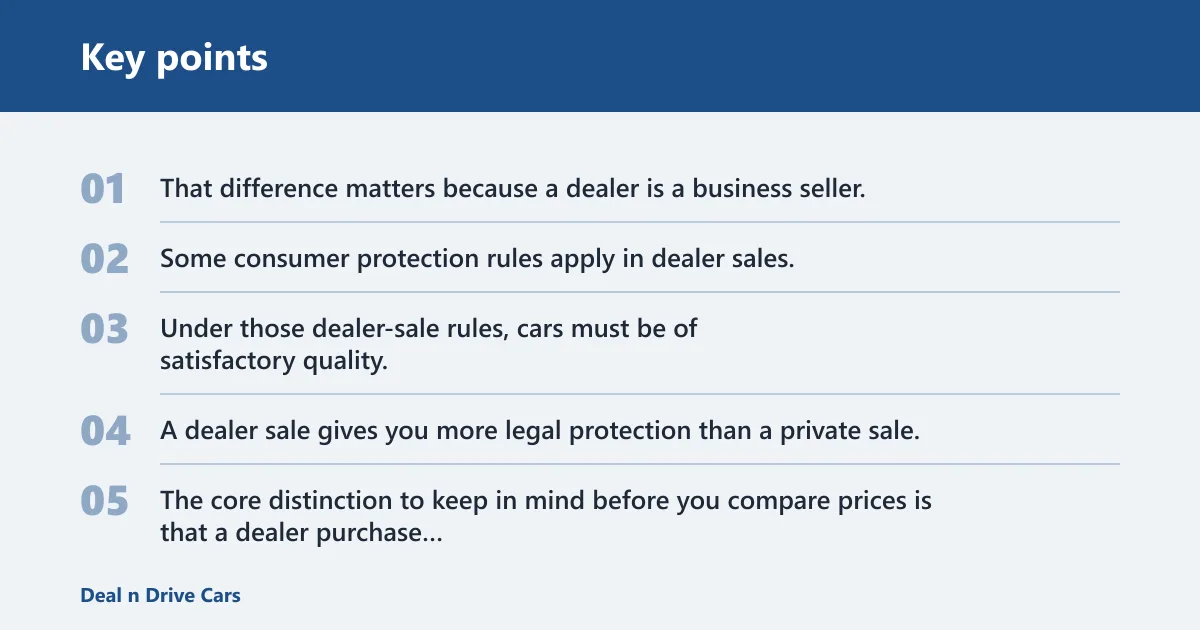
That difference matters because a dealer is a business seller. Some consumer protection rules apply in dealer sales, but they are not the same as the rules that apply to a private sale. Under those dealer-sale rules, cars must be of satisfactory quality, fit for their particular purpose, and as described.
Private seller vs dealer
A dealer sale gives you more legal protection than a private sale. The core distinction to keep in mind before you compare prices is that a dealer purchase usually comes with stronger legal remedies than a private sale. A lower private-party price can be attractive, but the trade-off is usually weaker recourse if something turns out to be wrong.
That does not mean every private sale is bad. It means you need to do more of the checking yourself: ownership proof, title status, history, and the paperwork needed to transfer the car cleanly.
How does a private sale change your rights?
A private sale usually gives you fewer remedies after purchase than a dealer sale. With a dealer, consumer law in some places gives buyers a clearer route if the car is not as described, not fit for purpose, or not of satisfactory quality. With a private seller, those rights are narrower and depend more on the deal terms and local law.
What limited recourse can look like
In a private-party sale, your recourse often shrinks to proving fraud, misrepresentation, or a paperwork problem. That is very different from going back to a dealer with a fault, where consumer law can give you stronger options. Do not assume you can return the car simply because a warning light appears later.
Some buyers have rights even with used cars, but those rights are not the same in every type of sale. Dealership remedies are stronger, while private-party disputes can be harder to unwind once money and keys have changed hands.
Private seller buyer checkpoint
| Question | Why it matters | What a good answer or document looks like | When to walk away |
|---|---|---|---|
| Ownership proof | Shows the seller has the right to sell the car. | Title or ownership document in the seller’s name, plus a matching photo ID. | If the seller cannot prove they own it, or the names do not match. |
| Title status | Tells you whether the car can be transferred cleanly. | A clear title or ownership record with no missing signatures, liens, or unexplained marks. | If the title is missing, damaged, branded in a way you do not understand, or still tied up. |
| Accident history | Helps you compare condition with the asking price. | A vehicle history report plus repair records that match the bodywork and panel condition. | If the seller will not discuss prior damage, or the report conflicts with the story. |
| Payment method | Protects you from cash-only pressure and fake transfer claims. | A traceable payment method agreed in advance, with a written receipt at handover. | If the seller pushes for urgent cash, overpayment, gift cards, or another unsafe route. |
| Registration transfer | Moves the car into your name and reduces later disputes. | Clear steps for the transfer, with both sides completing the needed forms at sale time. | If the seller refuses to complete transfer steps or says you can sort it out later. |
| Post-sale recourse | Sets your expectations before money changes hands. | Written terms that match the law in your location, plus honest wording that no dealer-style warranty applies. | If the seller promises dealer-level protection, a return period, or fixes they will not put in writing. |
What should you check before paying?
Before you pay, get the paperwork, history, and condition checks done in that order. Printing the seller-question list before shopping can help you compare vehicles and negotiate price. It also frames used-car advice as a way to avoid being ripped off.
Paperwork to ask
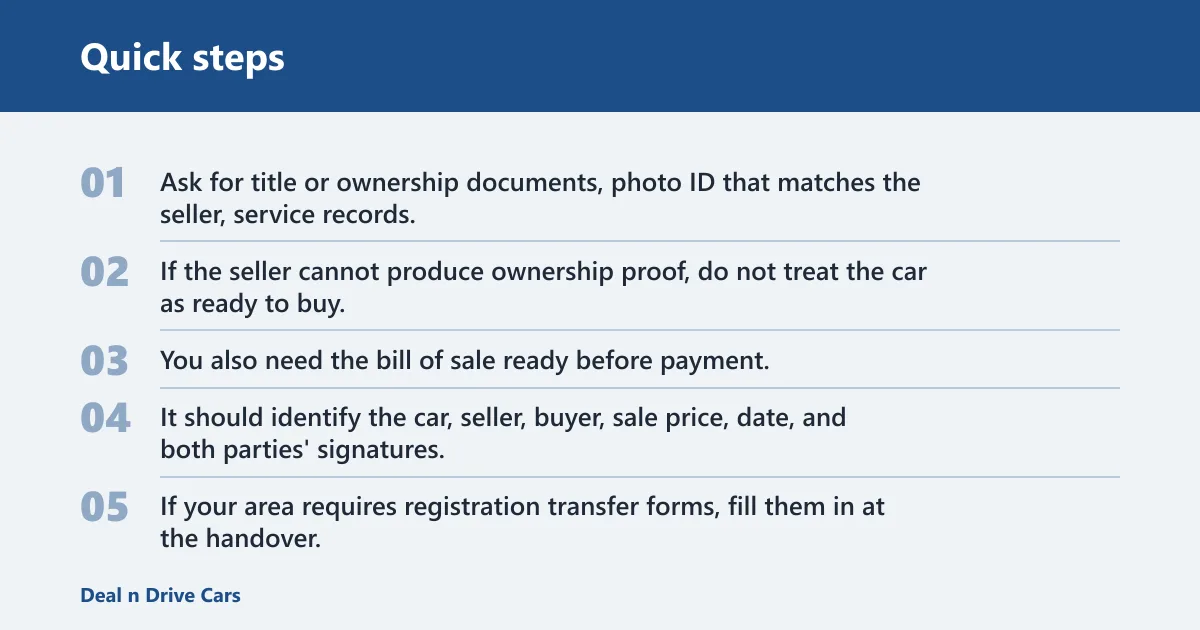
Ask for title or ownership documents, photo ID that matches the seller, service records, and any repair invoices that explain visible bodywork. If the seller cannot produce ownership proof, do not treat the car as ready to buy.
You also need the bill of sale ready before payment. It should identify the car, seller, buyer, sale price, date, and both parties’ signatures. If your area requires registration transfer forms, fill them in at the handover, not days later.
Vehicle history report and car history checker
A vehicle history report is for due diligence rather than a guarantee. Use it to compare the car against the seller’s story, looking for prior accidents, title problems, mileage gaps, theft flags, or repeated ownership changes. A car history checker on a retail site can add another layer of peace of mind before you commit.
Suppose the car is a 2018 hatchback with 68,000 miles and a fresh valet, but the report shows a prior insurance write-off or a mileage jump that does not fit the service records. That mismatch is a reason to step back, not a reason to negotiate harder.
Inspection and test drive basics
Check the body, interior, tyres, lights, warning lamps, fluids, and signs of uneven wear. Then test drive the car long enough to check steering, braking, clutch action, transmission behaviour, and noise at low and steady speeds. You are looking for evidence that the condition matches the asking price.
A common first-timer mistake is believing a tidy cabin means a sound car. It does not. Fresh seat covers can hide wear, but they do not fix a slipping gearbox, a coolant leak, or a title problem.
How do you pay and transfer the car safely?
Pay only after you have seen ownership proof, checked the title status, and confirmed the car matches the paperwork. Use a traceable payment method when possible, get a receipt, and complete the transfer steps at about the same time as the handover. Do not let a seller rush you into paying first.
Safer payment methods
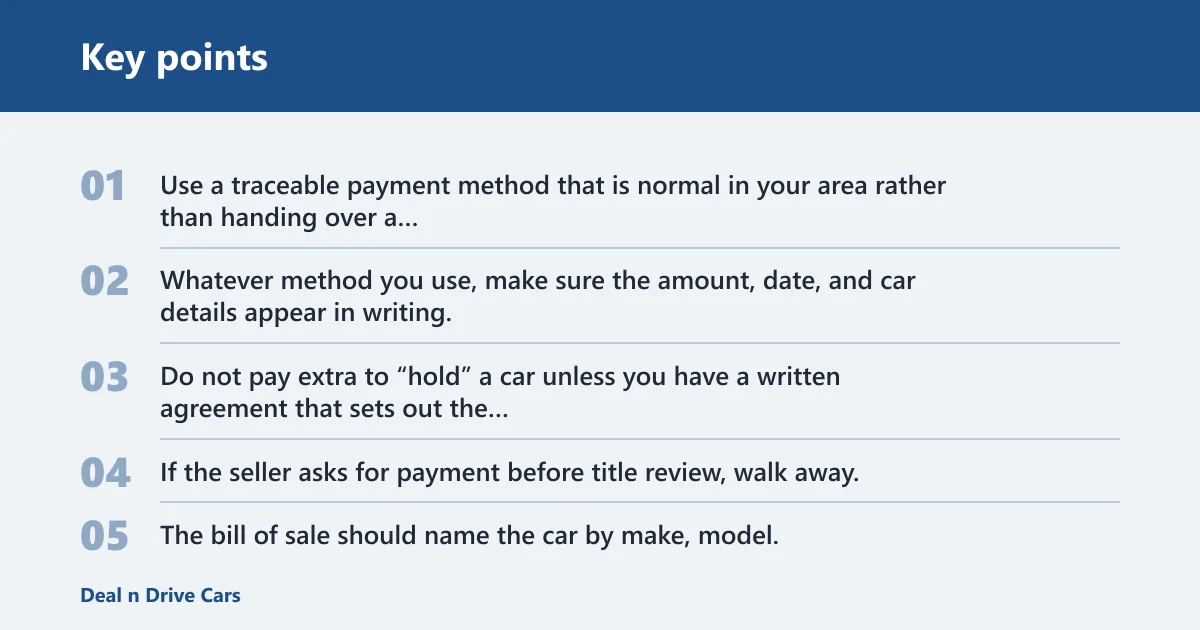
Use a traceable payment method that is normal in your area rather than handing over a stack of cash with no receipt. Whatever method you use, make sure the amount, date, and car details appear in writing. Keep a copy for your records.
Do not pay extra to “hold” a car unless you have a written agreement that sets out the terms, the deposit amount, and what happens if the sale falls through. If the seller asks for payment before title review, walk away.
Bill of sale and receipt
The bill of sale should name the car by make, model, and VIN or chassis number where used, along with the sale price, date, buyer, and seller. A receipt should confirm the money was received and the car was transferred as agreed. This paperwork matters more in a private sale because dealer remedies are not there to fall back on.
Registration transfer steps
Complete the registration transfer as soon as the sale closes. Depending on location, that can mean signing the title, notifying the authority, or submitting transfer forms. The point is the same: move the record into your name promptly so there is a clean handover trail.
When buying a used car from a private seller, do you pay tax? Often, taxes and fees depend on your location and the transfer process, so check the rules where you live before the sale. The seller may not collect or remit the same way a dealer would, which makes your local transfer steps even more important.
What should you ask the seller?
Ask direct questions about ownership, title status, repairs, accident history, service records, and why the car is being sold. A private sale gives you less built-in protection, so the seller’s answers need to line up with the documents and the car itself. If they do not, stop there.
Ownership and title questions
Ask who is named on the title, whether there is any finance outstanding, and whether the seller is the registered keeper or lawful owner. If the seller is not the person listed on the papers, you need a clear explanation and matching proof before you go further.
Accident, repair, and service questions
Ask whether the car has had accident damage, major repairs, airbag deployment, flood exposure, or repeated warning lights. Then compare the answer with the vehicle history report, service book, and repair invoices. These answers help compare vehicles and negotiate price, which is exactly why they matter.
Price negotiation in a private sale should follow evidence, not hope. Mileage, tyres, brakes, body damage, missing service history, and report findings all change what a fair offer looks like. A clean history can support a firmer asking price; a messy one should push the price down or end the deal.
When to walk away
Walk away if the seller cannot prove ownership, the title is missing, the story does not match the papers, or the payment demand feels unsafe. That is especially true when the seller pressures you to skip the history check or to pay before transfer steps are clear.
What is needed when buying a used car from a private seller?
You need ownership proof, title documents, a bill of sale, ID details that match the seller, and the transfer steps required in your area. You should also bring a payment method that leaves a record, plus time to check the car history and read the paperwork before money moves.
Print the seller-question list before you go. That list helps you compare vehicles and negotiate price, and that is useful because the private sale gives you less post-sale protection than a dealer purchase.
Frequently asked questions
What to know when buying a used car from a private seller?
Know that the seller is often an individual rather than a dealer, so you may have fewer buyer remedies after the sale. Check title, ownership, history, and transfer steps before you pay. Dealer sales usually have stronger legal protection, while private sales do not carry the same safety net.
What to expect when buying a car from a private seller?
Expect lower friction on price and less formal paperwork than a dealer sale, but also less recourse if the car has defects. You should inspect the vehicle, verify the seller, and complete the bill of sale and registration transfer before the car leaves the driveway.
What to bring when buying a used car from a private seller?
Bring photo ID, a payment method you can document, a pen, copies of the bill of sale, and a printed checklist of questions. If your local transfer system needs specific forms, take those too. You should also bring a phone or device for checking the vehicle history report on the spot.
When buying a used car from a private seller, what do I need to know?
You need to know who owns the car, whether the title is clear, what the history report says, and how the transfer works in your area. You also need to know that post-sale remedies are usually limited, so the best protection comes before payment, not after.
When buying a used car from a private seller, do you pay tax?
Tax treatment commonly depends on where you live and how your local transfer process works. In many places, the buyer handles transfer fees or taxes separately from the sale price, so check the rules before you meet the seller. Do not assume a private sale includes dealer-style fee handling.
What to do when buying a used car privately?
Check the seller’s ownership proof, compare the car against the documents, review the history report, test drive the car, and complete the paperwork before you pay. If the seller cannot support the title or keeps changing the story, leave the deal alone.
What to look for when buying a used car from a private seller?
Look for matching ownership documents, a clear title, a consistent mileage trail, signs of accident repair, worn tyres, warning lights, and missing service records. Use the car history checker and the seller’s answers together, because one source on its own does not prove the car is sound.
What to ask for when buying a used car from a private seller?
Ask for the title, proof of identity, service history, repair invoices, the bill of sale, and any transfer forms needed in your area. Ask whether there is outstanding finance, prior accident damage, or any reason the car cannot be transferred immediately.
How do I buy a used car from a private seller?
Start by checking the car and the seller, not the price tag. Review the paperwork, pull a vehicle history report, test drive the car, agree the price, complete the bill of sale, and finish the transfer before you hand over payment. If any step feels thin, stop.