
Does Auto Preapproval Hurt Your Credit Score? Fast Answer
Auto preapproval for a car loan often uses a soft credit check, which does not lower your score. It turns score-moving only when the lender submits a hard inquiry for a full application, usually after you choose to proceed. If you guess wrong, you can add avoidable inquiry damage before you compare offers. This guide explains how to spot soft versus hard pulls, when lenders switch from one to the other, and how to shop for financing with less credit-score risk.
Does auto preapproval hurt your credit score?
Sometimes. Auto preapproval can be a soft inquiry or a hard inquiry, and the score effect depends on which one the lender uses. A soft pull does not hurt your score. A hard pull can lower a FICO score by 5–10 points, usually by a modest amount, and only after a formal application.
Soft inquiry vs. hard inquiry in auto financing
A soft inquiry is often used for pre-qualification and some preapproval offers. It is visible only to you on your credit report and has no credit-score impact. A hard inquiry appears on the credit report, can be reviewed by underwriters, and is tied to a formal credit application.
That distinction matters because the word “preapproval” is not standardized across all lenders. One lender may use preapproval to mean a soft-pull estimate, while another may use it for a credit application that creates a hard inquiry. The label alone is not enough.
Many credit unions offer soft-pull pre-qualification, and that is often the safest first step. It can show indicative APRs and loan amounts without affecting your score. If you are early in the process, that usually gives you enough information to compare lenders.
📊 Auto-loan inquiries within a 14-day window can count as one inquiry for scoring. Source: How Much Does an Auto Loan Application Hurt Your Credit?.
What is the difference between prequalification and preapproval?
Prequalification is usually a soft pull that gives you indicative APRs and loan amounts without affecting your score. Preapproval is stronger, but it may still be a soft pull or a hard pull depending on the lender. Read the lender’s disclosure before you submit anything.
Prequalification and what it tells you
Prequalification helps you estimate whether you are likely to qualify and roughly what terms you might see. It is not binding. It is also the best fit when you want to compare several lenders before you commit to a formal application.
Because prequalification is usually soft, it is a useful first screen for first-time buyers and thin-file borrowers. It lets you see whether the numbers make sense before you let a lender make a harder credit decision.
Preapproval and when it can still be a hard pull
Preapproval often means the lender has gone further than prequalification, but not always in the same way. Some lenders use soft-pull preapproval to give a firmer estimate. Others treat preapproval as a full application and run a hard inquiry immediately.
Dealer-arranged “preapproval” deserves extra attention. In a dealership setting, that term may refer to a lender-generated estimate, a dealer desk submission, or a formal application sent to multiple lenders. Those are different steps, and they do not all have the same credit impact.
How to read lender language before you submit
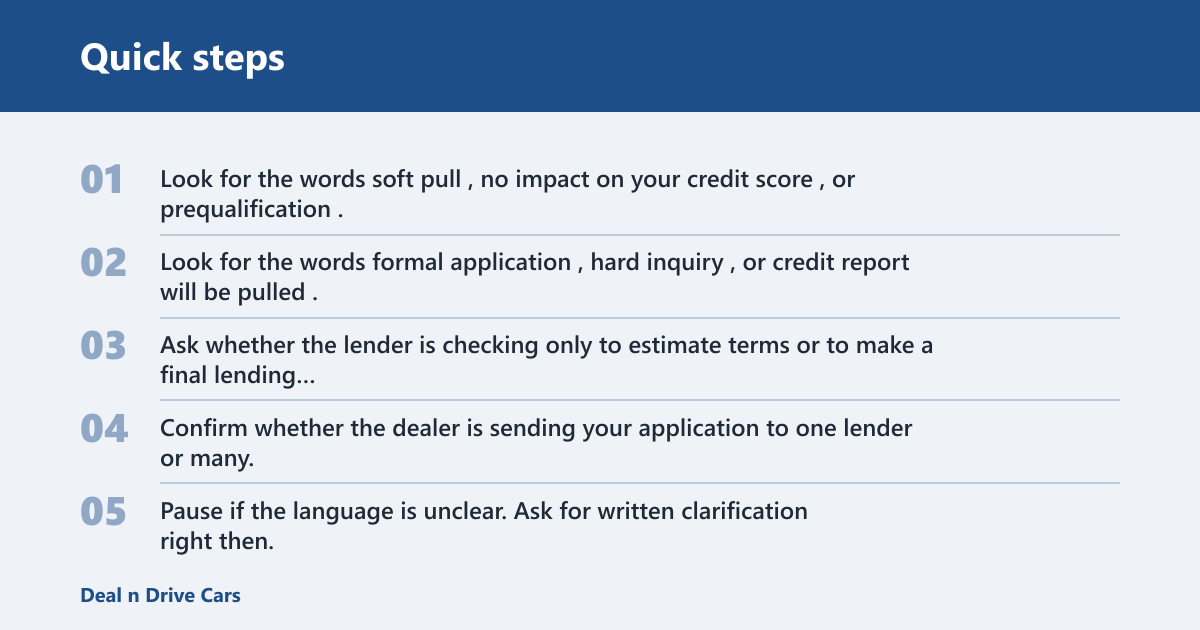
- Look for the words soft pull, no impact on your credit score, or prequalification.
- Look for the words formal application, hard inquiry, or credit report will be pulled.
- Ask whether the lender is checking only to estimate terms or to make a final lending decision.
- Confirm whether the dealer is sending your application to one lender or many.
- Pause if the language is unclear. Ask for written clarification right then.
How many points can an auto preapproval lower your score?
A single hard credit pull from an auto loan application typically costs 5–10 FICO points, though the exact result varies by profile. The effect is usually temporary. Inquiry impact on FICO generally fades over several months, even though the inquiry can remain on the credit report for a longer period.
Why the effect is usually temporary
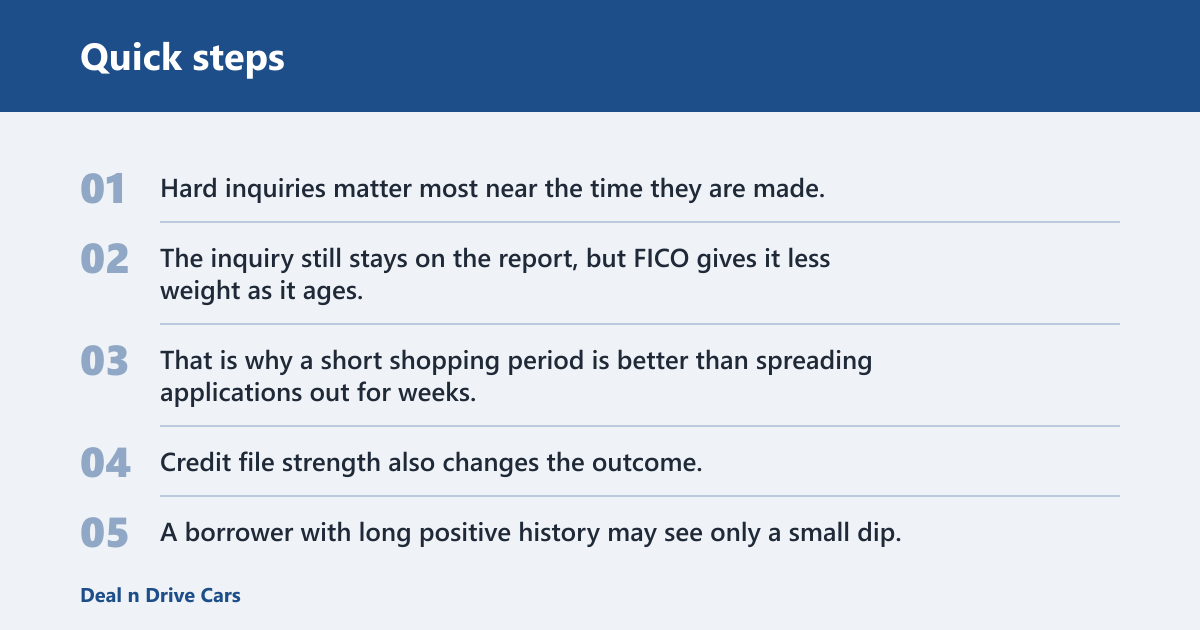
Hard inquiries matter most near the time they are made. Over time, their scoring effect weakens. The inquiry still stays on the report, but FICO gives it less weight as it ages. That is why a short shopping period is better than spreading applications out for weeks.
Credit file strength also changes the outcome. A borrower with long positive history may see only a small dip. A thin-file borrower can feel a larger shift because there is less other data in the score. That is normal, not a sign that something went wrong.
Why your score response may differ from someone else’s
FICO models weigh the full file, not just the inquiry. Recent late payments, revolving balances, and file age can all change how much a hard inquiry matters. Two shoppers can submit the same application and see different results.
Suppose you are planning to buy a compact SUV and your score is already near a lending cutoff. A 5–10 point dip may move you into a worse APR tier. In that case, checking whether the lender can give a soft-pull estimate first becomes more valuable.
How does the auto loan rate-shopping window work?
Auto-loan inquiries within a 14-day window can count as one inquiry for scoring. That rule is meant to protect shoppers who compare offers from multiple auto lenders. It does not hide the inquiries, and it does not apply the same way to every type of credit.
The 14-day consolidation rule for auto inquiries
If you submit multiple auto-loan applications inside the 14-day window, FICO generally groups them as one for scoring. That means a shopper can compare lenders without stacking the full score hit from each application. Timing matters, so keep the search period tight.
The credit report inquiry list still shows all the pulls. Underwriters can review that list. Multiple auto inquiries are normal when you compare banks, credit unions, and dealer-arranged offers in the same week.
Why multiple lender quotes are normal
Dealer F&I managers may submit an application to 5–15 lenders at once. That is common in dealership finance offices, but it is not the same as a soft preapproval. It is closer to a formal financing sweep, and it can generate several visible inquiries.
That visibility can matter even when scoring impact is consolidated. A mortgage underwriter, for example, may still ask about recent inquiries. The score may not take five separate hits, but the file still shows what happened.
Decision matrix: which financing step hurts credit and which does not
Not every financing step affects your score in the same way. Prequalification is usually soft and score-neutral. Lender preapproval may be soft or hard. Dealer desk submission and final loan application are typically hard. Use the step, not the sales language, to judge the credit risk.
| Auto-financing step | Inquiry type | Likely score impact | Best use case |
|---|---|---|---|
| Prequalification | Soft inquiry | Zero credit-score impact | Early comparison of indicative APR and loan amount |
| Lender preapproval | Soft or hard, depending on lender | No impact if soft; modest dip if hard | Getting a stronger offer before you shop the car |
| Dealer desk submission | Usually hard inquiry | Can lower FICO by 5–10 points for a hard pull | Dealer is packaging your file for lender review |
| Final contract and funding | Usually tied to the formal application already submitted | Usually no new separate inquiry at signing if the credit pull already happened | Completing the purchase after terms are approved |
When a preapproval is worth the inquiry

A hard-pull preapproval is worth it when you need a real lending decision before you buy, especially if you expect to negotiate based on an approved rate and amount. If you only need a rough sense of terms, prequalification is usually enough and keeps your score untouched.
When prequalification is enough
Prequalification usually works best if you are early in the shopping process, still comparing vehicle prices, or unsure whether your budget fits the loan amount. It is also the better first step if you want to avoid an unnecessary hard inquiry before you have a car selected.
When a hard-pull preapproval is worth it
A hard-pull preapproval can be worth the inquiry when you are close to buying, need a firm rate to compare against dealer financing, or want to know whether the lender will approve the amount you need. That is especially useful if your budget leaves little room for surprises.
For first-time buyers, a soft prequalification is often the cleaner starting point. For thin-file borrowers, a lender may need a hard pull sooner because there is less data to underwrite. For bad-credit shoppers, a hard preapproval can still be useful if it helps separate realistic offers from vague dealer estimates.
Best approach for first-time, thin-file, and bad-credit shoppers
First-time buyers: start with soft prequalification from a credit union or bank, then move to preapproval only if the numbers look workable.
Thin-file borrowers: expect some lenders to ask for a hard application sooner, because limited history makes a firmer review more likely.
Bad-credit shoppers: focus on lenders that clearly explain whether the first step is soft or hard, since a scattershot set of applications can create more damage than progress.
How to reduce credit damage while shopping for a car loan
You can shop for auto financing with limited score impact if you keep applications tight, avoid other new credit at the same time, and confirm whether each lender uses a soft or hard pull. The goal is to compare real offers without creating avoidable inquiry clutter.
Step-by-step way to shop with less risk
- Check your own credit first. Checking your own credit generally does not hurt your score.
- Start with soft-pull prequalification when available.
- Ask each lender whether a preapproval is soft or hard before you consent.
- Keep auto applications inside a short 14-day window if you need multiple quotes.
- Avoid applying for credit cards, personal loans, or other new accounts while rate shopping for the car.
- Save dealer financing submission for when you are ready to compare final numbers, not as an early guess.
Two common scenarios
Say your credit union offers a soft prequalification for a $22,000 used-car loan, while the dealer wants to send a full application to several lenders. The credit union step gives you a cleaner first read. The dealer step can wait until you know whether the vehicle and payment target still make sense.
A common first-timer mistake is applying for a car loan, a store card, and a personal loan in the same week. That turns a focused auto-shopping period into a broader credit event, which can make the report harder to read and may add avoidable score pressure.
Frequently asked questions
does car loan pre approval affect your credit score
It can, but not always. If the lender uses a soft inquiry, there is no score impact. If the preapproval is tied to a formal application, it can become a hard inquiry and may lower a FICO score by a modest amount.
does auto prequalification affect credit score
Usually no. Auto prequalification is typically described as a soft pull and has zero credit-score impact. It is designed to give indicative APRs and loan amounts without creating the score effect associated with a formal hard inquiry.
Is auto preapproval a hard inquiry or soft inquiry?
It depends on the lender. Some auto preapprovals are soft pulls, while others are hard pulls tied to a full application. The label alone is not enough, so read the lender’s disclosure or ask directly before you submit your information.
How many points can an auto preapproval lower your score?
A hard pull from an auto loan application typically costs 5–10 FICO points. The exact change depends on the rest of your credit file, and the effect usually fades over about 6–12 months even though the inquiry remains on the report for 24 months.
Does rate shopping for a car loan count as one inquiry?
Usually, yes, if the inquiries fall within the 14-day auto rate-shopping window. Multiple auto-loan inquiries during that period are generally treated as one for scoring. The inquiries still appear on your report, so lenders can see that you compared offers.
What is the difference between auto prequalification and preapproval?
Prequalification is usually a soft pull that gives you a rough idea of APR and loan amount without affecting your score. Preapproval is stronger, but it may be soft or hard depending on the lender. For credit protection, ask which one you are actually getting.