Used Car Buying Timeline: Step-by-step From Search to Keys
A used-car purchase usually takes about 1 to 7 days. Search and shortlisting can happen the same day, but financing, history checks, and a pre-purchase inspection typically deserve about 24 hours before you commit. Rush from ad to signature, and you can overpay, miss title or damage issues, or buy a car that fails inspection. This timeline splits the process into same-day tasks, 24-hour checkpoints, hard stops, and before-you-go, before-you-buy, before-you-drive, and after-purchase actions.
The big timing split is simple. You can screen listings, set a real all-in budget, ask for the out-the-door price in writing, check a vehicle history report, and line up insurance quotes quickly. Pause for financing terms, recall checks, document matching, and any independent inspection. If a seller pushes back on those checks, you already have your answer.
What is the fastest safe used-car buying timeline?
The fastest safe timeline is same-day search and screening, then at least a 24-hour pause for financing, history review, recalls, and an inspection if the car clears the first checks. A one-day purchase can work, but only when the documents are clean, the written price holds, and insurance and registration steps are ready before delivery.
What can happen in one day?
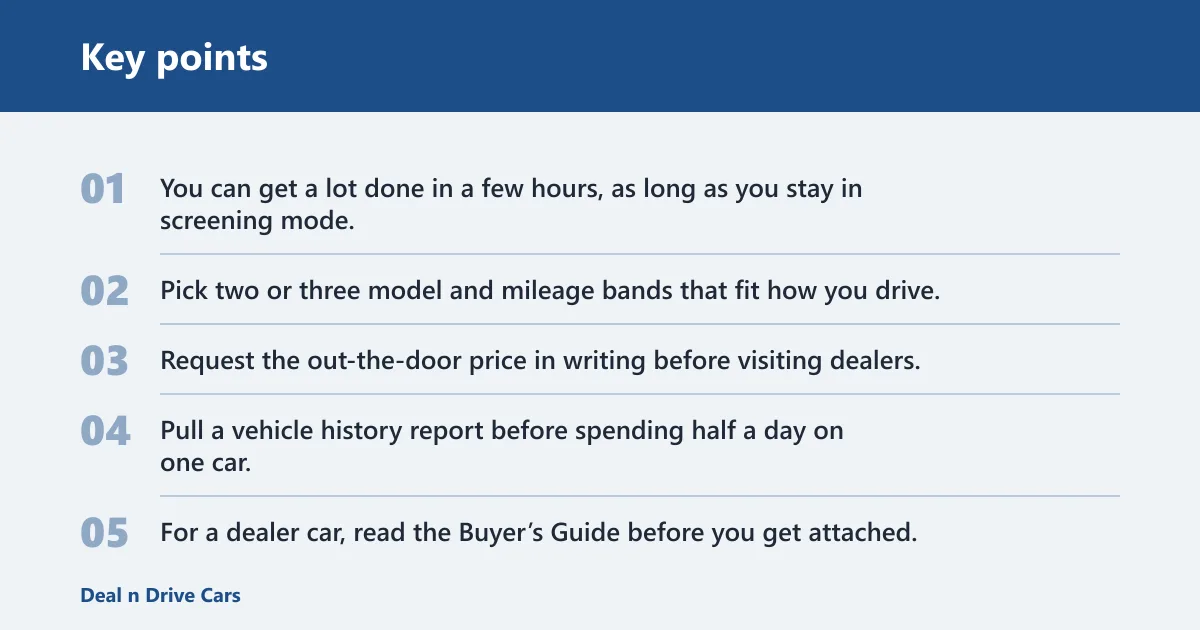
You can get a lot done in a few hours, as long as you stay in screening mode. Set a firm all-in budget. Pick two or three model and mileage bands that fit how you drive, such as a compact hatchback under about 80,000 miles or a midsize SUV between about 3 and 7 years old. Request the out-the-door price in writing before visiting dealers. Pull a vehicle history report before spending half a day on one car.
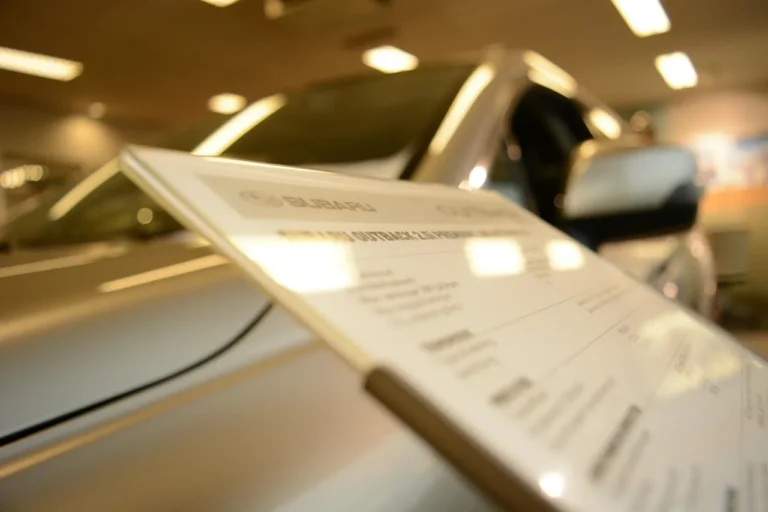
For a dealer car, read the Buyer’s Guide before you get attached. Dealers have to place a Buyer’s Guide on every used car, and online used-car buyers are also entitled to a Buyer’s Guide. The form states whether the car has a warranty or is sold as-is. That single sheet often tells you if a same-day visit is worth the drive.
For a UK private sale, ask for the registration number, make, model, and MOT test number before viewing. Then check that the MOT status and history match the seller’s details. Also check whether the vehicle has been recalled for a serious safety issue.
What should take at least 24 hours?
Financing should. So should any independent pre-purchase inspection. Rate comparison matters because the average used-car price is close to $28,000, and a rushed finance choice can cost far more than a small price discount saves.
Use that pause to verify written figures against the deal sheet. Written quotes help confirm that advertised prices, discounts, and rebates were actually applied. They also expose add-ons and other charges before the last minute.
Suppose a dealer advertises a compact SUV at one price, then the written out-the-door quote shows a protection package and a document fee missing from the ad. That is not the time to improvise at the desk. It is the time to pause, compare, and decide whether the original quote was real.
When a multi-day pause is the safer choice
Take longer when any hard-stop issue appears: a suspicious V5C, VIN mismatch, missing title paperwork, unresolved recall concerns, refusal to allow inspection, or last-minute changes to the written price. Online purchases also need more time because delivery windows and remote document review add risk that a lot visit does not.
A same-day purchase is fastest when the car is local, the paperwork is clean, and no independent inspection is needed. A multi-day purchase is safer when the car is uncommon, expensive to repair, far away, or sold by a seller who wants a deposit before basic verification.
📊 Average used-car price is close to $28,000. Source: FTC.
Set your budget before you shop
Set the budget before shopping, then keep to it. Decide how you will use the car, because that choice shapes fuel cost, tyre wear, cargo space, and insurance more than trim level does. Build in registration, insurance, gas, and maintenance. Add purchase taxes or fees where they apply, then set a firm walk-away number for the full transaction.
Build the real all-in budget
Budgeting starts with use case. A short urban commute, school runs, and motorway miles put different pressure on fuel use, tyre wear, and cargo space. Make that call before you start comparing trim, color, or wheel size.
Buyers should include registration, insurance, gas, and maintenance in the budget. In the UK process, remember that vehicle tax must be arranged immediately after purchase. In the US, title, tag, and local fees can move the total more than many buyers expect.
Leave room for insurance, tax, fuel, and first repairs
Insurance can change the monthly cost more than the finance rate on some cars, especially for younger drivers or high-theft models. Get quotes before your shopping narrows to one car. If the quote weakens the deal, drop the car before you visit.
A common first-timer mistake is focusing on the monthly payment while ignoring the first week. A used hatchback may hit the loan target, then need two tyres, a battery, and registration fees before it is truly usable. The budget has to survive that week, not only the signing table.
Set a firm walk-away number
Your walk-away number should be for the out-the-door total, not the sticker, not the monthly payment, and not a “close enough” estimate. Once that number is set, every add-on, admin fee, and protection package has to fit inside it or be removed.
What should you do before visiting a dealer or seller?
Before any visit, narrow the vehicle type, compare asking prices, request the out-the-door price in writing, check the seller’s reputation, and run a vehicle history report. Those steps cut wasted trips and make it easier to spot price padding, missing paperwork, and cars that already fail basic ownership or condition checks.
Shortlist models, mileage, and age bands
Check model-specific repair records, safety test results, and mileage before you contact anyone. Look up common failures, recall history, crash-test scores, and service intervals for each model on your list, then compare cars within the same age and mileage band so the prices mean something. Shortlisting by model, age band, and mileage range keeps your comparisons clean. It also stops a seller from switching the conversation from “this car” to “this payment.”
Keep the shortlist tight. Two body styles and a realistic mileage range are enough to compare pricing without getting lost in tabs. If one model has a known expensive service item at a certain age, build that question into every call.
Request the out-the-door price in writing
Ask for out-the-door prices in writing before visiting dealers. That figure is your checkpoint against the advertised price. It should show whether discounts and rebates were applied and whether extras appeared before you sat down in the showroom.
Written quotes help spot add-ons and other charges before the last minute. If a seller will not provide a written out-the-door figure, treat the visit as low priority at best and a walk-away sign at worst.
Check dealer reviews, complaints, and return terms
Look for patterns, not one angry review. Repeated complaints about deposits, surprise fees, title delays, or add-ons matter because they affect timing and paperwork, not only customer mood. For online sellers, return terms and delivery-condition rules matter even more because your inspection window may be short.
Pull the vehicle history report before you commit time
Pull the vehicle history report before you visit, and compare the VIN, title status, mileage entries, prior ownership count, and any salvage, flood, theft, or total-loss branding to the listing and the seller’s claims. It does not replace an inspection, but it can stop a wasted trip if it shows salvage branding, mileage concerns, flood history, or title gaps that the listing did not mention.
When should financing happen in the timeline?
Financing should begin before shopping, not after you pick a car. Pre-approval sets the real budget, lender comparison keeps the rate honest, and final lender checks happen before delivery. Waiting until the desk stage costs time, weakens your bargaining position, and can remove your clean exit.
Get pre-approved before shopping
Start with a bank, credit union, or other lender before visiting sellers. Pre-approval tells you the amount, likely rate range, and any car-age or mileage limits that could block the purchase later.
This matters because some older or higher-mileage used cars are harder to finance on standard terms. If the lender will not fund the car you are eyeing, that is a no-go even if the test drive feels fine.
Compare lender terms before you negotiate
With pre-approval in hand, you can compare dealer finance to outside finance without guessing. Check rate, term, down payment, total paid, and whether any advertised price depends on using one funding source.
If a dealer says a discount applies only with dealer-arranged finance, ask to see the full written numbers both ways. If the cheaper selling price is wiped out by a worse loan, the deal is weaker than it looks.
Know when cash, bank finance, and dealer finance change the pace
Cash can speed up handover but does not excuse skipping checks. Bank finance can add a short pause for lender paperwork. Dealer finance can be fast the same day, but it is also where price, add-ons, and payment terms can get mixed together. Keep them separate on paper.
What must you check before saying yes to the car?

Before saying yes, confirm warranty status or as-is status, check recalls, compare history records with the seller’s story, and decide whether the car needs an independent inspection. These are decision gates, not finishing touches. If the answers are incomplete or inconsistent, stop before discussing a deposit or delivery.
Read the Buyer’s Guide for warranty or as-is status
For dealer sales, the Buyer’s Guide is mandatory and should be reviewed early. Dealers have to place a Buyer’s Guide on every used car, and online used-car buyers are also entitled to one. The Buyer’s Guide states whether the car has a warranty or is sold as-is.
As-is status should change your pace. It raises the value of an independent inspection and lowers the value of verbal promises. If the car is being sold as-is, get every promised repair or included item written into the paperwork or assume it may not happen.
Check recalls and open safety campaigns
Recall checks belong in pre-buy verification, not after delivery. For UK buyers, check whether the vehicle has been recalled for a serious safety issue. In any market, unresolved safety recalls deserve attention before money changes hands, especially when the fix affects airbags, brakes, steering, or fire risk.
If the seller cannot show that a serious recall was completed or scheduled through the proper channel, pause the purchase. A “parts are on order” answer may be acceptable only if you are fully clear on when the repair will happen and whether you should avoid driving the car meanwhile.
Use the MOT test number and compare MOT history to seller claims
Before seeing a UK used vehicle, ask for the registration number, make, model, and MOT test number. Then check whether the MOT history matches the seller’s account of mileage, advisories, and recent work.
Picture a seller claiming “never had corrosion advisories,” but the MOT history shows repeated rust notes on the same axle area. That does not prove current failure, but it does move the car from same-day buy territory into inspection-first territory.
Book an independent inspection at the right point
Book the inspection after the car passes price screening, history review, and basic document checks, but before final payment. Skipping it is a bad risk on as-is cars, private-party sales, older performance cars, cars with patchy service records, or anything with signs of body repair.
Used car timeline checklist table
| Stage | Minimum recommended time | Go/no-go checkpoint | Dealer, private-party, and online differences |
|---|---|---|---|
| Budget and use case | Same day, before searching | Go only if the budget includes registration, insurance, gas, maintenance, and taxes or fees where applicable | All channels: same step. UK buyers should also plan for immediate vehicle tax after purchase. |
| Search and shortlist | Same day | Go only if the car fits the target model, age, mileage, and ownership risk level | Online listings need extra scrutiny for missing photos, vague damage notes, and delivery terms. |
| Price pre-screen | Same day | Go only if the out-the-door price is provided in writing and matches the advertised basis of the deal | Dealer: insist on written out-the-door pricing. Private-party: confirm sale price and any included items in writing. Online: get the full delivered total and fees. |
| History and reputation checks | Same day to 24 hours | No-go for major title issues, unexplained damage history, mileage concerns, or repeated seller complaints about paperwork or fees | Dealer reputation matters for add-ons and title timing. Private-party history matters more because there is usually less formal recourse. Online seller return rules matter before deposit. |
| Financing | 24 hours | Go only if pre-approval or funds are ready and the final terms do not depend on hidden conditions | Dealer finance can be same day but needs slower review. Private-party sellers may need bank transfer timing planned. Online sellers may require proof before shipping. |
| Buyer’s Guide and warranty status | Same day, before commitment | No-go if dealer paperwork conflicts on warranty versus as-is status | Dealer and online dealer sales should provide a Buyer’s Guide. Private-party sales usually do not use this form. |
| Recall and MOT verification | Same day to 24 hours | No-go for unresolved serious recall concerns until the remedy path is clear; no-go if MOT history conflicts with seller claims | UK checks are especially important for private-party and online cars you have not seen yet. |
| Independent inspection | 24 hours to multi-day | No-go if the seller refuses inspection or the report shows major structural, mechanical, or document issues | Dealer: ask before deposit. Private-party: meet at a shop if possible. Online: arrange third-party inspection if return rights are limited. |
| In-person document and VIN check | Same day, before payment | No-go for suspicious V5C details, mismatched VIN, altered paperwork, or missing title documents | Private-party sales carry more identity and ownership risk. Online deliveries require checking before accepting final handover where the process allows. |
| Paperwork and signing | Same day, allow time to read | No-go if the final numbers change from the written price without clear agreement or if promised repairs/accessories are not written in | Dealer contracts are longer and more likely to include optional products. Private-party bills of sale are simpler but ownership transfer details matter more. |
| Delivery and drive-home readiness | Same day after signing | Go only when insurance is active before driving and all keys and required documents are handed over | UK buyers must tax the vehicle immediately using the green new keeper slip where required. Online delivery adds a condition check on arrival. |
| First-week follow-up | Within the first week | No-go on delaying records storage, registration confirmation, baseline maintenance, or promised item follow-up | Online buyers should check return-window deadlines first. Dealer buyers should chase any owed items fast. Private-party buyers should store transfer proof carefully. |
What should you inspect in person before money changes hands?
Before payment, inspect the registration or title documents, match the VIN to the car and the paperwork, and review the final price line by line. This is where shaky deals usually break apart. If the documents look altered, the numbers do not match, or new fees appear, stop.
V5C checks, DVLA watermark, and suspicious serial details
When viewing a UK car, inspect the V5C vehicle registration certificate carefully. It should show a DVLA watermark. If the paper quality, print, or layout looks off, or if details appear changed, do not move ahead until you can verify the document properly.
Check the serial number as well. If it falls in suspicious ranges or otherwise raises concern, treat that as a hard stop rather than a “maybe later” issue. A suspect V5C turns the purchase into a paperwork problem first and a car problem second.
VIN match, log book match, and engine number check
Verify that the vehicle identification number matches the log book details. During inspection, compare it to the car’s VIN plate or stamped locations and check it against the engine number where applicable. Any mismatch is a walk-away point.
If a seller explains away a mismatch as an innocent clerical issue, put the burden back on the documents. Until the paperwork matches the car, there is no safe reason to continue.
Price, add-ons, and paperwork checks at signing
Before signing, review the bill of sale or purchase agreement, title or registration transfer documents, warranty paperwork if any, and copies of the written price terms. Make sure promised repairs, accessories, spare keys, charging cables, floor mats, or second keys are written down.
- Match the final sale figure to the written out-the-door quote.
- Strike any add-on you did not request.
- Confirm warranty or as-is wording matches the Buyer’s Guide.
- Confirm names, VIN, mileage, and dates are accurate.
- Do not pay until all missing items are either delivered or clearly written as owed items.
How soon can you drive the used car home?
You can drive the car home as soon as the sale is complete, insurance is active, and the legal registration or tax step for your market is handled. The handover itself can be same day. The mistake is driving off before the insurance, tax, or document transfer is actually in place.
Insurance before the wheels move
Insurance must be in place before driving the vehicle on the road. Arrange it before pickup if possible, using the VIN once the car is chosen. If the policy cannot start yet because the purchase is not final, have the insurer ready to activate it at handover.
Vehicle tax right after purchase in the UK process
After buying in the UK, the vehicle must be taxed immediately. The green new keeper slip from the log book is needed to tax the vehicle. Do not treat this as an end-of-week task. It belongs in the drive-home checklist.
Keys, documents, and handover items to confirm before leaving
Before leaving, confirm the keys, the bill of sale or purchase agreement, title or registration transfer papers, warranty documents if any, and any promised accessory or repair paperwork. Then store digital copies. If the seller promised a second key later, put the due date in writing before the first key leaves the desk.
Frequently asked questions
How long does it take to buy a used car from start to finish?
Most buyers can finish in 1 to 7 days. Same-day work includes search, shortlist, price requests, and some history checks. Financing, recalls, document review, and inspection should usually get at least 24 hours. Add more time for online delivery, private-party paperwork issues, or any mismatch in records.
What should I do before I go to a dealership to buy a used car?
Set the budget first, including registration, insurance, gas, and maintenance. Shortlist specific models and an age and mileage range that fit your driving, check safety test results and common repair items for those vehicles, ask for the out-the-door price in writing, check the dealer’s complaint pattern, and pull a vehicle history report before committing your time to the visit.
Can you buy a used car in one day?
Yes, but only if early checks are already done or come back clean fast. A one-day purchase is safer when financing is ready, the written price does not change, the Buyer’s Guide is clear, the paperwork matches, and the seller allows proper inspection rather than pushing for a rushed signature.
What should I check before buying a used car online?
Check the full delivered price, return terms, the Buyer’s Guide if it is a dealer sale, the vehicle history report, recall status, photos for condition gaps, and whether a third-party inspection is possible. Online deals often need more time because you are verifying documents and condition before physical handover.
What should I do if the used car’s V5C log book looks suspicious?
Stop the purchase until the V5C can be verified. Look for the DVLA watermark, check that the details match the car, and treat altered details or suspicious serial ranges as hard-stop issues. Do not rely on verbal reassurance when the ownership document is the part raising doubt.
How do I know if a used car has been recalled or sold as-is?
For recall status, check whether the vehicle has been recalled for a serious safety issue before purchase. For dealer sales, read the Buyer’s Guide, which must appear on every used car and is available for online used-car purchases. It states whether the car has a warranty or is sold as-is.