Can You Get Auto Preapproval Without a Hard Inquiry?
Expert review: This article was reviewed for credit-inquiry accuracy and auto-lending process nuance, with emphasis on FICO, CFPB, and the major credit bureaus’ guidance on inquiry treatment, reporting duration, and auto rate-shopping rules.
Yes, you can get a car-financing estimate without a hard inquiry by asking for a soft-pull prequalification or a lender-specific soft-pull preapproval; the hard pull usually follows only after you submit a full credit application or move into a lender’s formal underwriting step. But that is not universal: some lenders use hard pulls earlier, some products are prequalification only, and co-borrower, dealer, captive-lender, and state-specific policies can change the path. This guide shows how to get a no-hard-pull estimate first, then pinpoints the exact moment a hard inquiry becomes unavoidable.
How preapproval terms vary by lender and application stage
Yes, sometimes. Whether you can get auto preapproval without a hard inquiry depends on the lender’s policy and on how that lender defines “preapproval.” In practice, many lenders offer a soft-pull prequalification or an initial soft-pull preapproval estimate, but some lenders use a hard inquiry from the start or switch to a hard inquiry once you accept terms, add a co-borrower, or submit a full application.
What lenders mean when they say preapproval
Auto preapproval is often used for a lender’s stronger estimate of what you may qualify for, but it is not always the final approval. Some lenders use a soft pull for the early stage, then require a hard inquiry once you submit the full application or accept terms. Others use hard pulls from the start, and captive lenders tied to a dealership or brand can follow their own workflow.
That is why the same word can mean two different credit-check paths. A soft-pull preapproval helps you estimate budget and compare offers. A hard-pull preapproval usually means the lender is moving closer to final underwriting and wants a full look at your credit file. CFPB guidance also makes clear that “preapproval” and “prequalification” are not interchangeable across lenders; the label alone does not tell you whether the inquiry is soft or hard.
Why the answer depends on the application stage
The key point is the shift from quote to commitment. A no-hard-inquiry estimate stays soft-pull while the lender is only reviewing enough data to give you a range. The moment you formally apply, accept loan terms, add a co-borrower, or move into final underwriting, a hard inquiry usually follows.
Picture a shopper who wants a $28,000 used SUV and two rate quotes from a credit union and an online lender. If both tools are soft-pull, the shopper can compare payments without adding hard inquiries. If either lender asks for a full application, that step can trigger a hard pull. If a dealer later reruns the file for its finance desk, that can create another inquiry unless it is handled under the same auto-shopping treatment.
What to confirm before you submit anything
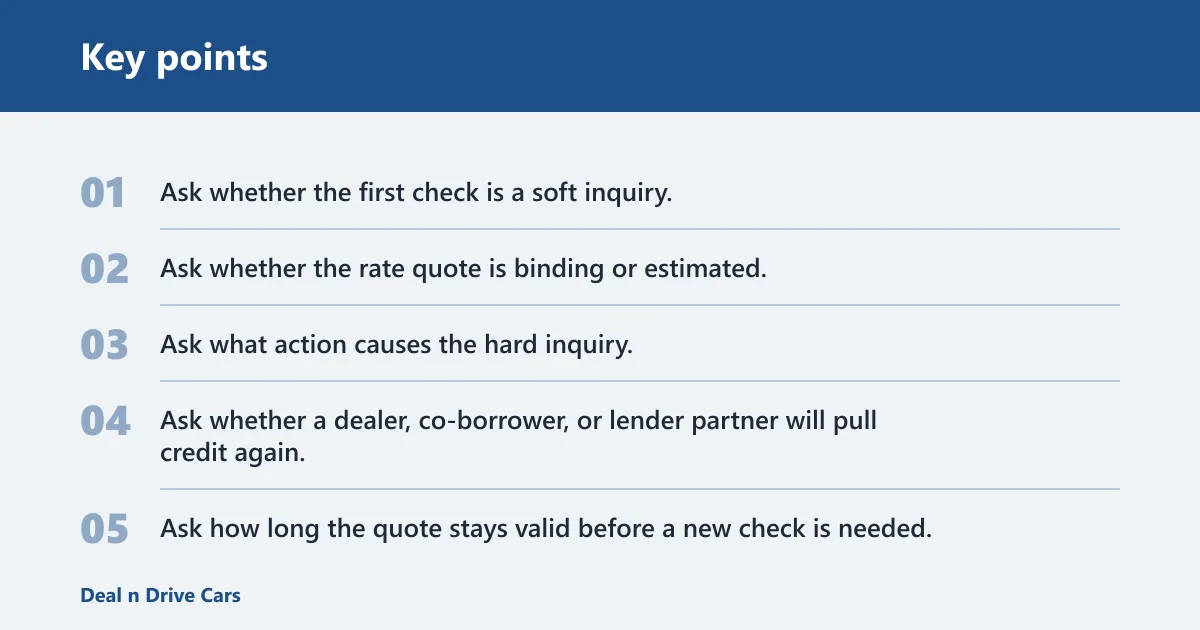
Ask three direct questions before you hand over a full application: Is this a soft pull or a hard pull? Is the quote conditional or final? What exact step turns this into a hard inquiry? Those questions prevent guesswork, and they force the lender to name the trigger point instead of burying it in fine print.
- Ask whether the first check is a soft inquiry.
- Ask whether the rate quote is binding or estimated.
- Ask what action causes the hard inquiry.
- Ask whether a dealer, co-borrower, or lender partner will pull credit again.
- Ask how long the quote stays valid before a new check is needed.
Yes/no decision tree: do you risk a hard inquiry?
Use this quick decision tree before you submit a form or sign a dealer worksheet.
| Question | Yes | No |
|---|---|---|
| Did the lender clearly say the first check is soft? | Stay in comparison mode and keep shopping. | Stop and ask before proceeding. |
| Are you submitting a full credit application? | A hard inquiry is likely. | You may still be in quote-only territory. |
| Are you accepting terms or locking in an offer? | That can convert the process to a hard pull. | The lender may still be in estimate mode. |
| Is a dealer submitting your file to multiple lenders? | Multiple inquiries are possible, depending on policy and scoring treatment. | You may control the lender count more easily. |
| Are you adding a co-borrower? | Both applicants may be checked. | The file may stay simpler. |
Soft pull vs hard pull for auto loans

A soft pull is a credit check that does not affect your score and is visible only to you on your report. A hard pull is a full inquiry that can lower your score by a few points, is visible to other lenders, and can stay on your report for up to 24 months. The difference matters most when you are comparing lenders, and the exact reporting and score effect can vary by bureau and scoring model.
What a soft inquiry shows
A soft inquiry can support prequalification and some preapproval tools. Experian, Equifax, and TransUnion all distinguish between soft and hard inquiries, and soft inquiries generally are not visible to lenders reviewing your file for a new credit decision. That makes them useful for early shopping when you want an estimate without adding visible application activity.
Soft pulls are common in auto loan prequalification, especially with online tools and credit unions. They can return an estimated APR and loan amount, but they do not guarantee approval. They are a starting point, not a final commitment, and the lender can still move to a hard inquiry later if you submit a full application.
What a hard inquiry shows
A hard inquiry usually appears when you formally apply for credit or move into final underwriting. It is visible to other lenders, and it can remain on your credit report for up to 24 months. FICO says hard inquiries can have a small impact on scores and generally matter less as they age; the CFPB and the credit bureaus note that inquiries stay on file for 24 months, even though score impact typically fades much sooner.
The size of the score effect is usually modest and varies by profile. The same source explains that one hard inquiry often has a small effect, and the impact is generally more noticeable for borrowers with thin files or few other credit accounts. That means the same inquiry can matter differently depending on how established your credit history is.
How each one can affect your score
The score impact is not the same for every borrower. A prime borrower may see a small, short-lived dip. A thin-file shopper, or someone already near a cutoff, may care more about a few points because it can affect pricing tiers or approval odds. A damaged-credit file may feel the difference less in score terms but more in lender access. FICO’s materials emphasize that inquiry impact is usually limited and temporary, but the practical effect can still matter if your file is on the edge.
Suppose a shopper with limited credit history applies at three places in one week. If all three trigger hard inquiries outside the auto rate-shopping window, the score effect can add up more than the shopper expects. If the checks are grouped correctly within the window, the scoring treatment can be different for auto loans, but the lender still sees the inquiry activity on the report.
When does a hard inquiry happen?
A hard inquiry usually happens when you formally apply, accept terms, or enter final underwriting. It does not have to happen during the first quote stage. That is why a soft-pull estimate can exist first, then flip to a hard pull later if you decide to move forward.
Formal application and final underwriting
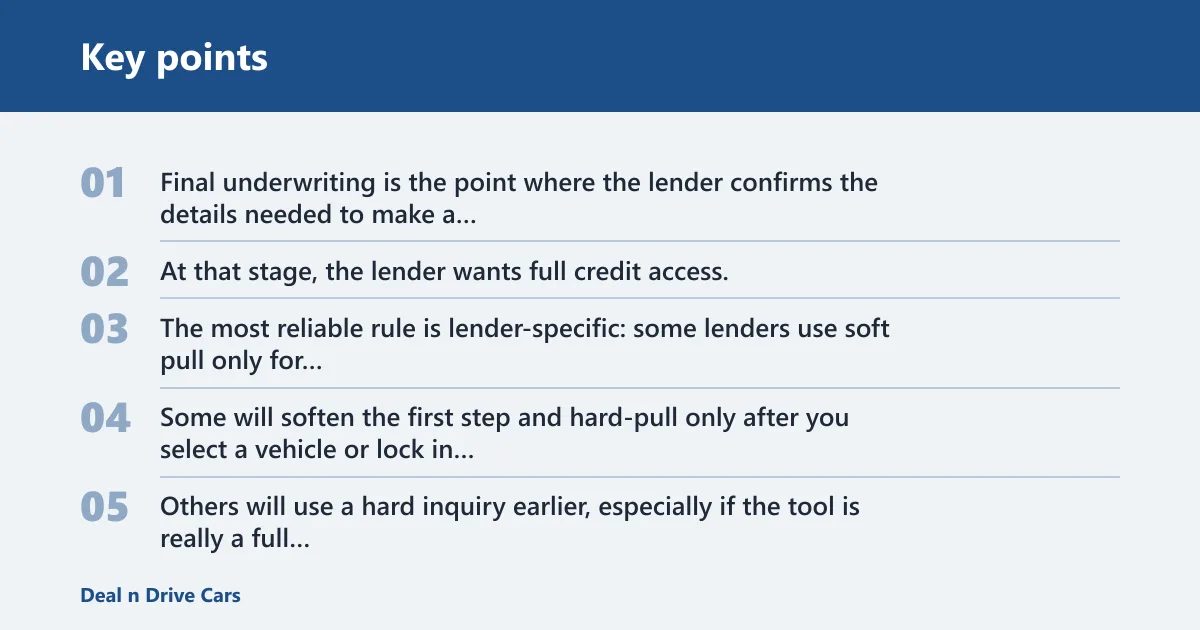
Final underwriting is the point where the lender confirms the details needed to make a binding decision. At that stage, the lender wants full credit access. The most reliable rule is lender-specific: some lenders use soft pull only for prequalification, some use soft pull for a conditional preapproval, and some pull hard once the final application is submitted or the car purchase becomes imminent.
The exact trigger can vary by lender. Some will soften the first step and hard-pull only after you select a vehicle or lock in a loan amount. Others will use a hard inquiry earlier, especially if the tool is really a full application in disguise. Dealer offices and captive lenders can be especially variable because the deal structure, brand incentives, and financing source can all affect when the pull happens.
Accepted terms versus quote-only offers
A quote-only offer can stay soft-pull if you are still comparing numbers. Once you accept terms, the lender may treat that as a formal credit application. That is the moment many shoppers miss, because the language sounds like approval even when the lender still needs a final review.
That distinction matters most in dealer offices. A finance manager may present a payment estimate first, then ask you to sign a credit application after you choose a car or agree to a financing path. The hard inquiry usually starts with that application, not with the first conversation. If there is a co-borrower, the dealer may need both people’s information before it can quote accurately or submit the file.
Why timing matters if you are rate shopping
Timing matters because auto inquiries can be rate-shopped. The same source says multiple auto inquiries within a short shopping period are generally treated as a single inquiry for scoring, and VantageScore also groups auto inquiries in a rate-shopping period, though the exact window can vary by version and implementation. In other words, the commonly cited 14-day window is not a universal rule across all scoring models or lender systems.
The practical goal is simple: do your comparison shopping in one short block, then stop. If you spread auto applications across several weeks, some lenders may still treat them separately for scoring and underwriting purposes. That can add avoidable damage, especially if other credit applications happen at the same time.
Can I shop multiple lenders without extra pulls?
Yes, you can usually compare multiple auto lenders without multiple score hits if you keep the checks inside the auto rate-shopping window. FICO and VantageScore both recognize this behavior, but the window is model-specific and can vary; the common 14-day example is widely cited, yet not every scoring version uses the same period. That makes fast, organized shopping the safer path.
How the auto rate-shopping window works
Auto inquiries made within the scoring window may count as one for scoring purposes. The rule applies to auto-loan inquiries, not every kind of credit inquiry. That means you can compare a credit union, a bank, and an online lender in the same short period and reduce the risk of repeated score impacts, but the lenders still may record the inquiries separately on the credit report.
Why FICO and VantageScore treat auto inquiries differently
Both scoring systems recognize that shoppers need to compare auto rates. They do not want every lender check for the same loan hunt to look like separate borrowing behavior. So they group multiple auto inquiries within the window as one for scoring, which limits the damage from rate shopping done the right way. The exact window and treatment can differ across model versions, so ask a lender or credit counselor not to assume a single universal rule applies.
How to compare offers in one short window
Start with soft-pull prequalification where possible, then move to formal applications only with the lenders that remain competitive. Keep your auto shopping narrow and time-bound. If you are ready to buy soon, line up your lender calls or online applications in a single week rather than stretching them out.
A common first-timer mistake is getting three soft quotes, then waiting a month before applying because the payment looks good. By then, the quotes may expire, and the shopper may need fresh checks that create new inquiries. A tighter schedule makes the scoring rules work in your favor.
Preapproval inquiry checklist
This table helps you separate soft-pull estimates from hard-pull applications before you submit anything. Use it to ask the right question at the right step, so you know whether a score impact is likely.
| lender type | application stage | likely pull type | what to ask | score impact expected? |
|---|---|---|---|---|
| credit union | online prequalification | soft pull | “Is this only a soft inquiry, and will I see it on my report?” | no score change expected |
| online lender | rate estimate or prequal tool | soft pull | “Is this quote conditional, or does it become a hard inquiry when I accept?” | no score change expected |
| bank | full loan application | hard inquiry | “Will this be a full application that appears to other lenders?” | yes, a small dip is possible |
| dealership financing desk | dealer-arranged financing | often hard pull, possibly multiple | “How many lenders will you submit this to, and can I approve each pull first?” | yes, if several lenders are submitted |
| dealer-assigned lender | after vehicle selection | hard inquiry likely | “Is this the final credit app or just a preliminary check?” | yes, if it is a formal application |
| co-borrower application | joint credit review | depends on lender | “Will both applicants be pulled, and at what step?” | possibly, for each applicant |
Which lenders are most likely to use soft pulls?
Credit unions are often a good place to start because they may offer soft-pull prequalification. Banks and online lenders may also use soft pulls for early estimates, but their exact process varies. Dealer-arranged financing is the least predictable because the financing desk may send your application to several lenders quickly, and captive lenders may follow a separate approval workflow tied to the manufacturer or finance arm.
Credit unions
Credit union auto lending often includes a soft-pull first step, which makes it useful for comparison shopping. That soft check can give you a payment estimate before you visit the dealership. If you are comparing a credit union against a bank and an online lender, ask which stage remains soft and which stage becomes formal.
Banks and online lenders
Banks and online lenders may offer soft-pull prequalification tools, but not every product works the same way. AutoLoan Rate names Capital One Auto Navigator as a soft-pull pre-qual example. That does not mean every bank tool is soft-pull; it means you need to ask before submitting, because lender policies and the consumer’s file can change the outcome.
Dealer-arranged financing
Dealer financing desks can create the most confusion because they often submit applications to multiple lenders in a short time. That can generate multiple hard inquiries, especially if the dealer is trying several captive or partner lenders at once. You should ask how many lenders will receive your application and whether each submission is necessary.
Do dealership financing applications count as one inquiry? Not always. The dealer may send your credit file to several lenders, and each submission can create a separate hard inquiry unless it is handled within the scoring window and under the same auto-shopping rules. The safest assumption is that dealer finance can create more than one pull, especially when the desk is moving quickly or trying to satisfy a manufacturer incentive.
How do you keep one hard pull from turning into several?
Keep the number of formal applications low, keep them close together, and keep non-auto credit applications off the same schedule. A single hard pull is easier to manage than several scattered ones. The goal is to make the rate-shopping window work for you rather than against you.
Limit the number of applications you submit
Start with soft-pull quotes, then submit full applications only to the lenders that remain competitive. That reduces the chance of unnecessary hard inquiries. If one lender’s soft quote is clearly weaker, there is no reason to let it move into a hard pull unless you need the backup offer.
Watch co-borrower and dealer-submitted applications
Co-borrowers can complicate the picture because both credit files may be checked. Dealer-submitted applications can do the same because the finance desk may spread your information across several lenders. Before anyone submits, ask who will be pulled, how many times, and whether the lender is asking for a soft or hard check.
Keep auto shopping separate from other credit applications
Loan application timing matters. If you are also applying for a credit card, personal loan, or mortgage around the same time, those can create separate inquiries outside the auto rate-shopping rules. Keep the auto search contained so the scoring treatment stays as clean as possible.
Suppose you prequalify with a credit union on Monday, a bank on Wednesday, and a dealer on Friday. If all three are formal auto applications inside the scoring window, the score hit should be grouped for auto scoring purposes. If you also apply for another line of credit that week, that extra inquiry can sit outside the auto-shopping protection.
Auto preapproval checklist
Use this checklist before you hit submit, sign at the desk, or agree to a dealership finance submission.
- You know whether the first check is soft or hard.
- You know whether the lender is giving a prequalification, a conditional preapproval, or a final offer.
- You know the exact step that changes the file to a hard inquiry.
- You know whether a dealer will shop your file to multiple lenders.
- You know whether a co-borrower will also be checked.
- You have asked about captive lenders, dealer partners, and state-specific documentation rules.
- You are comparing lenders within a short time window instead of spreading applications out.
- You have confirmed how long the quote lasts before it needs a new pull.
Frequently asked questions
Can you get auto preapproval without a hard inquiry?
Yes, many lenders can start with a soft-pull preapproval or prequalification, especially for early rate estimates. The hard inquiry usually arrives only when you submit a full application, accept terms, or enter final underwriting. Ask the lender to name the exact step that changes the pull type, because the process varies by lender and product.
What’s the difference between a soft pull and a hard pull for auto preapproval?
A soft pull is used for early estimates, does not affect your score, and is visible only to you on your report. A hard pull can lower your score by a few points, is visible to other lenders, and can stay on your report for up to 24 months. It usually appears at the formal application stage.
Does auto preapproval hurt your credit score?
Not always. A soft-pull preapproval should not affect your score, while a hard-pull version can cause a small, temporary drop. The difference depends on the lender’s process, not the word “preapproval” alone. If the lender cannot say whether the check is soft or hard, ask before you submit anything.
When does a hard inquiry happen in the auto loan process?
A hard inquiry usually happens when you formally apply, accept a preapproved offer, or move into final underwriting. It does not have to happen during the first quote stage. If you are still comparing lenders, keep the process in soft-pull mode until you are ready to commit.
Can I shop multiple auto lenders without multiple hard pulls?
Yes, if you stay inside the auto rate-shopping window. FICO and VantageScore group multiple auto inquiries within a scoring period, but the exact window can vary by model version and implementation. Keep the applications clustered and make sure they are all for the same loan hunt.
How long does an auto loan inquiry affect your score?
FICO, the CFPB, and the major bureaus treat inquiries as reportable for up to 24 months, while the score effect is usually much shorter. The exact effect depends on the rest of your profile. The hard inquiry becomes less important over time, but it remains visible on the report.
Sources
- FICO: hard inquiry impact, inquiry aging, and auto rate-shopping treatment
- CFPB: credit inquiry basics, report visibility, and consumer credit-reporting guidance
- Experian, Equifax, and TransUnion: inquiry definitions and reporting duration
- FICO and VantageScore model guidance on auto rate-shopping windows and model variation