How to buy a car from a private seller step by step
Buy from a private seller by checking the title, matching the seller to the registration, inspecting the car, running an odometer disclosure and lien check, paying with a protected method, and completing title transfer at the DMV the same day when possible. Skip one step and you can lose money, buy a car with hidden title debt, or fail to register it. This checklist covers seller checks, paperwork, payment, title signing, and the DMV handoff.
What you’ll need before you meet the seller
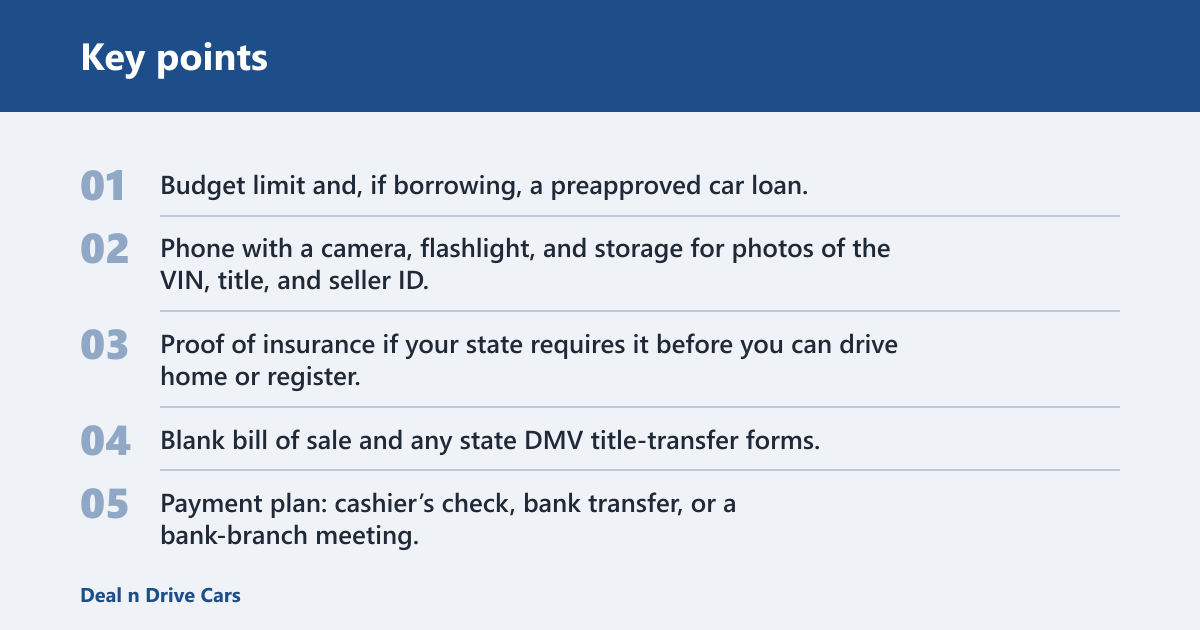
- Budget limit and, if borrowing, a preapproved car loan; NerdWallet recommends preapproval before shopping, and says an auto loan is the most common option.
- Phone with a camera, flashlight, and storage for photos of the VIN, title, and seller ID.
- Proof of insurance if your state requires it before you can drive home or register.
- Blank bill of sale and any state DMV title-transfer forms.
- Payment plan: cashier’s check, bank transfer, or a bank-branch meeting.
- Mechanic contact for a pre-purchase inspection.
NerdWallet also suggests aiming for a 20% down payment when possible, checking crash test ratings from the Insurance Institute for Highway Safety, using J.D. Power for reliability research, and considering Kelley Blue Book’s Five-Year Cost to Own tool. It also advises identifying three to five target models and comparing insurance, maintenance, repairs, and depreciation before you travel.
- Set a budget and compare similar models before you contact a seller.
- Collect the seller’s name, VIN, title photos, and current mileage.
- Bring insurance proof, ID, forms, and your payment method to the meeting.
- Book a mechanic inspection before money changes hands.
📊 NerdWallet says new car prices are about $10,000 more than in 2019. Source: How to Buy a New Car in 7 Steps.
What documents should the seller have?
The seller should have the vehicle title in hand, and the name on that title should match the person selling the car. If a lender still holds a lien, you also need a lien release. A private-party bill of sale usually lists buyer and seller names, VIN, sale price, date of sale, and signatures.
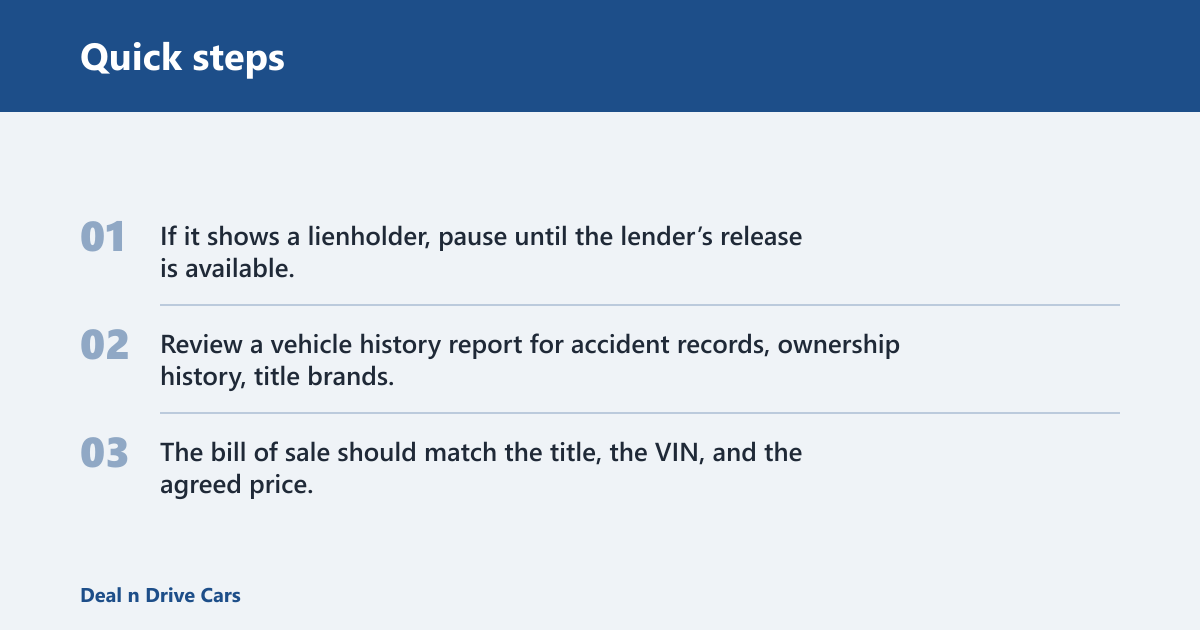
Title, lien release, history report, and bill of sale
Ask for the title first. If it shows a lienholder, pause until the lender’s release is available. Review a vehicle history report for accident records, ownership history, title brands, and odometer flags. The bill of sale should match the title, the VIN, and the agreed price. Keep copies of everything.
| Document | What to verify | Why it matters |
|---|---|---|
| Vehicle title | Seller name, VIN, title brand, signature blocks | Confirms who can sell the car |
| Lien release | VIN, lender name, paid-in-full status | Shows the lender no longer claims the car |
| Vehicle history report | Accident records, ownership history, odometer issues, title brands | Flags risk that the title alone may not show |
| Bill of sale | Names, VIN, sale price, date, signatures | Supports tax, title, and dispute records |
How do I check the title before buying from a private seller?
Match the seller’s ID to the name on the title, then check the VIN on the dashboard, door jamb, and title for exact agreement. Look for title brands, odometer issues, cross-outs, missing signatures, or a lender listed on the title. If the title is wrong, stop before you pay.
Check for name mismatch, brand marks, and open liens
The seller name must match the title holder. If a spouse or relative is selling, ask for the titled owner’s signed authorization and your state’s transfer rules. A branded title can indicate salvage, flood, rebuilt, or other issues. An open lien needs a release before transfer. A missing title is a hard stop.
Say the seller hands over a title with a lender name still printed on it and says the loan will be cleared “later today.” Do not pay yet. Wait for a release letter, or close at the lender, bank, or credit union that can verify the payoff.
Step 1: Verify the seller and the car
Use the seller’s legal name, photo ID, and title as your first check. Then confirm the VIN in three places and compare it to the paperwork. If the car’s identity does not line up on the spot, leave. That is the fastest way to avoid buying a car that cannot be titled cleanly.
Same-day verification order
- Match the ID to the title name.
- Confirm the VIN on the dash, door jamb, and title.
- Check the odometer reading against the history report.
- Look for title brands, altered fields, or missing signatures.
A common first-timer mistake is treating a clean body and a low asking price as proof that the sale is safe. Picture a compact sedan parked at a grocery lot with a fresh detail, but the title shows a different VIN by one digit. That mismatch should end the meeting.
Step 2: Review the history report and arrange an inspection
Read the vehicle history report for accident records, ownership history, title brands, and odometer issues, then book a pre-purchase inspection before you exchange money. A visual walk-around is not enough. A mechanic should check the engine, brakes, tires, suspension, diagnostic codes, and how the car behaves on a road test.
Inspection checklist for the mechanic
- Engine condition and visible leaks
- Brake pad, rotor, and fluid condition
- Tire wear, age, and matching sizes
- Suspension and steering components
- Diagnostic scan for stored codes
- Road test for noise, shifting, and braking
Suppose the history report is clean but the scanner shows pending engine codes and the road test reveals a pull under braking. That is enough to renegotiate or walk away. A report cannot replace a mechanic, and a mechanic cannot erase title problems.
How do you pay a private seller safely?
Use a cashier’s check or bank transfer only after the title checks out, and meet at a bank branch when possible. Avoid handing over cash unless you can count it safely and the title transfer is fully ready. Treat escrow offers with caution and confirm the provider is real.
Safer payment sequence
- Verify the title and lien status first.
- Agree on the exact sale price and out-the-door amount.
- Meet at a bank branch when possible.
- Exchange payment only after the title and bill of sale are filled out.
- Keep a receipt or bank confirmation for your records.
Cashier’s checks should be verified with the issuing bank using a number you locate yourself. Bank transfers are safer when completed in-branch with both parties present. Escrow can help only if the provider is legitimate and both sides understand the release rules; fake escrow is a common scam pattern.
Step 3: Sign the bill of sale and title transfer forms
Complete the bill of sale with buyer and seller names, vehicle VIN, sale price, date of sale, and signatures, then sign the title exactly as your state requires. If your state uses odometer disclosure, fill it in precisely. The paperwork order matters because title errors can block registration.
Signing order that reduces mistakes
- Fill in the bill of sale first.
- Enter the exact VIN and sale price.
- Sign the title in the correct boxes only.
- Complete any odometer disclosure form required by your state.
- Photograph every signed page before leaving.
Do not accept a title that is signed in the wrong spot or dated incorrectly. State transfer rules vary, and some titles need notarization or specific signature placement. The goal is not just to drive home; it is to leave with a title that your DMV can accept.
The same-day private-sale closing pack
Use this as a one-page closing pack: title, bill of sale, lien release if needed, insurance proof, ID, DMV forms, payment method, and photos of the VIN, title, and odometer. It also needs a red-flag decision tree for missing title, seller mismatch, or an open lien that is not cleared.
Closing pack checklist
- Photo ID for buyer and seller
- Vehicle title with matching seller name
- Lien release, if applicable
- Vehicle history report
- Signed bill of sale
- Odometer disclosure, if required
- Proof of insurance
- Cashier’s check or verified bank transfer
- Photos of VIN, title front and back, seller ID, and signed forms
- DMV transfer and registration forms
Red-flag decision tree
- Missing title: stop. Ask the seller to replace it before any payment.
- Name mismatch: stop. Require the titled owner’s signature or proper authority.
- Open lien: stop. Get a lien release or close at the lender.
- VIN mismatch: stop. Do not continue until the paperwork matches the car.
- Seller rushes payment: stop. Verify everything again.
What happens after the sale?

Get insurance active before you drive the car home if your state requires proof right away, then file the title transfer and registration at the DMV on time. Sales tax, title fees, and registration fees may still apply after the sale. Keep copies of every signed document until the registration is complete.
Drive-home versus register-later
Driving home is not the same as registering the car. Some states allow a temporary move permit or give a short transfer window, while others require immediate proof of insurance and paperwork filing. Separate the two questions before you leave the meeting.
- Drive home: only if insurance, title status, and any temporary permit rules allow it.
- Register later: only if your state gives you a filing window and you keep every receipt.
What’s needed at the DMV is usually the signed title, bill of sale, lien release if needed, registration forms, and payment of any required taxes and fees. If your state requires emissions testing, a VIN inspection, or notarization, handle that before the filing deadline.
Common mistakes to avoid
Common mistakes include buying without checking the title name and lien status, skipping the inspection, sending payment before the title is verified, confusing a drive-home permit with full registration, and missing state deadlines for title transfer.
What goes wrong and how to avoid it
- Title problems: compare the seller’s name, VIN, and lien status before payment.
- Inspection shortcuts: use a mechanic, not only a visual check.
- Payment risk: use traceable funds and verify the bank or escrow provider.
- Paperwork gaps: keep signed copies and photos of every document.
- Registration confusion: file with the DMV on time and pay required taxes and fees.
Prevention: save photos of the title, bill of sale, odometer, seller ID, and VIN before the seller leaves. Those images can settle a mismatch at the DMV faster than memory can.
Frequently asked questions
What are the steps to buy a car from a private seller?
Start by verifying the seller and title, then inspect the car, review the history report, arrange a mechanic check, agree on price, sign the bill of sale and title, pay with a traceable method, and file the transfer with the DMV. Insurance and state fee rules still apply after payment.
What is the process to buy a car from a private seller?
The process is seller verification, title review, inspection, payment, signing, and DMV filing. Keep the seller’s name matched to the title, confirm any lien release, and do not treat payment as registration. A private sale is finished only when the paperwork is accepted by your state office.
What documents are needed to buy a car from a private seller?
You need the vehicle title, a bill of sale, lien release if the title shows a lender, proof of insurance if your state requires it, and any DMV title-transfer or registration forms. Keep the vehicle history report and photo copies of the VIN and signed documents for your records.
How do I check the title before buying from a private seller?
Check that the seller’s name matches the title, the VIN matches the car, and there are no open liens, missing signatures, or visible alterations. If the title is branded, lost, or signed by someone else, stop and verify the state’s transfer rules before paying any money.
How do I pay a private seller safely for a car?
Use a cashier’s check or bank transfer after you verify the title and lien status, and meet at a bank branch when possible. Avoid cash unless you can count it safely and finish the paperwork at the same time. Ask for a signed receipt or bank confirmation.
What fees still apply after a private car sale?
Sales tax, title fees, and registration fees may still be due at transfer. Some states also charge document, plate, or inspection fees. Check the DMV’s transfer rules before closing so the final out-of-pocket amount is not a surprise after you already paid the seller.