Private Seller vs Dealership: Which Is Better for Buyers?
Private sellers usually ask less, while dealerships usually handle financing, paperwork, and post-sale protection. If the private-sale discount is under about 10% to 15%, many buyers may find a dealership purchase is the better value. Pick the wrong path, and repairs, fees, or interest can erase the savings. This guide compares both paths by buyer profile, discount size, inspection burden, and risk tolerance.
| Decision factor | Private seller | dealership | Winner |
|---|---|---|---|
| Price | Usually lower sticker price | Usually higher sticker price | Private seller |
| Financing access | You usually arrange a private-party auto loan through a bank or credit union | Dealer-arranged financing is often easier to obtain | dealership |
| Paperwork help | You usually handle title transfer, registration, and payoff details yourself | Staff often help with title and registration | dealership |
| Inspection burden | You must organize the pre-purchase inspection and verification | You should still inspect, but dealers often supply more records | dealership |
| Warranty and protection | Often sold as-is, with limited post-sale recourse | May include warranty, service contract, or CPO coverage | dealership |
| Title and recall risk | Higher risk of title gaps, VIN errors, and missed recalls if you do not verify | Lower risk, because dealers usually process more of the paperwork and disclosures | dealership |
| Negotiation flexibility | Often more room to haggle directly with the owner | Pricing can be firmer, though there may still be room on older inventory | Private seller |
| Recourse after sale | Usually limited once the car is sold | More options if the dealer misstates warranty status or misses required disclosures | dealership |
| Time spent | More calls, more checks, more running around | Faster if financing and paperwork are handled in one place | dealership |
| Best fit | Cash buyers, confident shoppers, and buyers who can verify the car carefully | First-time buyers, thin-credit buyers, and shoppers who want process help | Depends on buyer profile |
Which is better for you?
The better choice depends on the discount you can secure and the work you want to do yourself. Private seller is strongest when you can inspect carefully, pay cash or already have financing, and get a large enough discount to cover added risk. Dealership is stronger when you want financing, paperwork help, or a clearer backstop if something is wrong.
Price and total cost
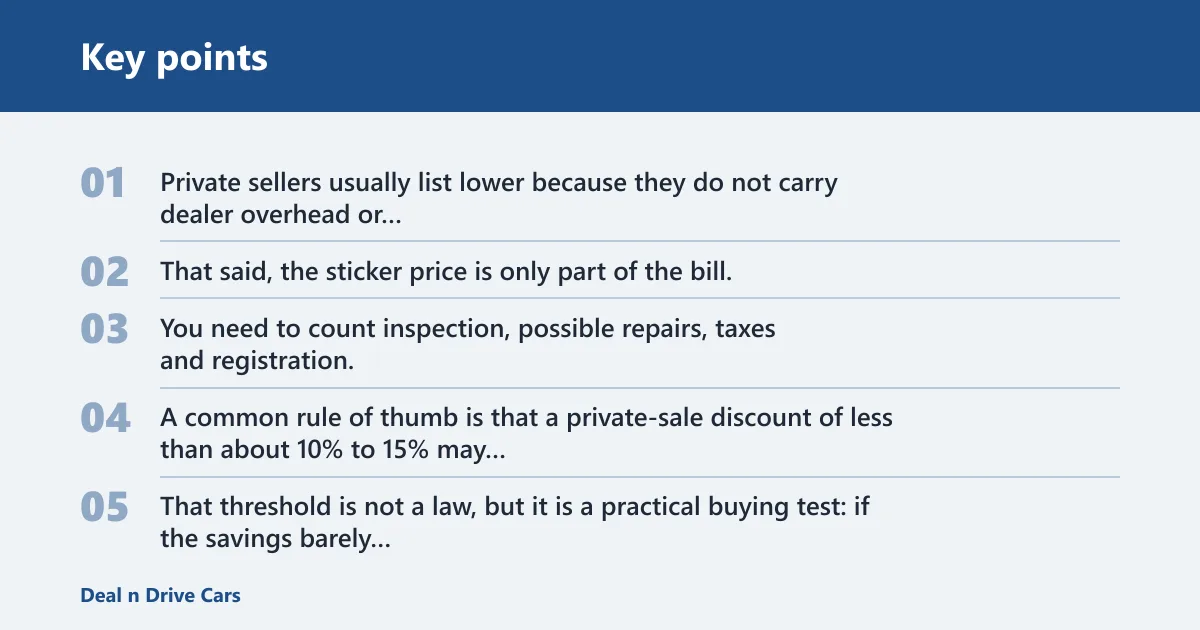
Private sellers usually list lower because they do not carry dealer overhead or reconditioning costs. That said, the sticker price is only part of the bill. You need to count inspection, possible repairs, taxes and registration, and any financing difference before deciding that the private deal is truly cheaper.
A common rule of thumb is that a private-sale discount of less than about 10% to 15% may not be enough to offset the extra effort and risk for many buyers. That threshold is not a law, but it is a practical buying test: if the savings barely cover a few needed repairs or a higher loan rate, the cheaper car is not actually cheaper.
Dealership pricing can be partly offset by value that is easier to measure: financing access, title handling, a vehicle history report that is often easier to obtain, and possible warranty or CPO coverage. Certified Pre-Owned vehicles are usually priced above non-CPO stock, often because they go through stricter inspections and may include warranty coverage and roadside assistance.
Price and fees in practice
Suppose a private seller is asking $14,000 and a dealer is asking $15,500 for similar cars. If the private car then needs $900 in immediate tires and brakes, plus a higher loan rate, the gap can shrink quickly. The smaller the discount, the more the dealership’s included help starts to matter.
Can you finance a car bought from a private seller?
Yes, but it is usually less convenient than dealer financing. A private-party auto loan is often arranged through a bank or credit union, and some lenders may cap vehicle age or mileage. Dealer-arranged financing is typically simpler because the dealership can submit the application and handle the sale in one place.
That convenience matters most for thin-credit buyers or anyone who wants to compare multiple loan offers without managing the paperwork alone. A private seller may still be the right pick if you already have a credit-union approval in hand and the car fits the lender’s age and mileage rules.
Dealer financing can also change the math on total cost. A slightly higher dealer price may still beat a private-sale deal if the loan rate is better, the term is cleaner, and you avoid separate trips for loan setup and title processing.
What protections do you get buying from a dealership?
Used vehicles sold by a licensed dealership are commonly covered by the FTC Used Car Rule, which requires a Buyers Guide on each used vehicle. That guide states whether the car is sold as-is or with warranty coverage. Dealerships may also provide reconditioning, title and registration help, and in some cases warranty or CPO coverage.
That protection is helpful, but it is not unlimited. A warranty may cover only certain parts or only for a short time, and CPO coverage varies by manufacturer. Read the Buyers Guide, ask what is covered in writing, and do not assume every dealer car has the same protection.
Certified Pre-Owned can be worth the extra cost for buyers who want a newer used car with stricter inspection standards and possible manufacturer-backed protection. It is usually more expensive than a non-CPO car, so the premium makes sense only if you value the additional screening and the coverage that comes with it.
What can go wrong in a private sale?
The main risks are title problems, VIN mismatches, hidden mechanical issues, and limited post-sale recourse. Private sales are person-to-person transactions, so the buyer usually handles inspection, paperwork, and financing. If the seller misstates the car’s condition, getting money back is much harder after the sale closes.
Recall status is another issue. The VIN should match the title and the vehicle, and it should be used to check accident history, title history, mileage signals, and open recalls. Unrepaired recalls do not always stop a sale, but they are a warning sign that the car has not been fully maintained or verified.
A private sale sold as-is means the seller is generally not promising repairs after delivery. If the transmission slips a week later, your options may be limited unless you can prove fraud or a title defect. That is why a pre-purchase inspection matters so much on private sales.
Private-sale failure cases to watch
Say your seller hands over a clean-looking sedan, but the VIN on the title does not match the plate on the windshield. That is a stop sign, not a minor paperwork issue. You should not pay until the mismatch is explained and corrected by the proper authority.
Picture a truck with a clean appearance and a fresh wash, but the independent mechanic finds a leaking coolant line and brake pads near the end of their life. The asking price may have looked low, but the needed work can erase the savings fast.
Should you still get a pre-purchase inspection either way?
A pre-purchase inspection is commonly recommended for both dealer and private purchases because it may reveal hidden mechanical issues before you own the car. Dealers may provide more paperwork and reconditioning, but that does not replace an independent mechanic’s review. The inspection is your best check on condition.
For a private sale, the inspection is especially important because the buyer often carries the full burden of discovery. For a dealer car, it is still valuable because the dealership’s reconditioning work may not cover every problem, and a history report alone cannot confirm current mechanical condition.
- Check the VIN on the car, title, and documents.
- Pull a vehicle history report and review accident, title, and mileage signals.
- Arrange an independent pre-purchase inspection.
- Confirm whether any recalls are open by VIN.
- Verify how the title transfer and registration will be completed.
- Only then compare the final out-the-door cost.
Choose Private seller if… / Choose dealership if…
Choose Private seller if you are a cash buyer, you can inspect the car carefully, and the discount is large enough to justify the added work. It also fits buyers who want the most room to negotiate and are comfortable handling the title transfer and registration themselves.
Choose dealership if you need financing, want help with paperwork, or want more protection if something goes wrong after the sale. It is also the better fit for first-time buyers, buyers who want CPO or warranty options, and anyone who values convenience over chasing the absolute lowest sticker price.
For many shoppers, the cleanest cutoff is this: if the private-sale savings are under about 10% to 15%, the dealership often makes more sense once you price in financing, paperwork help, and risk. If the private seller’s discount is clearly larger and the car checks out, private seller can be the better deal.
Frequently asked questions
Is it better to buy a used car from a private seller or a dealership?
Neither route wins every time. Private seller usually wins on sticker price, while dealership usually wins on financing, paperwork help, and post-sale protection. If you need a loan or want lower hassle, dealership often fits better. If you can verify the car and pay cash, private seller can save money.
Are private seller cars really cheaper than dealer cars?
Usually, yes on the asking price. But the total cost can change once you add inspection, possible repairs, title work, and loan terms. A private car that is only a little cheaper may end up costing more than a dealer car with better financing or included protection.
What risks come with buying from a private seller?
The main risks are limited recourse, title problems, VIN mismatches, hidden damage, and open recalls. A private sale is usually as-is, so the seller may not owe repairs after the deal closes. That is why a history report, VIN check, and pre-purchase inspection matter so much.
Do dealers handle title transfer and registration for you?
Often, yes. Many licensed dealerships help with title transfer and registration as part of the sale, which reduces the chance of paperwork mistakes. Private buyers usually have to manage those steps directly, so you need to check local requirements and make sure the VIN matches the title before paying.