How to Write a Private Car Sale Listing That Gets Replies
Write a private car sale listing in 3 parts: buyer filters first, then proof, then trust signals. Vague ads waste time, pull in weak leads, and leave serious buyers scrolling past. This guide shows what to include, what to leave out, and the best order for replies.
Why some listings get replies
Buyers are more likely to reply when the listing answers the main filters quickly: what it is, how many miles it has, what shape it is in, what the title status is, and how to contact you. Put those details low in the ad, and the buyer has to work for them. Many will move on.
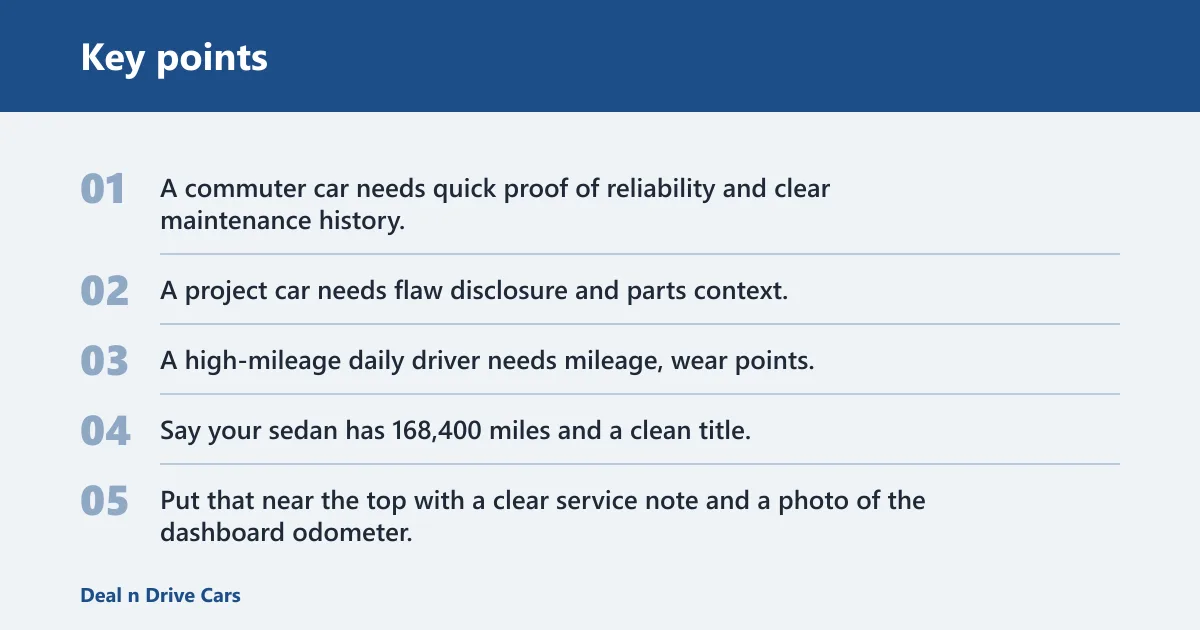
Reply intent also changes by vehicle type. A commuter car needs quick proof of reliability and clear maintenance history. A project car needs flaw disclosure and parts context. A high-mileage daily driver needs mileage, wear points, and a straight explanation of what still works well.
Say your sedan has 168,400 miles and a clean title. Put that near the top with a clear service note and a photo of the dashboard odometer, and the buyer can decide fast whether to keep reading. Hide the same facts after a long story, and the message rate usually drops. For pricing basics, use broad valuation references from Kelley Blue Book or NADA before setting an asking price.
What to put in the title?
A common title format is year/make/model/trim. Keep it scannable, and leave out pricing, hype, and excessive punctuation. The best titles let a buyer sort the listing in one glance. Put the strongest filter words first, because many shoppers read only the title and first line.
Title format that works best
A clean title format is simple: 2017 Honda Civic LX clean title. If the mileage is a major selling point, add it after the trim. Keep the wording plain and avoid all-caps. The goal is clarity, not sales copy.
| Good title | Why it works | Bad title | Why it loses replies |
|---|---|---|---|
| 2017 Honda Civic LX clean title | Easy to scan, includes core filters | 🔥🔥 HONDA CIVIC!!! MUST SELL!!! | Looks spammy and hides details |
| 2012 Subaru Outback 2.5i 178k clean title | Trim, mileage, and title status are visible | Great SUV low price | No make, no model, no title status |
| 2008 Toyota Tacoma double cab salvage title | Discloses the title issue up front | Truck for sale | Too vague for filtered searches |
What to leave out of the title
Do not put the price in the title. Do not stack emojis, symbols, or repeated exclamation marks. Do not write a sentence when a label will do. The title should help a buyer decide whether to open the listing, not tell the whole story.
If a detail helps search but is not needed in the title, keep it in the description. That includes service notes, options, and long condition details. The title should stay short enough to read on a phone without guessing.
Reply-rate listing checklist
Use this order when you write the listing. It matches how buyers scan: first the title, then the opening lines, then proof, then trust, then the call to message. Shuffle that order, and the listing has to work harder to earn the same reply.
| Write this next | What to include | Pass / fail test |
|---|---|---|
| Title | Year, make, model, trim, title status | Pass if a buyer can identify the vehicle in about 2 seconds. |
| First two lines | Odometer reading, key condition note, why it matters | Pass if the main facts appear before any long sentence |
| Mileage and condition block | Exact mileage, body type, transmission, drivetrain, fuel, title status | Pass if the filter fields are easy to copy into a search |
| Flaw disclosure | Known defects, worn parts, warning lights, cosmetic damage | Pass if a buyer will not be surprised at meet-up |
| Service proof | Maintenance records, recent service, major repairs, non-smoker status, garage-kept status if true | Pass if a buyer gets a reason to trust the car’s story |
| Photo order | Front three-quarter, rear three-quarter, both sides, dashboard, engine bay, damage shots | Pass if the photos answer common follow-up questions |
| Closing CTA | How to message, what payment is preferred, what happens next | Pass if the next step is obvious and safe |
Pass-fail audit for common no-reply mistakes
- Fail: no mileage near the top.
- Fail: no title status listed.
- Fail: no clear contact method.
- Fail: only one or two photos.
- Fail: no mention of flaws on a car that clearly has them.
- Fail: vague lines like “runs great” with no proof.
- Pass: the buyer can judge fit before sending a question.
How should you write the description?
Write the description in short factual blocks. Lead with the buyer filters, then mileage and condition, then flaws, then service proof, then the contact call to action. That order matches how shoppers read. It also cuts repeat questions, which is one reason listings get replies instead of endless “what’s the mileage?” messages.
Start with the filters buyers use first
The opening two lines should carry the core facts. State the year, make, model, trim, and odometer reading right away. Then add the title status and one condition phrase that helps the buyer sort the listing, such as clean daily driver, project, or commuter.
A simple opening can look like this: 2016 Toyota Corolla LE, 142,300 miles, clean title, automatic, FWD, gas. That one line gives a shopper the basic filters without making them hunt through the ad.
Use short factual paragraphs
Keep each paragraph focused on one job. One paragraph for mileage and mechanical condition. One for known flaws. One for service history. One for message instructions. Short blocks are easier to read on a phone, and they make the listing feel organized rather than defensive.
For a commuter car, emphasize regular maintenance, no warning lights, and predictable running costs. For a project car, explain what works, what does not, and which parts come with the sale. For a high-mileage daily driver, be direct about wear, but also mention the maintenance that keeps it usable.
Keep the tone firm and clear
Do not sound apologetic, and do not sound evasive. A buyer wants facts they can verify. That means plain sentences, no hype, and no claims that need a long explanation. If you say the car was garage-kept or non-smoker, only include it if you can stand behind it.
Picture a 200,000-mile sedan with fresh tires, a recent water pump, and a small dent on the rear door. If you list the dent clearly and mention the service work, the ad feels honest. If you hide the dent, the first message may be a challenge, not an offer.
Which photos should you include?
Use about 10 to 12 strong photos, and put the most useful ones first. The best order starts with the car’s shape, then moves to condition proof, then to the details buyers ask about later. This sequence cuts down on follow-up questions because the listing answers them visually.
The 10 to 12 photo sequence
- Front three-quarter view.
- Rear three-quarter view.
- Driver side.
- Passenger side.
- Front interior wide shot.
- Dashboard with odometer visible.
- Front seats.
- Rear seats.
- Engine bay.
- Trunk or cargo area.
- Known damage or wear area.
- Second damage shot if needed.
Which damage shots to add?
Photograph every flaw that a buyer would notice at meet-up: dents, cracked glass, rust, torn upholstery, clearcoat failure, warning lights, or mismatched panels. One clean damage photo is better than a hidden problem that costs you the sale later. If there are several flaws, give each one its own image.
Do not bury damage shots at the end and hope nobody notices. Put them in the set so the buyer sees the full condition, then message quality improves because serious shoppers know the listing is honest.
What interior and mechanical photos matter most?
The dashboard with the odometer visible is one of the most important images. The engine bay matters too, even for buyers who are not mechanics, because it signals whether the car is cared for or neglected. If the interior is unusually clean or unusually worn, show that plainly.
For a commuter car, a clear dashboard photo and a clean cabin shot build confidence. For a project car, the engine bay and any missing trim or damaged panels matter more. For a high-mileage daily driver, the interior wear often tells the truth faster than a long paragraph.
What details do buyers look for in a used car ad?
Buyers look first for mileage, title status, transmission, drivetrain, fuel type, and whether the car matches their budget and use case. After that, they want proof that the car has been maintained and that the seller is not hiding an obvious defect. The more direct those facts are, the faster replies come in.
Mileage and title status
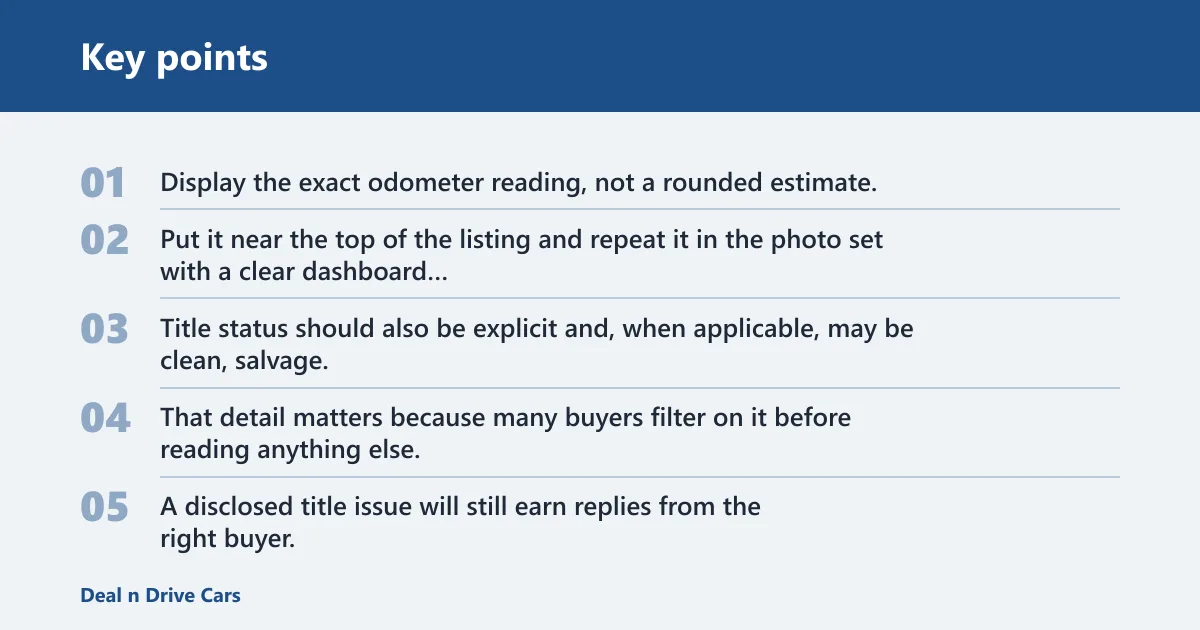
Display the exact odometer reading, not a rounded estimate. Put it near the top of the listing and repeat it in the photo set with a clear dashboard image. Title status should also be explicit and, when applicable, may be clean, salvage, rebuilt, parts only, lien, or missing title.
That detail matters because many buyers filter on it before reading anything else. If the title is not clean, say so plainly. A disclosed title issue will still earn replies from the right buyer; a hidden one usually earns none. For title definitions and buyer expectations, see Common Titles and What They Mean.
Transmission, drivetrain, and fuel
These are core filters. Manual or automatic. FWD, RWD, AWD, or 4WD. Gas, diesel, hybrid, or electric. Put them in the vehicle details field set and repeat them once in the opening lines if the listing platform does not surface those fields clearly.
A common first-timer mistake is to describe the car like a story and never list the vehicle type. Buyers who search for a specific drivetrain or transmission may never find the ad, even if the car would have fit their needs.
Service history and known defects
Maintenance records matter because they show the car has a paper trail. Recent service details help too, especially larger jobs such as a timing chain replacement, brake work, or a recent battery. If the car is a non-smoker or has been garage-kept, those are useful buyer signals only when they are true.
Known defects should be listed in plain language. Do not bury them in a sentence that sounds like a disclaimer. If the air conditioning is weak, the check engine light is on, or the paint is peeling on one panel, say it directly and in the first pass. For valuation context before you set your asking price, compare similar listings and guidebook ranges in How to Price a Used Car.
How do you handle price and contact?
State the asking price clearly, add OBO only if you are open to reasonable offers, and keep payment language simple. Use marketplace messaging or Craigslist’s email relay first, then share a phone number only after the buyer is screened. Also keep location privacy tight by using a nearby intersection or business, not a home address.
Asking price and OBO wording
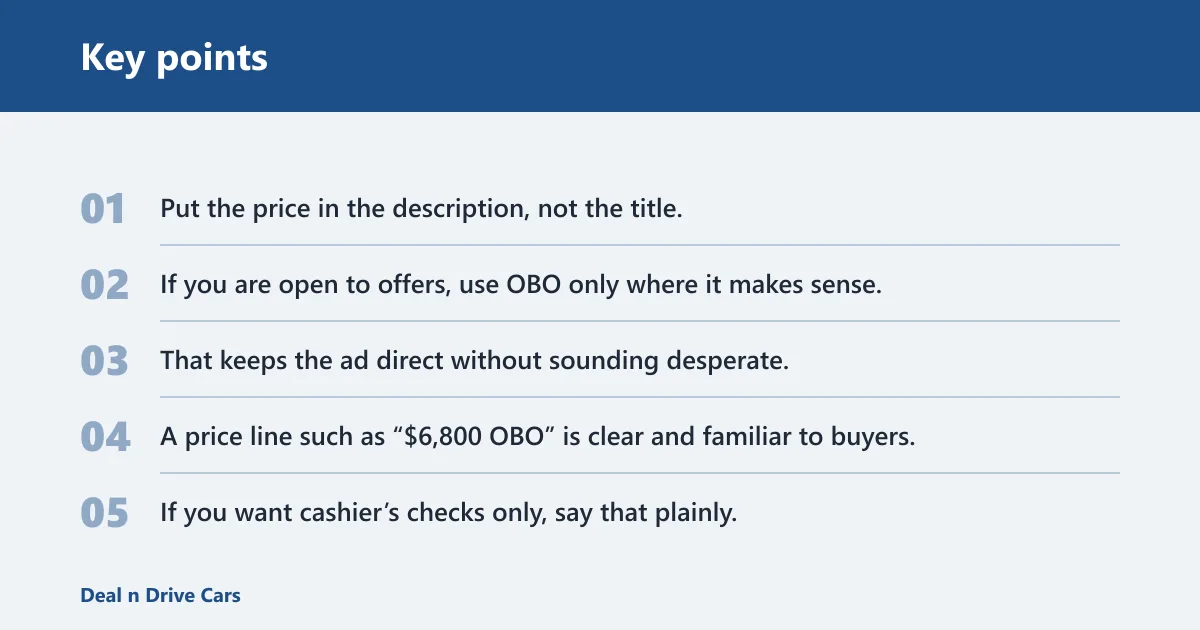
Put the price in the description, not the title. If you are open to offers, use OBO only where it makes sense. That keeps the ad direct without sounding desperate. A price line such as “$6,800 OBO” is clear and familiar to buyers.
For payment, say what you will accept. Cash is common for private sales. If you want cashier’s checks only, say that plainly. Clear payment language screens out people who are not ready to buy. The FTC’s used-car guidance also emphasizes accurate disclosures and straightforward seller communication: FTC used-car guidance.
When to share a phone number
Start with the platform’s relay or messaging system. Craigslist says email replies are anonymized through its relay, which helps protect your direct contact details early on. Share a phone number only after a buyer has asked sensible questions and shown real interest.
Use the map pin carefully. Pick a public, easy-to-find spot such as a police station parking lot, a bank lot, or a busy retail center near the buyer’s side of town. For example, a pin at a well-lit shopping center entrance tells the buyer where to meet without exposing where the car is stored. A home address can undermine trust because it signals both privacy risk and a lack of seller boundaries. For more safety screening, see Safe Meet-Up Tips for Private Car Sales and Craigslist safety tips.
How to publish and respond to leads
After you publish, watch for the confirmation step and the verification link, which expires quickly after publication. Respond fast, answer the first question directly, and keep the tone short. A prompt, factual reply often matters more than a longer listing once the buyer has clicked through.
The best first response is simple: confirm availability, restate the mileage or title status if asked, and offer the next step. If the buyer wants more photos, send only the specific angle requested. That keeps the conversation clean and avoids sounding pushy.
Frequently asked questions
How do I write a car listing that gets more replies?
Lead with the filters buyers search first: year, make, model, trim, mileage, and title status. Then give proof with service history and clear photos. Finish with a safe, simple call to message. Listings get more replies when buyers can judge fit quickly and do not need to chase basic facts.
What should I put in a private car sale description?
Include the exact mileage, title status, transmission, drivetrain, fuel type, body type, known flaws, recent service, and any trust signals such as maintenance records or non-smoker status. Keep it factual. Short paragraphs work better than a long sales pitch because they are easier to scan on a phone.
How long should a car ad be?
Long enough to answer the main buyer questions, short enough to read fast. For most private sales, a focused description of a few short paragraphs is enough. If the car has major service history or visible flaws, add detail where needed, but keep the opening tight and information dense.
What photos should I include in a car listing?
Use 10 to 12 photos. Start with front three-quarter, rear three-quarter, both sides, then show the dashboard with the odometer visible, the interior, engine bay, trunk or cargo area, and any damage shots. Put the clearest condition photos early so buyers do not have to search for them.
Should I mention flaws in my car listing?
Yes. Mentioning flaws early reduces back-and-forth and filters out buyers who would walk away anyway. List cosmetic damage, mechanical issues, warning lights, and title problems in plain language. A direct flaw disclosure usually builds more trust than a perfect-sounding ad that fails at the meet-up.
What title format works best for a used car listing?
Use year, make, model, and trim in a plain, scannable format. Add mileage or title status if it helps the search, but keep the title short. Avoid all-caps, extra punctuation, and pricing in the title. The goal is quick recognition, not a slogan.