How Much Can You Negotiate on a Used Car Price?
On many used cars, a common target is about 5% to 10% off the asking price, or roughly $1,000 to $2,500 on a typical $20,000 car. On slow-selling or overpriced used cars, about 10% to 15% off the asking price may be realistic. Push too hard and you can lose the car, or win a price cut and still overpay through fees, add-ons, or financing. This guide shows when to ask for more, when to stop, and how to judge the out-the-door total.
This guide is part of our Price negotiation for a used car: how to pay less series.
What you’ll need before you negotiate
- Recent listings for the same year, trim, mileage, and options from nearby dealers.
- A target out-the-door budget that includes dealer documentation fees, mandatory add-ons, and tax.
- Private-party and dealer trade-in estimates for your current car.
- A bank or credit-union preapproval with rate, term, and maximum amount.
- A note of any dealer add-ons already listed on the window sticker or buyer’s order.
How much can you negotiate on a used car price?
For a normal used-car listing, 5% to 10% off asking price is a fair target. If the car has sat on the lot, is priced above nearby ads, or shows age and mileage pressure, 10% to 15% can be realistic. If the number already matches market value, the better win may be a cleaner out-the-door total.
When a discount is real money
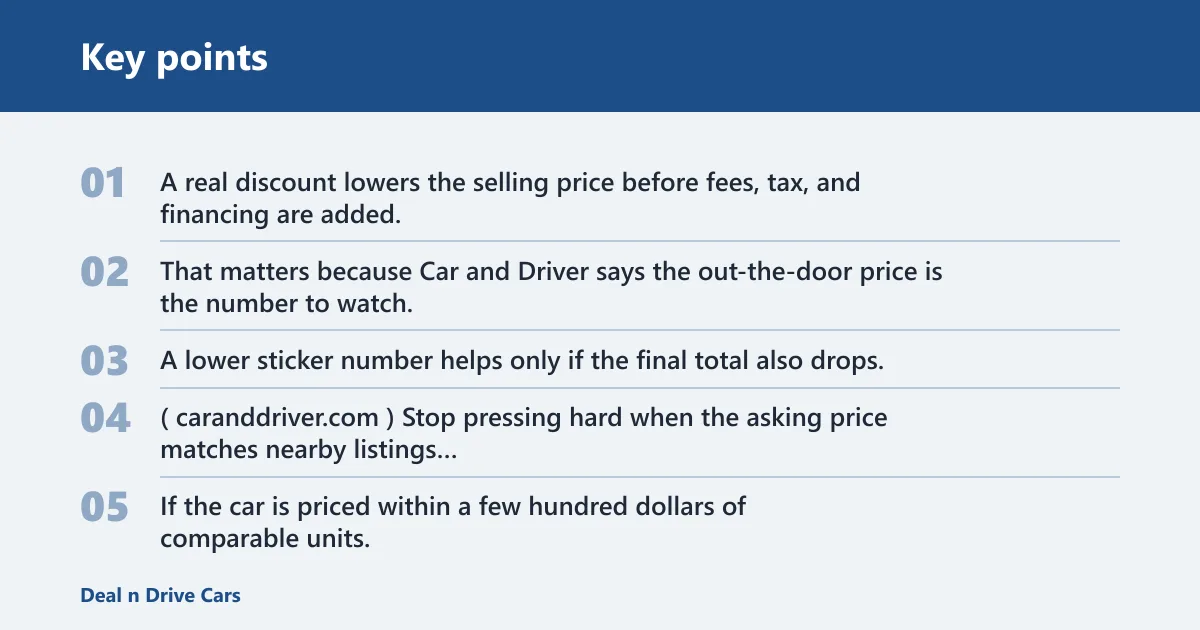
A real discount lowers the selling price before fees, tax, and financing are added. That matters because Car and Driver says the out-the-door price is the number to watch, and it should include dealer documentation fees, mandatory add-ons, and tax. A lower sticker number helps only if the final total also drops. (Caranddriver)
When to stop pushing
Stop pressing hard when the asking price matches nearby listings and the vehicle is conditionally strong. If the car is priced within a few hundred dollars of comparable units, extra pressure often brings noise, not savings. At that point, push on fees, add-ons, or financing terms instead of trying to force another large cut.
What to compare before you negotiate
Use three numbers before you make an offer: the market price, your trade-in value, and your financing terms. Car and Driver advises getting pricing from nearby dealers, and it also says many dealers make a lot of profit on in-house or automaker-backed financing. Compare those pieces before you decide what is truly negotiable.
Trade-in and financing can move the total
Check your current car’s private-party value and the dealer offer separately. A weak trade-in can erase a strong discount on the purchase side. Do the same with financing. A lower selling price may not beat a worse interest rate, especially over 60 or 72 months.
Say your trade-in is worth $14,000 in private-party listings, but the dealer starts at $12,000. That $2,000 gap may matter more than another $300 off the used car. Picture a $22,500 SUV with a strong rate from your credit union. The dealer may still win or lose on the total, not the sticker.
How do you negotiate a used car price?
Start with the out-the-door number, then separate the selling price from fees and add-ons. Ask for the best price instead of answering a salesperson’s budget question. Use nearby quotes and a lender preapproval as backup. If the dealer keeps shifting numbers across documents, slow the process and compare every line.
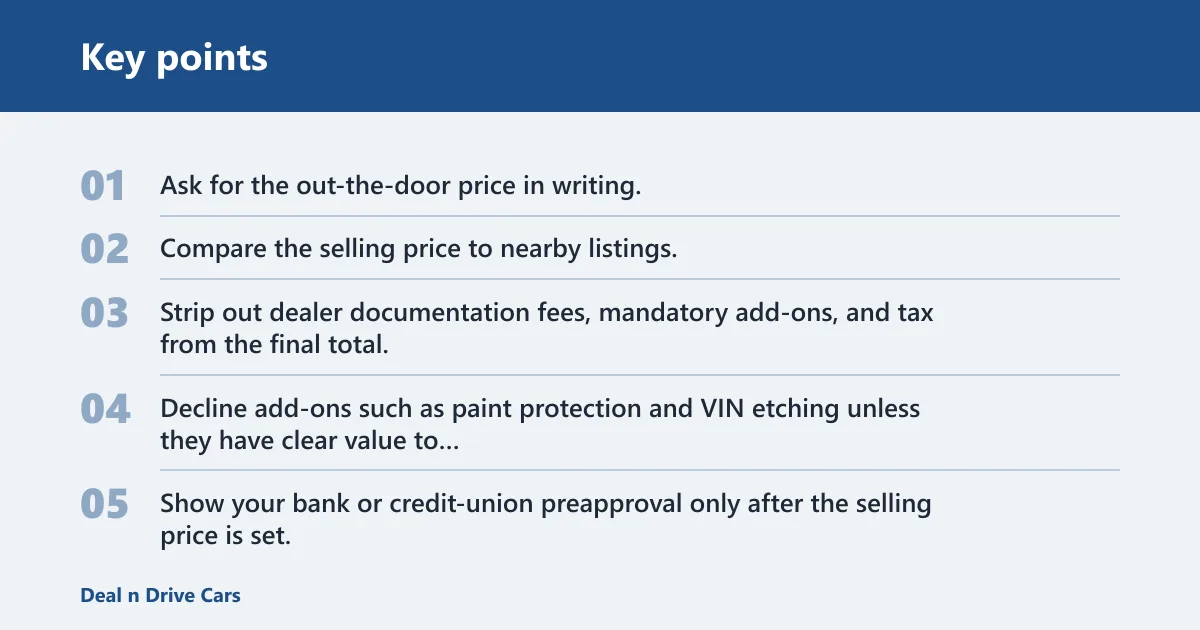
- Ask for the out-the-door price in writing.
- Compare the selling price to nearby listings.
- Strip out dealer documentation fees, mandatory add-ons, and tax from the final total.
- Decline add-ons such as paint protection and VIN etching unless they have clear value to you.
- Show your bank or credit-union preapproval only after the selling price is set.
- Increase your offer in $250 to $500 steps, then recheck the total.
Use walk-away leverage only when you mean it
Car and Driver says to be ready to walk if the deal is not acceptable, and saying no thanks can sometimes make the price change in your favor. That only works when you can actually leave. If the salesperson knows you will buy anyway, walk-away leverage has little force.
How much negotiate table

This table turns the usual question into a realistic ask. Use the selling price range first, then check whether fees or financing eat the savings. The right target depends on condition, inventory pressure, and how close the car already sits to market value.
| Scenario | Realistic ask | What justifies it | When to stop negotiating |
|---|---|---|---|
| Strong deal | 3% to 5% off asking, or about $600 to $1,000 on a $20,000 car | Listed near market, clean history, normal demand | When the out-the-door price already matches your budget |
| Average deal | 5% to 10% off asking, or about $1,000 to $2,500 on a $20,000 car | Comparable cars are priced lower, or the unit has been listed for a while | When the dealer will not move on the selling price but will remove fees or add-ons |
| Overpriced car | 10% to 15% off asking | Higher than nearby listings, stale inventory, or visible condition gaps | When the offer still sits above real market value after fees |
| Certified or prepared inventory | 3% to 7% off asking | Reconditioning, inspection, or certification has already added cost | When the prep work is documented and the total is fair |
| High-mileage car | 7% to 12% off asking | Higher wear, shorter remaining life on some components, or slower resale | When the lower price is offset by a strong service record and a fair OTD number |
| Low-inventory specialty model | 0% to 5% off asking | Hard-to-find trim, color, or drivetrain with limited local supply | When the listing is already near market and competing offers are likely |
How much can you negotiate on a used car price at a dealership?
At a dealership, the selling price is only part of the fight. The dealer documentation fee may appear as a separate line item and can be hard to change, but it still belongs in the out-the-door total. Dealer add-ons are often high-margin, so declining them can save more than squeezing the sticker by another small amount.
Fees that matter most
Car and Driver says some dealers present lots of numbers on different documents to confuse customers. Focus on the total, not the stack of line items. If the dealer will not move the documentation fee, ask whether it can be offset in the final out-the-door total.
Add-ons to refuse first
Car and Driver names paint protection and VIN etching as add-ons to resist, and it notes some add-ons are little more than ways to pad profits. Decline them unless you truly want them. If they are already included, ask for removal before discussing any further price cut.
Common mistakes
The biggest mistakes are simple. They cost real money because they shift attention away from the full deal. Fix them before you sign.
- Fixating on the monthly payment instead of the selling price and out-the-door total.
- Ignoring dealer documentation fees, mandatory add-ons, and tax.
- Forgetting to compare trade-in value before the negotiation starts.
- Letting dealer financing hide a worse rate or longer term.
- Pushing hard on a car that is already fairly priced.
- Accepting paint protection or VIN etching without a clear reason.
How much negotiate checklist
If the answer is yes to most of these, stop pressing on price and move on to the total or the next car:
- The car matches nearby listings within a few hundred dollars.
- The dealer has already removed most of the obvious add-ons.
- The trade-in offer is close to your research.
- Your financing quote is already competitive.
- The out-the-door price fits your budget without strain.
How far down can you negotiate a used car price?
Usually, not farther than the market will support. A 5% to 10% cut is common room, while 10% to 15% is more realistic for stale, overpriced, or less desirable inventory. For specialty models and strong certified units, the room may shrink to a few percent. The out-the-door total still decides whether the deal is worth it.
What a top-up step looks like
Increase your offer in $250 to $500 steps, then recheck the out-the-door price after each change. That keeps the negotiation controlled and makes it easier to see whether a lower selling price is real or just offset by fees, add-ons, or financing.
Frequently asked questions
How much can you haggle used car price?
Use the same range most shoppers can expect: about 5% to 10% on a normal deal and more only when the car is clearly overpriced. Haggling should be tied to comparable listings, condition, and inventory pressure, not to a fixed number that fits every car.
How much can you negotiate a used car price down?
Higher-mileage or stale inventory may allow more, while specialty models may allow less. If the dealer resists on selling price, try to remove add-ons or improve financing instead.
How much can you negotiate a used car price at a dealership?
At a dealership, the best result may come from a mix of selling-price reduction, fee control, and financing terms. Dealer documentation fees are often hard to move, but they still count in the final total. Ask for the out-the-door number before you judge the offer.
How much can you haggle on a used car?
Most buyers can haggle enough to make a real difference, but not enough to ignore market value. A fair expectation is a few percent on strong inventory and up to 10% or more on overpriced stock. The cleanest savings often come from removing add-ons and protecting the final total.