What Warning Signs Should Make You Walk Away After a Test Drive?
Walk away immediately if the test drive reveals brake failure, transmission slip, overheating, warning lights that stay on, or unsafe steering; get a pre-purchase inspection for milder noise, vibration, or fluid leaks. Ignoring those signs can turn a cheap used car into a repair bill, a lost deposit, or a safety risk. This guide ranks test-drive warning signs by severity and tells you when to stop, inspect, or keep negotiating.
Warning signs that mean walk away now
The most serious test-drive problems affect control, stopping distance, or the chance of a breakdown. A listing cannot show how the car pulls under acceleration, how the steering wheel stays centered on a flat road, or how much wind noise enters at highway speed, so the drive itself has to answer those questions.
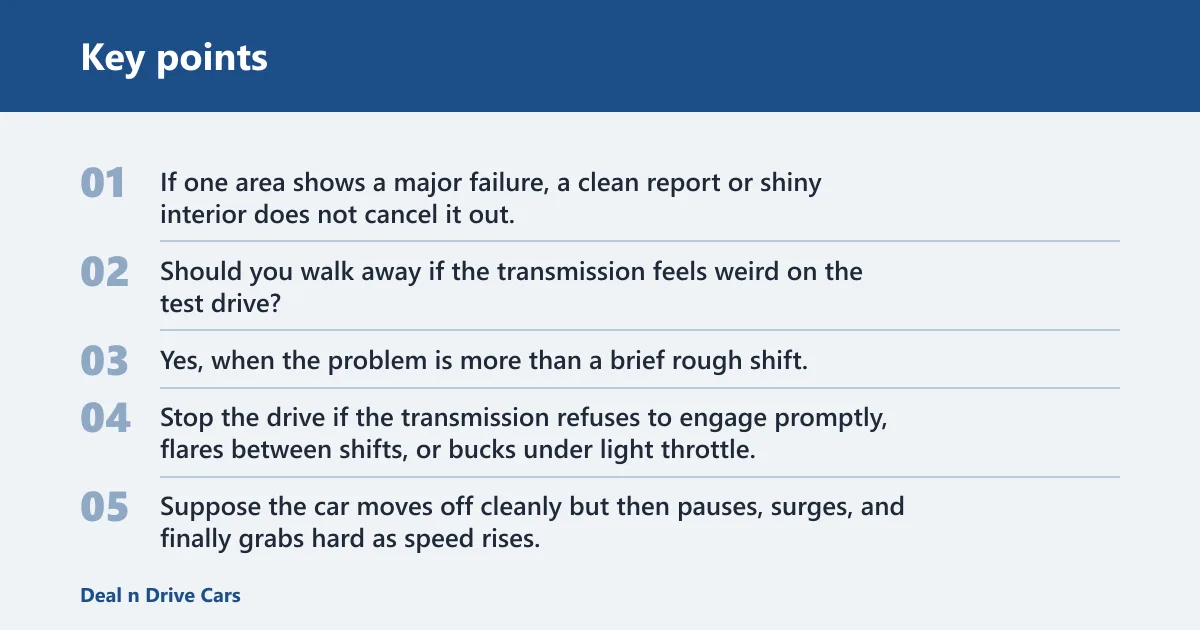
A thorough used-car test drive covers four areas: mechanical systems, structural condition, seller behavioral red flags, and legal standing. Keep that order in mind. If one area shows a major failure, a clean report or shiny interior does not cancel it out.
Transmission symptoms that should end the deal
Should you walk away if the transmission feels weird on the test drive? Yes, when the problem is more than a brief rough shift. Hesitation under acceleration, delay shifting into gear, a surging or slipping feel, and harsh or noisy engagement are all high-risk signs that can point to internal wear, low fluid, or electronic control trouble.
Stop the drive if the transmission refuses to engage promptly, flares between shifts, or bucks under light throttle. Stop-and-go traffic can reveal transmission hesitation, and a highway merge can reveal pickup and whether the engine strains. Those are useful clues because they load the drivetrain in ways a parking-lot crawl cannot.
Suppose the car moves off cleanly but then pauses, surges, and finally grabs hard as speed rises. That pattern is not a normal quirk. It belongs in the walk-away column unless the seller has recent repair records and agrees to an inspection.
Brake, steering, and cooling clues that are too serious to ignore
Brake pull during braking, a soft or spongy pedal, vibration through the pedal, and brake warning lights after startup are generally considered immediate caution signs. If the car also feels unsafe in the steering wheel, do not keep driving it just to “see if it gets better.” It will not.
A smooth residential street can reveal whether the vehicle tracks straight. If the car drifts across the lane, the steering wheel sits off-center on level pavement, or the vehicle pulls left or right without road crown explaining it, the issue may be alignment, tire mismatch, brake drag, or something larger.
Cooling problems deserve the same respect. A coolant smell, visible overheating, or rising temperature warnings can point to a failing fan, leak, or head-gasket concern. A car that smells hot and starts acting rough at the same time is a poor gamble for a daily driver.
Walk away vs Inspect vs negotiate
This decision matrix separates immediate walk-away signs from problems that merit inspection or room to negotiate. Treat it as a severity filter, not a shopping list. If more than one serious symptom appears together, move the decision up one level.
| Symptom | Likely cause | Severity | Recommended next step |
|---|---|---|---|
| Transmission hesitates under acceleration | Internal wear, low fluid, control fault | Walk away | Do not offer until a transmission specialist diagnoses it |
| Delay shifting into gear | Valve body issue, worn clutches, software fault | Walk away | Stop the drive and decline the car |
| Surging or slipping feel | Transmission slip, torque-converter trouble | Walk away | Do not assume a fluid change will solve it |
| Noise or harsh engagement | Mounts, drivetrain wear, internal transmission damage | Inspect | Schedule a pre-purchase inspection before any offer |
| Pulling during braking | Sticking caliper, uneven brake wear, tire issue | Inspect | Inspect brakes and tires before negotiating |
| Soft or spongy pedal | Air in lines, fluid leak, hydraulic fault | Walk away | Do not buy a car with uncertain stopping feel |
| Vibration or pulsation while braking | Warped rotors, suspension wear, tire issue | Negotiate | Price the repair if braking remains predictable |
| Warning lights after startup | Stored fault, failed sensor, system fault | Inspect | Read codes and verify the cause before deciding |
| Clunks and rattles over bumps | Loose suspension parts, worn bushings, mounts | Inspect | Get a suspension check and estimate repair cost |
| Uneven ride height | Broken spring, failed air suspension, crash damage | Walk away | Do not ignore a car that sits crooked |
| Musty smell or wet carpet | Flood exposure, leaks, hidden moisture | Walk away | Stop the deal and look for flood clues elsewhere |
| Fresh seam sealer or undercoating in odd places | Body repair, rust cover-up, possible structural repair | Walk away | Inspect only if a body shop can verify the repair |
| Seller rushes the decision | Pressure tactic, possible known defect | Walk away | Leave if the seller will not slow down |
| Seller discourages inspection | Hidden defect, refusal to support due diligence | Walk away | Do not sign until an independent inspection is allowed |
A clean vehicle history report can show title events, mileage records, and ownership changes, but it cannot erase a bad drive. If the car slips, smells like coolant, or pulls hard under braking, the report is supporting paperwork, not a rescue plan.
What warning lights should stop a purchase?
What warning lights mean I should not buy the car? Any light that stays on after startup, returns during the drive, or points to brake, engine, or stability problems deserves serious caution. A brief self-check is normal; a light that does not clear or that comes back under load is not something to shrug off.
Pay attention to indicator behavior after ignition. Many systems flash for a bulb check, then go dark. If the check-engine light, ABS light, airbag light, or traction-control alert remains lit, the car may have a fault that affects safety or emissions compliance. That is inspection territory at minimum.
Lights that stay on after startup
Lights that remain on after the engine settles are a sign that the car is reporting a problem, not just reminding the driver of a maintenance item. A check-engine light can mean anything from a loose gas cap to a misfire; an ABS light points to braking-system concern, which matters more on a used car you have not yet trusted.
One warning light is not always a dead stop, but a warning light plus rough shifting, hard starts, or odd braking is a strong reason to walk away. The more systems that complain at once, the more likely the issue is expensive or unresolved.
Lights that return during the drive
If a light clears and then returns under acceleration, braking, or highway speed, that often suggests the fault is still active. That matters because a stored code can be old, while a returning light shows the problem is still happening now. A clean history report does not overrule that road test result.
Dealers sometimes suggest that an old code “was probably fixed.” Do not accept that without proof. Ask for documentation, an independent scan, and a repair invoice. If the seller cannot supply those, treat the symptom as live.
Should you walk away from a car that pulls or shakes?
Is it a bad sign if the car pulls to one side during a test drive? Yes, unless road crown or lane slope clearly explains it. A steady pull, a crooked steering wheel on level pavement, or a car that drifts under light throttle can mean alignment trouble, tire issues, brake drag, or body damage.
Shaking is different from pulling, but it can be just as serious. Vibration that grows with speed, bounce that continues after a bump, or clunks from the corners can point to suspension wear or wheel problems. If the car feels unstable, the test drive has already done its job.
Brake pull versus alignment pull
Brake pull appears when the pedal is pressed. Alignment pull shows up while cruising on a level road with your hands relaxed. That distinction matters because a brake issue can affect stopping distance, while alignment issues can be cheaper but still reveal accident damage, bent parts, or worn components.
If the car pulls only when braking, inspect the brakes. If it pulls all the time and the steering wheel sits off-center, look harder at alignment, tires, and possible structural damage. A crooked wheel after a straight road is not a cosmetic annoyance. It is evidence.
Vibration, bounce, and suspension clues
Suspension clues include clunks and rattles, uneven ride height, squeaks over bumps, and excessive bounce after a dip or speed bump. These signs often come from worn bushings, struts, shocks, or broken springs. They are worth inspection, but the severity depends on whether the car still feels predictable.
If the car sits lower on one corner, bounces more than once after a bump, or bangs over small road imperfections, that is more than a comfort issue. A daily driver should not feel loose, lazy, or crooked. A project car buyer may accept it, but only with a repair budget and a known reason.
When steering feel points to a bigger issue
Steering that wanders, resists turning, or feels loose in the center can point to worn suspension parts, alignment faults, or steering-system wear. If the wheel is off-center on a flat road and the car still moves straight, the issue may be simpler. If it does not track straight, do not dismiss it.
A common first-timer mistake is to accept “it just needs alignment” as the full answer. Sometimes that is true. Sometimes it hides tire damage, bent suspension parts, or a past impact that also left fresh seam sealer or strange panel gaps elsewhere on the car.
Signs of body damage, frame issues, or flood damage
Structural damage clues are often visible before they are explainable. Uneven panel gaps, sticky doors, rippled roof rails, and fresh seam sealer or undercoating can mean repairs, corrosion cover-up, or more serious body work. Flood clues and frame clues can overlap, and either one can turn a bargain into a mistake.
These signs matter even if the car drives reasonably well. A vehicle can mask body damage at low speed and still have alignment, corrosion, or electrical trouble that appears later. The road test should not be treated as proof of structural health.
Uneven gaps, sticky doors, and fresh undercoating
Uneven door gaps, doors that catch or need a hard pull, and a hood or hatch that sits slightly twisted can suggest collision repair or frame movement. Fresh seam sealer in odd places, undercoating sprayed over patches, or rippled roof pillars deserve close attention because they may be hiding repaired metal.
Frame damage clues include uneven door gaps and rippled roof pillars. If those signs appear together, the safest move is to walk away or send the car to a body shop that can verify what happened. A clean listing photo is no match for a crooked opening or a roof rail that looks wavy in daylight.
Musty odor, wet carpet, and waterline residue
Should you walk away if the car smells like water or mildew? Often yes, if the odor is persistent or paired with damp carpet, foggy lenses, or waterline residue under trim. Flood damage can hide under fresh cleaning, and hidden electrical issues often appear after the seller is long gone.
Look for moisture under floor mats, in the spare-tire well, and near seat rails. Musty smell, wet carpet, lingering moisture, and residue lines are all stronger than a vague odor from old upholstery. If several flood clues appear together, the car is not worth the risk.
Picture a sedan with clean paint, a smooth idle, and a damp smell that gets stronger with the fan on. If the carpet feels slightly wet near the rear footwell and the power windows hesitate, that is enough to stop the test drive. Flood issues often start with small, quiet clues.
Why on-road symptoms matter more than a clean listing
A clean vehicle history report can show title events, mileage records, and ownership changes, but it will not catch every flood car or every repair hidden by cosmetics. If the road test and your senses point to damage, trust the symptoms first. The report is useful, but it is not a shield.
That matters most when one problem looks minor and one problem looks major. A small vibration may be negotiable. A musty cabin or uneven body structure is not. Rank the findings by severity, then let the worst one decide.
What seller behavior is a red flag?
What seller behavior is a red flag during a used car test drive? Pressure, evasiveness, and limits on inspection time are warning signs on their own. A seller who rushes the decision, discourages inspection, will not allow enough drive time, or pushes immediate signing is making the process harder for a reason.
Private-seller risk and dealer risk are not identical. A dealer should usually be able to arrange a reasonable inspection path and a longer drive route. A private seller may be less formal, but that does not lower the need for time, access, and clear answers.
Rush tactics and pressure to sign
If the seller keeps saying another buyer is waiting, or pushes you to leave a deposit before you finish the drive, walk away. Pressure tactics are especially suspicious when paired with mechanical complaints, warning lights, or a refusal to answer direct questions about repairs.
Do not let urgency replace evidence. A car that is sound today will still be sound after a proper inspection. If the seller cannot tolerate that pace, the deal is already unstable.
Refusal to allow enough drive time
A planned test-drive route should last at least 20–30 minutes. That gives you enough time to include city traffic, a steady road, and a highway stretch. It also gives transmission, brake, cooling, and steering systems time to show behavior that a quick block loop would miss.
If the seller limits the drive to a short circle, will not let you reach highway speed, or insists on staying in the car the whole time, treat that as a problem. A legitimate seller should welcome a route that exposes faults before money changes hands.
When a seller blocks inspection or questions
If the seller discourages an independent inspection, delays answers about repairs, or refuses basic documents, the safest decision is often to leave. Hidden problems are more likely when the seller blocks normal buyer checks. That is true whether the car is at a dealership or in a driveway.
Take notes on every refusal. Record what was denied, what was said, and when the pressure started. Those notes help you compare vehicles later and keep the decision tied to facts instead of sales talk.
How to judge a test drive before you make an offer
The question is not whether the car felt perfect. It is whether the problems fit the role you need it to play. A daily driver should be predictable, safe, and free of major faults. A project car can tolerate more, but only when the defects are known, priced in, and not safety-related.
Use the drive, the history report, and your own use case together. If the car will be a commute car, brake issues, transmission slip, flood clues, or structure concerns are deal-breakers. If it is a project, some noise or vibration may be acceptable after inspection and a repair estimate.
- Compare road feel to the listing. Check whether the car accelerates cleanly, tracks straight, and stops without pull. A listing cannot show those traits, so the drive is the proof.
- Match symptoms to severity. Put transmission slip, brake failure, flood odor, and steering instability in the walk-away column. Put mild vibration, worn tires, and isolated noises in the inspect or negotiate column.
- Check the report against the drive. Use the vehicle history report for title events, mileage records, and ownership changes. If the report looks clean but the car feels wrong, trust the road test.
- Decide based on use. A daily driver needs a much stricter standard than a project car. If the car cannot safely handle your normal commute, do not rationalize it.
- Write down the result. Record the symptoms, where they appeared, and how severe they felt. Notes make it easier to compare cars and harder to talk yourself into a bad purchase.
Say your test drive is only 15 minutes and the car already shows a steering wheel off-center plus a brake pull. That is enough to stop, even before a longer route would have exposed more. The short drive has already revealed a major issue.
Suppose the car has a clean history report, but the cabin smells musty and the ABS light stays on after startup. Do not let the report override the road signs. The smell and the light are live warnings, while the report only tells part of the story.
Frequently asked questions
What warning signs should make me walk away after a test drive?
Walk away for brake failure, transmission slip, unsafe steering, overheating, flood odor, or structural clues like uneven gaps and fresh seam sealer. These are not minor repair items. If the car feels unsafe or smells like hidden damage, the test drive has already given you the answer.
What are the biggest red flags on a used car test drive?
The biggest red flags are symptoms that affect control or reliability: delayed shifting, brake pull, spongy pedal feel, warning lights that stay on, and a car that pulls or shakes in ways the seller cannot explain. Add seller pressure and inspection resistance to that list.
Should I walk away if the transmission feels weird on the test drive?
Yes, if you feel hesitation under acceleration, delay shifting into gear, surging, slipping, or harsh engagement. Those symptoms can point to costly internal problems. Minor roughness may justify an inspection, but a transmission that behaves unpredictably is a strong reason to leave.
What warning lights mean I should not buy the car?
A light that stays on after startup or returns during the drive deserves caution, especially for the check-engine light, ABS light, airbag light, or traction-control alerts. A brief bulb check is normal. A light that remains or comes back under load needs diagnosis before any offer.
Is it a bad sign if the car pulls to one side during a test drive?
Yes, unless the road crown clearly explains it. Pulling during braking points to brakes, while drifting during a straight cruise points more toward alignment, tire mismatch, or suspension wear. If the steering wheel is off-center on a level road, treat it as a real warning.
Can a car pass a test drive and still have hidden damage?
Yes. A car can feel acceptable for 20 minutes and still have flood damage, frame repair, or electrical trouble hidden by cosmetics. That is why a clean history report does not override bad on-road clues. If the car smells wrong or drives wrong, assume more checking is needed.