What Route Should You Take on a Used Car Test Drive?
Take a 30- to 60-minute route with four parts: stop-and-go city streets, a highway stretch, rough pavement, and a parking lot or tight-turn section. A poor route can hide transmission, brake, steering, and visibility problems until after you buy. This guide shows how to plan the drive, what each segment reveals, and what red flags to watch for.
Use your own route to expose faults a dealer loop hides
Plan a route that matches your daily driving, then add the surfaces and speeds most likely to expose faults. A dealer’s loop may be too short, too smooth, or too familiar to reveal a pull, vibration, brake shake, or noise that shows up only on rougher roads or at highway speed.
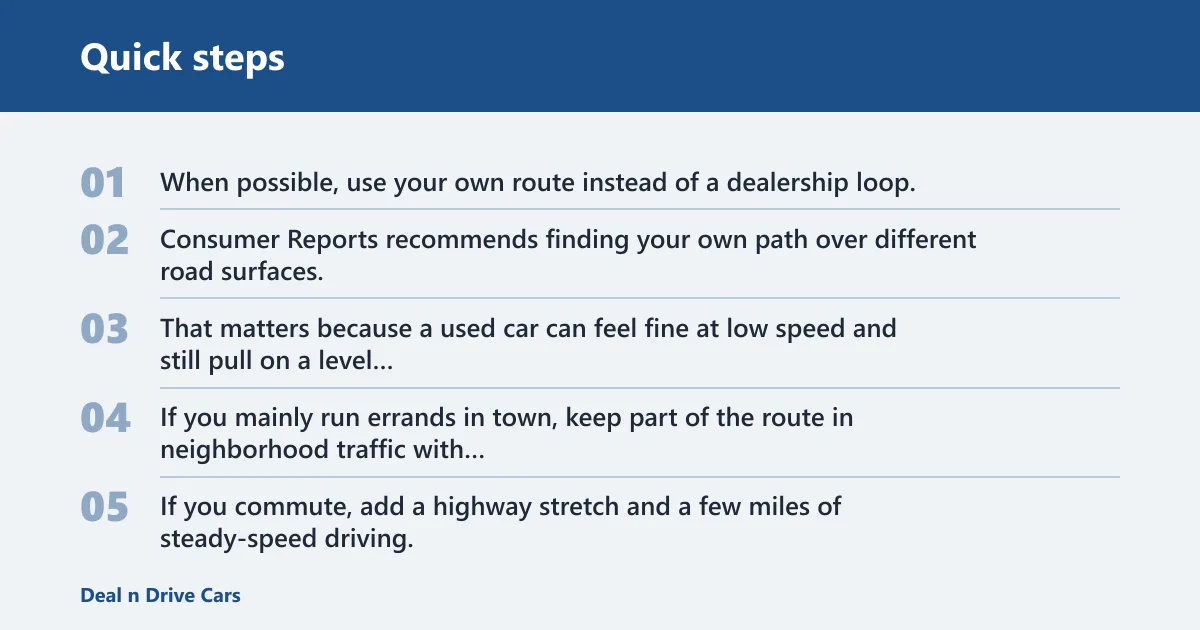
When possible, use your own route instead of a dealership loop. Consumer Reports recommends finding your own path over different road surfaces, and the route should include both city and highway conditions. That matters because a used car can feel fine at low speed and still pull on a level road, wander on the highway, or shake when braking.
Match the route to your daily driving
If you mainly run errands in town, keep part of the route in neighborhood traffic with several stops, turns, and parking maneuvers. If you commute, add a highway stretch and a few miles of steady-speed driving. If the car is older, has higher mileage, or already shows warning signs, plan the longer route and use every segment you can safely fit in.
Suppose your weekday drive includes a school drop-off, a busy arterial, and a freeway on-ramp. Your test route should mirror that mix. A short, quiet loop around the dealership lot will not tell you much about braking feel in traffic or whether the car drifts when the wheel is held straight on a level road.
Why your own route beats a dealer loop
A dealership route is often convenient, but convenience is the problem. It may avoid rough pavement, steep turns, abrupt stops, and highway merging. It may also route you through streets the dealer already knows well, which can make a car seem smoother than it will seem on your daily route.
If the dealer offers only a very short loop, treat that as a quick screen, not a final answer. A route that never gets past neighborhood speeds is too easy. It can hide steering-wheel vibration, transmission hesitation, wind noise, and the brake behavior you only notice when the car reaches true road speed.
When a dealership route is enough
A dealership route can still help if the car is clearly wrong in the first few minutes, such as when the wheel sits off-center, the brakes grind, or the suspension bangs over small bumps. It is also useful for a first look at a private-seller car, where you may not want to commit to a long drive before the basics check out.
Still, if the route stays on slow streets the whole time, it may not be enough for a final decision. The strongest route is one you control. That lets you choose the roads most likely to reveal noise, pull, vibration, comfort problems, and control issues before money changes hands.
How long should the test drive be?
A used-car test drive should last at least 30 minutes. About 30 to 45 minutes is a better target when traffic allows, and a longer drive may be better if you need city roads, rough pavement, and a highway stretch in the same drive. Shorter than that, and too many faults stay hidden. (Consumerreports)
Why 30 minutes is the minimum
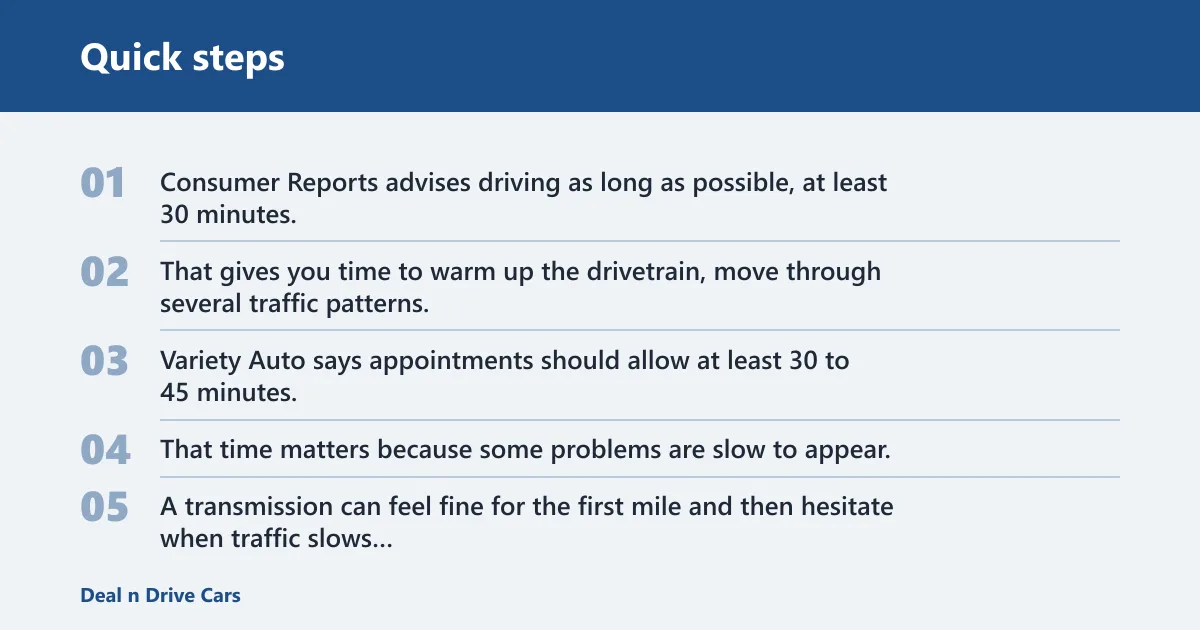
Consumer Reports advises driving as long as possible, at least 30 minutes. That gives you time to warm up the drivetrain, move through several traffic patterns, and check how the car behaves after the first few turns and stops. Variety Auto says appointments should allow at least 30 to 45 minutes.
That time matters because some problems are slow to appear. A transmission can feel fine for the first mile and then hesitate when traffic slows again. A brake pedal can feel normal at first and then pulse or grow soft after a few firmer stops. A short lap around the block may never reveal those changes.
When 30 to 45 minutes is better
Use the longer end of that range if the vehicle is a long commute candidate, has higher mileage, or comes with a history that deserves caution. It is also the better choice when you need to test electronics, climate controls, parking-lot maneuvering, highway speed, and a few stops under real traffic conditions.
Back-to-back appointments help compare vehicles more easily, so a little extra time can matter even more if you are shopping several cars in one day. A friend can help keep you focused during the drive, which is useful when you are moving between appointments and do not want to miss a sound or feel.
When to walk away from a too-short route
If the seller or dealer will only allow a very short, smooth loop, treat the result as incomplete. Do not confuse a polite drive with a proper evaluation. A route is too short or too easy to trust when it leaves out highway speed, stops, turns, and at least one rough-surface segment.
A common first-timer mistake is accepting a five-minute loop because the car feels fine on calm streets. That route may still miss a brake shimmy, a steering pull, or a suspension clunk that appears only after the vehicle has settled into normal road speed and hit a few bumps.
Used-car route blueprint

Use the route that fits your time and the car’s risk level. The table below gives three practical templates: a short urban route, a mixed daily commute route, and a more complete evaluation route. Each one mirrors real use and adds the surfaces most likely to expose hidden problems.
| Route template | Route segments | What each segment reveals | Approximate minutes |
|---|---|---|---|
| Short urban route | Dealer lot checks, neighborhood streets, a few stop signs, one or two turns, parking-lot maneuvering, one rough patch or speed bump | Basic steering feel, visibility, brake response at low speed, seat comfort, mirror adjustment, obvious suspension noise | 15-20 |
| Mixed daily commute | Dealer lot checks, stop-and-go city streets, smooth pavement, speed bumps, rutted parking lot, short highway stretch, exit ramp, several braking events | Alignment pull, drifting on a level road, steering-wheel vibration, road noise, wind noise, brake shake, transmission behavior in traffic | 30-45 |
| Comprehensive evaluation | Dealer lot checks, city streets, stop-and-go traffic, repeated left and right turns, full-turn parking-lot maneuver, rough pavement, speed bumps, rutted lot, highway speed, passing lane, abrupt but safe stop | Suspension clunks and rattles, tire wear clues, braking vibration, mushy pedal feel, steering stability, cabin noise, seat and climate usability, electronics at speed | 45-60+ |
Short urban route
Use this when time is tight or the car is a low-risk candidate. Keep the route local, but do not skip the parking-lot checks and one rough-surface pass. Even a short route can reveal an off-center wheel, a squeak over a bump, or a seat that cannot be set comfortably.
This route is best for a first pass. It is not enough for a final yes if the car feels vague, noisy, or uneven.
Mixed daily commute route
This is the best all-purpose choice for most shoppers. It includes the road types that matter most when time is short: city streets, stop-and-go traffic, one rough-surface segment, and a highway stretch. That mix catches the most common faults without forcing a long detour.
If you only have one route, make it this one. It gives you the best balance of speed, noise, braking, and comfort checks.
Comprehensive evaluation route
Choose this for a higher-mileage car, an older car, or any vehicle that already has signs of trouble. Add more turns, more lane changes, more braking, and more time at speed. A full-turn test in the parking lot can also help expose steering noise or binding before you reach public roads.
Say your route includes a freeway on-ramp, a rough lot behind the store, and a few block-long city streets. If the car shudders while braking off the highway or clunks during a full lock turn, that is not a minor detail. It is a sign to slow down and dig deeper before buying.
What roads should you include on a test drive?
Include city streets, a highway stretch, stop-and-go traffic, smooth pavement, and at least one rough-surface section such as speed bumps or a rutted parking lot. The order matters less than the mix. The goal is to make the car work in the same ways your daily driving will make it work.
City streets and stop-and-go traffic
City driving reveals low-speed steering feel, brake smoothness, and transmission behavior when the car is constantly starting and stopping. It also shows whether the car feels bulky in traffic or hard to place in a lane. That matters for parking, merging, school runs, and errands.
MasterCars says a useful route should include neighborhood speeds, stop-and-go traffic, turns, braking, and a brief stretch at higher speed. Those pieces belong early in the drive because they quickly show whether the car feels calm or loose before you spend more time on it.
Highway speed and passing lanes
Highway driving is appropriate on a test drive when it is safe and legal. It can expose vibration, steering instability, road noise, wind noise, and transmission behavior that slow streets hide. A car that feels fine at 25 mph may drift, shake, or drone at 65 mph.
Cavender Auto recommends testing in stages from parking lot speed to highway speed. That staged approach helps you notice whether the car stays settled as speed rises. A brief merge, a steady cruise, and one safe lane change can tell you a lot more than a short loop near the lot.
Speed bumps, rutted lots, and rough pavement
The same source suggests using speed bumps or a rutted parking lot, and iSeeCars recommends testing over moderate bumps such as speed bumps or small potholes. These surfaces are useful because they reveal suspension issues that smooth roads can hide. Listen for clunks, rattles, squeaks, and body noises.
Do not treat rough pavement as optional. It is one of the best ways to find weak struts, loose trim, worn bushings, or a suspension that settles with a thud instead of a clean, controlled motion. If the car bangs over small bumps, that is meaningful.
What should you listen and feel for?
Listen for noises and feel for changes in the steering, brakes, and suspension. A used car can sound fine in one part of the route and reveal a fault in another. Pay attention to where the symptom appears, because that often points to the system that needs a closer look.
Alignment and steering clues
On a level road, the car should track straight with the wheel centered. If it pulls to one side or drifts on a level road, alignment may be off, tire wear may be uneven, or a suspension part may be worn. Steering-wheel vibration can also point to tire or alignment trouble.
Turn left and right several times. The wheel should feel consistent in both directions. A full-turn maneuver in a parking lot can reveal tight spots, odd noises, or a steering system that does not return cleanly after the turn.
Brake behavior and pedal feel
Test the brakes before entering public streets if the route begins in a lot. The pedal should feel firm and predictable, not mushy. During the drive, listen for grinding or squeaking, and watch for vibration under braking. An abrupt stop should feel controlled, not jerky or unstable.
If the pedal pulses or the steering wheel shudders during braking, treat that as a serious clue. It may point to warped rotors, brake wear, or another issue that deserves a closer inspection before any deal is final.
Suspension noises and vibration
Drive over bumps and potholes at a safe pace. Clunks and rattles usually point to suspension wear, loose parts, or trim problems that were easy to miss on smooth streets. A car that thumps or bangs over moderate bumps is giving you useful information.
Use this section of the route to judge ride comfort as well. If the cabin feels busy, if the body keeps wobbling after a bump, or if the car sends too much road texture into the seat and wheel, those are comfort and suspension concerns, not minor annoyances.
What should you check before pulling out?
Before the car moves, set the seat, mirrors, steering wheel, and climate controls. Check for warning lights and obvious fluid leaks, then confirm that basic controls work. This is the moment to make sure the car fits you and the controls behave normally before the road test begins.
Seats, mirrors, and driving position
Adjust the seat so you can reach the pedals comfortably and see the road clearly. Set the mirrors before you leave the lot. If the wheel blocks the gauges, or the seat cannot move far enough for a relaxed driving position, that is a real usability issue.
Visibility matters on a used car route because some cars feel fine in motion but are awkward to place in traffic or to park. Check blind spots, rearview visibility, and how easily you can reach the turn signals, wipers, and other basic controls.
Bluetooth, cable connection, Android Auto, and Apple CarPlay
Test the phone connection before you leave if tech matters to you. Check Bluetooth pairing, a cable connection, Android Auto, and Apple CarPlay as applicable. If a basic phone setup fails in the lot, it is better to know that before you buy.
Also confirm that the audio and display controls are easy to use without taking your eyes off the road for long. A route can expose whether the interface is distracting, slow, or hard to navigate while driving.
Climate controls and warning lights
Start the car and check that the climate controls respond as expected. Make sure the warning lights are limited to what you already know about, and note anything unexpected. A light that stays on or a control that fails to respond should not be ignored because the drive feels good.
If the cabin will not cool, warm, or clear windows properly, that affects comfort and safety. Use the first minutes on site to catch those issues, not after a long route.
Should you bring a friend on a test drive?
A friend is helpful, but not required. A second person can help keep you focused, watch for warning lights, and listen for noises while you drive. That is especially useful on a longer route where the car may reveal issues only after several miles.
How a second person helps
A friend can handle the notes while you keep both hands on the wheel. They can also spot changes you might miss, such as a warning light that appears late, a trim piece that rattles, or a brake sound that is easier to hear from the passenger seat.
This is most useful on back-to-back appointments, where fatigue and comparison shopping can blur the details. A second set of eyes helps you remember which car had the pull, which one had the noise, and which one felt stable under braking.
When going alone is fine
Going alone is fine for a basic screening drive, especially if the car already looks promising and you have a short list of things to check. It is also acceptable when the seller is private and the route needs to stay simple for safety and comfort reasons.
If you drive alone, take notes right after the drive while the details are still fresh. Record where the symptom happened: city street, highway, bump, parking lot, or braking event. That location is often the most useful clue.
Frequently asked questions
What route should you take on a used car test drive?
Take a route that includes city streets, stop-and-go traffic, a highway stretch, and at least one rough-surface section such as speed bumps or a rutted lot. If possible, build your own route instead of relying on a dealer loop. That gives you a better chance of finding pull, vibration, brake issues, and noise.
Should you plan your own test drive route?
Yes, when you can. A dealership route may be too short, too smooth, or too familiar to reveal real problems. Your own route can match your daily driving and add the surfaces most likely to expose alignment trouble, brake shake, suspension clunks, or comfort problems.
How long should a used car test drive be?
A used-car test drive should last at least 30 minutes. Thirty to 45 minutes is better when traffic allows, and longer is ideal if you need to combine city driving, rough pavement, and highway speed. A very short route is not enough to trust the result.
Can you test drive a used car on the highway?
Yes. Highway driving is useful because it can expose steering instability, vibration, wind noise, and transmission behavior that slower roads hide. Keep it legal and safe, and add it to the route if you want a more complete view of how the car behaves at real cruising speed.
Should you drive over bumps during a test drive?
Yes, with care. Speed bumps, small potholes, and a rutted parking lot can reveal suspension issues, rattles, and clunks that smooth roads will not show. Do not hammer the car over rough pavement, but do use moderate bumps to see how it settles and whether anything sounds loose.