How to Get a Pre Purchase Inspection for an Out-of-state Car
Arrange a third-party inspection within about 24 to 48 hours of agreeing on terms, and do not send payment until the written report and photos are received. A rushed remote deal can hide frame damage, title issues, flood clues, or repair costs that erase the savings. Use the report to buy, renegotiate, or walk away.
What you’ll need
- The vehicle identification number and the exact location of the car
- The seller’s full name, phone number, and preferred contact method
- A vehicle history report tied to the VIN
- The title status, including whether any money is still owing on the car
- Access instructions for a shop bay, driveway, gated lot, or apartment parking area
- Payment details for the inspector, if payment is due before release of the report
- The seller’s availability for a cold start and road test
- Any service records, key count, and second-key details
How to get a pre purchase inspection for an out-of-state car
A pre-purchase inspection checks a used car before you buy it, and a qualified mechanic or technician performs it before money changes hands. For an out-of-state buyer, the process is remote coordination: confirm the vehicle, book a local inspector, get the report delivered digitally, and use that report before you travel or send payment.
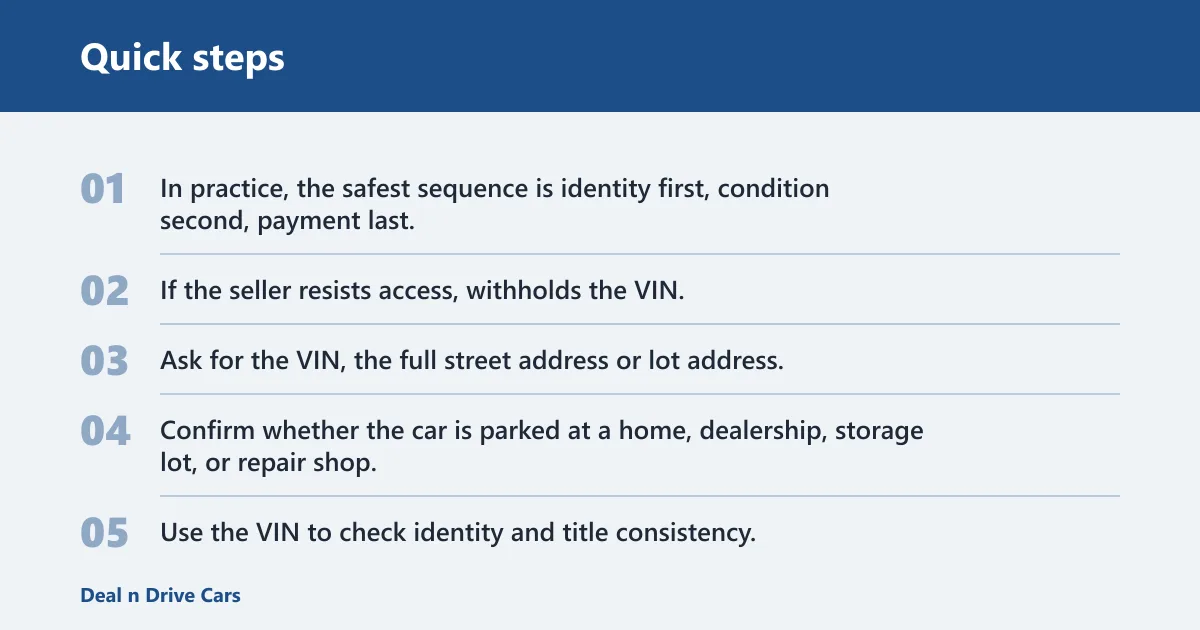
In practice, the safest sequence is identity first, condition second, payment last. If the seller resists access, withholds the VIN, or pushes for a deposit before the report, treat that as a warning sign rather than a scheduling problem.
Start with the VIN and the seller’s exact location
Ask for the VIN, the full street address or lot address, and the best time window for access. Confirm whether the car is parked at a home, dealership, storage lot, or repair shop, because some inspectors will not enter certain locations without advance permission. Use the VIN to check identity and title consistency, then cross-check recall and branding signals through NHTSA tools and NICB VINCheck guidance before you book.
Book a local mobile inspector or shop
A mobile inspector travels to the vehicle location, can coordinate directly with the seller, and sends a digital report with photos and findings. A local shop works too if the seller will drive or tow it there. Ask for the exact scope, turnaround time, and any charge for long-distance travel before you confirm, because the total price can change with access and distance.
Check what the inspection must include
At minimum, the report should cover mechanical, cosmetic, structural, fluid, paperwork, and road-test checks when possible. For an out-of-state buy, add VIN validation, underbody photos, paint depth readings, and a clear statement on whether the car should be driven, shipped, or left alone. If the car has flood or salvage history, the report should note waterlines, corrosion, electrical oddities, and any signs of incomplete repairs.
What to ask the seller before the inspector arrives
Ask whether the inspector can meet the car where it is, whether the seller will allow a cold start and road test, and whether the title, keys, and service records are ready. If the seller will not answer these basics, treat that as a risk signal before you pay for the inspection. If access is still vague after one follow-up, stop the deal rather than chase it.
- Can the inspector meet the car at its current location?
- Will the seller allow a cold start and road test?
- Are the keys, title documents, and service records available?
- Is there any money still owing on the car?
- Is there a second set of keys?
Suppose the seller says the car “runs fine” but will not let anyone see a cold start. That can hide warning lights, rough idle, or hard-start behavior that a parked walkaround will miss. If the bonnet is warm when it should be cool, delay the inspection or reschedule for a true cold start. If the seller refuses twice, walk away.
Remote inspection steps
Use a fixed sequence so you do not miss title problems, transport timing, or a failed inspection. The goal is to verify identity first, confirm condition second, and decide whether to travel or pay only after you have the report in hand. If transport is already booked, the inspection still comes first; shipping a problem car is usually the most expensive mistake.
- Verify the VIN and paperwork match the body tags and title.
- Review the vehicle history report before inspection day.
- Schedule access, payment, and timing with the seller.
- Ask the inspector to check the body, undercarriage, fluids, brakes, tires, and lights.
- Request road-test notes if the seller allows driving.
- Review photos, notes, and the final report before you commit.
- Decide whether to buy, renegotiate, delay transport, or walk away.
History report first, inspection second
Should you still get a vehicle history report if you’re buying out of state? Yes. A VIN-based report can flag accidents, open recalls, previous owners, and service history, but it does not replace an inspection. It gives the inspector context and helps you spot title or odometer conflicts early. If the report shows salvage branding, flood branding, or a title transfer pattern that looks unusual, ask for stronger documentation before you move forward.
Road test and fluid checks
A road test matters because it can reveal engine, transmission, steering, brake, and noise issues that are not visible while parked. Fluid checks can catch leaks, contamination, or low levels that point to maintenance gaps. If the seller limits driving, treat that limitation as part of the risk. A refusal to road test is usually a walk-away signal unless the car is sold strictly as a non-running project.
What the report should include
A strong report should show damage, wear, rust, warning lights, paint readings, VIN validation, leak notes, and road-test results. For EVs, battery health needs separate attention because it affects range and value. For classics, rust and prior repairs matter more than cosmetic shine. For flood or salvage candidates, look for water residue, fogging, corrosion inside connectors, unusual odor, and inconsistent interior wear.
| Report item | What you should see | Why it matters |
|---|---|---|
| Photos | Body panels, tires, underside, warning lights, interior wear | Lets you verify what the inspector saw |
| Paint depth readings | Readings across panels with notes on mismatches | Helps identify repaint or bodywork |
| VIN validation | VIN on paperwork, dash, door tag, and body labels | Helps catch identity or title mismatches |
| Fluid checks | Oil, coolant, brake fluid, transmission fluid, and leak notes | Shows maintenance condition and active leaks |
| Road-test notes | Engine, transmission, steering, brakes, and noise behavior | Finds symptoms that do not appear stationary |
| Battery health | State of health or charging-related notes for EVs | Directly affects range and purchase value |
A common first-timer mistake is treating photos as the whole report. Photos help, but notes on rust thickness, fluid leaks, and road-test behavior are what tell you whether the car is worth a flight or a transporter booking.
Pre purchase inspection inspection decision table
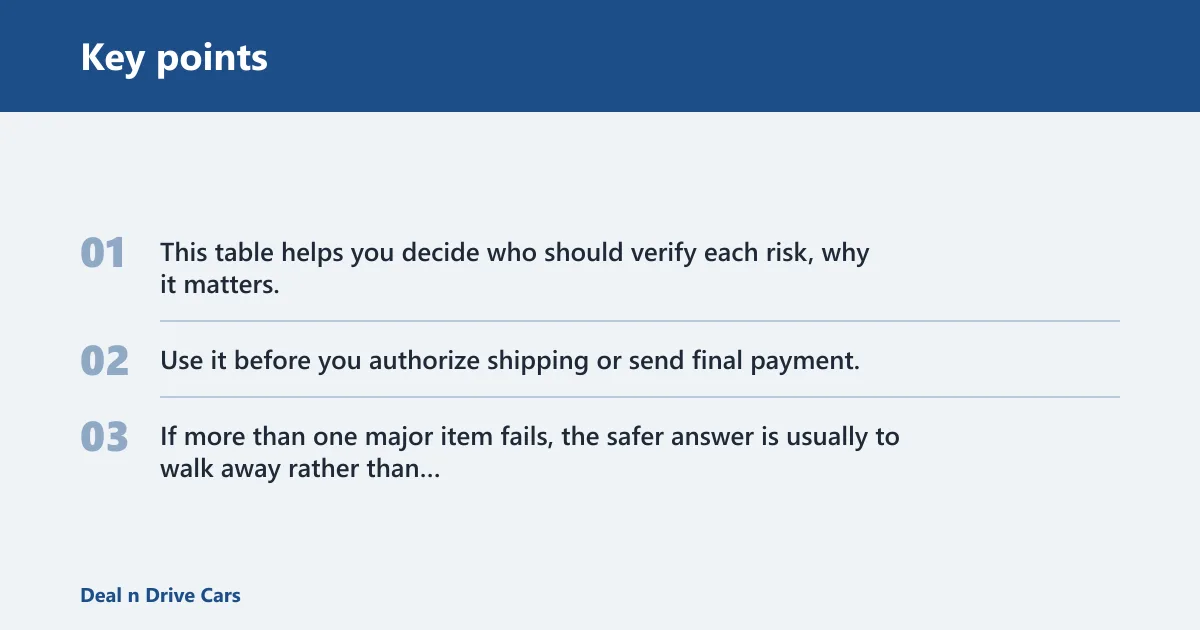
This table helps you decide who should verify each risk, why it matters, and what to do if the check fails. Use it before you authorize shipping or send final payment. If more than one major item fails, the safer answer is usually to walk away rather than stack repairs onto a remote purchase.
| Risk signal | Who checks it | Why it matters | Action if it fails |
|---|---|---|---|
| Rust on frame or subframe | Inspector | Structural corrosion can be a deal-breaker | Walk away or require a major price cut |
| Flood smell or damp carpet | Inspector | Flood damage can affect electronics and safety systems | Walk away unless proof of repair is strong and documented |
| Underbody corrosion | Inspector | Salt-belt damage can shorten service life | Renegotiate or walk away if severe |
| Paint mismatch | Inspector | Can signal prior repair or bodywork | Request photos, repair history, or a lower price |
| VIN mismatch | Inspector and buyer | Identity or title problems can block registration | Stop the deal immediately |
| Warning lights | Inspector | May point to emissions, airbag, brake, or engine faults | Get codes checked and renegotiate or walk away |
| Tire wear unevenness | Inspector | Can show alignment, suspension, or crash issues | Factor in tire and alignment costs |
| Brake performance issues | Inspector during road test | Affects stopping distance and safety | Walk away if the brake feel is poor or noisy |
| Fluid leaks | Inspector | Signals maintenance or repair needs | Estimate repair cost and renegotiate |
| Service gaps | Buyer and inspector | Missing records weaken confidence in care history | Use only if condition is strong and price reflects risk |
| Seller refusal | Buyer | Blocks the inspection process | Walk away unless the seller changes terms |
| Transport timing pressure | Buyer | Shipping before inspection can trap you with a bad car | Delay transport until the report clears the car |
| Battery health concerns | Inspector or EV-capable shop | Low battery health changes range and value | Request a battery report or renegotiate sharply |
Common mistakes
Most remote-buying mistakes happen before the car is inspected. They are easy to avoid if you slow the sequence down. A seller who is slow to share photos, title details, or access information is already creating friction that can become a bigger problem after the deposit.
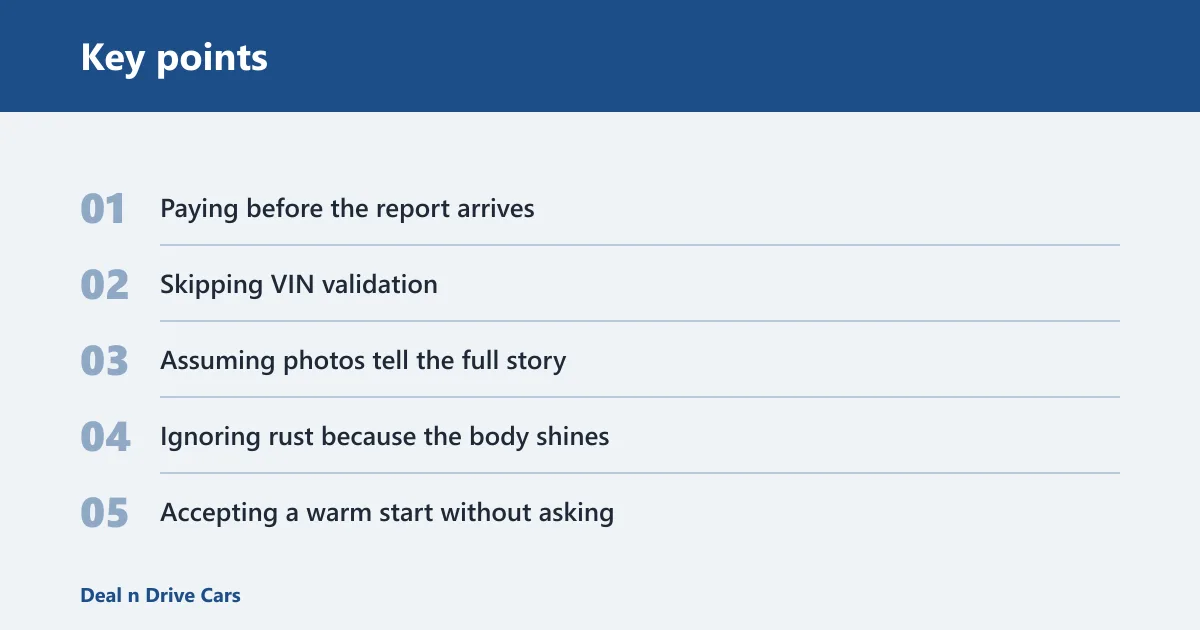
- Paying before the report arrives: wait for the written findings and photos first.
- Skipping VIN validation: confirm tags, paperwork, and labels all match.
- Assuming photos tell the full story: insist on notes and road-test results.
- Ignoring rust because the body shines: always check the underbody and frame.
- Accepting a warm start without asking: request a cold start when possible.
- Letting transport move first: delay shipping until the inspection clears the car.
Picture a salt-belt sedan with clean paint and new seat covers. The report shows heavy underbody corrosion and one tire worn faster on the inside edge. That combination points to structural exposure and possible alignment issues, so the safer move is to renegotiate or walk away. If the seller says the rust is “normal” but cannot document repairs, do not treat that as a pass.
What to do if the seller won’t cooperate
If the seller will not meet at a shop or allow a test drive, treat that as a serious limitation. Ask for a different inspection time or a different location, but do not skip the inspection to keep the deal alive. If access remains blocked, walk away. If the seller cannot provide seller access to the exact vehicle within a reasonable window, the deal is too risky for a remote buyer.
If that did not work, ask the seller to move the car to a neutral shop and approve a limited road test there. If the answer is still no, the deal is no longer safe for a remote buyer. A refusal paired with a transport deadline is especially dangerous, because pressure can turn a bad inspection outcome into a sunk shipping cost.
How much does an out-of-state pre purchase inspection cost?
Pricing varies by location, vehicle type, and whether the inspector travels to the car or the car goes to a shop. Out-of-state buyers should also budget for added services such as lift access, EV battery checks, or extra photos. Get the full price before scheduling. Typical bands are roughly $150 to $250 for a mobile inspection, $100 to $200 for a shop inspection, and $250 to $450 or more for specialty, EV, diesel, or classic-car inspections, especially when the job requires deeper diagnostics or travel.
Common add-on fees include lift access for the undercarriage, compression tests, battery reports, extra travel surcharges, after-hours appointments, and paid photo packages. Ask whether the quote already includes road-test time, code scanning, and any shop lift fee so the final total does not jump later.
What matters most is not the lowest quote. It is whether the inspector can confirm the exact vehicle, deliver a usable digital report, and include the checks that matter for your car type. A slightly higher fee is usually worth it if it prevents buying a car with hidden structural, title, or electrical issues.
How long does it take to get the inspection report back?
Turnaround depends on the provider and the report format. Many mobile inspections come back the same day or within 24 hours, while deeper shop or specialty checks can take longer if the car is busy, difficult to access, or requires more diagnostics. Ask for the delivery window before you book, and confirm whether photos and notes are included in the first release or arrive later.
If your travel or shipping deadline is tight, set that expectation at booking. A report that arrives after your deposit is sent does not help you make a safer decision. If the seller wants a fast close but the inspection slot is delayed, let the deadline slip rather than compress the only safety check in the process.
Frequently asked questions
What is a pre purchase car inspection?
It is a pre-buy check by a qualified mechanic or technician that looks for mechanical, cosmetic, structural, fluid, and paperwork issues before you buy. For remote buyers, the report should also include photos and enough detail to support a buy, negotiate, or walk-away decision.
Can I book a mobile inspection in the seller’s state?
Yes. A mobile inspector can travel to the vehicle location and coordinate directly with the seller. Confirm the address, access rules, and report delivery format before paying, because the point of the service is to verify the exact car without you being there.
What should I ask the seller before the inspector arrives?
Ask where the car is parked, whether the inspector can meet it there, whether the seller will allow a cold start and road test, and whether the title, keys, and service records are ready. Also ask if there is any money still owing on the car.
What extra checks matter most when buying a car from another state?
Rust and frame condition, flood clues, VIN validation, paint depth readings, and road-test results matter most. These checks help separate a clean-looking car from one with hidden structural damage, prior repairs, or a title issue that could complicate registration. NHTSA and NICB resources help with history screening, but the inspection remains the deciding step.
What do I do if the inspection finds rust, flood damage, or prior repairs?
Use the report to decide whether the risk is cosmetic, repairable, or a deal-breaker. Severe rust, flood damage, or VIN problems usually mean walking away. If the issue is limited and documented, ask for a price reduction that covers the repair and the added risk. For flood or salvage clues, the burden shifts to the seller to prove the car is still worth the price.
How do I get a pre purchase inspection for an out-of-state car?
Verify the VIN, buy or review the history report, choose a local inspector, and arrange seller access before you pay. Then wait for the written report and photos. Do not travel or send final money until the inspection results make the deal acceptable.
Pre-booking checklist: confirm the VIN, check history and recall sources, verify seller access, get the full price including add-ons, and set the report deadline before you pay.
Post-report actions: pass if the car is clean, renegotiate for limited issues, or walk away if there is VIN mismatch, severe rust, flood evidence, road-test refusal, persistent warning lights, or a transport deadline that forces a rushed decision.