Instant Cash Offer vs Selling Privately: Which Pays?
An instant cash offer can leave you with more money if a private sale only pays about 10% to 15% more, because repairs, advertising, delays, and buyer risk can erase the gap. Miss those costs, and the “higher” private-sale price can net less than the offer in your hand. This guide breaks down repair costs, time, fees, and risk so you can compare the real net payout.
| Decision factor | Instant cash offer | selling privately | Winner |
|---|---|---|---|
| Headline price | Usually lower than a private-party listing, especially on mainstream cars with healthy demand. | Often higher because you can ask closer to private-party value instead of trade-in value. | selling privately |
| Repair spend | Often lower, because buyers usually accept the car as-is after an inspection. | Often higher, because small mechanical and cosmetic fixes can raise the listing price and improve buyer confidence. | Instant cash offer |
| Time to payment | Same day to a few days is common, depending on inspection, title, and payment method. | Days to weeks is normal, and longer if the car needs the right buyer. | Instant cash offer |
| Risk and hassle | Lower risk of no-shows, scams, test-drive damage, and payment problems. | Higher exposure to buyer screening, renegotiation, bad checks, financing failures, and liability during meetups. | Instant cash offer |
| Net-money upside | Best when the private-sale premium is small or the car needs work. | Best when demand is strong and the private-sale premium stays well above the costs of selling. | Depends on the car |
Headline price
Private selling usually starts with a higher asking price, often near private-party value rather than trade-in value or auction value. An instant cash offer often tracks an auction or wholesale anchor, then adjusts for condition after inspection. The gap can be meaningful, but it is only the starting point.
That gap shrinks fast if the car has a check-engine light, body damage, worn tires, a salvage title, or a history that narrows the buyer pool. A seller with a clean, in-demand sedan may see a strong private-party premium. A high-mileage SUV with repair needs may not.
Repair spend
Repairs matter only if the added sale price beats the cash you spend to get there. Mechanical repairs, cosmetic fixes, detailing, and inspection prep can all help, but each one needs a break-even check. If a $600 repair only lifts the likely private-sale price by $400, it does not pay.
Low-cost items often have the best return: a proper wash and interior cleanup, a bulb replacement, tire inflation, fluid top-offs, and a cheap fix that clears an obvious warning light. Larger jobs are harder to justify unless the car is otherwise attractive and the market values a cleaner example.
Time to payment
Instant cash offer channels are built for speed. Online appraisal tools, dealer cash offer desks, and direct-sale programs often give an initial number quickly, then finalize payment after inspection and title checks. Private sale timing is less certain, because the car must attract the right buyer, pass the buyer’s scrutiny, and complete title and payment transfer without problems.
The time gap has a real cost. Every extra day can mean more messages, more meetups, more missed work, more storage hassle, and more delay before you can use the money. If you need funds fast, speed becomes part of the price.
What the channels look like in practice
- Dealer cash offer. Usually the fastest path to a firm next step, with the offer tied to inspection and paperwork.
- Instant online appraisal tools. Good for a quick range, but the final figure can change after an in-person look.
- Peer-to-peer marketplace. Better price potential, but more screening, more messages, and more no-shows.
- Consignment. Less work than a private sale, but fees reduce net proceeds.
- Auction. Useful for certain older or problematic cars, though the seller gives up control over the final price.
How much money do you keep after repairs?

The cleanest answer is net proceeds, not headline price. Net proceeds are the sale price minus repair spend, transport or detailing costs, time cost, and risk cost. Once those are counted, a private sale only wins if the premium is large enough to cover the extra work and uncertainty.
| Scenario | Instant cash offer | selling privately | Winner |
|---|---|---|---|
| 2018 sedan, clean title, 72,000 miles, no repairs needed | Offer: $11,200 Repair spend: $0 Transport/detailing: $0 Time cost: $150 Risk discount: $0 Net: $11,050 |
Gross price: $12,300 Repair spend: $0 Transport/detailing: $150 Time cost: $400 Risk discount: $250 Net: $11,500 |
selling privately |
| 2014 SUV, cosmetic damage, 118,000 miles, needs cleaning and a brake job | Offer: $6,700 Repair spend: $0 Transport/detailing: $0 Time cost: $150 Risk discount: $0 Net: $6,550 |
Gross price: $8,000 Repair spend: $900 Transport/detailing: $200 Time cost: $450 Risk discount: $300 Net: $6,150 |
Instant cash offer |
| 2012 hatchback, warning light on, buyer demand moderate, likely inspection pushback | Offer: $4,900 Repair spend: $0 Transport/detailing: $0 Time cost: $150 Risk discount: $0 Net: $4,750 |
Gross price: $6,000 Repair spend: $500 Transport/detailing: $150 Time cost: $500 Risk discount: $450 Net: $4,400 |
Instant cash offer |
| 2019 pickup, strong private-party demand, minor cosmetic wear only | Offer: $24,000 Repair spend: $0 Transport/detailing: $0 Time cost: $150 Risk discount: $0 Net: $23,850 |
Gross price: $26,500 Repair spend: $250 Transport/detailing: $150 Time cost: $350 Risk discount: $200 Net: $25,550 |
selling privately |
These four cases show the break-even pattern. A private sale that pays about $1,100 more on paper can still lose after $150 to $500 in time cost, transport or detailing, and risk discount. When the spread is large and the car is attractive, the private sale wins. When the spread is thin, the cash offer keeps more in your pocket.
A simple break-even rule
Start with the likely private-party value and subtract every cost you will actually incur: repairs, detailing, transport, ad fees if any, time cost, and a risk discount for no-shows, haggling, and payment trouble. If the remaining premium over the instant cash offer is under about 10% to 15% of the car’s value, a private sale often stops making sense.
How long does each option take?
An instant cash offer can move from appraisal to payment in the same day or within a few days if the title is clean and the inspection matches the online estimate. Private sale timing is less certain. Even a good car may sit for days or weeks before the right buyer shows up.
That delay matters when the seller needs to replace the car, pay off a loan, or stop storing an unused vehicle. It also adds communication time: messages, calls, viewings, and follow-up questions all cost effort. The longer the sale takes, the more the gap between offer and payout gets consumed by inconvenience.
What risks can lower your payout?
Private sales carry more failure points than instant cash offers. The buyer may disappear, try to renegotiate after a test drive, fail financing, or delay payment. Fraud and liability risk also rise when strangers meet to inspect the car or drive it.
Scams and payment problems
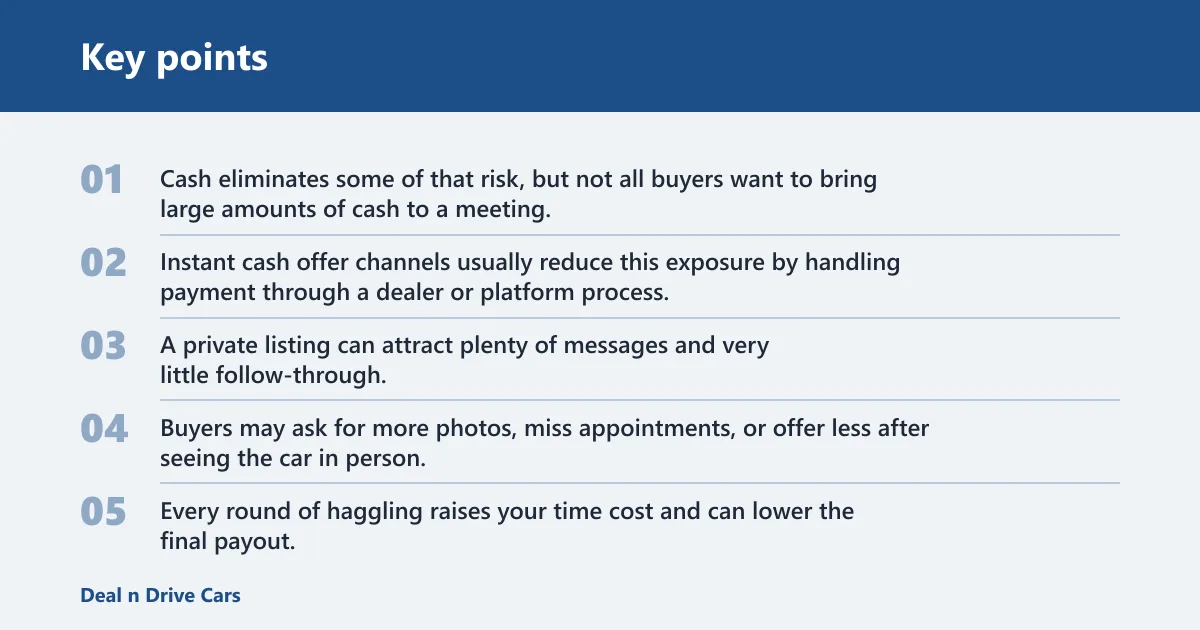
Bad checks, fake cashier’s checks, payment reversals, and incomplete title transfer are commonly reported payment risks in private sales. Cash eliminates some of that risk, but not all buyers want to bring large amounts of cash to a meeting. Instant cash offer channels usually reduce this exposure by handling payment through a dealer or platform process.
No-shows and price haggling
A private listing can attract plenty of messages and very little follow-through. Buyers may ask for more photos, miss appointments, or offer less after seeing the car in person. Every round of haggling raises your time cost and can lower the final payout.
Test-drive and title-transfer issues
Test drives create liability questions, especially if the buyer has an accident or claims a new fault after driving the car. Title transfer also takes coordination, and some states require specific paperwork or notarization. If the buyer’s financing falls through at the end, the sale can collapse after you have already spent time and effort.
Say your sedan gets a private offer that is $1,200 above the instant cash offer, but the buyer wants a weekend test drive, a mechanical inspection, and a lower price after spotting worn front tires. If the tires cost $380 and the time cost reaches $300, the paper premium can disappear quickly.
What repairs are worth doing first?
Do repairs that are cheap, visible, and likely to remove a buyer objection. Skip repairs that are expensive relative to the likely price lift. The break-even point is simple: if the repair and prep package does not raise expected sale proceeds by more than it costs, it is not worth it.
Low-cost fixes that can pay off
-
Clean the car thoroughly. A full wash, vacuum, and glass clean can improve first impressions for a small outlay. Detail work often helps a private listing more than a cash offer because appearance affects buyer confidence.
-
Fix obvious small faults. Replace burned-out bulbs, top off fluids, and address simple warning items that may scare buyers away. These are low-cost signals that the car has been cared for.
-
Repair visible wear only when cheap. Small bumper scuffs, a torn trim piece, or a cracked tail lamp can be worth fixing if the quote is modest. Big paint or body work is usually a weak bet unless the model has strong demand.
Repairs to skip before selling
Skip major mechanical work, expensive cosmetic restoration, and anything that depends on a likely perfect outcome to recoup the spend. A transmission repair, for example, may help a private sale, but it can also fail to return enough extra value. If the car is older, high-mileage, or already priced as a project, those costs rarely come back in full.
When to sell as-is
Sell as-is when the car needs significant work, has title issues, has accident history that limits buyer confidence, or is unlikely to attract a wide private-party audience. That choice is especially sensible for urgent sellers and for cars that are near the wholesale floor already. In those cases, an instant cash offer can protect the net payout better than a longer private listing.
Picture a 15-year-old car with 160,000 miles, a faded hood, and a check-engine light. A $1,000 repair may not add $1,000 to the sale price, and a private buyer may still ask for a discount after inspection. Selling as-is can be the cleaner financial choice.
Choose Instant cash offer if… / Choose selling privately if…
Choose the option that leaves the higher net amount after repair spend, time cost, and risk cost. The better choice changes with the car and with your schedule. The right answer is not the highest sticker price.
Choose Instant cash offer if…
- You need payment quickly and cannot wait days or weeks.
- Your car needs repairs that are unlikely to pay back at sale.
- The car has high mileage, cosmetic wear, title issues, or weak private-party demand.
- You want lower exposure to scams, no-shows, and payment problems.
Choose selling privately if…
- Your car is clean, well-maintained, and likely to draw strong private-party demand.
- The likely private-sale premium is well above your repair, time, and risk costs.
- You can handle messages, meetups, title transfer, and payment checks without pressure.
- You have time to wait for the right buyer and are comfortable with some negotiation.
Frequently asked questions
Is it better to sell my car privately or take an instant cash offer?
It depends on the net proceeds, not the headline price. If the private-sale premium is small, the cash offer often wins because it avoids repair spend, ad time, and buyer risk. If the car is attractive and demand is strong, selling privately can keep more money in your pocket.
How much more money can I get selling privately than with an instant cash offer?
Private sales often bring more on paper, but the usable gap can shrink fast. If the gross premium is only about 10% to 15%, repairs, transport, and time cost may erase it. A larger premium is usually needed before a private sale clearly beats the offer.
What repairs should I do before selling my car privately?
Focus on low-cost fixes that remove obvious objections: cleaning, bulbs, fluids, tire inflation, and cheap cosmetic items. Skip major work unless it clearly raises the likely sale price more than the repair bill. The right line is the one where the added value is greater than the spend.
What costs and risks come with selling a car privately?
Private sales can bring no-shows, scam attempts, bad checks, payment reversals, and price renegotiation after a test drive. There is also the burden of messages, meetings, and title transfer. Those costs do not always show up in the listing price, but they can reduce the final net payout.
How long does it take to get paid with an instant cash offer?
Some instant cash offer channels can pay the same day once the inspection and paperwork are complete, while others take a few days. Timing depends on title status, inspection results, and the payment method used by the dealer or platform. Clean paperwork usually speeds things up.
What fees or deductions should I expect with an instant cash offer?
Many instant cash offer programs advertise low or no-fee positioning, but the final number can still move after inspection. Deductions may reflect condition, tires, body damage, warning lights, or title issues. The key is to compare the final payout, not the first appraisal screen.