Vehicle History Report: How to Read One
Read the report in this order: title status, odometer, damage type, ownership/use, and timeline gaps; any branded title or mileage inconsistency is a walk-away, while one minor damage entry usually needs proof, not panic. Misread a clean-looking report and you can overpay for hidden structural repairs, title trouble, or rollback risk. This guide shows which findings overrule everything else, which ones need backup, and which are often just noise.
Start with the VIN match
Confirm the report belongs to this exact vehicle
A vehicle history report starts with the 17-character VIN, the unique identifier tied to that exact car in title, registration, insurance, auction, and recall databases. Before you read anything else, match that VIN in four places: the report, the windshield base, the driver-side door jamb, and the registration card. If one character is off, stop. The rest of the report cannot be trusted.
The VIN can be found at the windshield base, door jamb, and registration card. Check the seller’s title document too. A copied report with one changed page, a cropped screenshot, or an old PDF can make a different vehicle look clean.
Check for outdated, partial, or altered paperwork
Look for missing pages, cut-off dates, blurred VIN characters, and a report date that is far older than the sale listing. A fresh report matters because title changes, auction announcements, insurance total-loss records, and mileage updates can appear late.
If the seller sends images instead of the full report, ask for the complete document with the report date and VIN visible on every page. If the seller refuses, treat that as its own warning sign.
What does a vehicle history report actually prove?
A vehicle history report can confirm recorded events tied to the VIN, such as title and registration history, some accident and damage records, ownership chain, service entries, and mileage readings. It cannot prove a car is damage-free, flood-free, or honestly represented when data was never reported or was reported late.
What the report can confirm from recorded data
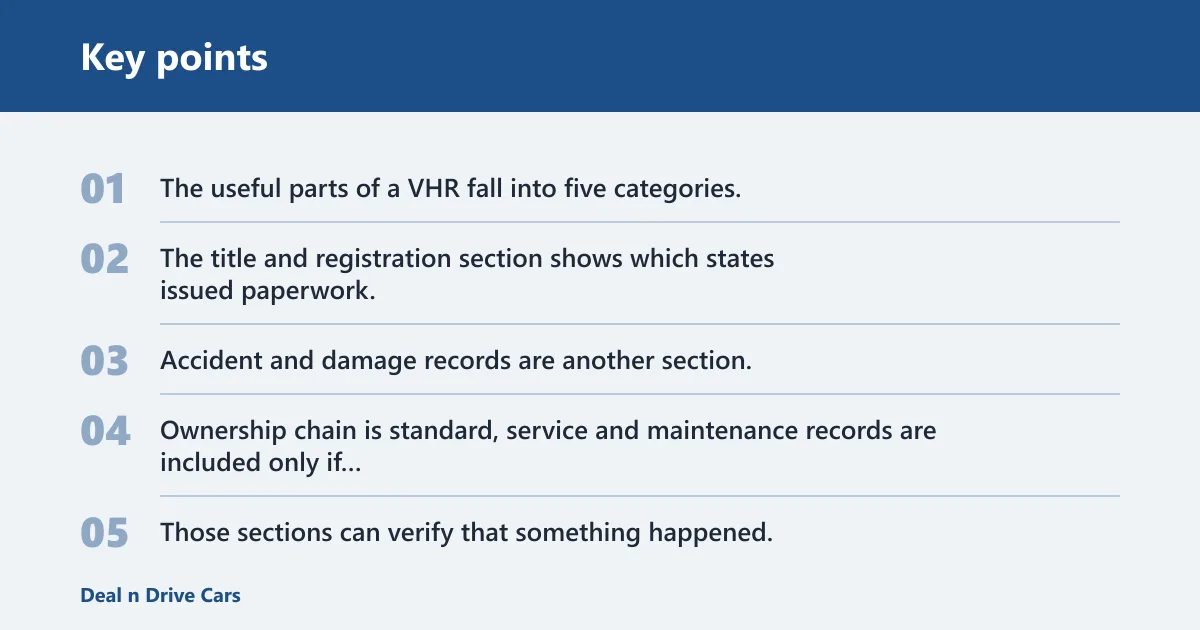
The useful parts of a VHR fall into five categories. The title and registration section shows which states issued paperwork, when ownership changed, and whether any brand such as salvage, rebuilt, or flood was attached. Accident and damage records are another section. Ownership chain is standard, service and maintenance records are included only if reported, and odometer history uses every recorded mileage reading.
Those sections can verify that something happened. They are weaker at proving that nothing happened. A clean title line does not erase a later auction damage flag. No accident entry does not rule out body work paid in cash.
What the report cannot confirm, even when it looks clean
Reports often miss cash repairs, unreported collisions, independent-shop maintenance, delayed state branding, and some cross-state issues. Flood history can be especially messy if the vehicle changed hands quickly after a storm or moved through states with different branding timing.
Open safety recalls are another gap in the report. Open safety recalls do not automatically disqualify a vehicle, and they may not appear in the report at all. Check them separately through NHTSA’s free VIN recall tool at nhtsa.gov/recalls by entering the full 17-character VIN.
Why delayed reporting changes negotiations
Delayed reporting matters because a seller can show a clean-looking report that simply has not caught up. If the car was at auction last month, in a storm region two weeks before that, and now has a fresh out-of-state registration, the timing matters more than the word clean near the title line.
Read the report in this order
1. Title status and registration history
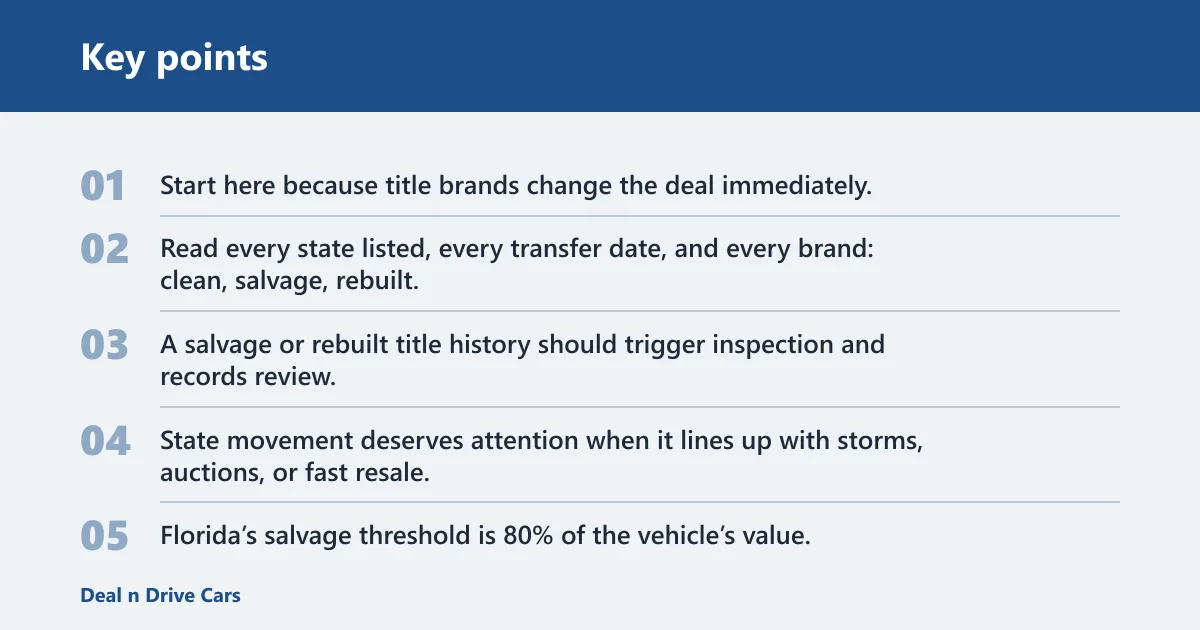
Start here because title brands change the deal immediately. Read every state listed, every transfer date, and every brand: clean, salvage, rebuilt, flood, lemon-law buyback, or junk. A salvage or rebuilt title history should trigger inspection and records review. A junk brand is generally an end point.
State movement deserves attention when it lines up with storms, auctions, or fast resale. Florida’s salvage threshold is 80% of the vehicle’s value, which helps explain why a badly damaged vehicle may receive a salvage brand there while a similar claim in another state may be handled differently.
2. Odometer continuity before damage entries
Check mileage next, before reading the damage notes. Recorded mileage should climb steadily over time. A backward odometer reading is described as the biggest red flag. Large jumps, long blank periods followed by unusually low mileage, or title renewals with odd reading patterns also deserve scrutiny.
Mileage tells you whether the rest of the story makes sense. A “lightly used” car with a five-year service gap and then a low reading can be fine, or it can mean cluster replacement, reporting error, or rollback risk. The next sections help sort that out.
3. Ownership chain and vehicle use
Now test the seller’s story against the ownership chain. Was it personal use, lease, fleet, rental, commercial, or auction inventory? Frequent changes in a short span can mean normal wholesale movement, but they can also follow a problem car that keeps getting passed along.
A one-owner claim should match the report. If the ad says “grandparent-owned” but the VHR shows lease, auction, then dealer transfer, trust the paper trail until documents prove otherwise.
4. Service records and timeline gaps
Service entries help, but missing maintenance records do not automatically mean neglect. Service and maintenance records are included only if reported. Dealer-serviced cars usually leave a denser trail than cars maintained at small independent shops or by owners who kept paper receipts.
5. Recall check outside the report
Finish by checking recalls separately. Enter the VIN in NHTSA’s free recall lookup at nhtsa.gov/recalls. An open recall alone is not usually a deal-breaker, but it should be resolved before or soon after purchase depending on the repair and parts availability.
Which clues should outweigh a clean-looking report?
Three clues beat a clean-looking summary line: any branded title, any mileage inconsistency, and any damage evidence that the report does not explain. After those, watch for auction flags, insurance total-loss hints, and ownership or state-move patterns that do not fit the seller’s story. Those conflicts matter more than a neat headline.
Title brands that change the decision fast
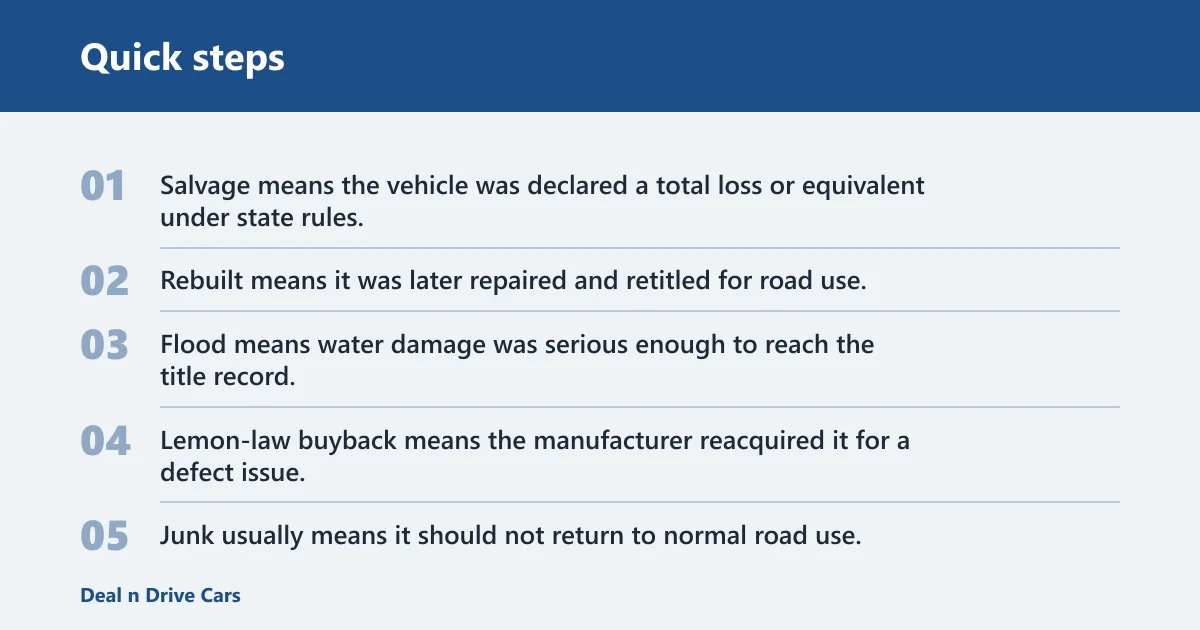
Salvage means the vehicle was declared a total loss or equivalent under state rules. Rebuilt means it was later repaired and retitled for road use. Flood means water damage was serious enough to reach the title record. Lemon-law buyback means the manufacturer reacquired it for a defect issue. Junk usually means it should not return to normal road use.
A clean current title does not always erase an older salvage or flood history. Read the full title timeline, not the latest line only.
Mileage patterns that matter more than a clean title line
Odometer history uses every recorded mileage reading. If one reading moves backward, treat it as a stop sign until proven otherwise. If the report shows 82,114 miles, then later 76,203 miles, the burden shifts to the seller to produce cluster-replacement records, clerical correction paperwork, or other hard proof.
Suppose a seven-year-old SUV shows steady annual increases, then one emissions inspection two years ago posts a reading 11,000 miles lower than the prior service entry. That can be a typo, but it is not harmless noise. The seller needs records, and the pre-purchase inspection becomes mandatory.
Auction, insurance, and damage entries that need physical verification
An auction announcement of damage, structural note, airbag deployment entry, or insurance total-loss indicator can outweigh a clean title line because those events may post before state branding catches up. Read the dates in sequence. If damage appears first and title branding never follows, do not assume the repair was proper.
When ownership gaps and state moves raise risk
Gaps are more serious when they sit between a storm event and a state transfer, or between an auction sale and a fresh retail listing. They are less serious when the car spent years with one owner and the mileage climbed normally.
Say your report shows a sedan registered in one coastal state during a major storm month, then auctioned, then retitled in another state six weeks later with no flood brand. That is a verification case at minimum, and often a walk-away if water clues appear in person.
What are the biggest red flags on a vehicle history report?
The biggest red flags are salvage, rebuilt, flood, junk, or lemon-law buyback brands; backward odometer readings; repeated damage or structural entries; airbag deployment notes; and recent title activity that conflicts with the seller’s explanation. Those findings either change the price sharply or end the deal unless paperwork and inspection support the story.
Title brands and severe damage notes
Salvage, rebuilt, flood, and junk require extra caution. A lemon-law buyback needs separate attention because the concern is not crash history but the defect that caused the buyback. Repeated damage entries on multiple dates can point to more than one event, which matters for alignment, corrosion resistance, and long-term resale.
Backward readings and implausible jumps
A backward odometer reading is the clearest mileage danger. Big upward jumps can matter too. An abrupt leap may reflect a data-entry error, but it can also expose earlier underreporting. Compare each mileage date with service entries, inspection stickers, oil-change windshield tags, and the instrument cluster reading on the car.
Recent paperwork that does not fit the sale story
Be careful when a seller claims long personal ownership but the report shows an auction sale, dealer transfer, or new title issue very recently. A fresh title by itself is not bad, yet it needs an explanation supported by registration papers and bill-of-sale timing.
How do you read title, damage, and mileage together?
Read these sections as a timeline, not as separate boxes. A clean title plus one minor damage entry may call for proof and inspection, while a clean title plus a backward mileage reading usually kills the deal. Conflicts matter most when two sections support each other against the seller’s explanation.
Clean title plus damage record: verify or walk away?
One minor damage entry with steady mileage and long-term ownership often lands in verify. Ask for repair invoices, paintwork details, and insurance paperwork. A structural damage note, airbag deployment, or repeated auction damage entries push the case toward walk away unless the price and intended use justify heavy scrutiny.
Picture a compact hatchback with a clean title, one rear-end accident six years ago, and mileage that rises evenly every year. If body-panel gaps are straight and a repair invoice matches the date, that is very different from a “clean title” coupe with three damage entries in nine months and no paperwork.
No accident record plus body evidence
If the report is clean but the car shows overspray, mismatched paint texture, uneven panel fit, newer glass on one corner, or airbag warning issues, trust the car over the report. Accident records are reported collisions only, commonly from insurance claims, police reports, auctions, or other reporting partners.
Damage paid out of pocket may leave no database trail at all.
Mileage gaps plus low wear: support or weaken rollback concerns
Low pedal wear, a crisp steering wheel, and clean seat bolsters can support low mileage, but those clues are weak on their own because interiors can be reconditioned. If the report has long gaps, the stronger check is whether service stickers, tire date codes, and maintenance receipts line up with the displayed odometer.
Cross-state title movement and delayed branding
Cross-state movement becomes more serious when it follows a loss event or flood season. State branding gaps matter because one state’s status may post later or differently than another’s. A “clean” current title in a new state should never cancel earlier auction or insurance clues.
Report reading scorecard
| Report clue | What it may mean | How serious it is | What to ask the seller | What to inspect next | Independent pre-purchase inspection required? |
|---|---|---|---|---|---|
| One-owner history, steady mileage, routine service entries, no damage records | Consistent paper trail; still not proof of a perfect car | Green light | Ask for the latest service receipt and title in seller’s name | VIN match, panel fit, tire wear, fluids, road-test behavior | Recommended |
| One minor damage entry with normal mileage progression | Likely repairable prior incident | Verify | Ask for repair invoice, insurer estimate, and photos | Paint mismatch, trunk floor or bumper supports, alignment | Yes |
| Salvage or rebuilt title history | Prior total loss, later repaired or retitled | Negotiate or walk away, depending on records and intended use | Ask for full rebuild paperwork, parts list, and state inspection records | Frame rails, welds, airbags, corrosion, tire wear, scan for fault codes | Yes, mandatory |
| Flood brand, auction flood announcement, or storm-date state move | Possible water intrusion even if title line looks clean now | Walk away or verify only with very strong evidence | Ask where the car was during the storm, who owned it, and for detailed repair records | Musty odor, silt under trim, corrosion in connectors, damp spare-tire well | Yes, mandatory |
| Backward mileage reading | Rollback risk, clerical error, or cluster replacement | Walk away unless documentation is strong | Ask for cluster-replacement proof, inspection records, and correction paperwork | Displayed mileage, wear points, stickers, receipts, module scan | Yes, mandatory |
| Long service gap but steady title history and normal mileage rise | Likely unreported maintenance | Verify | Ask for paper receipts or shop contact info | Fluid condition, brakes, tires, maintenance due items | Recommended |
| Recent auction sale followed by quick retail listing | Fresh wholesale flip; reason may be harmless or not | Verify or negotiate | Ask why it went through auction and who titled it | Condition consistency, reconditioning quality, title dates | Yes |
| Open recall with otherwise clean history | Safety repair still pending | Verify | Ask whether recall parts are available and if repair can be completed before sale | NHTSA recall status, dealer scheduling, warning lights | Optional, but still wise |
| Junk title | Vehicle may be designated for dismantling or non-road use | Walk away | Ask nothing unless buying strictly for parts under local rules | No further consumer purchase inspection | No, because the retail purchase should stop |
What should you do if the report has gaps or missing records?
Do not treat every gap as proof of a bad car. Missing service history is common when work was done at independent shops or by owners. A gap becomes serious when it clashes with mileage, ownership type, geography, or recent title movement. The key is to decide whether the gap is normal noise or missing evidence.
When missing service history is normal
A privately owned car with steady annual mileage and a long same-state registration run can be fine even if service entries are sparse. Many routine oil changes, batteries, tires, and brake jobs never reach the report database.
When long record gaps deserve extra scrutiny
Scrutiny rises when the gap sits around a collision date, storm period, auction transfer, or ownership change. It rises again when the odometer reading after the gap looks surprisingly low or when the seller claims heavy maintenance but has nothing on paper.
Use ownership type, mileage pattern, geography, and market channel
Fleet, lease, and dealer-managed vehicles often leave more record traces. One-owner private vehicles may leave fewer. Auction-channel cars deserve closer timeline reading because auction disclosures can be brief, and cosmetic cleanup can happen before retail relisting.
Ask for documents that fill the blank spots
- Title in the seller’s name, front and back if local rules allow review.
- Registration card and emission or inspection records.
- Service receipts with dates, mileage, and shop name.
- Insurance repair invoices or photos for any listed damage event.
- Rebuilt-title inspection paperwork if the title history ever changed status.
Compare the report to the car in person
Match paperwork, labels, and displayed mileage
Compare the title document, windshield VIN plate, and door-jamb label. Make sure badges and trim level make sense for the VIN-decoded vehicle. Then compare the displayed mileage to the latest report entry and to service stickers in the door frame or windshield corner.
Look for water, corrosion, and flood clues
Flood checks go beyond a title brand. Inspect the spare-tire well, seat tracks, lower dash fasteners, under-seat wiring, trunk seams, and fuse-box areas for silt, white residue, muddy staining, or odd corrosion. Sniff for musty odor after the cabin has been closed up for a bit.
Look for repair evidence the report may miss
Check panel gaps, paint texture, overspray around weather seals, glass date mismatches, headlight age mismatch, uneven tire wear, and airbag warning behavior. A report can be incomplete, and the body and interior often tell the missing part of the story.
When the inspection becomes mandatory
An independent pre-purchase inspection moves from wise to mandatory when the report shows salvage, rebuilt, flood, structural damage, airbag deployment, any mileage inconsistency, or a conflict between the report and what your eyes show. It is also mandatory when the seller cannot document a major report entry.
Frequently asked questions
How do I read a vehicle history report before buying a used car?
Read it in order: title status, odometer continuity, damage entries, ownership chain, then timeline gaps. Confirm the 17-character VIN on the report matches the windshield base, door jamb, and registration card first. Use the sections together, because conflicts between them matter more than any single clean-looking line.
What does salvage, rebuilt, or flood mean on a report?
Salvage means the vehicle was declared a total loss or similar under state rules. Rebuilt means it was later repaired and retitled for road use. Flood means water damage reached the title record. None of those labels can be priced like a comparable clean-title car without careful verification.
How do I tell if an odometer rollback happened?
Look for any backward reading, then for long gaps followed by unusually low mileage or jumps that do not fit the timeline. Compare report entries with inspection records, service receipts, windshield stickers, and the displayed mileage. One clue alone is not proof, but a backward reading demands seller documentation.
What do vehicle history reports miss even when they look clean?
They can miss cash-paid repairs, unreported collisions, independent-shop service, delayed title branding, and some cross-state history problems. They may also omit open recalls. That is why a clean report does not prove a clean car, and why the in-person check still matters before you make an offer.
How recent should a vehicle history report be before I buy?
A report should be pulled or verified close to the transaction date, ideally right before you commit. Late-posting title changes, auction notes, insurance data, and mileage updates can change the reading. If the seller shows an old PDF or screenshot, ask for a fresh full report with the VIN visible.