How to Check Vehicle History for Free: What Reports Miss
Check a VIN for free with NHTSA, NICB, state title records, and service or inspection records. If any gap appears in title, theft, mileage, or crash history, pay for a full report. Skipping that step can hide title brands, odometer jumps, or theft flags that make a cheap car very expensive. This guide shows a layered free check, what each source does and misses, and when a paid report is worth it.
Start with the VIN and the documents
The VIN is a 17-character identifier that should match the vehicle, title, registration, and listing photos. Start there because every history check depends on the right number. A mismatched VIN, an altered plate, or a title that does not line up with the car is a stop sign, not a paperwork issue.
Find the VIN and compare every document
Look for the VIN on the dashboard near the windshield, the driver’s door jamb, and the paperwork the seller provides. Then compare it with the title, registration, insurance card, and any online listing. If the vehicle is a truck, motorcycle, or older car, the label locations can differ, so check the owner manual or maker guidance.
Watch for obvious tampering
Use a bright light and inspect rivets, labels, and the font style around the VIN plate. Scratches, fresh adhesive, missing stickers, or a plate that looks newer than the surrounding trim deserve a closer look. A clean-looking report cannot fix a mismatched identity.
What can I check for free?
You can check several risk buckets for free: theft, salvage flags, title branding clues, open recalls, and some mileage or service hints. No single free source covers everything. The best approach is layered. A clean result from one tool only shows that one source did not find a problem.
Free sources worth using first
- NICB VINCheck for theft and certain salvage-related flags.
- State DMV records where title or registration lookups are public.
- NMVTIS-based checks through approved providers for title and brand data.
- NHTSA recall lookup for open safety recalls.
- Service or inspection records when a dealer, shop, or state inspection portal makes them available.
What each source is best at catching
NICB is best for theft screening and some salvage exposure. NMVTIS is the backbone for title and brand data because it consolidates information from participating state motor vehicle agencies and junk, salvage, and insurance-related sources through approved providers. State DMV records can add title transfers, branding events, and sometimes odometer entries.
Why free checks vary by state and vehicle
Availability changes by state, by brand type, and by the car’s history. A vehicle that lived in one state its whole life may have more complete records than one that moved across multiple states. Older cars, private-sale vehicles, and auction-return vehicles often leave bigger gaps.
Use NICB VINCheck to screen theft and salvage flags
NICB VINCheck can be a free first pass for theft and salvage-related risk. It can reveal whether a vehicle appears in theft or salvage databases tied to the participating sources NICB uses. It does not prove a car is clean, and it does not replace a full title-history report.
What VINCheck can reveal
VINCheck can sometimes flag a vehicle that has been reported stolen and not recovered, or one with salvage-related exposure in the participating records. That makes it useful before you spend money or travel for an inspection. If the seller cannot explain a salvage or theft flag, stop and verify the paperwork.
What VINCheck cannot reveal
It will not give a full accident timeline, a repair history, or every title event. It also will not catch many minor crashes, unreported damage, or repairs that never reached an insurer or a state brand record. A clean VINCheck is useful, but it is not a clean bill of health.
What to do if the result is clean
If VINCheck comes back clean, move to title and odometer checks. Then compare the result against the seller’s story and the car’s visible condition. A clean theft screen is only one piece of the puzzle.
Check NMVTIS and state DMV records for title history
NMVTIS is a federal vehicle-history source for title and brand data, but it is not a full repair or crash archive. Used through approved providers, it helps identify title changes and major brands such as salvage, rebuilt, flood, junk, and lemon where available. State DMV records add local title and registration detail when access exists.
How NMVTIS supports title and brand data
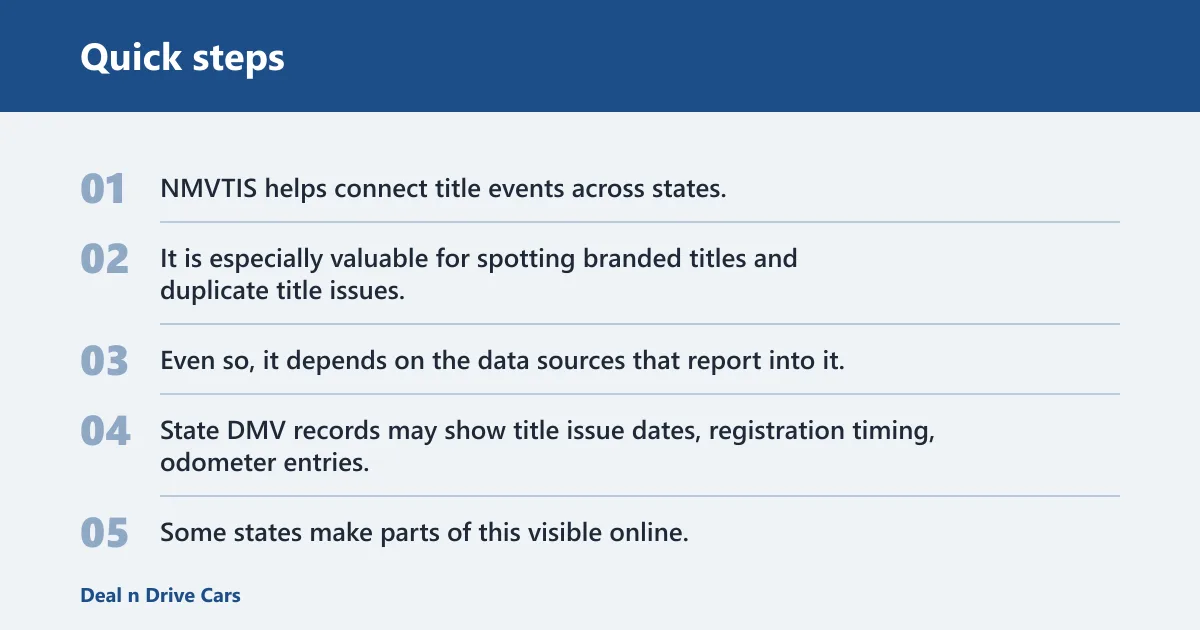
NMVTIS helps connect title events across states, which matters when a car crosses borders and paperwork gets fragmented. It is especially valuable for spotting branded titles and duplicate title issues. Even so, it depends on the data sources that report into it, so some history can still be missing.
Where state DMV records add value
State DMV records may show title issue dates, registration timing, odometer entries, and branding events that do not appear elsewhere. Some states make parts of this visible online; others require a request or do not offer a public search at all. The value is in the local detail, not in one national report.
Why title gaps still happen
Title gaps happen when a vehicle changes hands without a complete data feed, moves between states, or is rebuilt after a loss and re-titled later. A car can look ordinary and still have had a salvage, flood, or junk brand in a prior state. That is why one clean lookup is not enough.
How do free reports handle accidents and damage?
Free reports often miss minor crashes, unreported collisions, and damage repaired without an insurance claim or police report. They may show a salvage or branded-title event, but that is not the same thing as a full accident history. A wrecked car can still look clean on paper if no one filed the right record.
Why minor crashes often stay hidden
Many small parking-lot impacts, fender-bender repairs, and repaint jobs never reach the databases that free reports search. If the owner paid out of pocket, the car may have no paper trail beyond the bodywork itself. That is common, not rare.
How auction photos can expose old damage
Suppose a sedan shows a clean title and no accidents in a free report, but auction photos reveal a crumpled rear quarter panel, deployed airbags, or waterline marks. That changes the risk picture fast. Auction listings can fill a major gap because photos often reveal sale condition that records do not.
Why some wrecked cars still look clean on paper
A vehicle may be repaired before it is branded, sold across state lines, or picked up after a private settlement. The paper trail can miss the event even when the body panels, paint shade, or airbag trim tell a different story. This is why the car itself still matters.
Use mileage, service, and recall checks to fill the gaps
Odometer history, service records, and recall lookups answer different questions. Mileage checks help spot rollbacks or jumps. Service records can support ownership timing. Recall lookups tell you about safety defects, but they do not prove a clean history or a crash-free past.
Reading odometer history for mismatches
Watch for mileage that drops, stalls for long periods, or jumps in a way that does not fit the age of the car. Gaps are common, but a gap between an inspection reading and a later title transfer can still be useful. A pattern that makes no sense deserves follow-up.
What service records can and cannot prove
Service or maintenance records can help confirm mileage, ownership timing, and whether the car was maintained at a dealer or shop. They rarely give a full history, and private shops may not report every visit into a searchable database. Treat them as support, not proof.
Why recall checks matter but do not prove a clean history
An open recall means a safety fix may still be needed. It does not mean the vehicle was in a crash or had title trouble. Likewise, a car with no open recalls can still have salvage, flood, or mileage issues.
Source-by-source coverage matrix: what free tools cover and miss
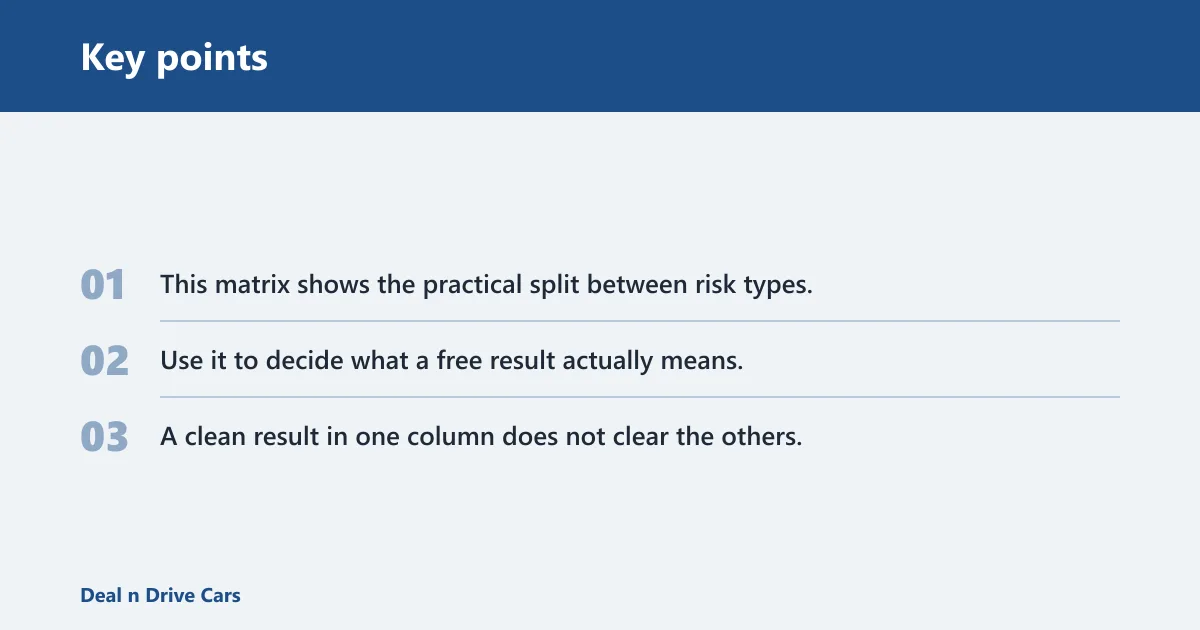
This matrix shows the practical split between risk types. Use it to decide what a free result actually means. A clean result in one column does not clear the others, and an incomplete result tells you exactly where to spend the next dollar.
| Free source | Best at revealing | What it cannot reliably reveal | Best next step if clean or incomplete |
|---|---|---|---|
| NICB VINCheck | Theft flags; some salvage-related records | Full accident history; service records; odometer trail | Check NMVTIS or state title records; then inspect the car in person |
| NMVTIS-based lookup | Title brands such as salvage, rebuilt, flood, junk, lemon | Most repairs; minor crashes; detailed service history | Verify with state DMV records and a paid report if the car is high risk |
| State DMV records | Local title and registration history; some odometer or branding events | Interstate gaps; complete accident data; auction damage | Compare to seller documents and ask for inspection paperwork |
| Service and inspection records | Mileage support; ownership timing; recurring maintenance | Hidden wrecks; branded titles; theft history | Use them to test whether odometer readings and story lines match |
| Auction photos and listings | Prior damage; sale condition; flood clues | Formal title status; recall status; later repairs | Ask why the car was sold and whether repairs were documented |
| NHTSA recall lookup | Open safety recalls | Accidents; title brands; mileage fraud | Use it only as a separate safety check |
Is a free report enough, or should you pay?
A free check is usually enough only when the car is low risk, the paperwork matches, and every free source agrees. Consider paying for a full report when the vehicle is expensive, branded, imported, auction-returned, flood-prone, or has missing records. If the history looks incomplete, the paid report is the cheaper mistake.
When a free check is usually enough
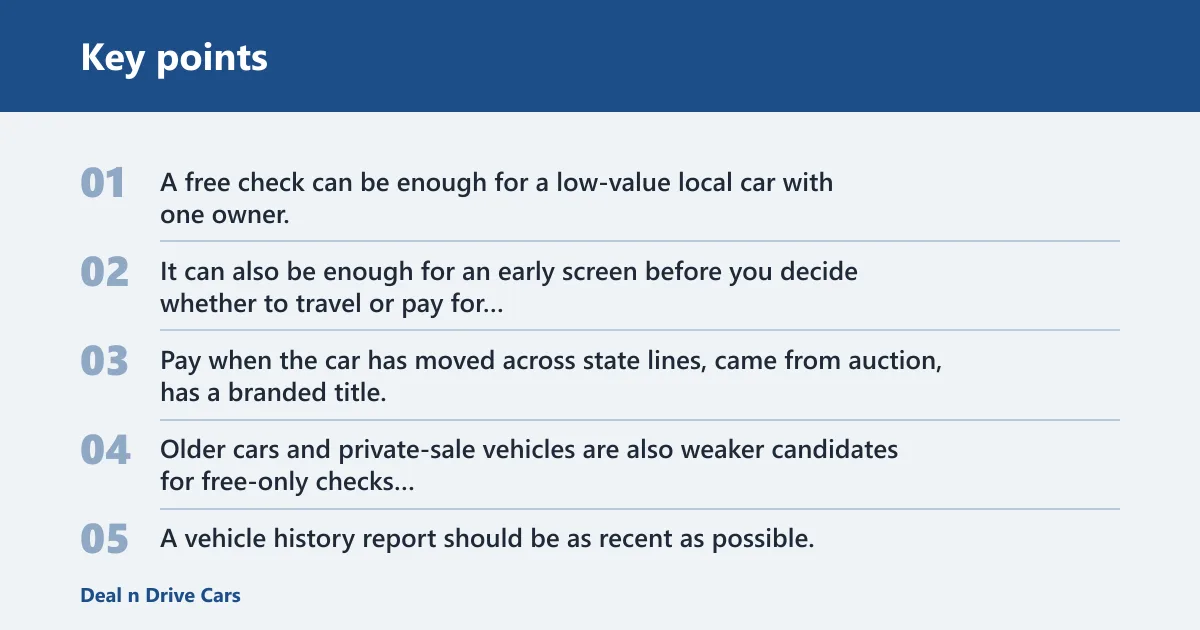
A free check can be enough for a low-value local car with one owner, clear service records, matching documents, and no sign of title issues. It can also be enough for an early screen before you decide whether to travel or pay for an inspection. Low risk still needs a real comparison.
When the risk level justifies a paid report
Pay when the car has moved across state lines, came from auction, has a branded title, has inconsistent mileage, or shows bodywork that does not fit the paperwork. Older cars and private-sale vehicles are also weaker candidates for free-only checks because the history trail is often thin.
How recent the report should be
A vehicle history report should be as recent as possible, ideally run after you have the current VIN and right before you commit. History can change quickly if a theft claim, title update, or auction listing appears. If the car sits on a lot for weeks, rerun the checks before paying.
Frequently asked questions
How can I check a vehicle history for free?
Start with the VIN, then use NICB VINCheck, a state DMV title lookup if available, NMVTIS-based public access through approved providers, and the NHTSA recall check. Add service or inspection records when you can. Use more than one source so a clean result from one tool does not hide a missing record elsewhere.
What can I find with a free VIN check?
A free VIN check can reveal theft flags, some salvage-related issues, title branding clues, open recalls, and occasional mileage or registration entries. It can also confirm whether the VIN format looks valid. It cannot guarantee that the car has no crash history, no flood exposure, or no service gaps.
What do free vehicle history reports miss?
Free reports often miss minor accidents, unreported bodywork, private repairs, complete service history, and many out-of-state events. They can also miss mileage inconsistencies when the odometer was not recorded often enough. A clean free report means only that the searched databases did not show a problem.
Can a free report show accidents or title issues?
Yes, but only some of them. Title issues such as salvage, rebuilt, flood, junk, or lemon branding are more likely to surface than small accidents. Free sources usually do not show every crash, especially if no insurance claim, police report, or title brand was created. Treat any accident data as partial.
Is there a truly free Carfax or AutoCheck report?
Not as a full replacement for the paid report. Some dealers, listing sites, and promotions offer limited previews or one-time copies, but those are not the same as a complete free Carfax or AutoCheck report. If the car is high value or the history is unclear, a paid report is still the safer move.
What should I do if a free report has gaps?
Use the gaps as a checklist. Ask for the title, registration, service invoices, inspection slips, and any auction photos or repair estimates the seller has. If the vehicle moved across states or has bodywork that does not fit the story, buy a full report and consider a pre-purchase inspection before you pay.
How do I verify a used car if the report looks clean?
Match the VIN to the car and documents, check the body for uneven gaps, repaint, water marks, or airbag clues, then compare the mileage to service and inspection records. A clean report lowers risk, but it does not clear the car. The vehicle itself still has to make sense.