What Should You Check Before Starting a Used Car Test Drive?
Before a used car test drive, spend about 60 seconds checking for warning lights, leaks, low fluids, flat tires, damage, and missing paperwork; if airbag, check-engine, brake, or transmission faults are present, many buyers treat that as a walk-away until explained. That quick triage can spare you wasted time and a costly mistake. This guide sets the order: what is normal, what needs questions, and what should stop the drive before it starts.
This guide is part of our Test drive checklist for a used car series.
What you’ll need
- Your phone with notes ready.
- The listing, keys, and any service records the seller has.
- Comfortable shoes so pedal feel is clear.
- A quiet moment with the radio and fan off.
- Time for a route with streets, rough pavement, and a highway segment if possible.
Triage table
| Check | What good looks like | Immediate red flags | Yes/no decision |
|---|---|---|---|
| Cold start | Engine starts cleanly, then settles into a steady idle with no heavy smoke | Long hesitation, repeated cranking, rough idle that does not calm down, or smoke that keeps building | No if it will not settle quickly |
| Gauge cluster | Warning lights clear in the normal way and the temperature gauge rises into a stable operating range | Temperature keeps climbing, fluctuates, or points toward overheating; critical lights stay on without explanation | No if overheating is visible |
| Brake pedal | Firm pedal with predictable travel; no grinding or squeaking when braking before public streets | Mushy feel, sinking pedal, grinding, or loud squeal under light brake use | No if the pedal feel is unsafe |
| Parking-lot steering lock | Full-lock turns are smooth at low speed and produce no binding or odd noises | Resistance, clunking, or a shudder at full lock | No if steering binds or groans hard |
| Transmission engagement | Park to Drive engages promptly with a mild, normal shift feel | Delay, harsh clunk, or flare before the car moves | No if engagement is slow or violent |
| Cabin controls | Seat, mirror, steering wheel, screen, and key buttons work without lag or guesswork | Broken adjustments, screen lag that blocks normal use, or controls you cannot reach safely | Maybe, if it is a comfort issue only |
What should you check before starting a used car test drive?
Start with a cold car, quiet the cabin, and scan the dashboard before you move. A used-car check asks more of you than a new-car drive, and iSeeCars says its checklist has 14 key things to look for during a test drive. The first minute should tell you if the car deserves a shift into gear.
Check the car while it is still parked
- Look for leaks under the engine bay and beneath the car.
- Check tire pressure by eye for one low corner or a visibly flat tire.
- Scan the cluster for warning lights that deserve an explanation.
- Turn off the radio before you start driving, then set the fan low or off so sounds are easier to hear.
Say the dealer has already warmed the car and left it idling in the lot. That can hide a rough cold start and shorten the chance to hear early noises, so ask for a cold start before any route begins.
Should the car be cold before a test drive?
Yes. Bumper says the car must be cold before the drive to reveal hidden issues, and that matters because a warm engine can mask hesitation, rough idle, and some start-up noises. Cold starts often expose faults a warmed-up engine has already smoothed over.
Why a cold start matters
Listen for whether the engine starts cleanly or hesitates, then watch for smoke, rough idle, and how quickly it settles. A brief rough idle can be normal on some cars, but it should not linger or get worse as the engine warms. Keep the judgment simple.
What counts as normal settling
A short rise in idle speed, then a steady idle, is common. The temperature gauge should climb into a normal operating range and generally stay there without unusual fluctuation or signs of overheating. If the needle climbs too high or keeps moving around, stop and ask why before driving farther.
When to walk away immediately
Persistent smoke, repeated cranking, a stall after starting, or a temperature gauge that points toward overheating are not nuisance items. They deserve explanation before the test drive continues, and if the seller cannot give one, the safest decision is to leave.
What should you check before you roll?
Before entering public streets, check the brake pedal, shift from Park to Drive, and make a slow steering sweep in the lot. iSeeCars says to test the brakes before entering public streets, and it also notes that full-lock parking-lot turns can reveal power steering and CV joint problems. That is the safest place to catch them.
Brake pedal feel in the lot
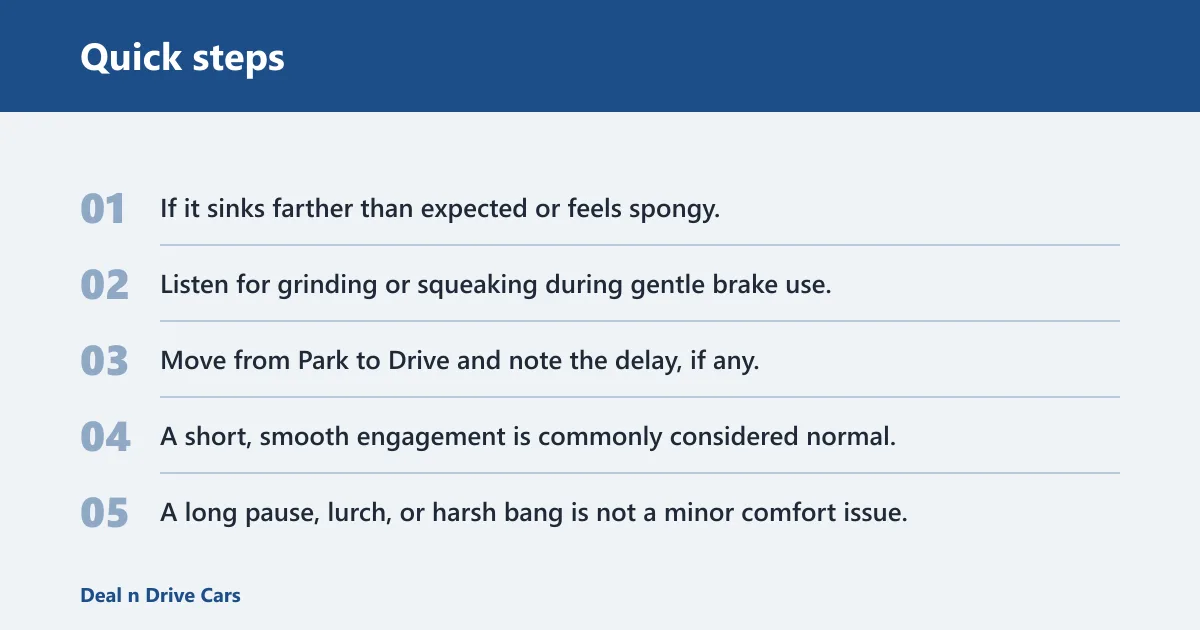
The pedal should feel firm, not mushy. If it sinks farther than expected or feels spongy, that needs attention before the car leaves the lot. Listen for grinding or squeaking during gentle brake use, since those sounds can point to worn pads, rotor wear, or warped rotors; iSeeCars says braking from moderate speeds can reveal rotor wear or warping.
Transmission engagement from Park to Drive
Move from Park to Drive and note the delay, if any, and whether the car clunks on engagement. A short, smooth engagement is commonly considered normal. A long pause, lurch, or harsh bang is not a minor comfort issue; it can point to a transmission problem that deserves a closer inspection.
Steering lock and low-speed turn feel
Turn fully at low speed in the lot, not in traffic. Full-lock resistance, binding, or odd noises are not normal. A parking-lot sweep is enough to feel whether the steering is smooth and whether the front end stays quiet when loaded at full lock.
Picture a compact SUV that shifts cleanly but groans every time the wheel reaches full lock in the parking space. That one symptom is more useful than a polished idle, because it may point to a steering or front-drive issue that a short straight drive would miss.
What should you listen and feel for on the road?
Use the drive to separate nuisance noise from signs of repair work. Listen for clunks, whining, grinding, and squeaking, and feel for seat or steering wheel vibration under idle, light load, and cruise. Keep the route varied enough to expose faults, but do not use unsafe maneuvers.
Noise, vibration, and harshness clues
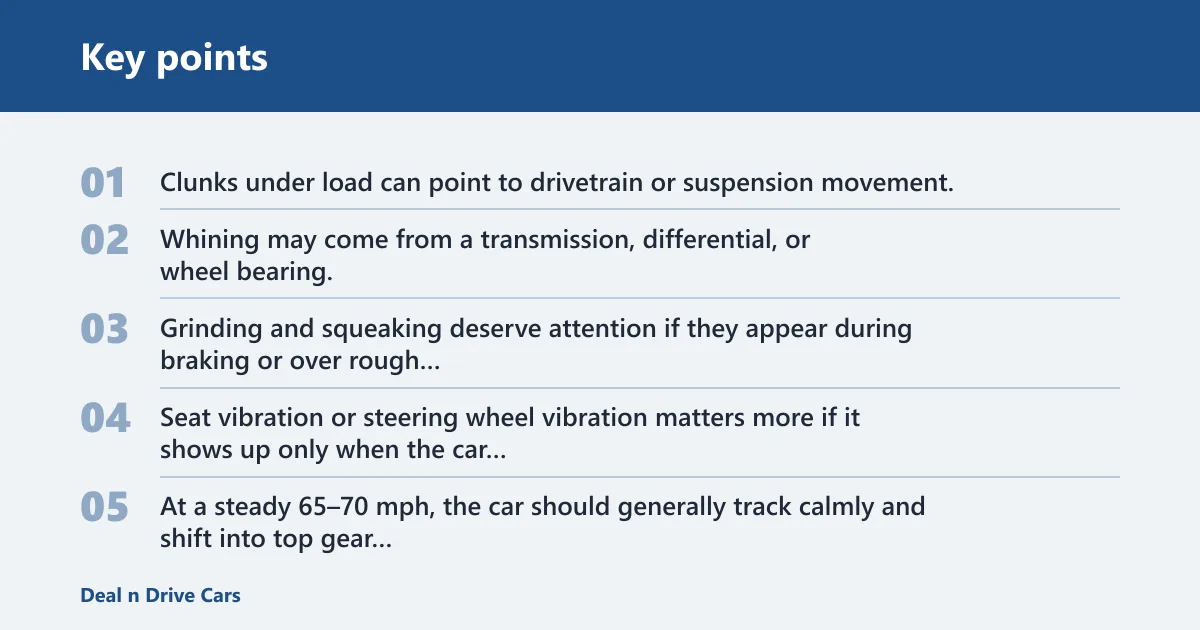
Clunks under load can point to drivetrain or suspension movement. Whining may come from a transmission, differential, or wheel bearing. Grinding and squeaking deserve attention if they appear during braking or over rough pavement. Seat vibration or steering wheel vibration matters more if it shows up only when the car is under load or when the road speed rises.
Straight-line and highway checks
At a steady 65–70 mph, the car should generally track calmly and shift into top gear without drama. iSeeCars says alignment issues can show up when the car drifts on a straight drive, and vibration that appears only at highway speed can point to wheel balance, tires, or driveline issues. Do not let go of the wheel to check drift; hold it normally and watch whether the car pulls.
Route variety
Use a route with a rough surface, a sharp turn, a hard stop, and a highway segment if the seller allows it. Those conditions expose different faults without turning the drive into a stunt. A proper drive should take at least 20 minutes, and Bumper says to budget 30 minutes to do it properly.
Suppose a sedan feels quiet around town but starts vibrating at 68 mph on the highway. That split matters. A fault that only appears at speed can hide during a short neighborhood loop, which is why a simple city route is not enough.
How should you use the cabin checks during the drive?
Set the seat, mirrors, and steering wheel before you pull away, then touch the controls you will use every day. Carwow says used-car test driving requires more rigour than a new-car test drive, and it advises checking seat and steering wheel settings for a good long-term driving position while playing with everything, including controls and settings. That order matters.
Cabin controls and visibility
Make sure you can reach the screen, climate controls, stalks, and buttons without stretching. Test whether the screen lag is tolerable, whether the seats move fully, and whether the mirrors give a clean rearward view. If the basics do not work now, they will not improve after purchase.
Keep the setup realistic
Adjust the seat, then the wheel, then the mirrors, and finally confirm pedal reach. If one setting forces an awkward driving position, that is worth noting even if the car drives well. Comfort problems can become daily problems.
Common mistakes
- Using a route that is too short to show highway vibration or warm-up problems.
- Leaving the radio on and missing grinding, clunks, or whining.
- Assuming every warning light is fatal. Some indicators, like seat-belt or parking-brake lights, can be normal while the car is parked.
- Confusing a brief idle change after start-up with a serious fault.
- Skipping the brake and steering checks until after the car is already on public roads.
- Ignoring controls that fail to move, lag, or block a proper driving position.
Prevention note
Write down anything that sounds off, feels off, or lights up. That note helps you compare cars, ask sharper questions, and bring the right concerns to an independent mechanic if the rest of the car still looks promising.
Frequently asked questions
Should you turn off the radio before a test drive?
Yes. iSeeCars recommends it because audio can cover clunks, whining, squeaking, and grinding. Leave the cabin quiet long enough to hear the first start-up noises, then keep the volume down through the brake and steering checks.
What should the brakes feel like before you leave the lot?
The pedal should feel firm and predictable, not soft or spongy. Test it in the lot before entering public streets, and listen for grinding or squeaking when you brake gently. If the pedal sinks, pulses badly, or sounds harsh, stop and ask for an explanation.
Can you test the steering before getting on public roads?
Yes. A slow full-lock turn in the lot is the safest place to do it. iSeeCars says full-lock parking-lot turns can reveal power steering and CV joint problems, while straight-line drift on the road can point to alignment issues. Do both checks if the route allows it.
How long should a proper used car test drive be?
Plan for at least 20 minutes, and 30 minutes is better if the seller allows it. That gives you time for city streets, a rough patch, a hard brake, and a highway run. Short loops hide problems that show up only after the car settles in.