What Do I Need to Bring for a Test Drive?
Bring your driver’s license, proof of insurance, your phone, and a charged payment method; add preapproval, trade-in papers, and a way to compare notes if you plan to buy. Missing the right documents can waste time, limit the route, or leave you unable to complete a deal. This guide breaks the pack list into three cases: just test driving, test driving to buy, and private-seller test drives.
This guide is part of our Test drive checklist for a used car series.
Scenarios, required documents, and common turn-down reasons
The safe answer is a valid government-issued photo ID, any insurance proof the seller or dealership asks for, and a phone with enough battery to confirm details or compare numbers. If you may buy the car, add payment proof, financing paperwork, and trade-in documents.
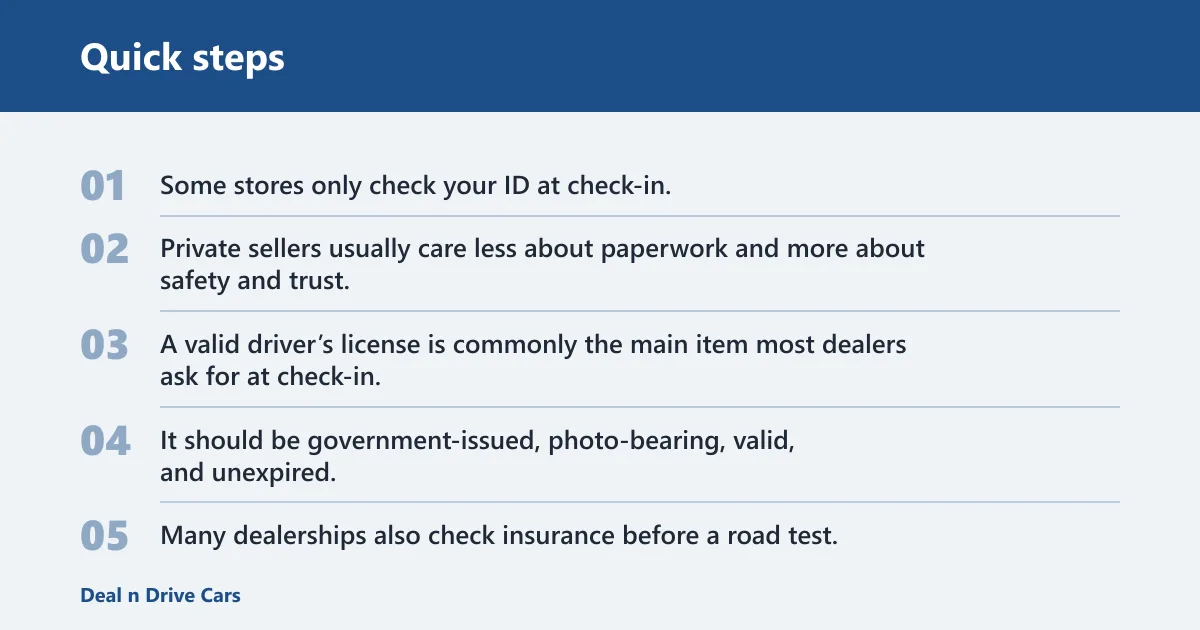
Dealership rules vary. Some stores only check your ID at check-in, while others also want insurance before they hand over the keys. Private sellers usually care less about paperwork and more about safety and trust.
What to bring, by scenario
| Scenario | What to bring |
|---|---|
| Dealership test drive only |
Required documents: valid and unexpired driver’s license; proof of insurance if requested. Optional items: phone, a notepad, sunglass case, route notes, passenger approval if you plan to bring someone. Common reasons you may be turned away: expired license, no ID, no insurance when the dealer asks for it, arriving too close to closing, or a salesperson cannot accompany you. |
| Dealership test drive with intent to buy |
Required documents: driver’s license; proof of insurance if requested; payment method such as cashier’s check, personal check, debit card, credit card for a deposit, or a preapproval letter if financing; trade-in title, registration, payoff information, and spare key if available. Optional items: calculator or payment app, insurance card, comparison notes, vehicle history report if you already pulled one. Common reasons you may be turned away: no approved payment plan, missing deposit method, incomplete trade-in paperwork, or an expired ID. |
| Private-seller test drive |
Required documents: driver’s license; proof of insurance if the seller wants it; any written permission the seller requests. Optional items: a friend, phone location sharing, flashlight for a quick inspection, and cash only if you are ready to pay and have verified the vehicle. Common reasons you may be turned away: unsafe meeting spot, no license, seller is uncomfortable with the route, or you ask to drive alone without permission. |
Minimum items most dealerships ask for
A valid driver’s license is commonly the main item most dealers ask for at check-in. It should be government-issued, photo-bearing, valid, and unexpired. Many dealerships also check insurance before a road test, especially if the route includes public roads rather than a closed lot.
Bring your phone, too. A phone helps you confirm the route, save the stock number, call your insurer if the dealer wants proof, and compare trim details later. If the store allows passengers, your phone can also share your location with someone else.
What to bring if you plan to buy
If you plan to buy the car after the test drive, bring payment proof before you arrive. That can mean a cashier’s check, personal check, debit card, credit card for a deposit, or a preapproval letter if you are financing. Dealers often move faster when the money side is ready.
Trade-in paperwork matters just as much. Bring the vehicle title if you have it, current registration, payoff information if there is a loan, and a spare key if you have one. Missing one item may slow the appraisal or the final paperwork.
Suppose you are shopping for a sedan and expect to make an offer the same day. If the dealer needs a deposit to hold the car, a card or check may matter more than your route notes. If your lender is involved, the preapproval letter can be the difference between a smooth handoff and a delay.
What changes for a private seller
Private sellers usually do not follow dealership check-in steps, but they can set their own terms. Many private sellers want to see a valid license, and some ask for insurance before they hand over the keys. Plan for a public meeting place and treat the exchange like a safety check, not a casual errand.
Picture a private-sale meet-up in a supermarket lot at 4 p.m. You bring your license, a friend rides along, and you share the route with someone who stays home. That setup is safer than meeting after dark in an empty lot.
Do I need my license to test drive a car?
Yes, in most cases you need a valid driver’s license to test drive a car. Dealerships often use it as the first check at the front desk, and private sellers may want it before they hand over the keys. An expired or missing license is a common reason a drive gets canceled.
Why a valid photo ID matters
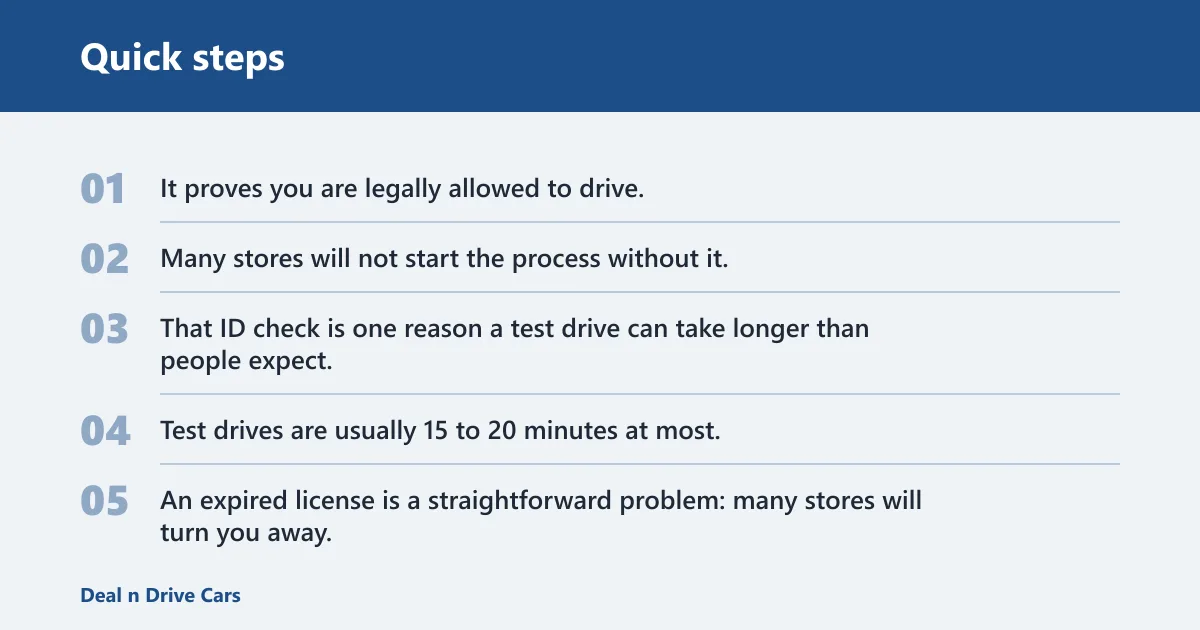
A driver’s license does two jobs. It proves you are legally allowed to drive, and it lets the dealership document who took the vehicle out. Many stores will not start the process without it, even if you are only taking a short loop around the block.
That ID check is one reason a test drive can take longer than people expect. Test drives are usually 15 to 20 minutes at most, but the visit around them can stretch because of check-in, paperwork, and waiting for the right vehicle to be ready.
Expired or temporary license issues
An expired license is a straightforward problem: many stores will turn you away. A temporary paper license can be accepted in some places, but others want the actual photo ID. If your license is close to expiring, renew it first if you can.
A common first-timer mistake is assuming an online renewal receipt will be enough. It usually is not. Bring the physical or digital item the dealership says it accepts, and confirm that in advance if your license status is unusual.
When a dealer may ask for more than a license
Some dealers ask for proof of insurance before a road test. Others want a co-driver’s information if you plan to bring a passenger. If you plan to buy, they may also ask for payment proof or financing documents before they let the car leave the lot.
The route can also affect what they ask for. A drive that includes city streets, a parking lot, a highway segment, and mixed traffic may trigger stricter rules than a short loop on nearby roads. Ask before you arrive so you know whether the route is just around the block or includes faster roads.
What should you bring if you plan to buy?
If buying is on the table, bring the money trail with you, not just your license. That means a cashier’s check, personal check, debit card, credit card for a deposit, or a preapproval letter if you are financing. Add trade-in paperwork so the dealer can work the numbers without delay.
Cash, card, or financing papers
- Bring a payment method the dealer accepts for the amount you may owe.
- Bring a preapproval letter if a lender is already involved.
- Ask whether the store accepts deposits by card, check, or cashier’s check.
- Confirm whether the amount needs to be exact or can be split across methods.
If you intend to pay cash, do not assume every store wants the same thing. In one common dealership example, the customer wanted to pay cash but had forgotten his checkbook before purchase. That kind of miss can stall the deal even when the buyer is ready.
The dealership process can take as little as 2-4 hours, but more commonly it advises planning for 4-6 hours at the dealership. If financing, appraisal, and paperwork all happen the same day, plan for that longer window.
Trade-in paperwork to bring with you
Bring the title if you own the trade-in outright. If there is still a loan, bring payoff information so the dealer can contact the lender or calculate what remains. Current registration helps, and a spare key is useful if you have one.
Dealers often need the trade-in details before they can finalize an offer. Missing the title or payoff information does not always stop the sale, but it usually slows it down.
Private-seller test drive safety
For a private-seller test drive, safety matters as much as paperwork. Meet in a public place, go in daylight, bring someone if you can, and share the route details with someone you trust. Private sellers set their own rules, so keep the plan simple and visible.
Meet in a public place
A parking lot, police-designated exchange zone, or busy retail area gives you more visibility than a driveway or isolated curb. A public location also makes it easier to leave if the seller changes terms or the car does not match the listing.
Go in daylight and bring someone
Daylight makes inspection easier and helps you spot body damage, tire wear, and warning lights. Bringing a friend adds another set of eyes and gives you backup if the meeting feels off. If the seller prefers you drive alone, ask why before agreeing.
Share the route before you leave
Tell someone where you are going and what roads you expect to use. A simple route with city streets and one short highway segment is easier to review than a vague “around the neighborhood” plan. If the seller will not agree to a clear route, walk away.
Private seller safety is not about being suspicious of everyone. It is about reducing avoidable risk when a stranger is handing you keys to a vehicle you have never driven.
Why might a dealership turn you away?
Dealerships usually turn people away for missing, expired, or mismatched documents, or for having no approved way to buy the car. If the store asks for insurance and you cannot show it, if your license is expired, or if you have no deposit plan, the drive may not happen.
Missing or expired ID
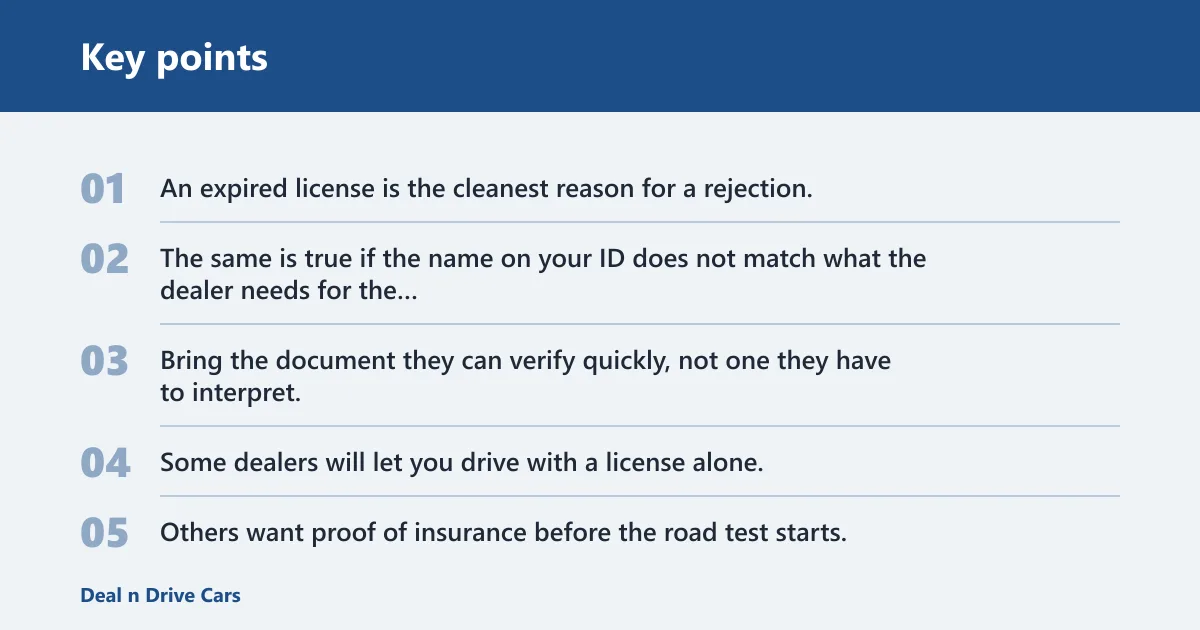
An expired license is the cleanest reason for a rejection. The same is true if the name on your ID does not match what the dealer needs for the check-in record. Bring the document they can verify quickly, not one they have to interpret.
No insurance when it is requested
Some dealers will let you drive with a license alone. Others want proof of insurance before the road test starts, and they may accept digital or physical proof depending on store policy. If your coverage does not fit the vehicle use, that can also cause questions.
No plan for payment or deposit
If you say you may buy the vehicle, the dealer may ask for a cashier’s check, card, personal check, or financing preapproval. If you have none of those, they may still let you drive, but they may not hold the car or move quickly on the paperwork.
Dealership appointment rules matter, too. Some stores check ID at check-in, some place a short hold on the vehicle while you wait, and some require a salesperson to stay with you the whole time. Ask before you go so the visit does not run long for the wrong reason.
What should you ask before you arrive?
Ask the dealer or seller about ID, insurance, passengers, route length, and whether the car can be held. Those five questions prevent the most common surprises. The answer can determine whether you need a license only or a full buying packet.
Ask about insurance and ID rules
Say plainly: “Do you need my license only, or do you also want proof of insurance?” That question tells you whether a digital card on your phone is enough or whether you should bring a physical copy. If your ID is temporary or recently renewed, mention that before arrival.
Ask about passengers and route length
Some dealerships allow a passenger only with permission, and some limit who can ride along because of age or insurance rules. Ask whether the salesperson stays in the car, whether you can drive alone, and whether the route includes city streets, parking lot maneuvering, a highway segment, or mixed traffic.
How long should you plan to stay? For the drive itself, not long. For the whole visit, plan wider. The customer in one example was on the test drive for a little over an hour, and he needed to be back home by 3pm. A dealership that is about 50 miles north of Temecula can still take a full chunk of the day once the paperwork begins.
Ask whether the car can be held
If you may buy, ask how long the dealership will hold the vehicle while you finish paperwork or arrange payment. A hold that lasts 15 minutes is very different from one that lasts through financing approval. Do not assume the car stays available unless the dealer says so.
Frequently asked questions
What do I need to bring for a test drive?
Bring a valid driver’s license first. Add proof of insurance if the dealership asks for it, plus your phone and any payment or financing documents if you may buy. For a private seller, a public meeting plan and a second person are smart additions.
What documents do I need to bring for a test drive?
At minimum, most dealerships want a government-issued photo ID that is valid and unexpired. Some also request insurance proof before the road test. If you intend to purchase, bring payment proof, financing preapproval, and trade-in papers so the deal can move without a second trip.
Can I test drive a car without bringing insurance?
Sometimes, yes. Some dealerships will let you test drive with only a valid license, while others ask for insurance before they hand over the keys. Because policies vary, call ahead and ask whether they accept digital proof, physical proof, or neither.
What should I bring to a dealership test drive?
Bring your license, any insurance proof the dealer requests, and your phone. If you may buy, add a payment method and financing paperwork. If there is a trade-in, bring the title, registration, payoff information, and a spare key if you have one.
What should I bring for a private seller test drive?
Bring your license, any insurance proof the seller requests, and a phone with location sharing ready. Meet in daylight at a public location and bring a friend if possible. Share the route details with someone you trust before you leave.
What if I forgot my checkbook or payment method?
Ask the dealership what backup payment forms they accept. A cashier’s check, debit card, credit card deposit, or financing preapproval may still let the deal continue. If they cannot verify payment, you may still test drive, but you may not be able to finish the purchase that day.
Can I test drive a car without buying it?
Yes. A test drive is for checking the vehicle, not a promise to buy it. Dealerships expect many shoppers to compare cars first, though they may still ask for ID, insurance, or a brief appointment check-in before you drive.