Fair price vs fair value: what’s the difference for a car?
Fair value is the benchmark. Fair price is the amount you should aim to pay or accept after negotiation. Mixing them up can leave you overpaying for a used car or taking less than a fair trade-in. This guide shows which number to use for retail, trade-in, and dealer listings, and how to compare asking price with each one.
| Decision factor | Fair price | Fair value | Winner |
|---|---|---|---|
| What it means | The amount you should reasonably expect to pay after negotiation. | The estimated worth of the vehicle in a defined valuation context. | Fair price for negotiation; fair value for appraisal context |
| Best use | Anchoring your offer before you talk numbers. | Comparing condition, mileage, and market context to a specific car. | Tie |
| How flexible it is | Moves with local supply, dealer pricing, and fees. | Moves with the valuation source and transaction type. | Tie |
| What it should be compared against | Asking price, then out-the-door price. | The correct valuation context: retail, trade-in, or wholesale. | Fair price |
| Fee treatment | Usually excludes taxes, title, and license in guides. | May also exclude taxes, title, and fees, depending on the source. | Tie |
| Negotiation value | Directly useful. | Indirectly useful. | Fair price |
Negotiation Targets Versus Contextual Worth
Fair price is the amount you should reasonably expect to pay after negotiation. Fair value is the estimated worth of the car within a set valuation context, such as retail, trade-in, or wholesale. They are related, but they are not the same number and should not be used interchangeably.
A simple definition of fair price
Think of fair price as the negotiation target. It is the amount that should fit the exact car, the local market, its mileage, options, and condition. In KBB terms, used-car fair purchase price is generally the midpoint of the Fair Market Range and is updated weekly. (b2b.kbb.com)
A simple definition of fair value
Fair value is the car’s estimated worth within a chosen context. A dealer’s trade-in offer, a consumer retail estimate, or a wholesale view can all count as “fair value,” depending on the source. That is why the label alone is not enough; you have to know which transaction type the number is meant to support.
Why the two numbers are not the same
Fair price is action-oriented. Fair value is context-oriented. A private-party seller, a franchised dealer, and a trade-in appraisal can all produce different “fair” numbers for the same car because each one reflects different costs, risk, and resale expectations.
Which number should you use for a used car?
Use fair price as your negotiation anchor and fair value as the reference point that matches the transaction type. For a dealer purchase, compare against retail-oriented numbers. For a trade-in, compare against trade-in value. For a private-party deal, compare against a fair market estimate for that exact car.
Retail dealer sale
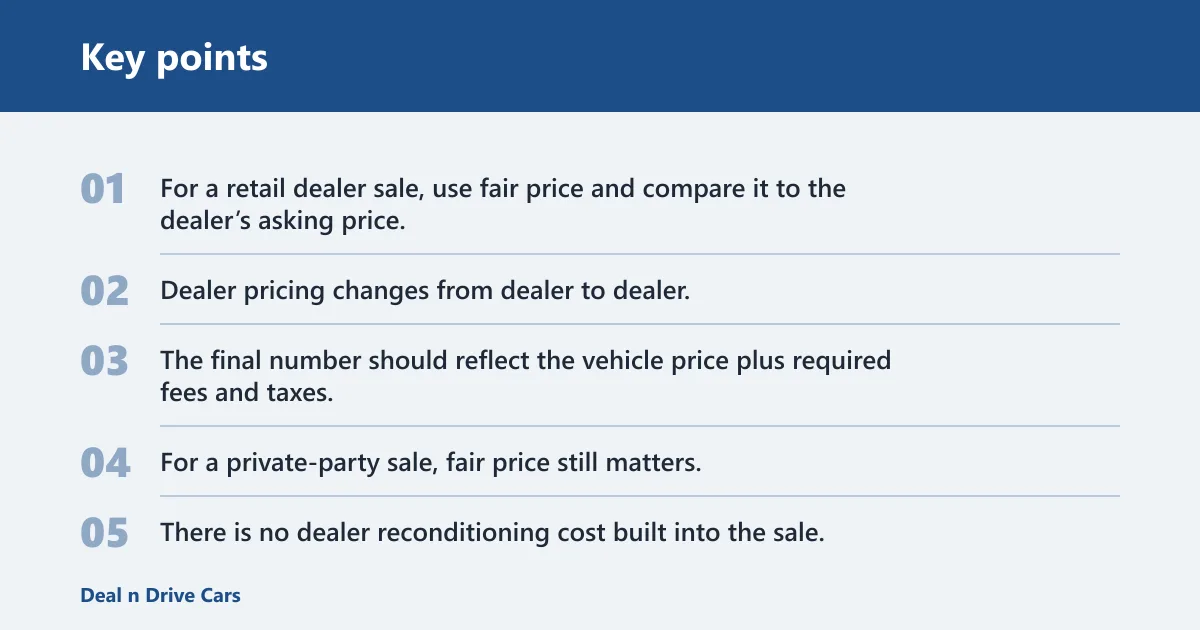
For a retail dealer sale, use fair price and compare it to the dealer’s asking price, then check the out-the-door total. Dealer pricing changes from dealer to dealer, so the asking price is only the first number on the sheet. The final number should reflect the vehicle price plus required fees and taxes, not a stack of extra charges.
Private-party sale
For a private-party sale, fair price still matters, but the benchmark is usually the private-party market for that car in your area. There is no dealer reconditioning cost built into the sale, so the asking price should generally sit below a dealer retail listing for a similar car in similar condition.
Trade-in offer
For a trade-in, compare the offer against trade-in value, not retail listing price. KBB’s trade-in value is what a consumer can expect to receive from a dealer for a trade-in vehicle, assuming an accurate appraisal of condition. It is usually lower than private-party value because the dealer must cover reconditioning and business costs.
CPO purchase
For a certified pre-owned purchase, compare the car against a dealer retail benchmark and the dealership’s CPO asking price, then inspect the added warranty or inspection package. A CPO car should not be benchmarked like a private-party car because it is typically reconditioned, carries dealer costs, and is sold through the dealer’s retail channel.
How Kelley Blue Book uses fair purchase price and fair market range
Kelley Blue Book’s used-car fair purchase price is generally the midpoint of the Fair Market Range. KBB updates used-car fair purchase price weekly, and it applies to a specific year, make, and model with typical miles and options. The number is built from actual transactions, other reliable third-party sources, and market conditions.
Fair purchase price as a midpoint
The midpoint matters because it keeps the number from pretending that every car in a model line should cost the same. A clean, lower-mileage example may sit above the midpoint. A higher-mileage car with wear may sit below it. The midpoint is a reference point, not a promise.
Fair market range as a band, not a single figure
KBB’s Fair Market Range is a consumer expectation band, not one fixed amount. It changes with local conditions, demand, inventory, and how the car is configured. That is why a model can have more than one “fair” number without anyone being wrong.
Why location changes the number
A car in one area can cost more or less than the same car elsewhere because supply and demand can vary by local market. City markets, rural markets, and regions with hard winters do not price used cars the same way. If you compare a local listing to a national average without adjustment, the number can mislead you.
Why dealer asking price can sit above fair value
Dealer asking price is the seller’s opening number, not the final one. KBB’s typical listing price reflects dealers’ asking prices for a used car, assumes the car has been fully reconditioned and has a clean title history, and includes dealer profit and operating costs. The actual sale price is often lower.
Typical listing price and dealer reconditioning
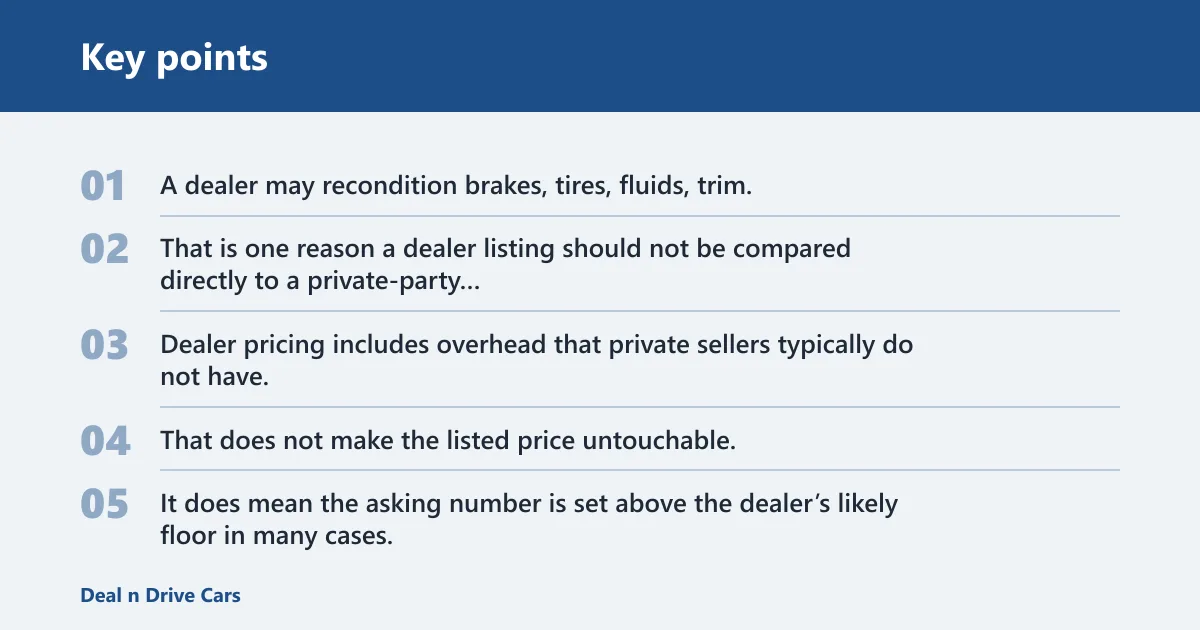
A dealer may recondition brakes, tires, fluids, trim, and cosmetic items before retailing the car. Those costs are part of the asking price. That is one reason a dealer listing should not be compared directly to a private-party price for a rougher car.
Profit and operating costs
Dealer pricing includes overhead that private sellers typically do not have, such as lot costs, staff, and reconditioning. That does not make the listed price untouchable. It does mean the asking number is set above the dealer’s likely floor in many cases, which is why negotiation still matters.
Why the final sale price may be lower
Final sale price can land below the sticker because buyers negotiate, inventory moves, and incentives change. Picture a compact SUV listed at one number on Monday and sold for less by Friday after a slow week on the lot. That gap is normal in retail used-car pricing.
Does fair price include taxes, title, and fees?
Usually not. Price guides often exclude taxes, title, and fees, and KBB excludes taxes, title, and fees from used-car fair purchase price. Those charges can change the out-the-door total materially, so you should always separate vehicle price from registration and dealer add-ons.
What price guides usually exclude
Guides usually focus on the vehicle’s base price or valuation number, not government charges or dealer paperwork charges. That means a number can be accurate for the car itself and still understate what you will actually pay to drive it home.
What belongs in out-the-door price
Out-the-door price is the full purchase total. It should include the negotiated vehicle price plus required taxes, title, license, and other mandatory fees. Optional products belong in a separate line so you can decide whether to accept them.
How to compare quotes correctly
Compare vehicle price to vehicle price, then compare out-the-door total to out-the-door total. If one dealer advertises a low base price but adds fees later, that quote may end up higher than a dealer with a stronger upfront number. A clean quote makes the comparison possible.
How condition and mileage change the number
Condition and mileage are core inputs to used-car valuation. They affect fair value and fair price because the same year, make, and model can be worth very different amounts depending on wear, accident history, and equipment. The match has to be for the exact vehicle, not just the model year.
Matching the exact trim and options
KBB’s used-car fair purchase price applies to a specific year, make, and model with typical miles and options. A higher trim with driver-assist features, better audio, or a sunroof may sit above a base model. Comparing the wrong trim can make a fair number look high or low by mistake.
High-mileage and low-mileage effects
Higher mileage generally pulls value down because buyers expect more wear and more near-term maintenance. Lower mileage can push value up if the condition supports it. A 2019 sedan with relatively low mileage should not be judged the same way as the same sedan with much higher mileage.
Clean title versus problem history
A clean title matters because problem history can lower value and increase buyer risk. KBB’s typical listing price assumes a clean title history. If a car has accident damage, flood history, or branding on the title, fair value should be adjusted downward for that risk.
One-page comparison: fair price, fair value, asking price, and out-the-door price
This table shows what to compare, by transaction type, and which fees belong in each number. Use it as a checklist before you negotiate or sign.
| Transaction type | Fair price | Fair value | Asking price | Out-the-door price |
|---|---|---|---|---|
| Retail dealer sale | Negotiation anchor based on local market and exact vehicle | Retail-oriented valuation for the same year, make, model, trim, miles, and condition | Dealer’s posted asking price; expect room to negotiate | Base price + tax + title + license + required dealer fees |
| Private-party sale | Negotiation anchor for the individual seller’s car | Private-party value or a consumer market estimate for that exact car | Seller’s asking price; may be firm or flexible | Purchase price + title transfer costs + taxes and registration where applicable |
| Trade-in | Use as a check against the dealer’s offer | Trade-in value from a source that prices dealer intake | Dealer offer amount for the trade | New car price or used car price minus trade credit, then add taxes and fees on the purchase |
| CPO purchase | Compare against retail fair price for the exact car | Retail valuation with reconditioning and clean-title assumptions where relevant | Dealer’s certified pre-owned listing price | Listed vehicle price + certification charges if required + taxes + title + license + dealer fees |
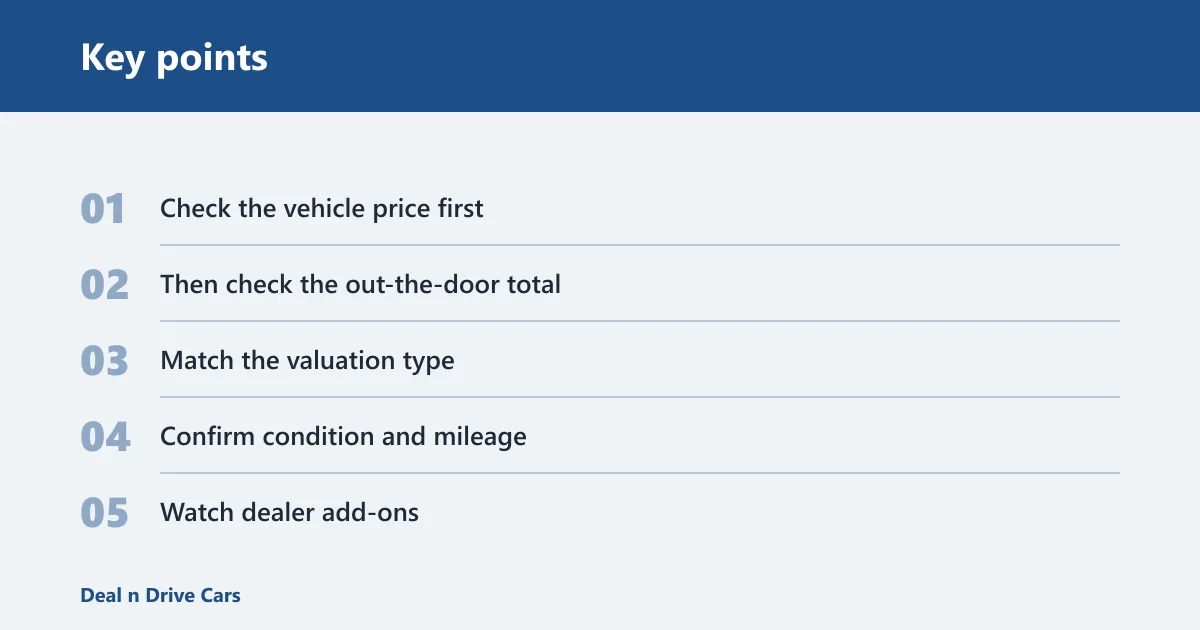
- Check the vehicle price first. Is the asking price reasonable for the exact car?
- Then check the out-the-door total. Do the taxes, title, license, and fees make the deal less attractive?
- Match the valuation type. Retail against retail, trade-in against trade-in, private-party against private-party.
- Confirm condition and mileage. A mismatch can distort the comparison by a lot.
- Watch dealer add-ons. Required charges belong in the out-the-door total, not hidden inside the vehicle price.
Choose fair price if…
Choose fair price if you are trying to decide what to offer, what to accept, or how far to negotiate on a retail or private-party vehicle. It is the better tool for closing the gap between the asking price and the number that fits your market.
Choose fair value if…
Choose fair value if you need a valuation anchor for appraisal, comparison shopping, or trade-in analysis. It is the better tool when the question is what the car is worth in a specific context, rather than what you should try to pay today.
Bottom line
Use fair price to negotiate. Use fair value to evaluate. If you are buying from a dealer, compare against retail fair price and then calculate the out-the-door total. If you are trading in, compare the offer against trade-in value. If you are buying a CPO car, treat it like a retail purchase with dealer reconditioning built in.
Frequently asked questions
What’s the difference between fair price and fair value for a car?
Fair price is the amount you should reasonably expect to pay or accept after negotiation. Fair value is the estimated worth of the car in a specific context, such as retail, trade-in, or wholesale. They can be close, but they are not interchangeable.
Is fair value the same as fair market price on a used car?
Sometimes people use those terms loosely, but they are not always the same thing. Fair market price usually points to what a buyer can reasonably expect to pay in a market, while fair value may refer to worth in a retail, trade-in, or wholesale setting depending on the source.
Which value should I use when negotiating a used car price?
Use fair price as your negotiation target and compare it against the seller’s asking price. If you are at a dealer, check the retail-oriented number and then verify the out-the-door total. If you are buying privately, use the private-party market context instead.
How does KBB define fair purchase price for used cars?
KBB’s used-car fair purchase price is generally the midpoint of the Fair Market Range. It is updated weekly, based on actual transactions plus other reliable third-party sources and market conditions, and it applies to a specific year, make, and model with typical miles and options.
What value should I compare a CPO car against?
Compare a CPO car against a retail benchmark, not a private-party benchmark. Certified pre-owned pricing reflects dealer reconditioning, clean-title assumptions, and dealer costs. That makes it closer to a retail listing than a private seller’s asking price.