When Should You Get Financing Before Shopping for a Used Car?
Get preapproved before comparing used cars. You get a hard budget, a likely APR, and room to move fast when the right listing appears. If you shop first, you can waste time on cars you cannot afford or lose a good deal while waiting on financing. This guide explains when to secure financing, how approval timing works, and how to compare lenders before you visit sellers.
Should you get preapproved before shopping?
Yes, for most used-car shoppers, preapproval should come before serious shopping. It gives you a real ceiling on price and payment, not a guess, so you can sort listings by what fits your loan terms and down payment instead of by sticker price alone.
What preapproval tells you about your budget
Auto loan preapproval is a lender review that estimates how much you can borrow, at what APR, and on what terms before you pick a car. That matters because the lender reviews your credit, income, and debts, then sets a limit you can use as a shopping boundary.
It also helps you compare used cars on the same basis. A $22,000 SUV with a shorter term and a larger down payment may fit a budget better than a $19,000 sedan with a longer term and higher fees.
How preapproval differs from prequalification
Prequalification is usually an estimate based on self-reported information. Preapproval is stronger because the lender has already reviewed your financial profile more closely and may have done a credit check. In shopping terms, prequalification is a rough guide; preapproval is the number you can use.
Bankrate says to get financing before visiting a dealership, and that advice lines up with the way used-car inventory moves. Dealers compete for used cars on the open market, and the market is highly competitive, so the best car may not sit around while you sort out financing.
Apply once you know you are ready to shop in the next few weeks, not after you have already found a car you want. A good rule is to get preapproved before test drives and before you start calling sellers in earnest, so you can move quickly when a listing fits your budget.
Apply now, wait, or shop cash only
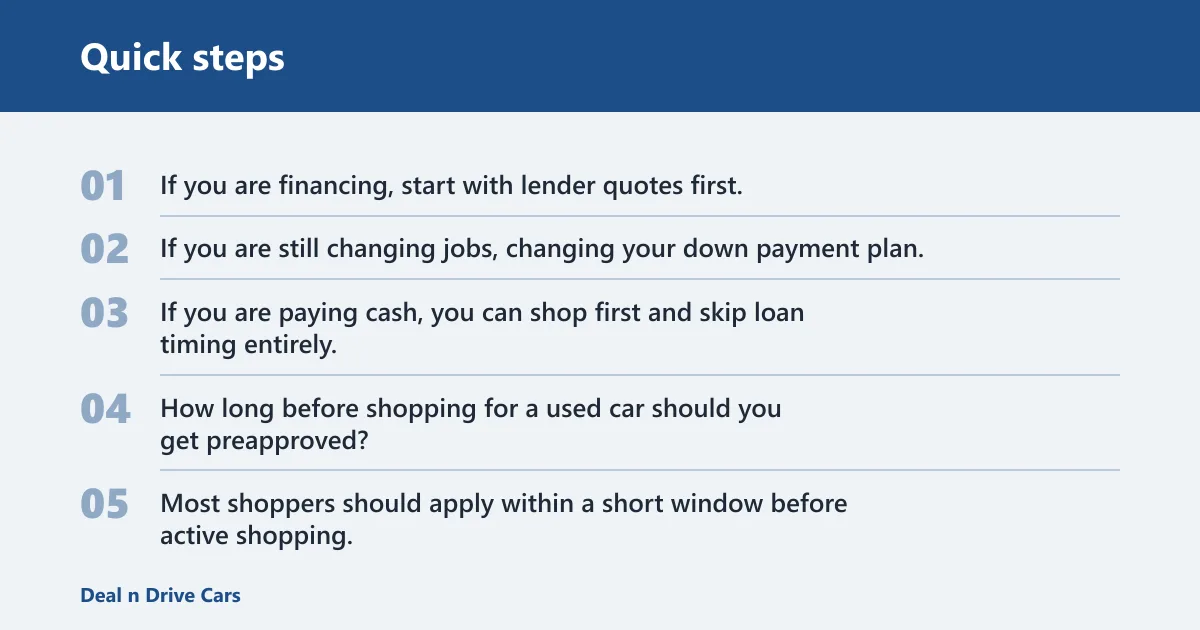
If you are financing, start with lender quotes first. If you are still changing jobs, changing your down payment plan, or fixing obvious credit issues, wait until your numbers are stable enough to apply once, not repeatedly. If you are paying cash, you can shop first and skip loan timing entirely.
How long before shopping for a used car should you get preapproved? Most shoppers should apply within a short window before active shopping, often a few weeks at most, because lender approval periods vary. If the preapproval window expires, the lender may ask for updated documents and may refresh the credit review.
A simple rule for rate shopping before test drives
Do your rate shopping before you start serious test-driving. Compare a bank, a credit union, and, if needed, a dealer finance office within a tight window so multiple inquiries are less likely to create confusion. The goal is to compare offers on the same loan amount, term, and down payment.
That matters because dealer APR can differ from bank or credit union APR even when the car price is the same. Consumer Reports positions its used-car content around reliability and budget, with pricing ranges and fuel-economy data that can help you choose the right car once your financing ceiling is set.
What to do if approval expires mid-search
If the preapproval expires while you are still shopping, do not assume the old terms still apply. Ask the lender whether you can renew it, whether new documents are needed, and whether the credit pull must be repeated. If your income or debt changed, the old approval may no longer match your file.
Say your lender approved you for a fixed amount, but you keep shopping for another month and add a new credit card in the meantime. The original offer may no longer be valid on the same terms, so you may need an updated decision before you sign.
Credit score and APR basics
Lenders check your credit score because it helps them judge repayment risk. That affects both approval odds and APR. Lenders may request a larger down payment when credit is weaker.
How credit affects approval and APR
APR is the annual cost of the loan, expressed as a rate that includes interest and certain loan charges. Comparing APR matters because a lower monthly payment can hide a higher total cost if the term is longer or the fees are steeper.
Suppose two lenders offer the same $18,000 loan. One quote has a lower APR but a shorter term, while the other has a higher APR and a longer term. The second may look cheaper each month, but it can cost more over the full loan.
How to compare lenders without extra surprises
Try to compare lenders in a tight rate-shopping window, then keep the details identical: same estimated price, same down payment, same term, and same vehicle type if possible. That keeps the quotes comparable and helps limit multiple hard-pull surprises on your credit report.
Bankrate distinguishes auto-loan sourcing through third parties, which is one more reminder to read the offer carefully. A brokered quote, a bank quote, and a dealer quote may all reach you through different channels, but the useful comparison is still APR, term, and total cost.
Monthly budget before you shop
Set your payment cap before you browse listings. Build it from the top down: monthly payment first, then taxes, registration, title, dealer fees, and insurance. That total becomes the ceiling for the car you should consider, not just the advertised price.
Use your cap as your shopping ceiling
Start with the highest monthly payment you can handle without strain. Then subtract estimated insurance and any other fixed transportation costs from your overall monthly budget. The remainder is the amount you can safely direct to the car loan payment.
Loan term changes the payment quickly. Common used-auto loan terms often fall somewhere around 36 to 72 months. Longer terms reduce the monthly payment, but they can increase total interest because the balance stays outstanding for more months.
Budget for taxes, fees, and insurance
Do not shop on sticker price alone. Sales tax, title, registration, dealer documentation fees, and insurance can move the real purchase cost enough to change which cars fit. If you plan to make a larger down payment, include that decision in the budget before you visit sellers.
Down payment reduces the amount financed, which lowers the payment and can improve approval odds. It also gives you more room if the lender values the car conservatively or if the dealer adds required fees at signing.
Used-car financing readiness checklist
This checklist helps you decide whether to apply now, wait, or skip financing. Use it before you visit dealers or private sellers, because the goal is to know your numbers before a test drive turns into a negotiation.
| Step | What to do | Why it matters |
|---|---|---|
| 1 | Decide whether you are financing, waiting, or paying cash | Sets the order of your search |
| 2 | Gather income, identity, and residence documents | Speeds the application and reduces delays |
| 3 | Check your credit score and recent changes to your debts | Helps predict approval odds and APR |
| 4 | Set a payment cap that includes taxes, fees, and insurance | Turns the budget into a real ceiling |
| 5 | Compare a bank, a credit union, and dealer financing | Shows which quote is best on the same terms |
| 6 | Note the approval window and expiration date | Prevents last-minute surprises if shopping runs long |
Documents to gather
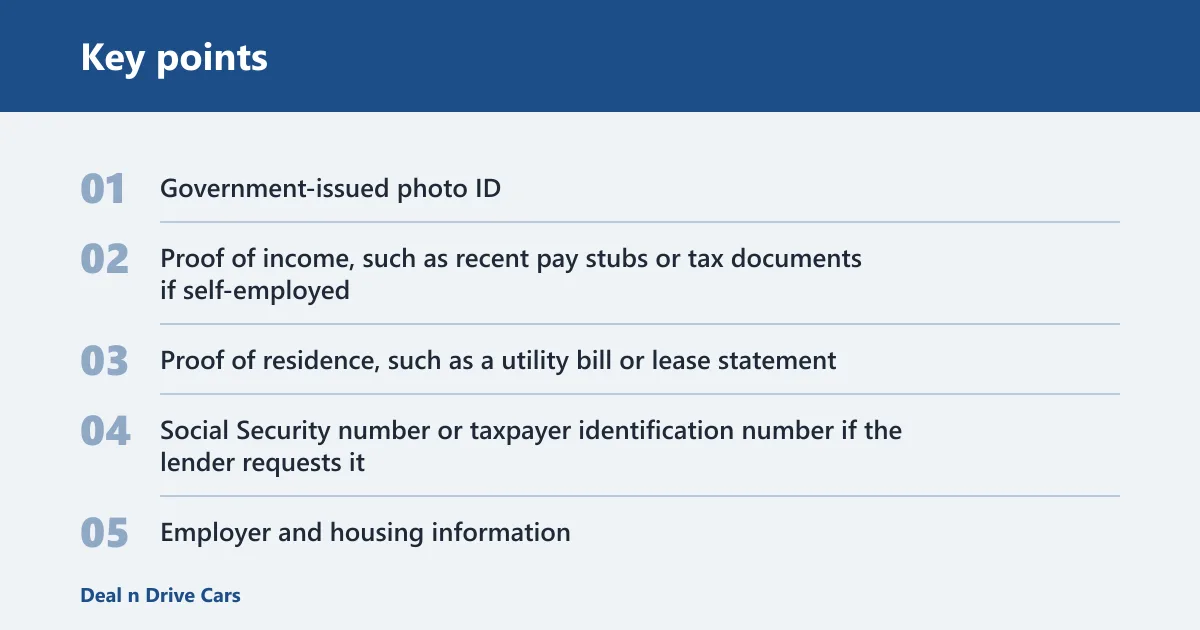
- Government-issued photo ID
- Proof of income, such as recent pay stubs or tax documents if self-employed
- Proof of residence, such as a utility bill or lease statement
- Social Security number or taxpayer identification number if the lender requests it
- Employer and housing information
- Details on trade-in payoff, if you still owe on your current vehicle
Estimated approval window
Approval timing varies by lender. Some decisions arrive quickly after the application and document review, while others take longer if income, residence, or trade-in payoff details need confirmation. Treat the approval window as a moving deadline, not a permanent offer.
When financing worksheet
| Budget item | Amount |
|---|---|
| Maximum monthly payment | $________ |
| Estimated insurance | $________ |
| Estimated tax, title, and registration | $________ |
| Dealer fees | $________ |
| Down payment | $________ |
| Maximum total you can spend | $________ |
Dealer financing versus outside loans

Dealer financing can be convenient, especially if you want one stop for the car and the loan. A bank or credit union loan can be better when you want a rate quote in hand before you arrive, or when the dealer offer is not competitive on APR, term, or fees.
When dealer financing can help
Dealer financing may help when the dealer has a promotional rate, a lender network that can approve more quickly, or a structure that works better for your down payment. It can also be useful if you want the dealer to match or beat another offer.
When bank or credit union rates matter more
Outside lenders matter most when you want a clean comparison before negotiating. A preapproval from a bank or credit union gives you a benchmark, so the dealer has to compete against a known offer rather than a vague payment target. That can improve your bargaining position.
Jalopnik notes that dealers compete for used cars on the open market, which is another reason to control the financing side early. If you walk in with a firm outside offer, you can judge the dealer’s APR and total cost against your own benchmark instead of accepting the first monthly payment you hear.
How preapproval helps you compare offers
Use the preapproval as a floor and a filter. If the dealer beats it on APR, term, and total interest without adding unwanted fees, the dealer offer may be the better choice. If not, you already have a backup and can keep negotiating from a stronger position.
Used-car financing decision tree
Use this simple path to decide what to do next. It separates financing timing from inventory shopping so you do not mix up rate shopping, car selection, and trade-in decisions.
- Apply now if you plan to finance and can gather documents this week. Get preapproved before test drives, compare the offer against at least one bank or credit union, and set your ceiling before you visit sellers.
- Wait until you choose a vehicle if your income, down payment, or trade-in payoff is still changing. Do not lock in a shopping budget until those numbers are stable enough for a useful application.
- Pay cash and skip financing if you are buying outright. In that case, focus on price, condition, title transfer, tax, registration, and sale paperwork instead of loan terms.
A common first-timer mistake is to fall in love with a car first and think about the loan later. That often leads to payment shock, weaker negotiating power, or a rushed lender search after the seller has already moved on to another buyer.
Frequently asked questions
Should I get an auto loan before going to the dealership?
Yes, if you plan to finance. Getting an auto loan before the dealership gives you a payment ceiling, a rate benchmark, and a faster path to closing. It also helps you compare dealer financing against a bank or credit union offer instead of starting from zero on the lot.
How long before shopping for a used car should I get preapproved?
Get preapproved before serious shopping starts, usually within a short window before test drives and dealer visits. The exact timing depends on the lender’s approval period, but a fresh approval is more useful than an old one that may expire before you choose a car.
Does getting preapproved hurt my credit score?
A preapproval can involve a hard credit inquiry, which may affect your score temporarily. The practical way to limit surprises is to compare lenders in a short window and keep applications close together. That keeps the shopping process organized and helps you compare offers cleanly.
What documents do I need before I apply for used-car financing?
Bring a photo ID, proof of income, proof of residence, your Social Security number if requested, and details about any trade-in payoff. If your income varies or you are self-employed, expect the lender to ask for extra documents such as tax returns or bank statements.