Which used car websites are legit for buyers to trust?
The legit used-car websites are the ones that show the seller’s real identity, full out-the-door pricing, clear fees, vehicle history, and purchase paperwork before you pay a deposit. Skip those checks, and you can lose money to fake listings, hidden damage, or delivery disputes. This guide shows how to judge a site’s trustworthiness fast, using seller, price, protection, and paperwork signals.
What makes a used car website legit?
A legit site lets you verify the seller, the vehicle, and the deal before money moves. The site itself may be trustworthy, but a listing can still be risky if the seller is private, the title is unclear, or the fees appear only after you start checkout.
Seller identity: dealer, retailer, private party, or auction
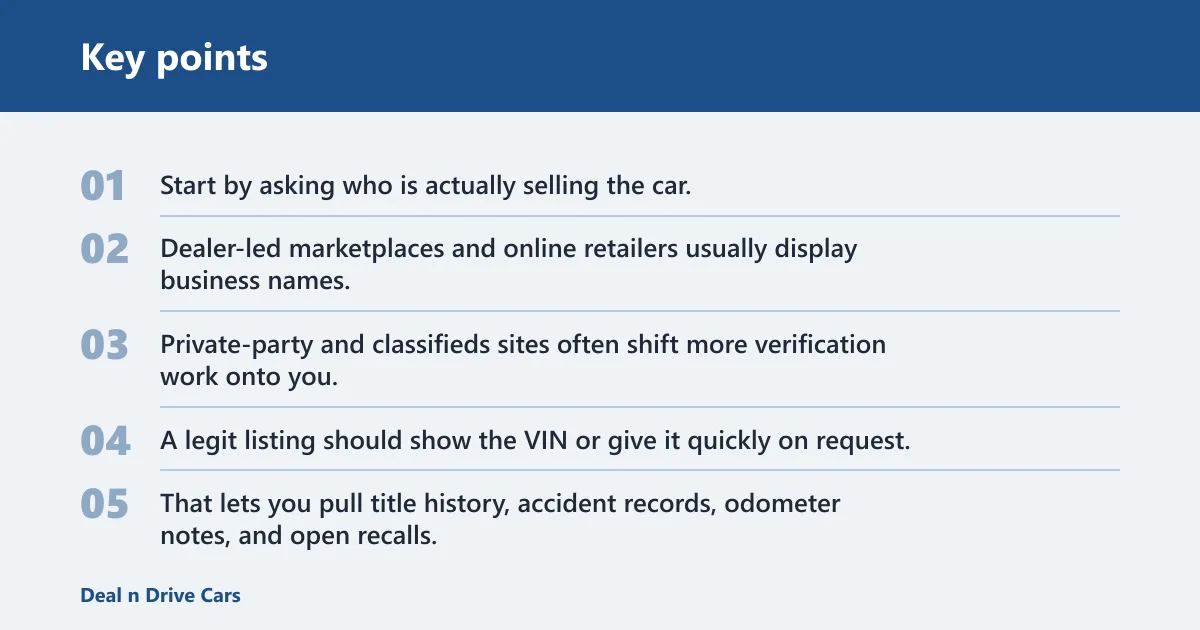
Start by asking who is actually selling the car. Dealer-led marketplaces and online retailers usually display business names, dealer license information, and inventory controls. Private-party and classifieds sites often shift more verification work onto you, which makes the listing cheaper but riskier.
VIN visibility and vehicle history access
A legit listing should show the VIN or give it quickly on request. That lets you pull title history, accident records, odometer notes, and open recalls. Consumer Reports says you should get a pre-purchase inspection by a certified mechanic, and that matters even more when the listing is far away.
Pricing clues: market comparison and price-drop history
Good sites show whether a price is above or below market and whether it has moved over time. CarGurus is known for deal ratings from Great to Overpriced, market-value comparison, and price-drop history. Those signals do not prove the car is good, but they help you spot bait-and-switch pricing.
Buyer protections: return policies, warranties, and dispute paths
Protection varies a lot by site type. Consumer Reports notes that used cars may have no or limited warranty, while CPO vehicles are inspected, refurbished, and warrantied. A site is easier to trust when it explains refund windows, warranty terms, transfer fees, and what happens if paperwork is missing.
📊 Consumer Reports says ESC became standard on all cars starting in 2012. Source: How to Find a Safe and Reliable Used Car for Your Budget….
Which used car websites are legit for buyers?
The strongest options combine visible seller identity, price transparency, and clear purchase rules. CarGurus, Carvana, CarMax, AutoTrader, and Cars.com are generally useful because they expose more buyer-verifiable details than a bare classified ad. Aggregators and private-party sites can still help, but you have to verify far more on each listing.
CarGurus
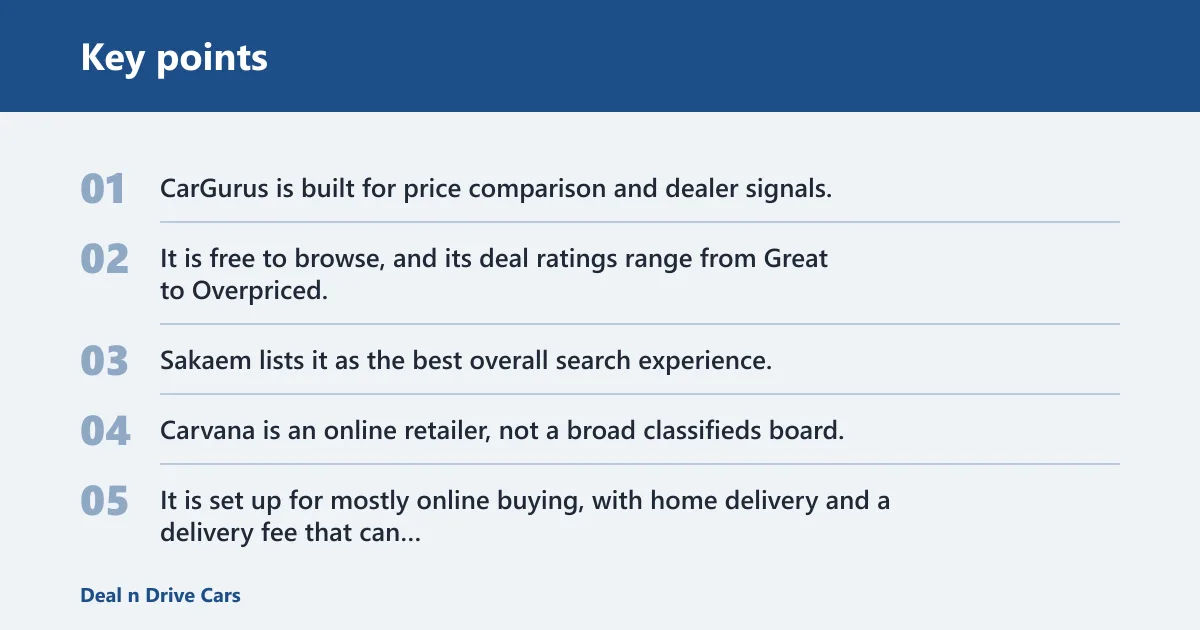
CarGurus is built for price comparison and dealer signals. It is free to browse, and its deal ratings range from Great to Overpriced, which can help you judge whether a listing seems well above or below market value. Sakaem lists it as the best overall search experience, and Top Consumer Reviews gives it 5.0 and notes a local inventory of 22,619 used vehicles.
Carvana
Carvana is an online retailer, not a broad classifieds board. It is set up for mostly online buying, with home delivery and a delivery fee that can vary. Consumer Reports says used cars can be bought from services like Carvana, so it fits buyers who want a single seller, defined checkout steps, and delivery logistics in one place.
CarMax
CarMax is a retailer with trade-ins and consumer protections. It also offers home delivery in some service areas, and transfer fees can vary. Sakaem lists CarMax for trade-ins and consumer protections. This is a strong fit if you want a more retail-like transaction and fewer private-party unknowns.
AutoTrader and Cars.com
AutoTrader and Cars.com are large dealer-led marketplaces. AutoTrader is known for classified listings depth and dealer-led inventory, while Cars.com emphasizes dealer reviews and marketplace listings. Both are free to browse, and both are most useful when you want a wide search with dealer-level contact details attached to the listing.
AutoTempest and Autolist
AutoTempest and Autolist are search tools that pull from other sources. AutoTempest searches many marketplaces at once, and Autolist offers mobile app search with aggregated inventory. Both are free to use. They widen your search, but the source site still decides whether the listing has strong paperwork, pricing, and seller checks.
Facebook Marketplace, Craigslist, and Bring a Trailer
Facebook Marketplace and Craigslist are best understood as local private-party channels. Sakaem says they shift verification work onto the buyer, and both are free to list. Bring a Trailer is different: it is an enthusiast auction site with buyer’s premium rules and no built-in home delivery, so transport may need to be arranged separately.
How do I compare marketplace, retailer, aggregator, classifieds, and auction sites?
The category matters because each type reveals different proof before you contact a seller. Retailers usually feel safer because they control inventory and paperwork more tightly. Marketplaces and classifieds can have better prices, but the buyer has to verify far more on each listing. Auctions are useful for unusual cars, not casual low-risk shopping.
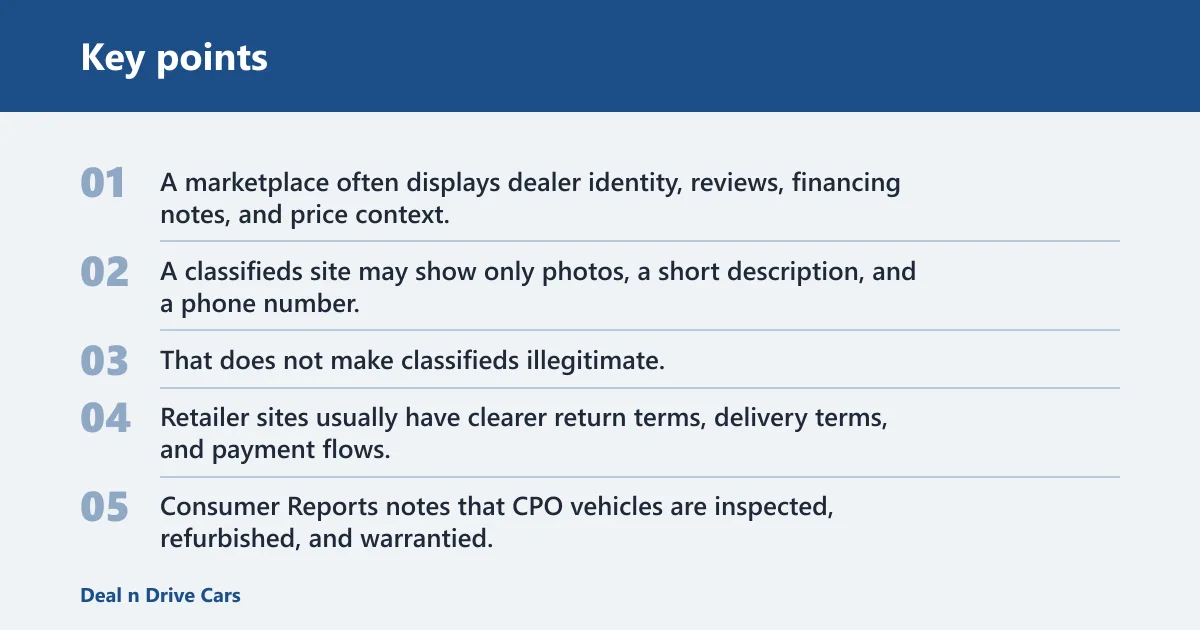
What a marketplace shows that a classifieds site may not
A marketplace often displays dealer identity, reviews, financing notes, and price context. A classifieds site may show only photos, a short description, and a phone number. That does not make classifieds illegitimate, but it means you must do more work on title status, VIN checks, fee confirmation, and payment security.
Why retailer sites usually feel safer
Retailer sites usually have clearer return terms, delivery terms, and payment flows. Consumer Reports notes that CPO vehicles are inspected, refurbished, and warrantied, which is why many shoppers feel more comfortable with dealer-backed or retailer-backed inventory. Safety still depends on the specific car, not the logo at the top of the page.
Why aggregators widen your search but do not verify every listing
Aggregators are useful because they centralize inventory. They are not final proof of legitimacy. AutoTempest can surface a broad set of listings, but the real checks still happen on the source site and with the seller. That is where you confirm VIN, title, fees, and whether the price changed.
When auctions make sense and when they do not
Auctions can be smart for enthusiasts, rare trims, or cars with strong documentation. They are less ideal if you want a simple return window or an easy out-the-door price. Bring a Trailer can be excellent for specialty cars, but you still need to plan inspection, payment, and transport before bidding.
Use the legitimacy checklist before you message any seller
This checklist separates site legitimacy from seller legitimacy. A reputable site can still host a bad private-party listing. Use the table below to judge the platform first, then judge the specific listing before you share personal information or send a deposit.
| Site type | Seller identity | VIN visibility | Price history | Dealer reviews | Return or refund policy | Financing transparency | Delivery terms | Paperwork readiness |
|---|---|---|---|---|---|---|---|---|
| Retailer site | High | High | Medium | Low | High | High | High | High |
| Dealer marketplace | High | High | Medium | High | Medium | High | Medium | High |
| Aggregator | Medium | Medium | Low | Low | Varies by source | Varies by source | Varies by source | Varies by source |
| Classifieds | Low | Low | Low | Low | Low | Low | Low | Low |
| Auction | High | High | Low | Low | Low | Medium | Low | Medium |
- Confirm who owns the listing and whether it is a dealer, retailer, private party, or auction seller.
- Get the VIN and run a history report before you send money.
- Compare the asking price with similar cars and note any price-drop history.
- Read return, refund, warranty, and fee terms line by line.
- Ask how financing, delivery, title transfer, and temporary registration are handled.
Which sites are safest for online buying and delivery?
Carvana and CarMax are often among the easier fits for remote buying because they are built around retail transactions, delivery terms, and more straightforward paperwork handling. Delivery is convenient, but it does not prove the car is good. You still need the VIN, title status, fees, and return terms before checkout.
Carvana’s online-retail model
Carvana’s fully online buying process reduces some of the friction that comes with private-party deals. That can help first-time remote buyers. Sakaem lists Carvana as best for fully online buying, and Consumer Reports says used cars can be bought from services like Carvana. Still, delivery fee varies, and the car can arrive with issues that need documentation.
CarMax and home delivery in service areas
CarMax offers home delivery in service areas, which helps when the right car is not nearby. Its trade-in process also simplifies the transaction for shoppers replacing a current vehicle. Transfer fees vary, so you should confirm them before deposit or financing paperwork.
What delivery does and does not protect you from
Delivery helps with convenience, not certainty. It does not stop title defects, hidden damage, or a mismatched trim level. Picture a buyer in a metro area ordering a sedan from 200 miles away: if the VIN, fees, and paperwork are not confirmed first, the car can arrive with a problem that is costly to unwind.
Shipping steps for out-of-area purchases
For shipped cars, ask who arranges transport, who insures the vehicle in transit, and whether pickup is allowed if the car fails inspection. Get every fee in writing. If a seller pushes you to pay a deposit before giving the VIN, title status, or final out-the-door price, walk away.
How do you avoid scam listings on used car websites?
Scam avoidance starts with verifying the VIN, comparing market price, and insisting on written fees and paperwork before any payment. Avoid off-platform payment pressure and any seller who wants to move the conversation to a personal app immediately. Fake listings often sound urgent, underpriced, and vague on title details.
Spot fake pricing and bait-and-switch tactics
Prices far below market should trigger extra checks. Use market comparison tools and look for price-drop history. If the listing changes after you ask for an out-the-door number, ask for a written breakdown. Bait-and-switch often appears as a low headline price with add-ons hidden until the last step.
Check title status and history reports
Ask whether the car has a clean title, salvage title, rebuilt title, or lien issue. Then verify that answer with a vehicle history report. Consumer Reports notes that used cars may have no or limited warranty, so title review matters even more when there is little seller protection after the sale.
Avoid off-platform payment pressure
Do not send money by wire transfer, gift card, or payment app to a seller you have not verified. Off-platform payment pressure is one of the most common warning signs in private-party and classifieds listings. A legitimate dealer or retailer should be able to explain secure payment steps in writing.
Confirm fees, transport, and paperwork before any deposit
Ask about documentation fees, dealer fees, delivery fees, transport insurance, registration timing, and who files the title. Consumer Reports notes that private sales mean handling paperwork yourself, so the burden is heavier there. A common first-timer mistake is paying a deposit before learning whether the seller can actually transfer the title.
Which sites are best for private-party buying and selling?
Facebook Marketplace and Craigslist are the biggest private-party options for local reach, and both are free to list. They can be cheaper than dealer sites, but they are also riskier because the site often provides little verification. Bring a Trailer suits enthusiast private sales better, but its auction structure changes the buying process.
Facebook Marketplace and Craigslist for local reach
These platforms work best when you can meet locally, inspect the car in daylight, and verify the seller’s identity. Sakaem says both shift verification work onto the buyer. That means title checks, VIN checks, and safe payment terms matter more than on dealer-backed sites.
Bring a Trailer for enthusiast listings and auction rules
Bring a Trailer is a fit for collector and enthusiast cars where detailed photos and auction rules matter. It is not a simple local classifieds experience. There is no home delivery, so you arrange transport. The buyer’s premium also changes the real cost, so budget beyond the bid price.
What private sellers should prepare before listing
If you are selling privately, have the title, registration, service records, VIN, and a clear description ready before you post. Honest disclosures reduce disputes. Buyers should ask for the same documents before meeting in person, especially if the car is older, modified, or listed far below similar examples.
Can I trust used car websites that show thousands of listings?
Yes, but volume alone means little. A huge inventory does not prove that every listing is accurate, current, or fairly priced. Trust comes from the site’s verification tools, seller identity, history access, and paperwork clarity. Use the big sites to broaden search, then verify each car individually.
Frequently asked questions
is cars for sale a legit website
Carsforsale-style sites can be legitimate marketplaces if they show dealer identity, VIN details, and enough pricing information to compare listings. The real question is not whether the site exists, but whether a specific car has clear seller information, a verifiable title status, and written fees before you contact anyone.
is good car a legit site
A site with a name like “Good Car” is only as trustworthy as the seller and listing details it exposes. Check for a real business identity, VIN access, price history, return terms, and paperwork timing. If those are missing, treat it like any other high-risk listing source.
How do I know if a used car site is legit?
Look for seller identity, VIN visibility, price history, dealer reviews, refund or return terms, financing transparency, delivery terms, and paperwork readiness. A legit site makes those details available before payment. If the site hides fees, refuses the VIN, or pressures a deposit, treat it as a warning sign.
Which used car sites have buyer protections?
Retailer-style sites usually have the strongest protections, especially when they publish return or refund rules and warranty terms. CarMax and Carvana are the clearest examples in this group. Dealer marketplaces may also offer protections, but those terms vary by seller, so read the listing and purchase documents carefully.