How Much Is Car Insurance Per Month for a Used Car?
For a used car, a common budget range is about $50 to $150 per month for liability-only coverage and about $120 to $300 for full coverage. Full coverage usually makes sense only when the car’s cash value is at least about 10 times the annual premium. Skip that math, and you can pay for coverage that returns too little after a total loss. This guide shows how to set a monthly insurance target, pick a deductible, and decide when full coverage still pencils out.
This guide is part of our Car insurance cost: what used car buyers should expect series.
What a monthly used-car premium means
A monthly premium is the amount you pay each month for the policy you choose. The number changes with driver profile, coverage level, vehicle details, and where the car is kept. A quote is an estimate, not a final bill.
That matters while you shop. A low monthly quote can rise when the insurer sees a fuller VIN, a different garaging address, or a driver detail that was missing from the first estimate.
The practical goal is to budget a monthly range before you buy, then check whether the car’s value and your deductible make that coverage worth the price.
What changes used-car insurance costs
Used-car insurance price is driven by the same core inputs on most policies: the driver, the car, and the location. The monthly bill can vary a lot even when two used cars cost the same to buy.
Driver profile factors
Age, driving record, years licensed, and a credit-based insurance score where state law allows it can all move the price. A clean record usually costs less than one with recent tickets or claims. Younger and less experienced drivers also often pay more.
Vehicle factors
Make and model matter because repair costs, parts availability, safety features, and theft risk affect claim costs. A used sedan with common parts and strong safety equipment often prices differently from a higher-theft SUV or a car with expensive body panels.
Location and garaging address
State rules set the legal floor, but ZIP code and garaging address can change the premium above that floor. Local theft rates, storm risk, traffic density, and claim frequency all feed into the quote. Parking on-street can also price differently from off-street storage.
Liability vs full coverage on a used car
Liability is usually the cheapest option because it covers damage and injuries you cause to other people, not your own car. Full coverage usually means liability plus collision and comprehensive, so the monthly premium is higher. Financed used cars often need full coverage.
What liability covers
Liability coverage usually includes bodily injury liability and property damage liability. Those limits may meet state minimum requirements, which are the legal baseline, but they do not pay to repair your own car after a crash or theft.
What full coverage usually includes
Full coverage is shorthand, not a separate legal category. In practice, it means liability, collision, and comprehensive. Collision helps with crash damage to your car. Comprehensive helps with theft, fire, hail, falling objects, and similar losses.
When lenders require full coverage
If you finance a used car, the lender may require collision and comprehensive until the loan is paid down or paid off. That can apply even to an older car with low market value. The lender’s rule can override a shopper’s choice to carry only liability.
How deductibles change the monthly price
A deductible is the amount you pay before collision or comprehensive coverage starts paying. Higher deductibles usually lower the monthly premium, but they raise your out-of-pocket cost after a claim. The tradeoff matters most on a used car with limited value.
Collision deductible basics
Collision applies when the car is damaged in a crash, whether you hit another vehicle or a fixed object. A $1,000 deductible often costs less per month than a $500 deductible, but the extra savings may be small compared with the added risk.
Comprehensive deductible basics
Comprehensive usually carries the same deductible concept. Raising it can lower the bill, but it also means you pay more if the car is stolen or damaged by a non-crash event. The right level depends on how much cash you could cover tomorrow.
Finding the tradeoff between premium and repair risk
A common rule is to compare the yearly premium savings from a higher deductible with the extra amount you would owe after a claim. If raising the deductible saves only a little per month, the added risk may not be worth it. If it saves a lot, it may fit a low-value car better.
Used-car insurance worksheet

Use the values below as a budgeting worksheet, not a quote promise. The point is to see when full coverage still makes sense and when liability becomes the cleaner budget choice.
| Scenario | Example car value | Estimated monthly premium drivers | Suggested coverage stack | Deductible choice | Keep or drop full coverage? |
|---|---|---|---|---|---|
| Low-value car | $4,000 actual cash value | Liability $55-$95; full coverage $140-$240, with theft risk and repair costs doing much of the work | Liability with medical payments or PIP if required; add roadside only if useful | Liability only, or $1,000 if collision and comprehensive are kept | Drop full coverage when annual full-coverage premium is close to, or above, 10% to 15% of the car’s value |
| Mid-value car | $12,000 actual cash value | Liability $60-$110; full coverage $150-$270, with model-specific repair costs and location driving the spread | Liability plus collision and comprehensive; add rental reimbursement only if a temporary substitute car matters | $500 if you want moderate protection; $1,000 if you can absorb a bigger repair bill | Usually keep full coverage until the premium starts to feel large relative to the car’s cash value |
| Financed used car | $9,000 actual cash value | Liability $65-$120; full coverage $160-$290, with the lender’s requirement adding pressure to keep collision and comprehensive | Liability, collision, comprehensive, and any lender-required gap or similar protection if offered | $500 to $1,000, based on cash reserve and lender rules | Keep full coverage until the loan is paid off, unless the lender allows a change |
For example, if a used hatchback is worth about $4,000 and full coverage costs around $200 per month, the comparison is easy to see. That works out to about $2,400 a year, or roughly 60% of the car’s value. In that case, a total-loss payout may not justify the price of collision and comprehensive unless the lender requires them.
For example, a sedan worth about $12,000 with full coverage at around $165 per month and a $1,000 deductible would be a workable comparison. The yearly cost is $1,980, which can still be reasonable if the car is financed, parked on the street, or expensive to replace after a crash.
How to estimate a quote before buying
You can estimate insurance before you buy by collecting enough details for an accurate quote. The quote gets better with the car’s VIN, but an early estimate can still work without it in many cases. Registration is often not needed for the first estimate, though it may be needed later to bind coverage.
Using the VIN for better accuracy
The VIN is the main lookup identifier for the car. It helps the insurer confirm the exact trim, safety equipment, engine, theft data, and repair profile. If you already have the VIN, use it. If you do not, a year-make-model-trim estimate is usually the next best step.
When registration is not needed yet
During shopping, you may only need the seller’s car details and your own driver information to get a rough quote. Later, once you are ready to bind coverage, the insurer may ask for registration or proof of the car’s final purchase details depending on the state and company.
What to compare across quotes
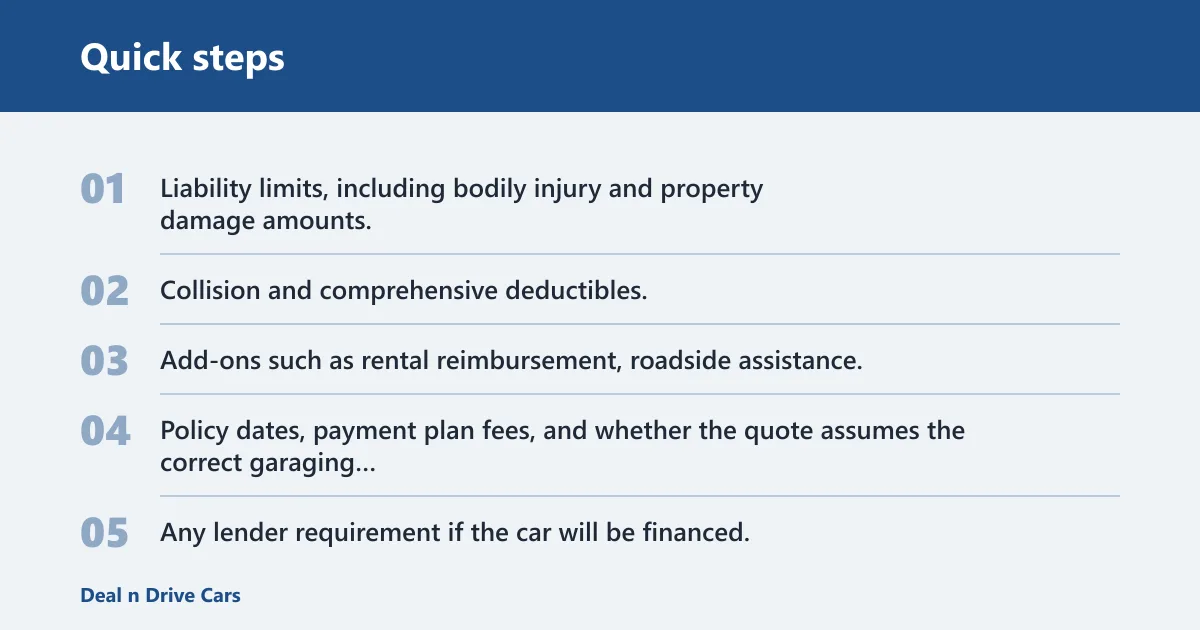
- Liability limits, including bodily injury and property damage amounts.
- Collision and comprehensive deductibles.
- Add-ons such as rental reimbursement, roadside assistance, and medical payments or PIP where offered.
- Policy dates, payment plan fees, and whether the quote assumes the correct garaging address.
- Any lender requirement if the car will be financed.
When should you drop full coverage on a used car?
Drop full coverage when the car’s actual cash value is too low to justify what you pay for collision and comprehensive each year. If the premium is high relative to the value of the car, the payout after a total loss may not make the coverage worth keeping.
Using actual cash value as the guide
Actual cash value is the amount the insurer generally uses to settle a total-loss claim. When a used car’s value falls, the maximum payout falls too. That is why a car that made sense to insure fully at $15,000 may stop making sense at $4,000.
A simple keep-or-drop rule
Start by multiplying the monthly full-coverage premium by 12. If that yearly cost is more than about 10% of the car’s current cash value, full coverage deserves a hard look. If it is far above that line, liability-only may fit the budget better.
Cases where dropping coverage is a bad idea
Do not drop full coverage if a lender requires it. Do not drop it if you cannot replace the car easily after a loss. And do not drop it if the vehicle still has meaningful value and your savings cannot absorb the repair or replacement shock.
Ways to lower the monthly bill
The fastest ways to cut cost are usually deductible changes, coverage adjustments, and quote shopping. Cheap and good are not the same thing, so compare the exact limits and deductibles, not just the monthly number.
Raise deductibles carefully
Moving from a $500 deductible to a $1,000 deductible can reduce the premium, but only if you can cover the extra out-of-pocket cost later. The savings are most useful on cars with modest cash value and on drivers who keep an emergency fund.
Adjust add-ons
Rental reimbursement, roadside assistance, and similar extras can be useful, but they do not change the core liability-versus-full-coverage decision. Remove them first if the monthly budget is tight and the main goal is keeping the legal and lender-required coverage in place.
Shop multiple carriers
Compare the same liability limits, the same collision and comprehensive deductibles, and the same driver and vehicle details across carriers. Small changes in the garaging address, annual mileage, or VIN details can move the quote, so keep the inputs consistent.
Frequently asked questions
How much is car insurance per month for a used car?
The final number depends on your driving record, age, location, the car itself, and the deductible you choose.
How much is car insurance per month usually?
There is no single usual number because monthly premiums change with coverage level, driver profile, and location. A clean driver in a lower-risk area often pays less than a young driver with a recent ticket. Full coverage also costs more than liability only.
Why is my used car insurance so expensive?
Used-car insurance can be high if the car has costly parts, higher theft risk, or weak safety ratings. Your age, claims history, years licensed, credit-based insurance score where allowed, ZIP code, and garaging address can also push the price up.
Is liability or full coverage cheaper on a used car?
Liability is usually cheaper because it covers damage to other people and their property, not your own car. Full coverage adds collision and comprehensive, so the monthly bill rises. A financed used car may still need full coverage even if it is older.
Can I get a quote without a VIN or registration?
Yes, many insurers can give an early estimate without a VIN or registration if you provide the year, make, model, trim, and your driver details. A VIN improves accuracy, and registration may be needed later when you bind coverage or finalize the policy.