What Affects Car Insurance Price on a Used Car?
Used-car insurance price comes from three inputs: your driving record and location, the car’s repair and theft risk, and the coverage you choose. An older car is cheaper only if lower liability, collision, and comprehensive costs offset your driver risk. Miss that mix, and a “cheap” used car can cost more to insure than a newer one. This guide explains the main pricing factors, which ones move most by model, and how to estimate the quote before you buy.
This guide is part of our Car insurance cost: what used car buyers should expect series.
How driver profile and vehicle traits shape premiums
Insurers price used cars by combining driver risk, vehicle risk, and coverage choice, not age alone. The same hatchback can cost very different amounts to insure when the driver has a clean record, the car sits in a low-theft ZIP code, or the buyer chooses liability only instead of full coverage.
Driver profile
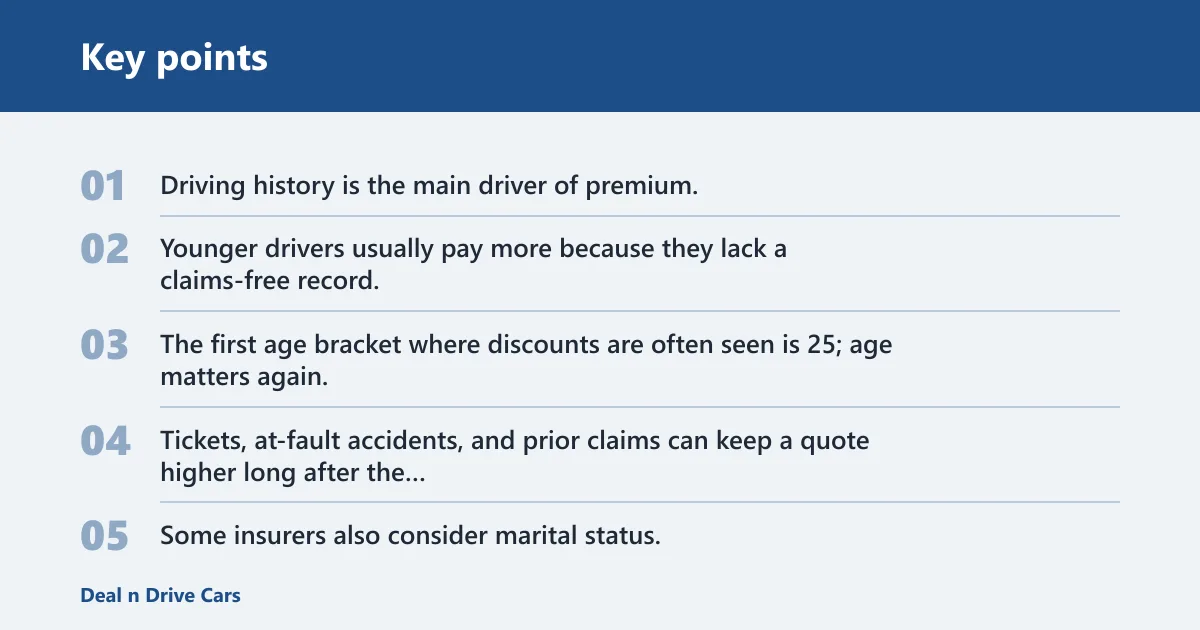
Driving history is the main driver of premium, and age usually matters through experience and claim patterns. Younger drivers usually pay more because they lack a claims-free record. The first age bracket where discounts are often seen is 25; age matters again, less strongly, until about 50 or 55.
Tickets, at-fault accidents, and prior claims can keep a quote higher long after the event. Some insurers also consider marital status, and some may price single drivers higher than married drivers. Driving for work or for pleasure can also affect rates, because business use is commonly reported to increase exposure.
Vehicle risk
What you drive affects your premium because insurers build rates from repair cost, theft data, safety records, performance, trim level, and market value. A base trim with ordinary parts may price differently from a sporty trim with larger tires, pricier body panels, and more claims.
Security features can help. An alarm, immobilizer, tracking device, and garaging may lower risk on some cars, especially models that are theft targets or parked on the street overnight. Insurers do not price every feature the same way, but anti-theft equipment can move a quote in the right direction.
Coverage choice
Coverage type changes the quote as much as the car does. Liability only, full coverage, comprehensive, collision, and state minimums do not price the same way, because each one changes what the insurer may have to pay after a loss.
Older cars often look cheaper under liability only because the vehicle itself is worth less. Full coverage can stay expensive when actual cash value is still meaningful, or when replacement parts and labor are costly. That is why an older luxury sedan can cost more to insure than a newer economy car.
Why a used car may cost more
A used car may cost more to insure when theft exposure, repair cost, or coverage choice pushes the quote up faster than age pulls it down. High-theft models, performance trims, and older luxury cars can all stay pricey, especially if the buyer keeps collision and comprehensive.
High-theft models and costly repairs
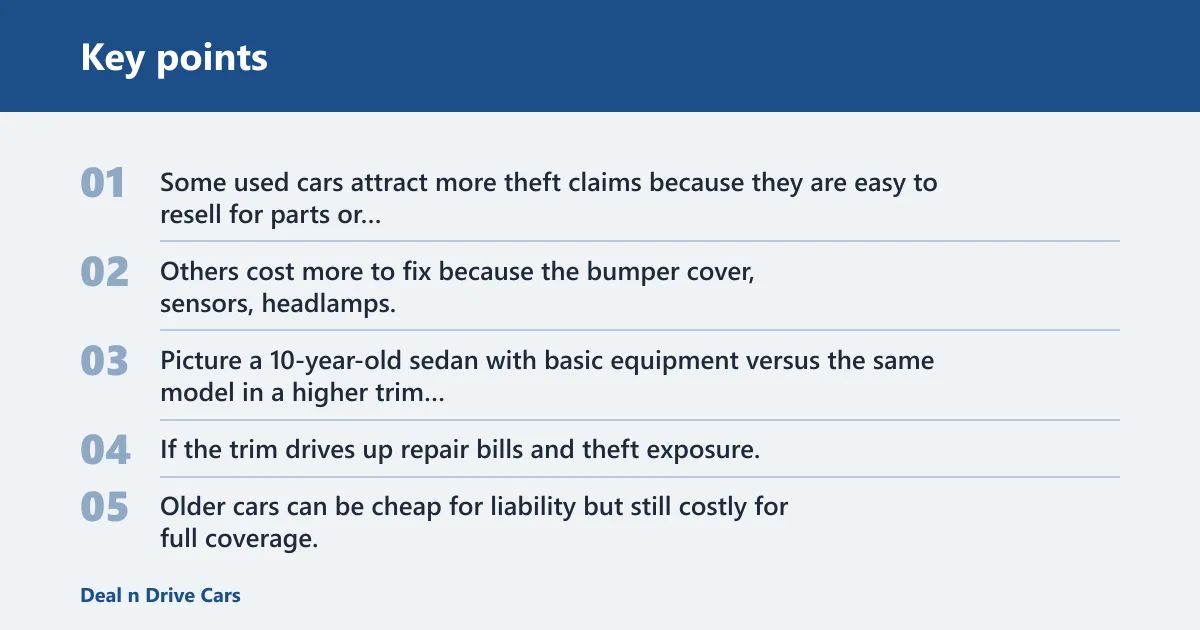
Some used cars attract more theft claims because they are easy to resell for parts or because a specific trim is desirable. Others cost more to fix because the bumper cover, sensors, headlamps, or body panels are expensive and may be harder to source for older model years.
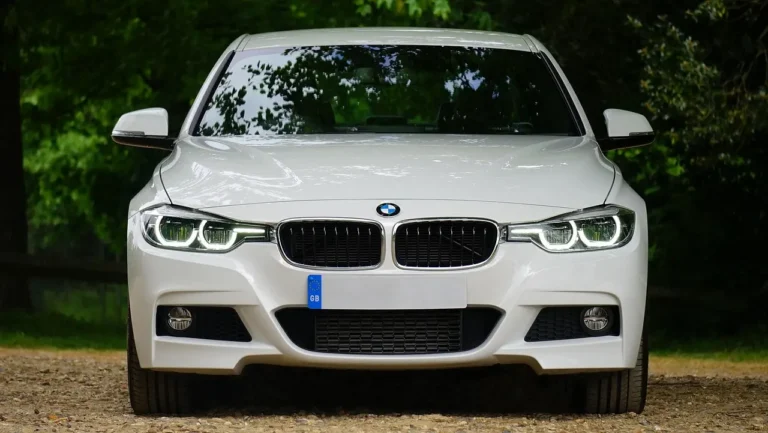
Picture a 10-year-old sedan with basic equipment versus the same model in a higher trim with larger wheels and LED headlamps. The older car is not automatically cheaper. If the trim drives up repair bills and theft exposure, the insurer can still rate it higher.
Full coverage on low-value cars
Older cars can be cheap for liability but still costly for full coverage. If actual cash value is modest, the premium may look unfair because the collision and comprehensive parts of the policy still reflect repair cost, parts scarcity, and payout limits.
That is where depreciation matters. Once the payout from a total loss falls close to the annual premium, full coverage may stop making sense. Loan and lease requirements can change that calculation, because lenders often require collision and comprehensive until the balance is gone.
Driver profile and claims history
Two people can insure the same used car and get different quotes because the driver is part of the price. Age, tickets, accidents, claims-free driving, marital status, and whether the car is used for work all feed the rating model, so the driver profile can outweigh the vehicle itself.
Age and experience
Younger drivers usually pay more because they have less claims-free history. The effect is strongest in the early years of driving, then softens as insurers see a longer clean record. That means a 24-year-old and a 34-year-old may not be priced the same even in the same car.
Tickets, accidents, and claims
Tickets and at-fault accidents signal higher future loss potential. Prior claims can matter too, including comprehensive losses such as theft, hail, or glass damage. A clean record tends to help over time because claims-free driving discounts are tied to a clean record.
Lapses and prior claims
Insurance gaps can raise concern because they break the continuity insurers like to see. Even when a lapse had a harmless reason, some carriers treat it as a rating factor. The result can be a higher quote than a driver with uninterrupted coverage and no recent claims.
Does the car’s age make insurance cheaper?
Age can lower insurance, but only if the loss value falls faster than the insurer’s expected repair and payout costs. Older cars often become cheaper for liability, though full coverage may still cost more if the car’s actual cash value remains high enough to make collision and comprehensive coverage worth considering.
Actual cash value and payout limits
Actual cash value is the amount an insurer may pay if the car is totaled, after depreciation and condition are taken into account. As that value drops, the payment exposure drops too. Once the payout shrinks, collision and comprehensive often become less attractive relative to the premium.
Suppose two buyers are choosing between a 2014 compact and a 2022 compact. If both carry full coverage, the older car may be cheaper only if its parts are ordinary and its value has fallen enough. If the older car is a premium trim, the gap can narrow fast.
Depreciation and loan or lease rules
Depreciation changes what the insurer might owe after a total loss, but it does not erase repair bills or theft risk. If you finance the car, the lender may require full coverage even on a low-value vehicle, because the loan balance can be higher than actual cash value.
That is the key used-car trap. Buyers often assume a cheaper purchase price means a cheaper policy. In reality, a low purchase price with expensive parts, a theft-prone badge, or required full coverage can keep the quote high.
Vehicle make, model, and trim
Make and model matter because insurers use actuarial data and underwriting criteria to score risk. The same brand can price differently across trims if one version has more horsepower, higher repair bills, or a worse theft record.
Repair cost and parts availability
Repair cost feeds directly into premiums. Cars with sensors, cameras, adaptive headlights, or specialty body panels may cost more to restore after a minor hit. Older models can also be pricier if parts are scarce or only available from limited suppliers.
Safety record and performance
Safety performance can help, but it does not cancel every other risk. A strong crash record may support lower pricing on some policies, while high-output engines, sport suspensions, and aggressive trims can point the other way because they often correlate with larger claims.
Theft risk and trim level
Theft risk often changes by trim, not just by model name. A common hatchback can be modest on one trim and expensive on another if the higher version is easier to resell in parts. That is why VIN-level quotes are worth getting before you buy.
Location and annual mileage
Where you live is one of the factors insurers use, and the ZIP code can shift a used-car quote enough to change the buying decision. State rules, local claim frequency, weather exposure, and urban-versus-rural traffic all influence what the insurer expects to pay.
State and ZIP code
Two identical used cars can price differently across state lines because minimum coverage rules, lawsuit exposure, and required benefits can vary. Even inside one state, different ZIP codes can rate differently if one area sees more theft, glass claims, collisions, or uninsured drivers.
Weather and claim frequency
Hail, flood risk, and storm exposure matter most on comprehensive coverage. If a car is parked in an area with frequent weather losses, the insurer may price that risk into the quote. A dry inland ZIP may produce a lower comprehensive cost than a storm-prone one.
Commute, business use, and low mileage
Annual mileage matters because more time on the road means more chance of a claim. A short commute can help, and some insurers offer low-mileage pricing. Business use can raise the quote because it creates more exposure than weekend or pleasure driving.
- Confirm the annual miles you expect to drive.
- Separate commute miles from pleasure miles.
- State whether the car will be used for business.
- Check whether garaging at home changes the rate.
- Compare the quote with and without full coverage.
Used-car insurance price checklist
Use this checklist before you commit to a used car. It helps you estimate the premium before you have a VIN, and it shows which details are worth verifying on the window sticker, listing, seller documents, or quote call.
| Factor | Why it raises or lowers price | What a shopper can verify before buying |
|---|---|---|
| Driver age | Younger drivers usually pay more because they have less claims-free history. | Check who will be the main driver and their age bracket. |
| Driving history | Tickets, at-fault accidents, and claims can raise the premium. | Review the driver’s recent record and any open violations. |
| Claims-free record | A clean record can qualify for claims-free driving discounts. | Ask how many years have passed since the last claim. |
| Marital status | Some insurers consider it in pricing, and some price single drivers higher. | See whether your insurer asks for it in the quote form. |
| Vehicle make and model | Repair cost, theft data, and safety records differ by vehicle. | Confirm the exact year, make, model, and body style. |
| Trim level | Higher trims often cost more to repair and may draw more theft risk. | Match the trim on the listing to the sticker or VIN decode. |
| Actual cash value | Lower value can reduce full-coverage exposure, but not always enough. | Estimate resale value and compare it with annual premium cost. |
| Coverage type | Liability only, full coverage, comprehensive, and collision price differently. | Ask for quotes with each coverage setup before you buy. |
| Deductible | A higher collision or comprehensive deductible usually tends to lower the premium. | Choose the deductible you could actually pay after a claim. |
| Annual mileage | More miles usually mean more exposure; low mileage can help on some policies. | Estimate commute, errands, and weekend use separately. |
| Location and garaging | State, ZIP code, urban traffic, theft exposure, and street parking can raise cost. | Use the exact overnight parking address and expected ZIP code. |
| Security and anti-theft features | Alarm, immobilizer, tracking device, and garaging may lower risk on some cars. | Ask which features the insurer credits and whether the car has them. |
Can you estimate insurance before buying?
You can estimate it before buying if you gather enough detail to price the likely risk. A VIN helps, but you can still get a useful range by using the year, make, model, trim, driver profile, ZIP code, mileage, and intended coverage level.
VIN-free estimate steps
Start with the exact year, make, model, and trim, because those change repair cost and theft exposure. Then compare liability only and full coverage quotes, since an older car can look affordable under one and expensive under the other. This is where buyers often get surprised.
Next, test deductible levels. A higher deductible usually lowers premium, but the savings need to be large enough to matter. If moving from a low deductible to a higher one barely changes the rate, the policy may already be priced more on driver or location risk than on car value.
What to verify before you sign
Ask the seller or dealer for the exact trim, any security equipment, and the parking situation. Then quote the car using your expected annual mileage and your real driving record. Different insurers use different rating formulas, so one company may price a used car far above another with the same inputs.
Shopping around is necessary because rating models are not identical. That is the practical way to find out whether the used car you want is cheap because the vehicle is low-risk, or expensive because your profile or coverage choice pushes the quote up.
Frequently asked questions
What factors affect car insurance price on a used car?
The main factors are driver profile, vehicle risk, location, mileage, and coverage choice. Insurers also consider tickets, accidents, claims-free history, marital status, actual cash value, deductible level, and anti-theft features. Rates come from a mix of factors, not one trait.
Why is insurance sometimes higher on a used car than expected?
That happens when the car is old but still costly to repair, theft-prone, or kept with full coverage. A used luxury model, a high-performance trim, or a car in a storm-heavy ZIP code can rate higher than a newer economy car with better loss data.
Does the car’s age make insurance cheaper or more expensive?
Age can cut price on liability and sometimes on full coverage, but it does not do that automatically. As actual cash value falls, payout exposure drops, yet repair costs, theft risk, and required coverage can keep the premium high on an older car.
How much do driving record and age affect used-car insurance?
Driving history usually matters more than age because it shows how likely future claims may be. Younger drivers usually pay more because they lack a claims-free record, while older drivers with tickets, accidents, or lapses can still see higher quotes than clean, experienced drivers.
Do location and vehicle type change used-car insurance rates?
Yes. Where you live is one of the factors insurers use, and the car itself affects premium through theft exposure, repair cost, and safety data. State rules, ZIP code, urban driving, and weather risk can all move the quote on the same used car.
Can I estimate insurance before buying a used car?
Yes. Use the exact year, make, model, trim, your ZIP code, annual mileage, and intended coverage to request quotes before you sign. Then compare liability only, full coverage, and different deductibles so you can see whether the car will actually be cheaper to insure.
Will a higher deductible lower my used-car insurance price?
Usually yes. A higher collision deductible or comprehensive deductible generally lowers premium because you accept more of the loss yourself. The tradeoff is simple: the monthly bill may drop, but your out-of-pocket cost rises if the car is damaged or totaled.
Should I choose liability only or full coverage on a used car?
Choose liability only when the car’s actual cash value is low enough that collision and comprehensive no longer make financial sense. Choose full coverage when the lender requires it, the car still has meaningful value, or the repair and replacement cost would hurt more than the premium.
Why do two drivers with the same used car get different quotes?
Because the car is only one part of the rating model. Age, driving history, claims-free record, marital status, mileage, garaging, and prior losses can all change the premium. Two drivers in the same vehicle can present very different risk to the insurer.
How long do car insurance claims affect your price?
It depends on the insurer’s rules, but claims can affect price for years. Recent at-fault accidents, multiple claims, or prior lapses often keep rates higher longer than a single older claim. The cleanest path is uninterrupted coverage and no new losses.
Cuvva — The car insurance claims ‘record’ – and how it affects your price
A claims record matters because insurers use it to estimate future loss. A clean history can support lower pricing, while repeated claims or a lapse can move the quote up. For used-car shoppers, the car’s age matters less than the driver’s recent record when the model itself is already low-risk.