How Much Does a Used Car Depreciate Each Year?
A used car typically loses about 10% to 15% of its value per year, though older, high-mileage cars often drop less in percentage terms and more in dollars; the next 12 months usually depend more on age and mileage than on a flat rate. Guessing wrong can mean overpaying on a trade-in, setting a bad asking price, or missing a sale window. This guide shows a simple age-plus-mileage way to estimate one-year value loss for your car.
This guide is part of our Ownership depreciation for used cars explained series.
What does used-car depreciation mean?
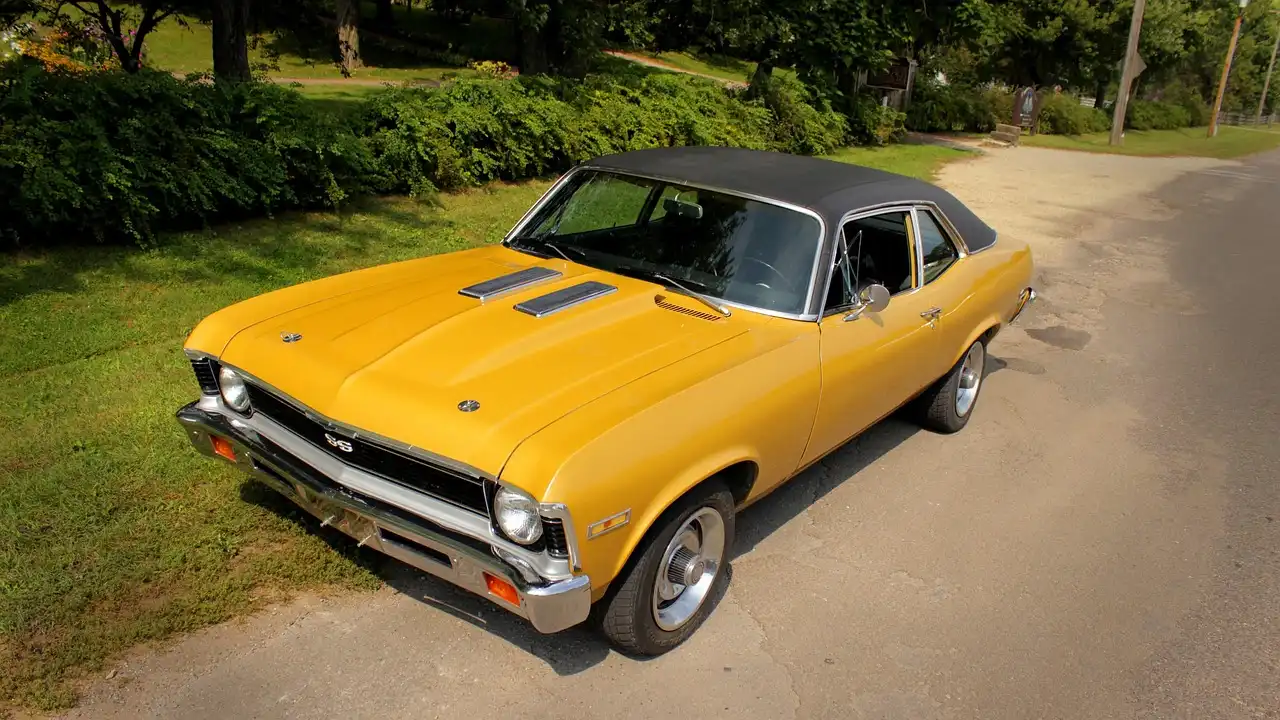
Used-car depreciation is the gap between what a car cost and what it is worth now. Yearly loss changes with age, mileage, condition, accident history, trim, and demand, so there is no fixed number. Trade-in value is usually the lowest, private-party value sits higher, and dealer retail is higher still.
Why yearly loss is not a fixed number
A three-year-old sedan with average miles does not lose value at the same pace as a ten-year-old pickup with a manual transmission and a strong local following. The age-plus-mileage curve matters more than any single “average” rate, because the market prices risk, repair cost, and replacement supply differently.
Trade-in value versus private-party value
Trade-in offers are lower because the dealer has to recondition the car, hold inventory, and protect against slow sales. Private-party prices can run higher because there is no dealer markup, but they also depend more on condition, paperwork, and how quickly the seller wants to move the car. Dealer retail is usually the highest listed price.
How much does a used car lose in a year?
For many used cars, the next 12 months mean a loss of roughly 8% to 20%, with the largest percentage drops typically happening in the first few years after the original sale. A 3-year-old car often loses more in dollars than a 10-year-old car, while the older car may lose a larger share of its remaining value.
Typical annual ranges by age
A newer used car can still fall fast because it has more value left to lose. By the time a car reaches 5 to 10 years old, the annual dollar loss often softens, though the percentage can still be meaningful if the car has high miles or weak demand.
What happens in the first year after purchase
The first year after purchase is usually the steepest part of the curve. A nearly new used car may drop 15% to 30% over that span, especially if it is a common model with heavy supply, low-option trim, or a market that has cooled since the last sale.
Why a 10-year-old car often loses less in dollars but more in percentage terms
At 10 years old, the dollar loss can be modest because the car may already be priced near the low end of the market. A $9,000 car losing $900 is a 10% decline, while a $30,000 car losing $3,000 is also 10%, but the dollar hit is much larger on the newer car.
How much used car table
This table gives a practical estimate of annual value loss by age and mileage. Use it as a band, not a promise; a strong local market can slow the drop, while body damage, weak service history, or a poor trim choice can make it worse.
| Age band | Under 10k miles/year | 10k-15k miles/year | 15k-20k miles/year | 20k+ miles/year | When it slows or worsens |
|---|---|---|---|---|---|
| 0-1 years | 15%-20% | 18%-23% | 20%-26% | 23%-30% | Slows on scarce, in-demand trims; worsens with oversupply, weak colors, or poor options |
| 1-3 years | 10%-14% | 12%-16% | 14%-18% | 16%-22% | Slows as the first-owner drop passes; worsens when warranty time is running out |
| 3-5 years | 7%-10% | 8%-11% | 9%-13% | 11%-15% | Slows as the curve flattens; worsens if the model has weak demand or expensive maintenance |
| 5-10 years | 4%-7% | 5%-8% | 6%-9% | 8%-12% | Slows for durable, popular vehicles; worsens when miles climb above the market average or repairs appear |
Why does age matter more than mileage?
Age usually matters more because the market pays heavily for newer model years, remaining warranty time, and a longer expected repair-free life. Mileage still matters, but it works as a modifier on top of age. A 3-year-old car with average miles often holds value better than a 5-year-old car with unusually high miles.
Why newer cars take the biggest hit
Newer cars lose value fastest because the first owner pays for the freshest body style, the most warranty coverage, and the largest amount of unused life. Once that premium is gone, the car drops into the used market, where buyers compare it with many similar vehicles at lower prices.
How 3-year-old and 5-year-old cars usually behave
Three-year-old cars often sit in a sweet spot for resale because much of the first-drop loss is already behind them, yet they still look modern and may have some warranty left. By 5 years, value loss slows in percentage terms, but mileage, tire wear, brake wear, and maintenance records matter more.
Why the depreciation curve flattens later
Once a car has moved past the steep early years, the market focuses more on operating cost and condition than on age alone. That is why many 8- to 10-year-old cars lose value more slowly each year unless they cross a mileage threshold, need major repairs, or belong to a weak-demand segment.
How condition and accident history change value
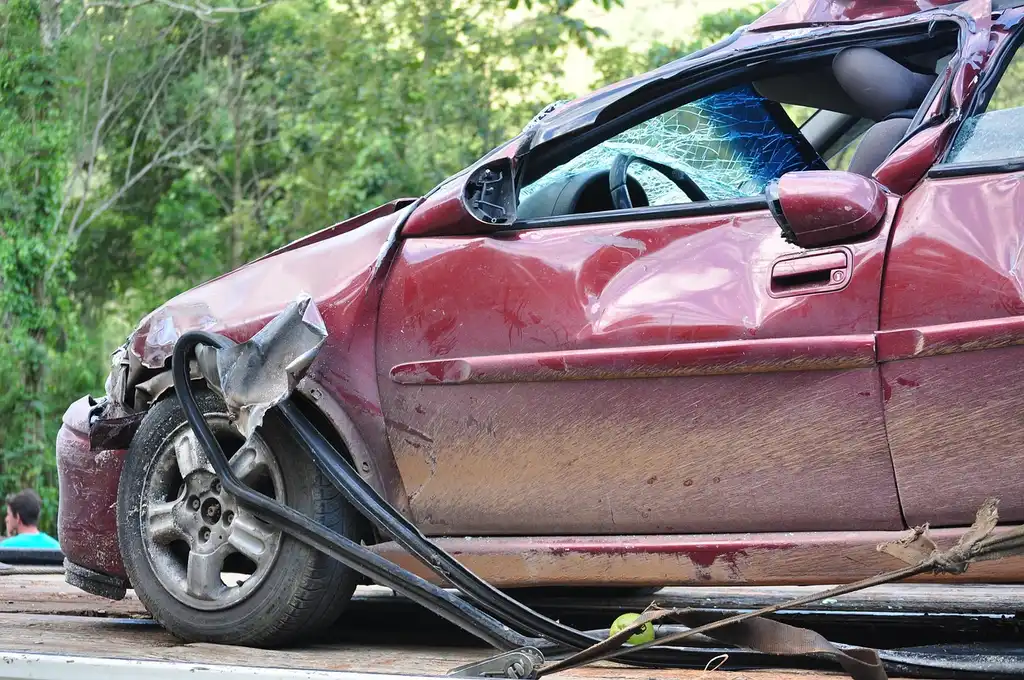
Condition can move resale value as much as age in the short run. Complete service records, clean body panels, and normal wear support a higher price. Cosmetic damage, missing maintenance, mechanical problems, structural damage, airbag deployment, and poor repairs create separate price cuts that sit on top of normal depreciation.
Service records and visible wear
Strong service history helps because it lowers buyer risk. Regular oil changes, brake service, tire rotations, and documented repairs matter. Visible wear also counts: torn seats, curb rash, faded paint, cracked trim, or warning lights can move a car from average to below average quickly.
Structural damage, airbag deployment, and repair quality
Structural damage usually hurts resale more than cosmetic damage because it raises concerns about alignment, safety, and long-term integrity. Airbag deployment signals a serious crash, and even well-repaired vehicles often bring less than similar cars with clean histories. Repair quality matters because uneven panels, paint mismatch, and unresolved codes raise doubt.
Title brands and how they affect resale
Title brands such as salvage, rebuilt, flood, or lemon history can cut value sharply and can also narrow the buyer pool. These are not ordinary annual depreciation; they are one-time market penalties that can stay visible every time the car is priced, financed, or insured.
Say your 4-year-old midsize SUV has 54,000 miles, a full service record, and no damage. It may follow the middle of the table. Now add an airbag deployment and a rebuilt title, and the asking price can move down far more than a normal year of depreciation would explain.
Which cars lose value slower?
Cars that are popular, efficient, and easy to resell usually hold value better. Trim level, engine choice, transmission type, and vehicle segment all matter. A well-equipped truck or mainstream SUV often depreciates more slowly than a luxury sedan with expensive options, high repair costs, or a narrow buyer base.
How trim level and options affect resale
Mid-level trims often sell best because they balance price and equipment. A tech package, better safety gear, and desirable convenience options can help resale, but some options add little value back. Engine choice and transmission type matter too; a common automatic usually sells faster than a rare setup that limits buyers.
Why SUVs, pickups, sedans, and luxury cars do not behave the same
Pickups and many SUVs often depreciate more slowly because demand stays broad and utility remains strong. Sedans vary widely; budget sedans can hold up well if running costs are low, while some larger sedans fall faster. Luxury cars often lose value faster because repair costs, options, and original price were higher.
How fuel prices, supply, and model popularity affect demand
Fuel prices can shift demand toward hybrids, smaller sedans, and efficient crossovers. Seasonality matters too; trucks and SUVs can move better in some regions and seasons. Local supply matters because a common model with many listings usually faces more price pressure than a scarce model with a strong reputation.
How to estimate next-year value loss
Start with the car’s age, then adjust for mileage, trim, and condition. Compare similar vehicles in pricing guides and depreciation calculators, then separate trade-in value from private-party value. If the car has a clean title, average miles, and good records, estimate from the middle of the band; if not, move lower.
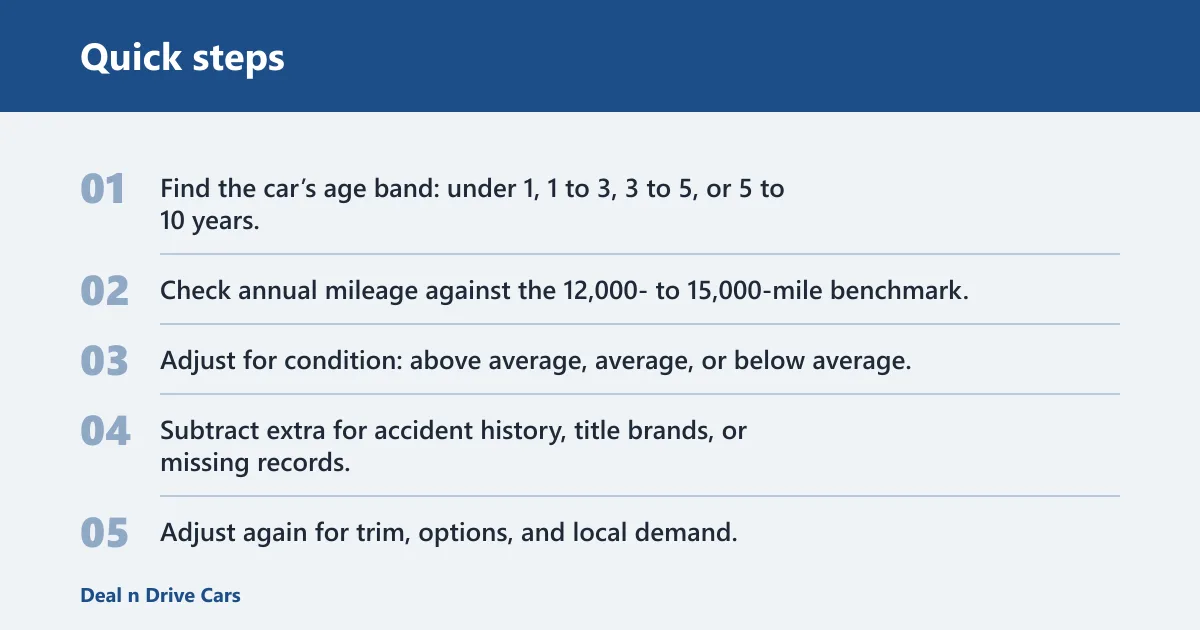
Use age, miles, trim, and condition together
- Find the car’s age band: under 1, 1 to 3, 3 to 5, or 5 to 10 years.
- Check annual mileage against the 12,000- to 15,000-mile benchmark.
- Adjust for condition: above average, average, or below average.
- Subtract extra for accident history, title brands, or missing records.
- Adjust again for trim, options, and local demand.
Check pricing guides and depreciation calculators
Pricing guides help you compare trade-in, private-party, and retail numbers side by side. Depreciation calculators can estimate the next 12 months, but they work best when you enter realistic mileage and trim details. If a guide says one number and local listings say another, the market usually wins.
Compare trade-in, private-party, and dealer retail values
Trade-in value is the number most owners should watch if they plan to replace the car soon. Private-party value matters if you plan to sell it yourself. Dealer retail is useful as a ceiling, not a promise, because it includes reconditioning, warranty cost, profit, and overhead.
Suppose a 5-year-old sedan is worth $18,000 in private-party condition today. If it sits in the 8% to 11% band, next-year value loss could be about $1,440 to $1,980 before any extra penalty for a collision repair or extra mileage.
Frequently asked questions
How much does a used car depreciate each year?
Most used cars lose about 10% to 15% of value per year, but the real number depends on age and mileage. A 2-year-old car can drop faster than a 9-year-old car, and a high-mileage example usually loses more than a similar car with average miles.
How much does a second hand car depreciate each year?
A second hand car usually depreciates in the same way as a used car, because those terms mean the same thing in resale markets. Expect a higher percentage loss in the first few years and a slower rate later, with mileage, condition, and local demand pushing the result up or down.
How much should a used car depreciate per year?
A fair rule of thumb is 8% to 20% per year, depending on age band. Newer used cars usually sit near the top of that range, while 5- to 10-year-old cars often fall closer to the low end unless they have very high miles or major condition issues.
How much does a 10 year old car depreciate per year?
A 10-year-old car often loses about 4% to 12% per year, and many examples may land closer to the lower end of that range if they are clean and in demand. At that age, one repair bill or title issue can matter more than another normal year of age.
How much does a used car depreciate in 6 months?
In six months, a used car may lose about half of its annual rate, so a common rule of thumb is roughly 4% to 10% for many vehicles. The drop can be steeper if the car is near a model-year change, has a high-mileage jump, or falls out of favor locally.
How much value does a used car lose each year?
The dollar loss depends on starting value. A $12,000 car losing 10% gives up about $1,200, while a $30,000 car losing the same percentage gives up $3,000. That is why buyers should estimate both percentage loss and dollar loss before deciding to keep or sell.