How Much Is Registration and Title Fees for a Used Car?
Title and registration fees on a used car usually run about $50 to $500, but the total out-the-door cost can be higher once sales tax, plates, and dealer document fees are added. Miss the paperwork math and you can sign for a car that costs hundreds more than you planned. This guide breaks down title, registration, plate, tax, and dealer fees, then shows what drives the biggest price swings.
Used-car closing costs at a glance
The headline cost is not one fee. It is a stack of separate charges tied to making the car legal to drive, moving ownership into your name, and paying any tax the state collects on the sale. Some fees go to the state or DMV, while others go to the dealer for paperwork handling.
For a used car, the main buckets are title transfer, registration, license plates, sales tax, and dealer documentation. Every state requires vehicle registration, and dealers may handle the registration process for the buyer. Title and registration can also include ordering the title and securing the license plate.
What changes the total most
Sales tax usually moves the total the most. Rates vary by the state where you live, and some states allow trade-in value to reduce the taxable purchase price. Some states also allow rebates and incentives to reduce tax obligations, but not all.
Dealer paperwork can matter too. Some dealers charge an additional fee for completing title and registration paperwork, and documentation fees can vary widely, from under $100 to hundreds of dollars. California has a doc fee cap of $80. (Caranddriver)
📊 Documentation fees can vary widely, from under $100 to hundreds of dollars. Source: Caranddriver.
How much are title and registration fees?
Title and registration fees on a used car are usually state-based costs that cover the ownership transfer and the legal right to drive the vehicle. The title fee is the ownership transfer charge, while registration covers the vehicle’s active record with the state. Together, they are often modest compared with sales tax.
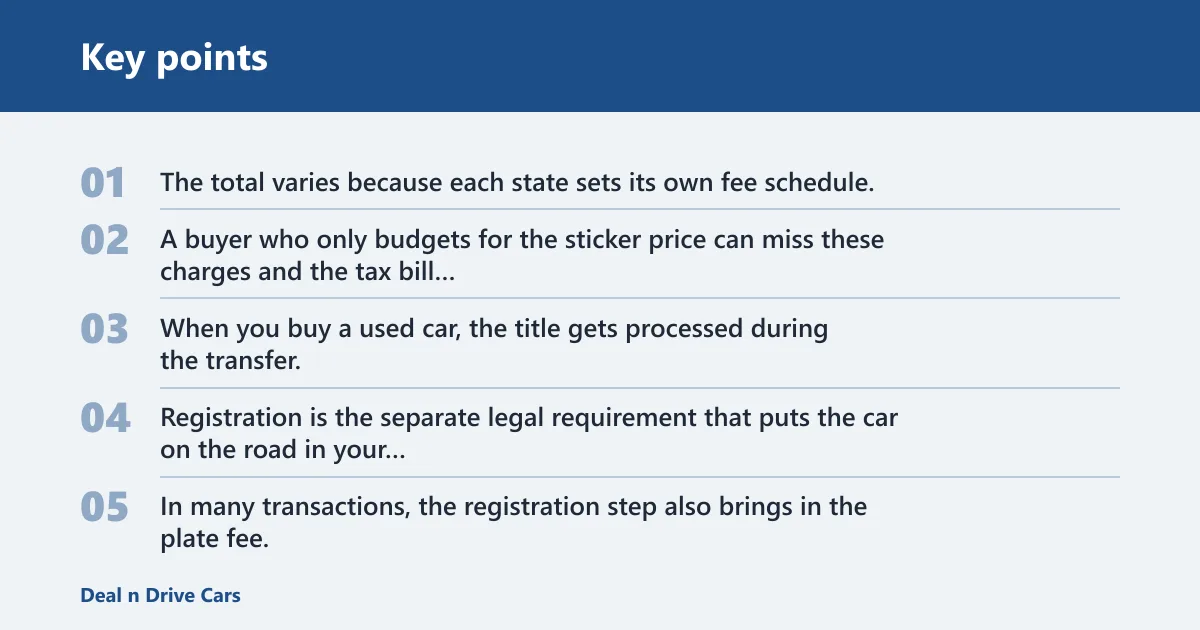
The total varies because each state sets its own fee schedule, and some also use vehicle details such as weight, model year, or locality when they calculate registration. A buyer who only budgets for the sticker price can miss these charges and the tax bill that often follows them.
Title transfer cost vs. registration cost
The vehicle title is the ownership document. When you buy a used car, the title gets processed during the transfer, and that step can carry its own fee. Registration is the separate legal requirement that puts the car on the road in your name, and it is often renewed periodically after purchase.
In many transactions, the registration step also brings in the plate fee. That means one line on a buyer’s order may hide multiple government charges, even though each one serves a different purpose.
Why the total varies by state and vehicle
There is no single national fee schedule. A buyer in one state may pay a small title charge and a larger registration bill, while another state may bundle more of the paperwork into a single line. Vehicle type can matter too, especially when the state ties registration to weight or other vehicle details.
Suppose you buy a 7-year-old sedan from a dealer and the state charges modest title and plate fees. The closing total may stay manageable. Suppose the same car is bought in a higher-tax state with a more expensive registration schedule. The total rises fast even though the car did not change.
What fees are part of the transfer?
The transfer usually includes three government-facing pieces: the vehicle title, vehicle registration, and license plate issuance or transfer. Some states treat these as separate line items, while others let the dealer or DMV process them together. The buyer should still know what each item means.
That breakdown helps you spot a charge that looks duplicated. If the buyer’s order lists a title fee, a registration fee, and a separate plate fee, that may be normal. If it also includes a second unnamed DMV line, ask for the exact purpose of the charge.
Vehicle title
The title fee covers the ownership document that moves from seller to buyer. It is a transfer cost, not a tax. If the title is missing, damaged, or not signed correctly, the transfer can stall until the paperwork is corrected.
Vehicle registration
Registration is the step that lets you legally operate the car in the state. It is required in every state, and it is often renewed after the first purchase. The cost depends on state rules and, in some places, vehicle details such as age or weight.
License plate issuance or transfer
License plates may be ordered fresh or transferred from an existing vehicle, depending on state rules and the sale structure. That plate step often appears beside title and registration on dealer paperwork, because the state usually wants the ownership change and road use updated at the same time.
Title fee worksheet
This worksheet separates the closing costs that matter most on a used-car purchase. Fill in the state-specific amounts before you sign, then compare the total to the dealer’s buyer’s order. Keep title transfer, registration, plate fees, sales tax, and dealer document fees on separate lines so you can see what is legal, what is tax, and what is dealer handling.
| Cost item | What it covers | State-specific amount | Your estimate |
|---|---|---|---|
| Title transfer | Ownership document processing for the used car | $ | |
| Registration | Legal registration to operate the vehicle in your state | $ | |
| Plate fee | New plate order or plate transfer, if charged separately | $ | |
| Sales tax | State and local tax on the purchase price, after any allowed trade-in treatment | $ | |
| Dealer doc fee | Paperwork handling and processing by the dealer | $ | |
| Late or out-of-state adjustment | Extra filing, transfer delay, inspection, or paperwork correction if your state requires it | $ | |
| Total estimator | Add every line above | $ |
A common first-timer mistake is to add the purchase price and stop there. That misses the title, registration, and tax lines that can appear before you can drive the car home. The worksheet above keeps those items visible before you agree to the deal.
What does the dealer handle?
Dealers may handle the registration process for the buyer, and they may submit title paperwork, collect fees, and forward forms to the state. That convenience does not remove the cost. It only changes who does the filing and how the charge appears on the buyer’s order.
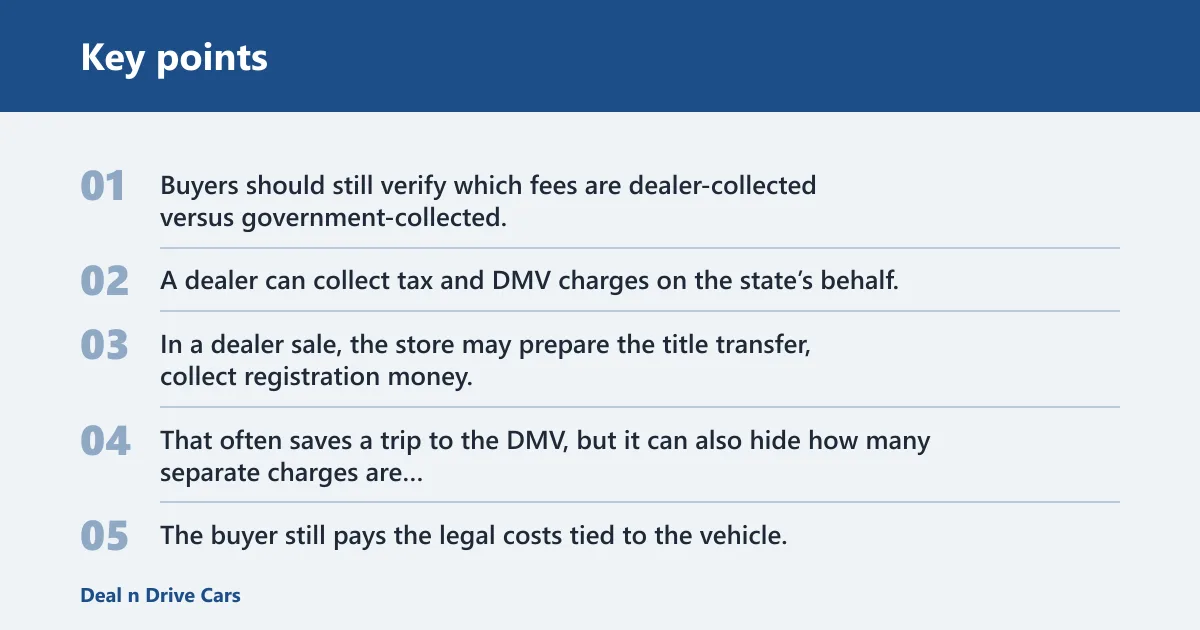
Buyers should still verify which fees are dealer-collected versus government-collected. A dealer can collect tax and DMV charges on the state’s behalf, but the line items should still be clear enough to identify what belongs to the state and what belongs to the dealership.
Paperwork the dealer may submit
In a dealer sale, the store may prepare the title transfer, collect registration money, and submit the application for new plates or updated registration. That often saves a trip to the DMV, but it can also hide how many separate charges are being folded into one amount.
Fees that still belong to the buyer
The buyer still pays the legal costs tied to the vehicle. Those costs can include title, registration, plates, and sales tax, even if the dealer files the forms. Some dealers also charge an additional fee for completing title and registration paperwork, and that fee belongs in your budget because it adds to the cash due at signing.
What other fees can show up?
Sales tax and dealer documentation are the biggest extras beyond title and registration. Sales tax rates vary by the state where you live, and some states allow trade-in value to reduce the taxable purchase price. Dealer documentation fees can be small or very large, depending on the store and state rules.
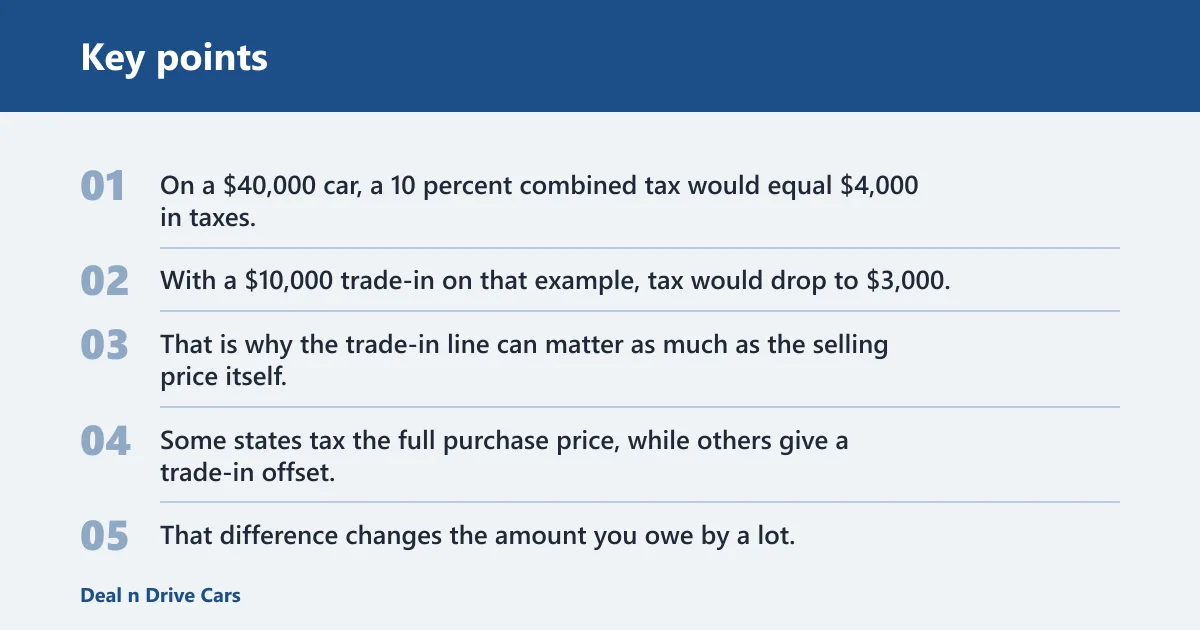
On a $40,000 car, a 10 percent combined tax would equal $4,000 in taxes. With a $10,000 trade-in on that example, tax would drop to $3,000. That is why the trade-in line can matter as much as the selling price itself.
Sales tax and trade-in treatment
Some states tax the full purchase price, while others give a trade-in offset. That difference changes the amount you owe by a lot. If your state allows a trade-in deduction, make sure the buyer’s order shows the taxable amount separately from the trade allowance.
Some states allow rebates and incentives to reduce tax obligations, but not all. That rule can change the real out-the-door total, so do not assume a rebate always lowers the tax bill.
Dealer documentation fee
The dealer documentation fee covers paperwork handling and processing. Some states cap the amount. California has a doc fee cap of $80, but many other states allow higher charges, and some dealers list the fee in a way that makes it hard to notice until the final sheet appears.
Documentation fees can vary widely, from under $100 to hundreds of dollars. If a buyer’s order shows a high doc fee, ask whether the number is capped by state law or simply set by the store.
Optional add-ons you can decline
Dealers may include extended warranties or maintenance plans in the transaction. GAP insurance may be required by some lenders. Market adjustment fees increase the vehicle price above MSRP. These items are not title or registration charges, and some are optional, so do not let them blur into the DMV total.
Say your dealer quotes a clean used SUV at $22,000, then adds a doc fee, extended warranty, and a service plan. The tax and DMV numbers may be correct, but the total still rises because of separate add-ons. Ask for each item to be shown on its own line before you agree.
What should you check before signing?
Check the buyer’s order line by line before you sign. Make sure title, registration, plate fees, tax, and dealer doc fees are listed separately, because that lets you see what is required and what is dealer set. If a fee is unclear, ask for the exact purpose and whether the charge goes to the state or the dealer.
You should also check the temporary tag timing, the title transfer schedule, and any state forms the dealer needs you to sign. If the vehicle came from another state or the paperwork is incomplete, the closing total can change after the sale if the store has to correct or refile something.
Buyer’s order line items
Look for these entries: title transfer, registration, plate issuance or transfer, sales tax, doc fee, and any separate filing or processing charge. If the dealer wrote “DMV fee” without detail, ask for a breakdown before you agree to the number.
Why does my used car buyer’s order include extra DMV fees? Usually because the dealer is collecting title and registration money, adding its processing charge, or passing through a state filing cost. The label may be vague, but the line should still be explainable.
Temporary tags, title timing, and state forms
Temporary tags give short-term legal driving status while the permanent paperwork moves through the state system. If the dealer says the title will arrive later, confirm who is responsible for filing and by when. Missing signatures or an unpaid lien can slow the transfer and raise the final admin cost.
- Ask for the title, registration, plate, and tax lines separately.
- Confirm whether the dealer or you will submit the forms.
- Check whether your state limits the doc fee.
- Verify how the trade-in affects the taxable amount.
- Ask about any out-of-state, late, or correction charges.
Frequently asked questions
How much are title and registration fees on a used car?
Title and registration fees on a used car often fall in the roughly $50 to $500 range, but the exact amount depends on state rules, plate charges, and vehicle details. That figure does not include sales tax or dealer documentation fees, which can push the closing total much higher.
What fees do I pay when I transfer a used car title?
You usually pay title transfer, registration, plate issuance or transfer, and sales tax, plus any dealer documentation fee if a dealer handles the sale. If the vehicle is late, out of state, or missing paperwork, extra filing or correction costs may also appear.
Does the dealer handle registration and title paperwork?
Often, yes. Dealers may handle the registration process for the buyer and submit title paperwork to the state. That service does not remove the fees; it only means the dealer collects or forwards them as part of the sale.
Are title and registration fees the same in every state?
No. Every state requires vehicle registration, but the fee structure changes from state to state. Some states also cap dealer documentation fees, while others allow much higher charges, so the total can vary sharply even for the same car.
What other fees should I expect besides title and registration?
Sales tax is the big one, and dealer documentation fees are another common add-on. You may also see plate fees, filing charges, and optional items such as extended warranties, maintenance plans, or GAP insurance, depending on the dealer and lender.
Can registration fees be rolled into my used car purchase?
Yes, often they can. Dealers commonly collect title and registration money at signing and include it in the out-the-door amount. That makes the purchase easier to complete, but it also means you should review the line items carefully so you know what you are financing or paying up front.
What should I check on the dealership paperwork before signing?
Check that title, registration, plate, tax, and doc fee lines are separate and understandable. Confirm who submits the forms, whether the state caps the doc fee, and whether any add-ons are optional. If a charge is listed as a generic DMV fee, ask for the exact breakdown.
Why does my used car buyer’s order include extra DMV fees?
Because the dealer may be collecting title and registration money on the state’s behalf, and it may also be adding its own processing charge. The label can sound vague, but each line should still map to a real cost, and you should know whether it goes to the state or the store.