How to Budget for Car Maintenance Month by Month
Set aside a fixed monthly amount for car maintenance, usually $75 to $150 for a used car, then adjust for mileage, age, and service due soon. Without a sinking fund, oil changes, tires, brakes, and surprise repairs hit cash flow all at once. This guide shows how to set the monthly target, split it across routine service and repairs, and track the balance month by month.
Typical cost range
Use a monthly allowance, not a guess. A useful starting point for a used car is about $75 to $150 per month, then move higher if the car is older, has higher mileage, or needs larger services soon. Keep that money separate from fuel and insurance.
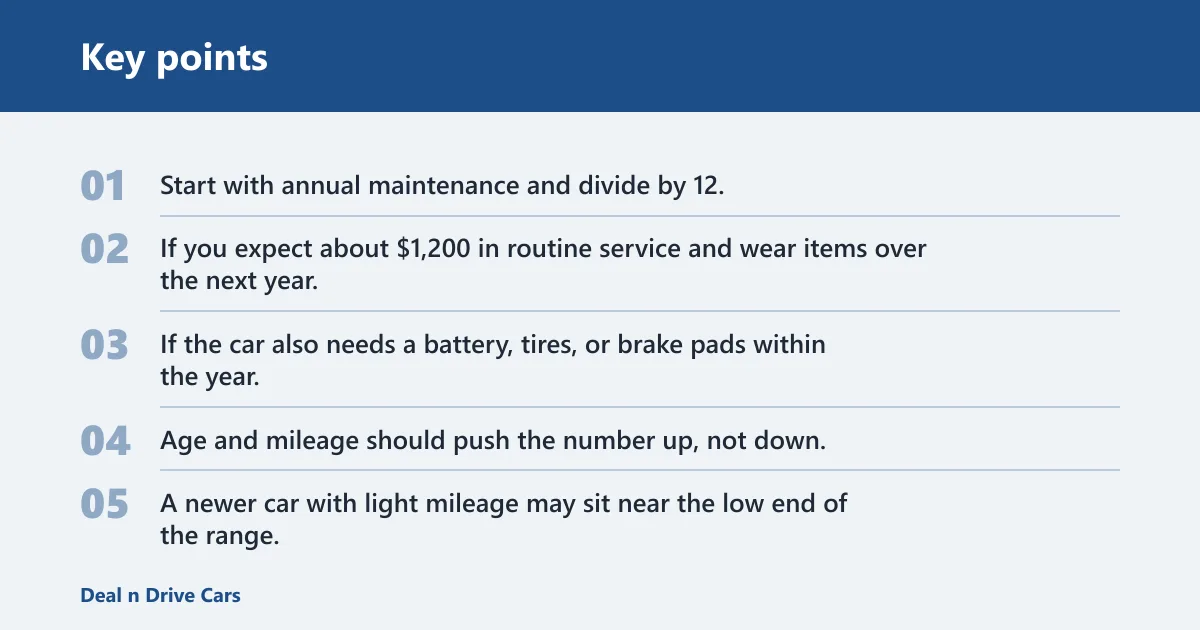
Start with annual maintenance and divide by 12. If you expect about $1,200 in routine service and wear items over the next year, the base monthly set-aside is about $100. If the car also needs a battery, tires, or brake pads within the year, add those expected costs across the remaining months.
Age and mileage should push the number up, not down. A newer car with light mileage may sit near the low end of the range. A 10-year-old sedan with around 120,000 miles often needs a larger reserve because parts wear faster and repairs can become less predictable.
Use a monthly allowance, not a guess
Build the number from known costs first, then add room for wear items and surprise repairs. That keeps you from underfunding months with little scheduled service and overreacting when a big job arrives.
Start with annual maintenance and divide by 12
List every scheduled item due in the next 12 months: oil changes, filters, fluid top-offs, tire rotation, inspections, brake work, and time-based services such as coolant or brake fluid replacement if your owner’s manual calls for them. Add the total and divide by 12 for the monthly allowance.
Adjust for age, mileage, and driving conditions
High-mileage cars need more frequent attention. Older cars also need a larger buffer because parts availability can be less predictable and small failures can lead to larger repairs. Severe-service use, such as lots of short trips, hot weather, or heavy stop-and-go driving, can shorten service intervals too.
What belongs in a monthly car maintenance budget?
A monthly car maintenance budget should include planned maintenance, wear items, and a separate repair reserve. Keep registration and fees in the car budget if you want a full ownership picture, but leave out insurance and fuel so the maintenance number stays clear.
Routine service items
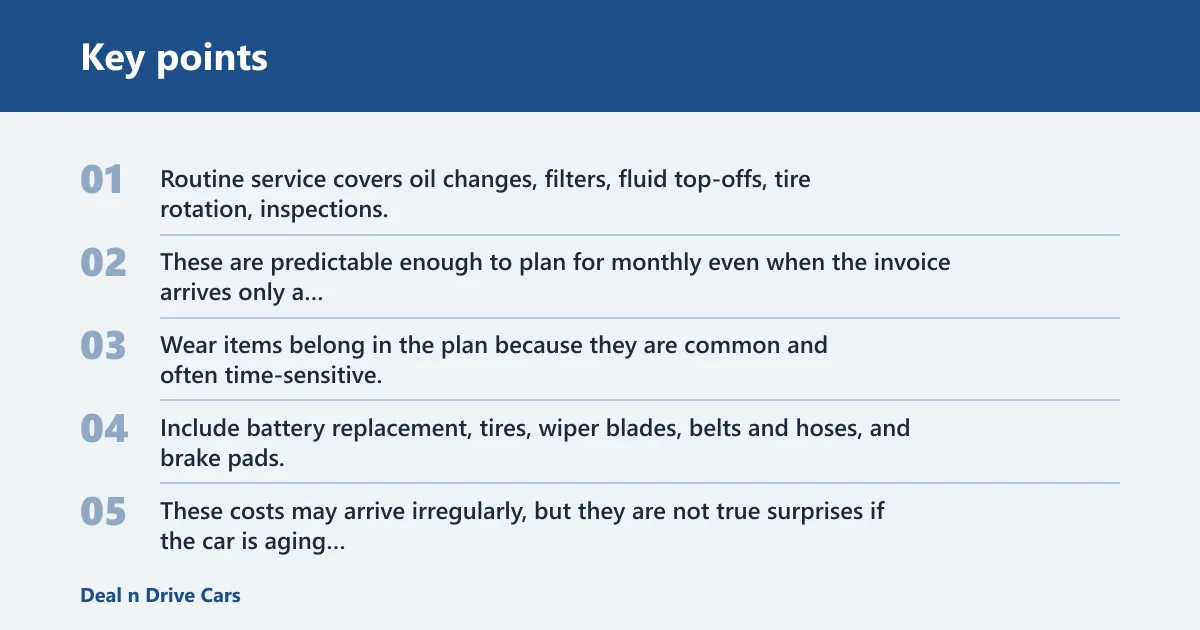
Routine service covers oil changes, filters, fluid top-offs, tire rotation, inspections, and scheduled brake service. These are predictable enough to plan for monthly even when the invoice arrives only a few times a year.
Wear-and-tear repairs
Wear items belong in the plan because they are common and often time-sensitive. Include battery replacement, tires, wiper blades, belts and hoses, and brake pads. These costs may arrive irregularly, but they are not true surprises if the car is aging or driven a lot.
Registration, fees, and what to leave out
Include registration and inspection fees if you want your car budget to reflect the full cost of ownership. Exclude insurance and gasoline from the maintenance line so you can see what the car itself costs to keep roadworthy.
Suppose a compact SUV needs two oil services, one tire rotation, a cabin air filter, and front brake pads over the next 12 months. That is a maintenance plan, not a crisis. If the same SUV also needs a starter or transmission repair, that bill belongs in the emergency reserve bucket.
| Month | Expected service items | Estimated set-aside | Mileage or age trigger | Routine maintenance or emergency repairs |
|---|---|---|---|---|
| January | Oil change, tire pressure check, washer fluid top-off | $90 | Every 5,000 miles or 6 months | Routine maintenance |
| February | Cabin air filter, wiper blades | $40 | 12 months or poor wipe performance | Routine maintenance |
| March | Tire rotation, brake inspection | $55 | Every 5,000 to 7,500 miles | Routine maintenance |
| April | Fluid top-offs, engine air filter | $45 | 12 months or dusty driving | Routine maintenance |
| May | Battery reserve, starter check if slow cranking appears | $60 | Battery over 3 years old | Routine maintenance |
| June | Oil change, tire rotation if due | $100 | 5,000 to 7,500 miles since last service | Routine maintenance |
| July | Tires reserve, alignment check | $80 | Tread wear, vibration, or uneven wear | Routine maintenance |
| August | Brake pads reserve, brake fluid check | $90 | Brake wear indicator or 30,000 to 70,000 miles | Routine maintenance |
| September | Engine air filter, coolant level check | $40 | Season change or 12 months | Routine maintenance |
| October | Oil change, wiper blades if needed | $90 | 6 months since last oil service | Routine maintenance |
| November | Emergency repair reserve top-up | $100 | Older car or higher mileage | Emergency repairs |
| December | Annual inspection, registration, fluid service | $120 | Yearly or state-required interval | Routine maintenance |
Use the table as a planning map, not a fixed promise. Your car may need more in one month and less in another. The goal is to keep the total annual amount steady so the account can absorb spikes without touching rent or savings.
How do mileage and age change your budget?
Higher-mileage cars need more frequent service and more wear-item spending. Older cars need a larger reserve because failures are less predictable and small fixes are more likely to stack up. Time-based service matters too, even if mileage is low, because fluids and rubber parts age on the calendar.
Higher-mileage cars need more frequent service
Many service schedules are mileage-based, so a car driven 1,500 miles a month will reach intervals faster than one driven 600 miles a month. That means more oil changes, tire rotations, and inspections across the year, plus faster wear on brake pads, tires, and belts.
Older cars need a larger reserve
Once a car moves deeper into middle age, budget for more than routine service. A battery can fail early in cold weather. Tires may wear sooner if alignment is off. Hoses and belts can crack with age even if mileage is modest.
Time-based service matters too
Do not wait for mileage alone. Most manufacturers list both mileage and time intervals for key items. If the manual calls for brake fluid every 2 or 3 years, that cost belongs in the monthly plan even if the car barely moved.
Picture a 9-year-old hatchback with 98,000 miles. The owner changes oil on time, but the battery is aging and the front tires are near the wear bars. The monthly budget should already include a reserve for both items, because those costs are likely to land close together.
How much should you save for unexpected repairs?
Set a separate emergency repair fund for surprise failures. A practical rule of thumb is about one to two months of car-related costs for a newer used car, and more for an older or high-mileage vehicle. Keep this reserve separate from planned maintenance so you know what is already spoken for.
Set a separate emergency repair fund
This fund is for surprise failures, not routine wear. Use it for a dead alternator, failed water pump, sudden fuel-system problem, or a repair that stops the car from being safe or legal to drive. Do not spend it on an oil change or tire rotation.
Target balance by vehicle age and condition
For a dependable used car with moderate mileage, a starting target of about $500 to $1,000 is a reasonable cushion. For an older car or one with around 100,000 miles or more, a target closer to about $1,500 to $2,500 can leave more room for a battery, tires, or an unexpected sensor repair.
When to pause nonessential spending and refill the fund
If the reserve gets drained by a major repair, pause nonessential car upgrades and rebuild the fund before the next big bill arrives. That may mean delaying cosmetic work, detailing, or optional accessory purchases until the emergency balance reaches your target again.
How do you build the monthly plan?
List upcoming services from the owner’s manual, spread known costs across the year, and record every due date in a maintenance tracker. This turns maintenance into a calendar problem instead of a panic problem. A spreadsheet works well because you can sort by month, mileage, and cost.
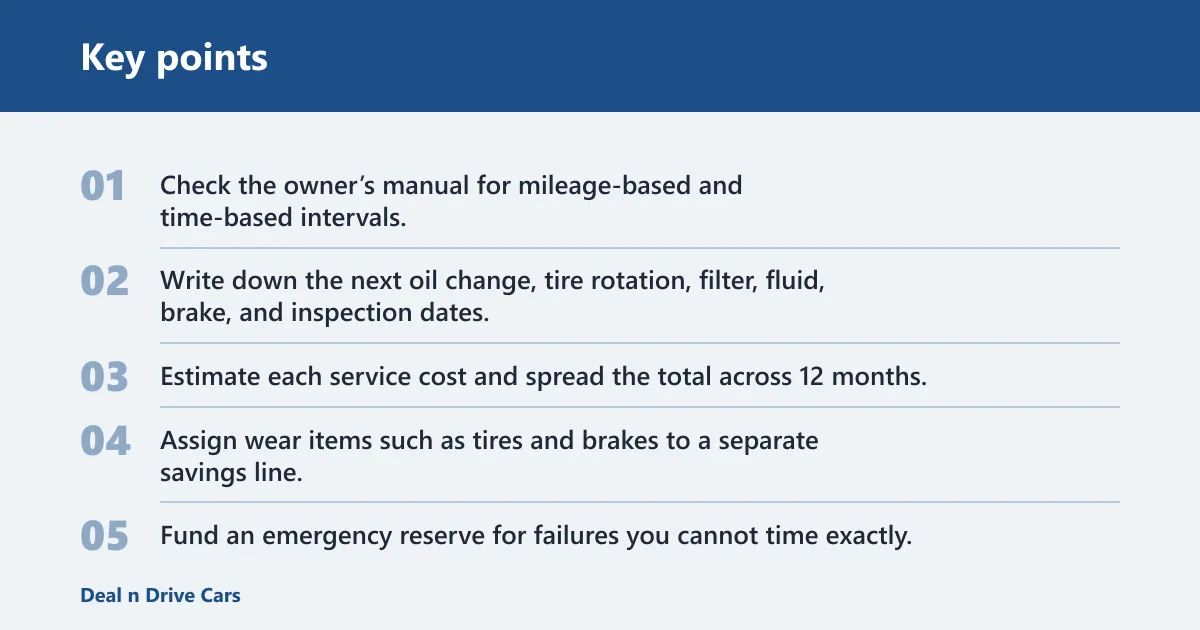
- Check the owner’s manual for mileage-based and time-based intervals.
- Write down the next oil change, tire rotation, filter, fluid, brake, and inspection dates.
- Estimate each service cost and spread the total across 12 months.
- Assign wear items such as tires and brakes to a separate savings line.
- Fund an emergency reserve for failures you cannot time exactly.
- Update the tracker after every visit with date, miles, cost, and the next due month.
Budgeting backward from known service dates makes the monthly number easier to trust. If three services land in the same quarter, divide them across earlier months instead of waiting until the invoice arrives. That keeps the account steady and avoids a scramble.
| Date | Miles | Service due | Cost | Next due month |
|---|---|---|---|---|
| 2026-01-10 | 62,400 | Oil change, tire rotation | $105 | April 2026 |
| 2026-03-22 | 65,100 | Cabin air filter, wiper blades | $48 | March 2027 |
| 2026-06-18 | 68,200 | Brake inspection, fluid top-off | $35 | September 2026 |
| 2026-09-05 | 71,000 | Battery replacement | $165 | September 2029 |
Calculator.net places transportation inside a standard budget category. It includes auto maintenance as a line item, tracks auto maintenance monthly or yearly, separates auto insurance from maintenance, keeps gasoline apart from auto maintenance, adds parking and tolls as its own category, and includes an emergency fund under savings and investments. That separation matches the way a car really costs money.
Its budget definition also frames a budget as an estimate and planning of income and expenditure, and it says successful budgeting involves a detailed personal budget. For maintenance planning, that means the monthly allowance should sit inside a larger transportation plan, not get mixed into fuel, insurance, or miscellaneous spending.
Frequently asked questions
How much should I budget for car maintenance each month?
A practical starting point for a used car is $75 to $150 per month. Use the lower end for newer vehicles with light mileage and the higher end for older cars, higher-mileage cars, or vehicles due for tires, brakes, or major fluid service soon.
What should be included in a car maintenance budget?
Include routine service, wear items, registration and fees, and a separate repair reserve. Routine service covers oil changes, filters, fluid top-offs, tire rotation, and inspections. Wear items include batteries, tires, wiper blades, belts and hoses, and brake pads. Leave out fuel and insurance.
How do I set aside money for repairs and service every month?
Add up the next 12 months of scheduled maintenance, divide by 12, and transfer that amount into a separate car account each month. Then set a second target for unexpected repairs so a battery or brake job does not wipe out the planned service fund.
How much should I save for unexpected car repairs?
For many used cars, a separate emergency repair fund of $500 to $1,000 is a workable starting target. Older vehicles or cars with higher mileage should usually carry more, often $1,500 to $2,500, because failures are harder to predict and more expensive to absorb.
How do mileage and age change a monthly maintenance budget?
Higher mileage usually means shorter service intervals and more wear-item spending. Older vehicles usually need a larger reserve because rubber parts, batteries, and brakes wear out more often, and replacement timing is less predictable. Time-based service still matters even if mileage is low.
What car maintenance costs should be paid monthly versus annually?
Pay for expected maintenance monthly, even if the bill arrives less often. Oil changes, tire rotations, filters, and routine inspections fit the monthly allowance. Annual items such as registration, inspections, or scheduled fluid services can also be spread across the year so they do not land as a surprise.