
Why Are Registration Fees Different From State to State?
Registration fees vary because each state sets its own formula, then adds vehicle-based charges and local taxes or surcharges. Miss one piece and a “cheap” car can cost hundreds more. This guide breaks down the state formula, the vehicle factors, and the local add-ons that change your bill.
What registration fees are, and what they are not
Registration fees are the charges a state or local agency collects to put a vehicle on the road legally for a set term. They are not the same thing as title fees, sales tax, or every plate-related charge that may appear on the same invoice. That difference matters when you compare states.
Registration fee vs. title fee vs. taxes
Registration usually covers the right to operate the vehicle for a term, such as one year or two years. Title fees cover ownership records and a change of name in the vehicle database. Taxes are separate in many states, though some billing systems group them on one screen, which is why shoppers often treat the whole amount as “registration.”
Plate issuance fees can also show up with registration. In some states, new plates cost more than a renewal with the same vehicle. In others, the plate charge is already built into the first registration cycle. The bill format can make two states look similar even when the underlying charges differ.
Why plate and renewal charges may appear on the same bill
Some DMV systems combine initial registration, plate issuance, and renewal setup into one payment. That is common when you buy a used car, move into the state, or replace expired tags. The total can feel high because it includes more than the recurring registration charge.
Why do states charge different registration fees?
States charge different registration fees because state law sets the formula, the billing cycle, and the add-ons. One state may use a flat fee, another may charge by vehicle value or weight, and another may mix both. Two cars with the same sticker price can land on very different bills.
State formula: flat-fee, value-based, weight-based, or mixed
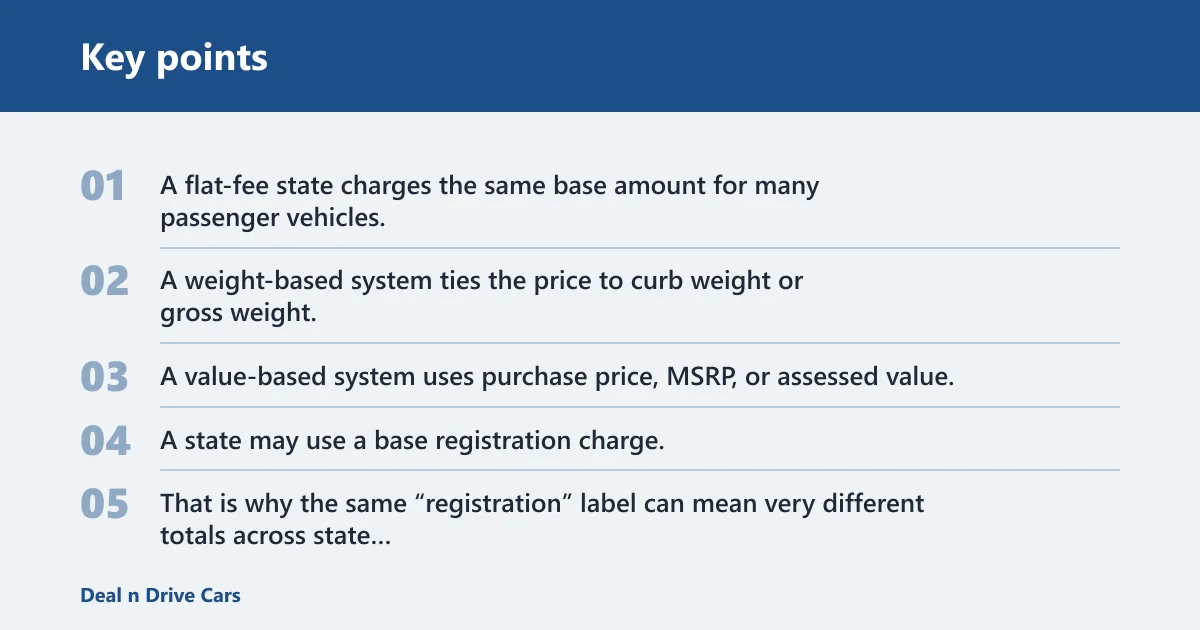
A flat-fee state charges the same base amount for many passenger vehicles, with limited variation by class or county. A weight-based system ties the price to curb weight or gross weight, which often affects trucks and heavier SUVs more than compact cars. A value-based system uses purchase price, MSRP, or assessed value, and the fee often declines as the vehicle ages.
Mixed systems are common. A state may use a base registration charge, then add a value-based or weight-based component, then layer in county fees. That is why the same “registration” label can mean very different totals across state lines.
Renewal timing and billing cycle differences
Some states renew yearly. Others renew every two years, and a few use multi-year options for certain vehicle classes. A biennial or multi-year system can look expensive upfront even when the annualized cost is similar. The billing cycle changes how the price feels, not just the dollar amount.
Say your car renews for two years at once. The payment may look twice as large as a yearly bill, but that does not mean the state charges more per year. Always compare the term length before judging a DMV quote.
Which vehicle details change the price most?

Vehicle value, weight, class, age, and model year often do more to change registration cost than shoppers expect. States use those details to sort vehicles into brackets. A passenger car, motorcycle, SUV, truck, or EV can each follow a different schedule under the same state law.
Vehicle value, MSRP, or taxable value
In ad valorem states, registration may depend on the vehicle’s value. That value can be the purchase price, an assessed value, or a table based on model year and depreciation. Newer vehicles often pay more in those systems because they start with a higher taxable value, then decline as the vehicle ages.
This is one reason a used car can register cheaply in one state and expensively in another. The fee is not tied only to the state name on the title. It is tied to what the state law says that vehicle is worth for registration purposes.
Weight, class, age, and model year
Vehicle weight can move a car or truck into a higher bracket in some states. That matters most for pickups, larger SUVs, vans, and commercial vehicles. A few pounds may not change much, but a heavier trim or towing package can push a vehicle into a pricier class in weight-based states.
Vehicle age can also reduce or alter fees where depreciation-based formulas apply. Some states use model year bands. Others use a declining value schedule over time. That means a 2019 vehicle may cost less to register than a 2024 model even if both are the same make and trim.
EVs, trucks, motorcycles, and commercial vehicles
Vehicle class matters because states often price it separately. Motorcycles may have lower fees. Trucks can be charged by weight or commercial use. EVs may face special registration charges or environmental fees in some places, especially where fuel-tax replacement policies are already part of the fee structure.
A common first-timer mistake is assuming every SUV follows the passenger-car schedule. Some do, but some states treat heavier SUVs more like trucks for fee purposes. Always check the class named on the state fee chart, not just the body style listed by the seller.
Why can the same car cost more in one county than another?
The same car can cost more in one county or city because local governments may add surcharges on top of the state base fee. Those add-ons can support roads, transit, air quality, or other local programs. The state formula may be identical, but the local layer changes the final total.
County and municipal add-ons
County-specific fees are usually tied to the owner’s address, not the place where the car was bought. That means two buyers in the same state can receive different totals if they live in different counties or municipalities. This is one of the most overlooked reasons DMV quotes vary inside a single state.
Emission or environmental surcharges
Some jurisdictions add emission or environmental fees, often in metro areas or counties with special air quality programs. These charges may apply at registration, renewal, or both. They can be modest on paper, yet still change the total enough to surprise a buyer comparing nearby ZIP codes.
How to estimate registration fees before you buy
You can estimate registration fees before purchase by separating the state base formula from title, plate, tax, and local charges. The best source is the state DMV fee chart or online calculator, because those tools usually show the vehicle class, value, and county rules that apply to your address.
Use the state DMV fee chart or calculator
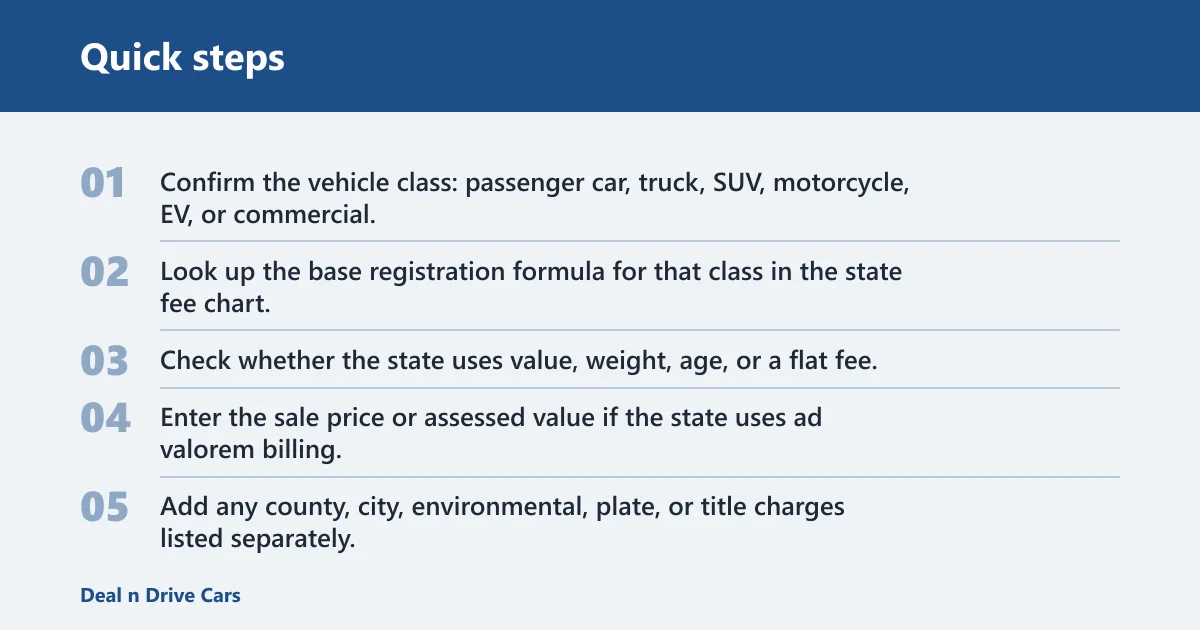
- Confirm the vehicle class: passenger car, truck, SUV, motorcycle, EV, or commercial.
- Look up the base registration formula for that class in the state fee chart.
- Check whether the state uses value, weight, age, or a flat fee.
- Enter the sale price or assessed value if the state uses ad valorem billing.
- Add any county, city, environmental, plate, or title charges listed separately.
- Check the renewal term so you know whether the quote is annual or multi-year.
Check title, plate, and local fees separately
Do not assume a single line marked “registration” includes everything. Title fee, plate fee, and local add-ons may be separate. A buyer comparing used cars should ask for the DMV line items, not just the total due at signing. That is the easiest way to avoid underestimating ownership cost.
Estimate moving-state costs before transfer
If you are moving, compare the prior state and the new state before the transfer deadline. Some states require fresh plates, a new title update, or a full first-year registration payment when the car enters the state. The new bill can be higher even if the vehicle itself did not change.
Proof table: one used car under three fee formulas
Here is a simple comparison for the same used car: a 2018 compact sedan valued at $12,000, weighing 3,100 pounds. The state formula changes the registration total even though the car does not. Title and local charges are shown separately so you can see what belongs to registration and what does not.
| Fee piece | Flat-fee state | Weight-based state | Value-based state |
|---|---|---|---|
| Base registration | $48 | $72 | $144 |
| Vehicle factor used | None beyond class | 3,100 lb bracket | 1.2% of $12,000 assessed value |
| Title fee | $15 | $15 | $15 |
| Local surcharge | $8 county fee | $8 county fee | $8 county fee |
| Total due | $71 | $95 | $167 |
This table shows the core idea: the same used car can face a different bill because the state formula changes. The title fee stays separate. The local surcharge stays separate. The total changes mainly because the registration formula changes.
What to do if your registration fee changes after you move
Your registration fee can change after a move because the new state uses a different formula, different renewal term, and different local add-ons. A vehicle that was cheap in a flat-fee state may cost more in a value-based or weight-based state. The reverse can happen too.
Why the bill changes across state lines
When you move, the new state may reassess the vehicle using its own definition of value, weight, or class. It may also charge a new plate fee, a title update fee, or a county fee based on your new address. The prior state’s rules no longer apply once the vehicle is registered under the new jurisdiction.
What to verify before transferring registration
Before transfer, confirm the new state’s deadline, inspection rules, title requirements, and county add-ons. Check whether your vehicle class changes under the new law, especially for trucks, EVs, or commercial vehicles. If the state uses assessed value, ask how it calculates the starting number for a used car.
What is the difference between registration fees, title fees, and taxes?
Registration fees pay for the vehicle’s legal operating status. Title fees update ownership records. Taxes are separate charges tied to the sale or transfer, though some states collect them at the same time. If you treat all three as one fee, your estimate will be off.
That separation also explains why a used-car quote can look different from a renewal notice. A first-time registration after purchase may include title work and taxes. A later renewal may include only the registration charge, plus any local surcharge or environmental fee.
Frequently asked questions
Why are car registration fees different from one state to another?
States set their own registration laws, so there is no national price. One state may charge a flat fee, another may use vehicle value, and another may use weight or class. Local add-ons and renewal timing can change the final bill even more.
What makes registration more expensive in some states?
Registration is often pricier where the state uses a value-based formula, a weight-based bracket, or a mix of base charges and local surcharges. Trucks, heavier SUVs, newer vehicles, and higher-value cars can move into more expensive brackets under those systems.
Are registration fees based on the value of the car or just the state?
Both can matter. The state decides the formula, and that formula may use value, weight, age, class, or a flat amount. In value-based states, purchase price or assessed value can directly affect the fee. In flat-fee states, value may not matter at all.
Why do some states charge yearly registration fees and others charge more upfront?
States choose different renewal terms. A yearly system spreads the cost out, while a biennial or multi-year system collects more at once. The longer term can make the first payment look higher even when the annual cost is similar. Always check the term length before comparing quotes.
Do taxes and local fees get included in registration fees?
Sometimes they appear on the same invoice, but they are not the same charge. Registration is separate from title fees and sales tax in many states. County, city, and environmental surcharges may be listed with registration or next to it, which is why the bill can be confusing.
Why did my registration fee go up when I moved states?
Your new state may use a different formula, a different renewal term, or extra county and emission surcharges. It may also require new plates or a title update. Even with the same car, the fee can change sharply when the registration jurisdiction changes.