Test Drive Checklist for a Used Car
By Alex Rivera, automotive editor. Technical review by Marcus Reed, ASE Master Technician. Methodology: this matrix was built by mapping common test-drive symptoms to the subsystem they most often indicate, then weighting the next step by safety risk, diagnostic certainty, and whether the likely repair is typically low-cost wear, a negotiation item, or a major inspection trigger. Recommendations and numeric checks below align with guidance from the National Highway Traffic Safety Administration (NHTSA), Consumer Reports, AAA, state inspection programs, and manufacturer owner’s manuals where warning-light behavior and temperature-gauge guidance are concerned.
Use a 20-to-30-minute test drive checklist: verify cold start, steering, braking, transmission, suspension, warning lights, and highway behavior, then classify each issue as continue, negotiate, order a pre-purchase inspection, or walk away. Miss the signs, and you can inherit a four-figure brake, CVT, turbo, battery, or AWD repair that wipes out any bargain. This checklist shows what to check in real time, which symptoms fit normal wear, and which ones mean stop, negotiate hard, or book an inspection.
Treat the drive as a decision tool. The useful question is not whether the car feels pleasant for ten minutes, but where a symptom shows up, what subsystem it points to, how expensive that fault usually gets, and what your next move should be.
A proper drive should last 20 minutes minimum, and 30 minutes is a better target when the seller allows it. Your route should include city traffic, rough pavement, a sharp turn, a full-lock parking-lot turn, a safe hard-braking area, and highway speed. That route structure matches mainstream buyer guidance from Consumer Reports and AAA, both of which recommend testing a vehicle on different road types and at realistic speeds rather than settling for a quick loop. For the highway section, many buyer guides suggest normal freeway speeds, and holding a steady 65–70 mph in top gear is a practical way to expose vibration, alignment, cooling, and transmission issues.
For related buying help, pair this checklist with a used car inspection checklist, a pre-purchase inspection guide, and a questions to ask when buying a used car guide before you make an offer.
Set up the test drive before you turn the key
Ask for a cold engine and choose the route yourself
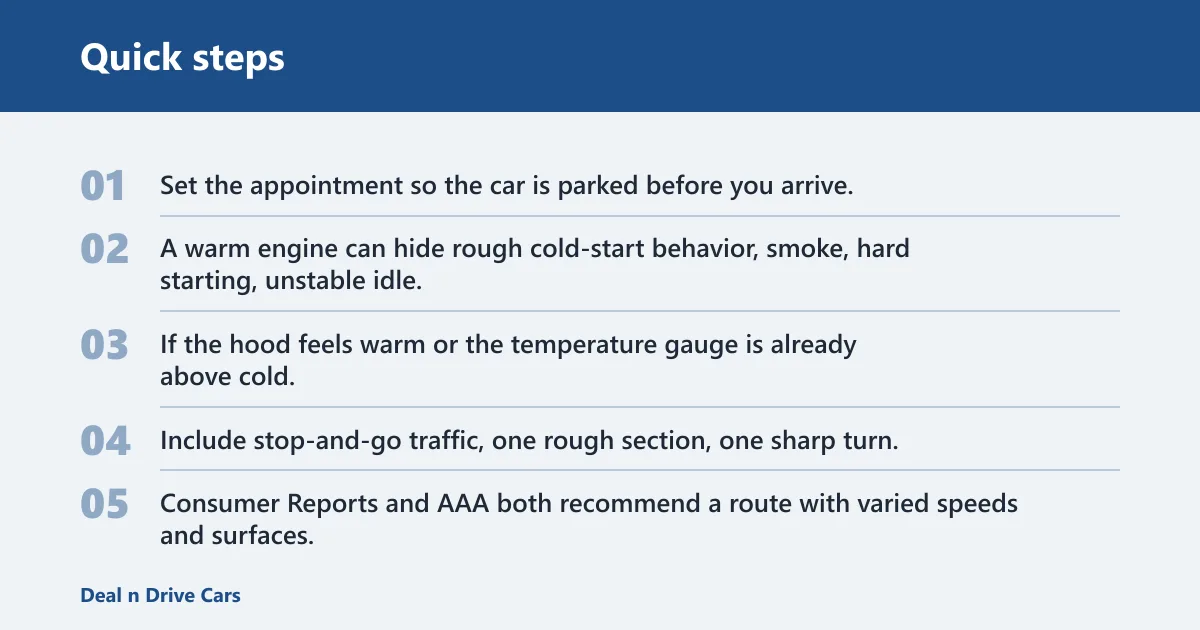
Set the appointment so the car is parked before you arrive, and tell the seller not to pre-warm it. A warm engine can hide rough cold-start behavior, smoke, hard starting, unstable idle, and some timing-chain or belt noise. If the hood feels warm or the temperature gauge is already above cold, note that as a setup risk.
Choose the route yourself. Include stop-and-go traffic, one rough section, one sharp turn, one full-lock turn in a parking lot, a place to merge, and one safe hard-braking stretch. Consumer Reports and AAA both recommend a route with varied speeds and surfaces, and Consumer Guide specifically includes merging as part of a power test. Do not accept a smooth three-minute loop around the block.
Before moving, brake once before entering public streets. That quick check matters because it confirms pedal travel and tells you right away if the car pulls, squeals, or surprises you at the first stop.
What to bring: license, insurance, flashlight, notes, and a second set of eyes
Bring your driver’s license, proof of insurance if the seller or dealer asks for it, a charged phone, a flashlight, a tread-depth gauge or coin, and a notes app or printed checklist. If you plan an OBD scan, confirm permission first. Bring a second person if you can, so one of you can drive while the other listens for noises, watches the gauges, and checks how the car tracks and shifts.
Bring simple comparison notes too: asking price, trim, mileage, tire brand and size, and the nearest similar listings. That matters later when you decide if a defect is a bargaining point or a reason to leave.
Dealership vs private seller: route control, accompaniment, and title-risk differences
Dealership drives and private-party drives carry different risks. At a dealer, the usual pressure points are route control, rushed timing, and keeping a salesperson in the car who talks over noises. Confirm who rides along, whether highway use is allowed, and whether dealer plate rules limit where you can go.
With a private seller, the bigger risks are title status, registration, insurance coverage, and ownership mismatches. Confirm that the seller’s name matches the title situation being described, that the vehicle can legally be driven, and that the route is still your choice. If the seller refuses a highway section or will not discuss title details, treat that as a risk signal before the mechanical checks even start.
How long the drive should be to expose problems?
Budget at least 20 minutes, and aim for 30 minutes when possible. That gives the car enough time for a cold start, city driving, highway speed, braking, a restart, and a hot-idle check. Short loops often miss faults that appear only after heat builds in the engine, transmission, brakes, or battery system. Consumer Reports and AAA both emphasize taking enough time to drive at different speeds and conditions rather than making a fast decision from a parking-lot impression.
What should you check before starting the car?
Before startup, confirm that the warning lights perform a normal self-check, the cabin and tires fit the asking price, and the engine is truly cold. This is also the best moment to catch water leaks, crash clues, tire mismatch, and seller setup tricks that can hide cold-start or title-related problems.
Do the dash warning lights pass the key-on self-check?
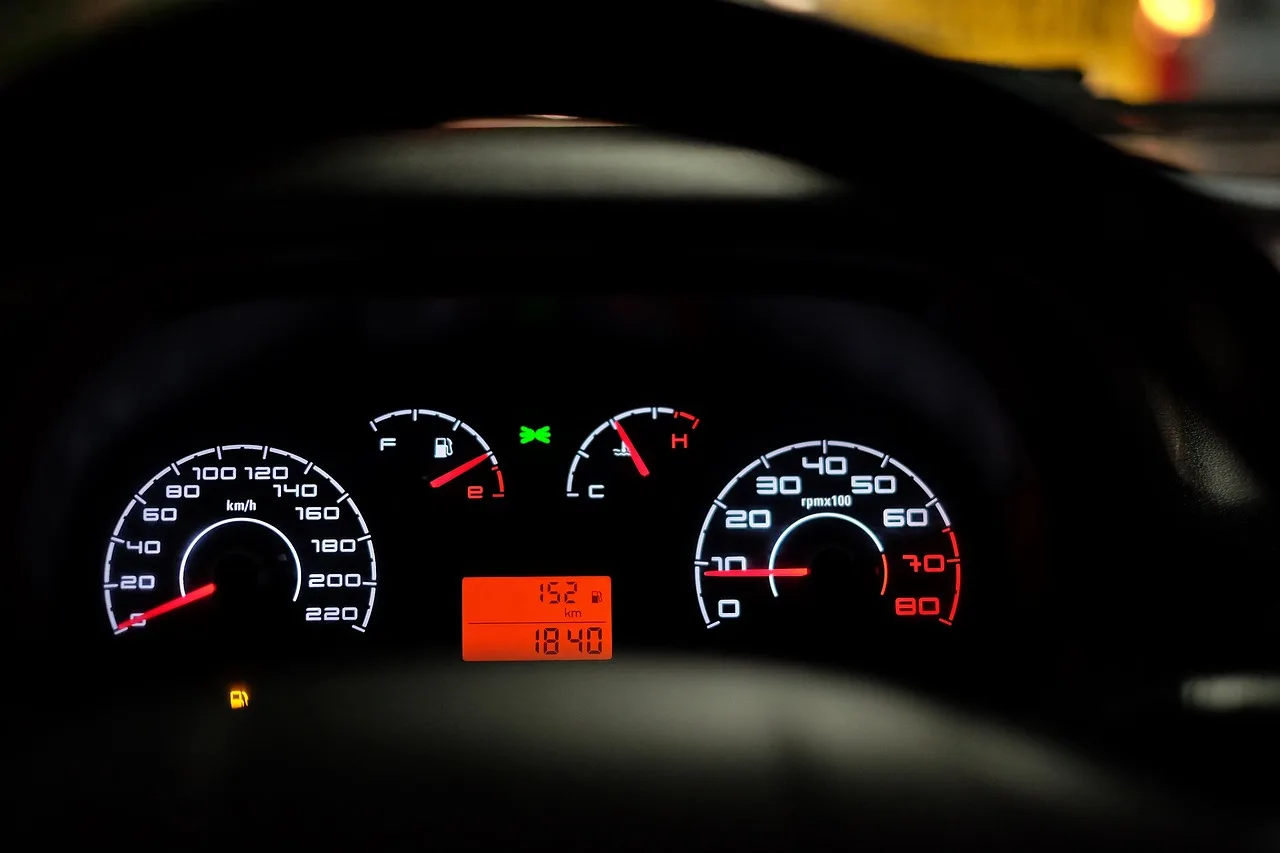
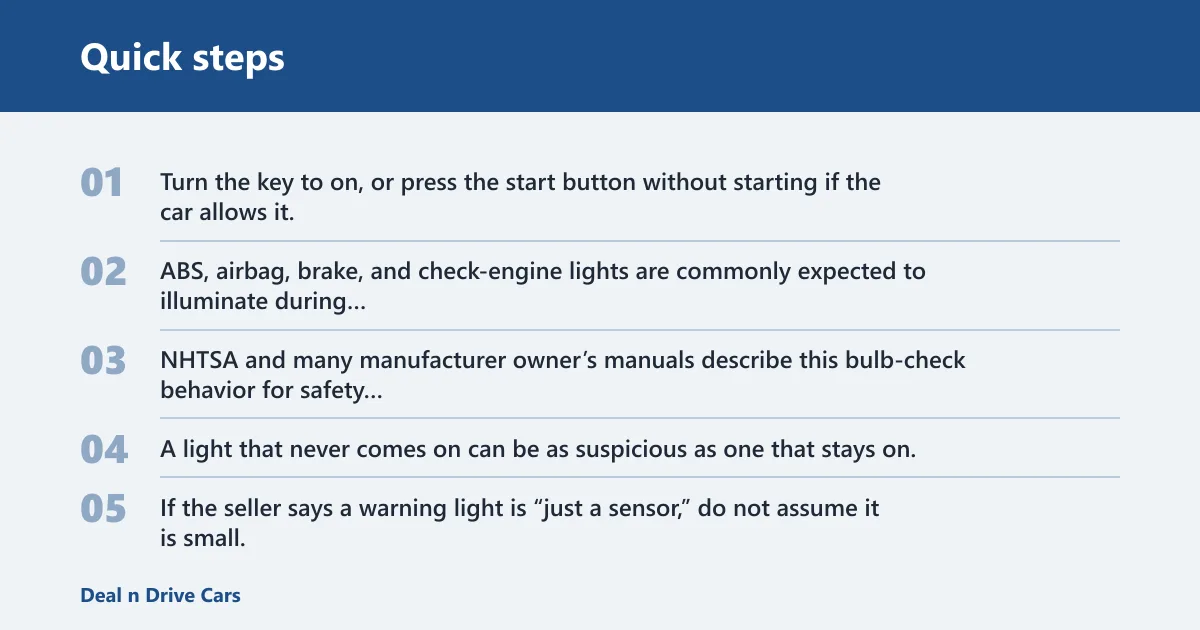
Turn the key to on, or press the start button without starting if the car allows it. ABS, airbag, brake, and check-engine lights are commonly expected to illuminate during the key-on self-check, then clear normally after startup. NHTSA and many manufacturer owner’s manuals describe this bulb-check behavior for safety and malfunction indicators. A light that never comes on can be as suspicious as one that stays on.
If the seller says a warning light is “just a sensor,” do not assume it is small. ABS and airbag faults are safety-system faults first, bargaining chips second. On most used cars, they move the next step from continue to inspect at minimum.
Does the cabin show signs of neglect, water leaks, or hidden damage?
Check the carpets, spare-tire well, headliner edges, and door seals for dampness or a mildew smell. Look for mismatched trim clips, missing fasteners, or an airbag cover that sits unevenly. Cabin neglect does not prove a major defect, but it lowers confidence in maintenance and can point to flood or body-repair history.
Also check what daily use will be like: adjust the seat and wheel, make sure you can get comfortable, confirm you can see the mirrors and corners of the car clearly, and check that gauges and major controls are easy to read and reach. Consumer Guide includes rear-seat practicality in comfort checks, so sit in the back if this car will carry adults or child seats.
Are tire condition, tire match, and wheel damage consistent with the asking price?
Look for even tread wear across each tire, the same brand and size across the axle, and no bent wheel lips. NHTSA advises checking tread condition and tire uniformity, and tire-industry guidance is especially strict about keeping matched tires on many AWD systems because circumference differences can stress driveline components. Mismatched tires can be a cost clue on any car, and on AWD or 4WD models they can also point to driveline stress or tight-turn binding later in the drive.
If one front tire is new, one is nearly worn out, and the steering wheel later shakes at speed, that combination matters more than either clue by itself.
Is the engine actually cold, and why that matters?
A cold start can help reveal crank time, initial idle quality, startup smoke, fuel smell, and noises that fade once oil pressure and temperature rise. The temperature gauge should rise steadily and then stabilize as the engine warms; if it is already warm when you arrive, one of the most useful checks is already gone. AAA and Consumer Reports both recommend starting with a cold vehicle when possible because some driveability and emissions faults are easiest to detect then.
What does a cold start tell you?
A cold start shows whether the engine starts promptly, idles evenly, smokes, smells of fuel, or makes timing, belt, chain, or valvetrain noise before heat masks it. It is one of the best filters for separating normal age from faults that deserve inspection or a hard pass.
Crank time, idle quality, and startup noises to note immediately
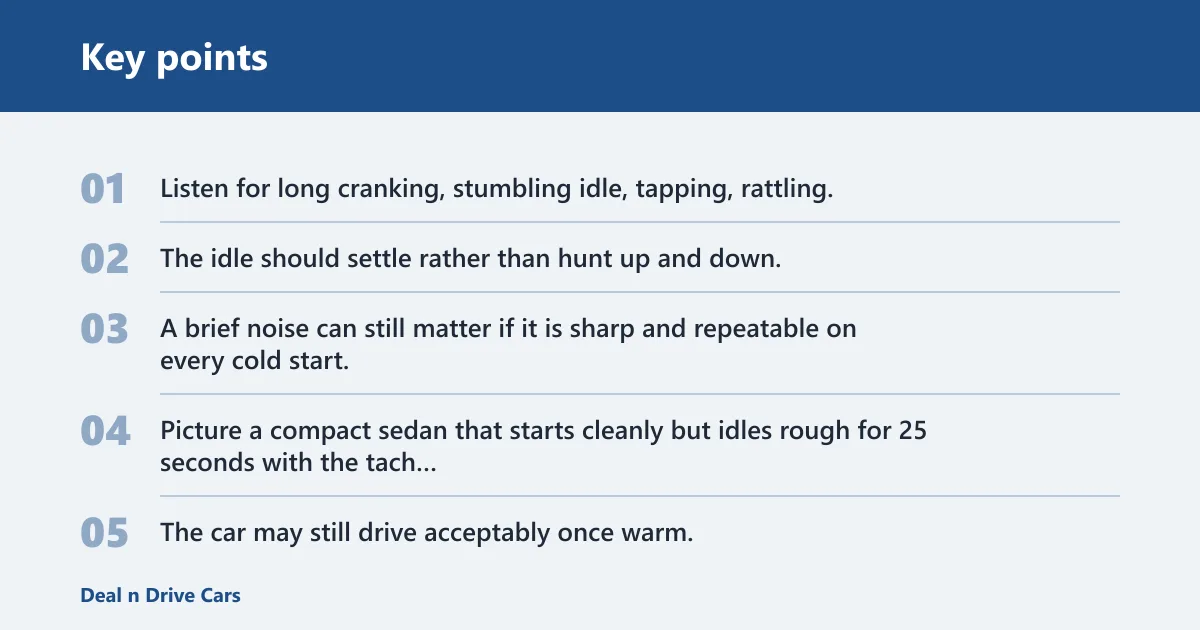
Listen for long cranking, stumbling idle, tapping, rattling, or belt squeal in the first seconds. The idle should settle rather than hunt up and down. A brief noise can still matter if it is sharp and repeatable on every cold start.
Picture a compact sedan that starts cleanly but idles rough for 25 seconds with the tach wavering and a fuel smell near the tailpipe. The car may still drive acceptably once warm, but that symptom set moves it out of “continue” and into “inspect” because warm behavior can hide the original fault.
Smoke, fuel smell, and exhaust clues that move a car into inspect or walk-away territory
Thin condensation on a cool day is normal. Blue smoke suggests oil burning, black smoke suggests an over-fuel condition, and heavy white smoke that lingers can point to coolant entry. A brief puff is different from smoke that continues after the idle settles.
Fuel smell from the exhaust or under hood after startup deserves attention. Pair it with a check-engine light, rough idle, or hard restart later, and the likely repair tier climbs fast. Heavy persistent smoke, overheating signs, or strong fuel odor are walk-away issues unless the price assumes a major repair and the car is heading straight to a professional inspection.
What warm-start masking looks like when a seller pre-runs the car
If the seller says, “I warmed it up for you,” assume that a useful check was removed. Warm engines can hide startup chain rattle, smoke, unstable idle, and hard starting. Ask to return another day for a true cold start if the rest of the car looks promising.
How should the car behave at low speeds?
At low speed, the car should engage Drive and Reverse without a long delay or harsh clunk, steer evenly, stop with a firm pedal, and stay quiet over bumps and full-lock turns. Parking-lot behavior often reveals faults that do not show clearly once road speed rises.
P to D and P to R engagement: delay, clunk, creep, or hesitation
Shift from Park to Drive and Park to Reverse with your foot on the brake. Engagement should be prompt and controlled. A delay, bang, shudder, or harsh lurch can point to transmission wear, mount problems, or low fluid condition where applicable.
As you roll away, shifts should be smooth and timely. Consumer Guide specifically tells buyers to evaluate smooth and timely shifts. Under moderate throttle, kickdown should happen without flare, slip, or a long pause.
Steering effort, return to center, and low-speed pull
The wheel should not feel heavy one moment and over-assisted the next. After a normal corner, it should return toward center on its own rather than sticking off-center. Pulling to one side can be simple alignment, but if it combines with brake pull, uneven tire wear, or steering dead spots, inspect before negotiating.
Full-lock turns, parking-lot bumps, and drivetrain noises
Use a parking lot for a full-lock turn in both directions. Tight, slow turns are useful because they can reveal power-steering complaints, CV-joint clicking, and AWD binding that do not show up in a straight line. Clicking can indicate CV-joint wear, groaning can point to steering-assist issues, and tire scrub or binding on AWD vehicles can suggest driveline mismatch.
Suppose an AWD crossover feels normal on a straight road but hops and resists movement in a tight parking-garage turn with matching steering input both ways. That is not normal “big tire” behavior by default. It raises the odds of tire circumference mismatch or transfer-case trouble.
Brake pedal feel, parking-brake hold, and stop-and-go smoothness
The brake pedal should feel firm, not mushy or sinking. The car should stop in a straight line with no grinding and ideally no squealing. Light brake squeak can be minor. Grinding is not. Test the parking brake on a slight incline if it is safe to do so. NHTSA notes that the red brake warning lamp can indicate a hydraulic or parking-brake issue, so any brake warning should be treated seriously.
In stop-and-go traffic, watch for transmission shudder, engine stumble, harsh downshifts, and brake release issues. These low-speed clues often decide whether a used car needs only minor maintenance or a serious inspection.
What should you test on the highway?
On the highway, the car can be checked for straight tracking, steering stability, wind noise, vibration, shift response, passing power, temperature stability, and braking from speed. Highway miles load the car differently than city streets, so faults in tires, bearings, alignment, cooling, and transmission behavior often become much easier to identify.
Straight tracking, lane changes, and steering stability at speed
Bring the car to highway speed and see whether it tracks straight without constant correction. A mild crown-related drift is one thing. Wandering, dead on-center feel, or a steering wheel that trembles is another. With windows up, listen carefully. Consumer Guide explicitly includes wind noise at highway speed in its checklist.
Acceleration, kickdown, and shift behavior under load
Use an on-ramp or clear passing zone to test moderate throttle. Merging belongs in the power test. The engine should pull cleanly, the transmission should downshift when asked, and acceleration should match the sound. Rev flare without matching speed is a bad sign.
Hold a steady cruise at 65–70 mph in top gear if conditions allow. Watch the temperature gauge. It should rise to normal and then stay stable, not climb in traffic and fall on the move, which can suggest cooling-system trouble. Owner’s manuals and state inspection guidance treat abnormal temperature behavior and active warning lights as inspection triggers because overheating can quickly become a major engine-risk issue.
Wind noise, road noise, wheel-bearing hum, and speed-linked vibration
Note where the noise is felt and whether it changes with speed, throttle, or steering angle. Steering-wheel shake often points toward front tire or wheel issues. Seat vibration can suggest rear tire problems. A hum that rises with speed may be tire roar or wheel-bearing wear.
Test with windows up, then briefly with them cracked or down. Wind noise around a door seal is different from a bearing hum or a tire thrum. If the sound changes when you gently load one side in a lane change, wheel-bearing suspicion rises.
Hard braking from speed: pedal pulse, ABS feel, and straight-line stopping
In a safe area, brake firmly from a higher speed. Pulsing through the pedal or wheel often suggests rotor variation. A soft pedal suggests hydraulic issues or air in the system. If ABS activates on a genuinely low-grip patch, the pedal should chatter in a controlled way, not sink or go dead. The same source describes that rapid pedal pulsation as normal ABS operation during hard stops on low-traction surfaces.
How do powertrain type and features change the checklist
Powertrain type changes both the symptoms to watch for and the likely repair bill. CVTs, turbos, hybrids, EVs, and AWD systems fail differently, so a generic used-car checklist misses signs that matter to the final decision and to the asking-price conversation.
CVT warning signs: flare, shudder, drone, and delayed response
On a CVT, watch for takeoff shudder, delayed engagement, rubber-band response, rev flare, or droning that rises without matching acceleration. Low-speed creep should be predictable. Any overheating warning, repeated shudder, or slipping feel is more than a minor bargaining point. It usually means inspect at minimum, and severe symptoms can justify walking away.
Turbo signs: weak boost, surge, smoke, whistle, and heat-related smells
Turbo cars should build power smoothly under load. Watch for a flat spot before boost, surging once boost arrives, smoke during acceleration, or a siren-like whistle that does not sound normal. After the drive, pay extra attention to burnt-oil smell around the engine bay and intercooler plumbing area.
Hybrid signs: engine start-stop quality, regen feel, and battery-system warnings
In a hybrid, engine start-stop events should feel controlled, not violent or hesitant. Regenerative braking should be predictable, with no sudden grab or dead spot at low speed. Large battery-state swings, loud cooling-fan noise from the battery area, or any hybrid-system message move the car straight to inspection. Because hybrid warning messages can involve the high-voltage system, manufacturer service information and owner’s manuals usually treat them as diagnostic items, not casual monitor-later issues.
EV and AWD signs: charge-port issues, driveline whine, regen consistency, and tight-turn binding
For an EV, inspect the charge port for damage, confirm state-of-charge seems realistic for the seller’s claims, and test whether acceleration and regen are smooth and repeatable. Clicking, clunking, or driveline whine under acceleration deserves attention, as do battery or powertrain alerts and major HVAC-related range drop during the drive.
For AWD or 4WD, watch for binding on tight turns, transfer-case noises, and vibration under acceleration. Tire mismatch matters more here than on a two-wheel-drive car because rolling-diameter differences can strain the system.
Drive matrix decision table
How to read the table
Use the table by matching a symptom to where it appears during the drive, then reading across to the likely subsystem, severity, repair tier, and next action. “Low” means common wear items. “Moderate” usually means negotiate or inspect. “High” and “very high” mean expensive or safety-critical faults where walking away becomes a normal outcome.
Decision matrix
| Symptom | Where it appears in the drive | Likely subsystem | Severity | Estimated repair tier | Recommended action |
|---|---|---|---|---|---|
| ABS, airbag, brake, or check-engine light stays on after startup | Key-on self-check and first minute | Safety systems, emissions, engine controls | High | Moderate to very high | Inspect; walk away if seller minimizes or hides it |
| Rough cold idle, long crank, repeated startup rattle | Cold start | Ignition, fuel, timing, valvetrain | Moderate to high | Moderate to high | Inspect before negotiating |
| Blue smoke or heavy white smoke that continues after startup | Cold start and early pull-away | Engine wear or coolant entry | High | High to very high | Walk away unless pricing assumes major repair and inspection confirms scope |
| Delay or harsh clunk shifting P to D or P to R | Parking lot | Transmission, mounts, driveline | Moderate to high | Moderate to very high | Inspect; negotiate only if diagnosis is clear |
| Mushy pedal, grinding brakes, strong pull under braking | Low speed and hard braking | Brakes, hydraulics, calipers | High | Moderate to high | Walk away or require repair proof before purchase |
| Wheel shake at speed, seat vibration, hum rising with speed | Highway cruise | Tires, wheels, bearings, alignment | Low to moderate | Low to moderate | Continue if mild; negotiate or inspect if persistent |
| Temperature gauge does not stabilize normally or climbs in traffic | Mid-drive and highway | Cooling system | High | Moderate to very high | Walk away unless a professional inspection immediately follows |
| Clicking on full-lock turns | Parking-lot full-lock test | CV joints or steering components | Moderate | Moderate | Negotiate if isolated; inspect if combined with vibration |
| Dealer limits route to a short local loop or refuses highway section | Before drive | Dealership setup risk | Moderate | Unknown | Do not decide today; continue only with a longer route |
| Title story, registration, or seller identity does not line up | Before drive or after | Private-seller ownership risk | High | Potentially very high | Walk away |
| Hybrid engine start-stop shudder or hybrid-system warning | City traffic and idle | Hybrid battery, inverter, controls | High | High to very high | Inspect; often walk away if warning is active |
| CVT shudder, flare, or drone without matching acceleration | Takeoff and moderate throttle | CVT transmission | High | High to very high | Walk away or inspect before any price talk |
| Weak boost, surge, smoke under load, abnormal whistle | Merge and passing test | Turbocharger, charge plumbing, engine | Moderate to high | Moderate to high | Inspect; negotiate only with diagnosis |
| EV battery or powertrain alert, driveline click, strong whine | Startup and acceleration | Battery, inverter, motor, reduction gear | High | High to very high | Walk away or require brand-level inspection |
What should you recheck right after the drive?
Right after the drive, recheck the car while it is hot. A warm engine or battery system can reveal smells, leaks, fan behavior, hot-idle problems, restart issues, and fresh warning lights that were absent when the car was cold, which makes this stage as useful as the opening minutes.
Hot idle, restart behavior, and new warning lights
Let the car idle for a minute after parking. Watch for stumbling, overheating, or warning lights that appear only when hot. Then shut it off and restart it. A hard hot restart, long crank, or fresh check-engine light changes the decision fast.
Under-hood smells, cooling-fan behavior, and fluid leaks
Open the hood if the seller allows it. Smell for burnt oil, coolant, or fuel. Listen for cooling fans cycling normally rather than running at full speed without reason. Look underneath for fresh drips and under the hood for wet spots around hoses, valve covers, turbo plumbing, or coolant tanks.
A second undercarriage and tire look after the car is warm
Recheck the tires for smell, fresh scuffing, and obvious heat difference side to side. A full undercarriage inspection is for a lift later, but a second look can reveal fresh seepage, torn boots, or contact marks that were not obvious before the drive.
How do you turn test-drive results into a buy or walk-away decision?
Turn the drive into a decision by sorting findings into four buckets: continue, negotiate, inspect, or walk away. Minor wear like light tire noise or small brake squeak may be negotiable. Safety warnings, overheating, severe transmission symptoms, heavy smoke, and ownership mismatches belong in the walk-away bucket.
Normal wear vs bargaining points vs red flags
Normal wear usually means isolated, low-cost items: older tires with even wear, light interior wear, or a minor rattle with no related driving fault. Bargaining points include mild brake pulsation, worn tires, weak battery, one noisy wheel bearing, or a small suspension clunk. Red flags include airbag or ABS faults, severe shift flare, repeated overheating behavior, strong smoke, title mismatch, and obvious crash or flood clues.
Compare as-equipped value against similar cars in the class
Compare the asking price with similar listings that match trim, mileage, drivetrain, and key options. Then subtract likely repair needs by tier, not by wishful thinking. A car priced like the best examples in its class should not need tires, brakes, suspension work, and an immediate transmission diagnosis.
When to book a pre-purchase inspection instead of negotiating on the spot
Book a pre-purchase inspection when the car is fundamentally promising but has a symptom that is expensive enough to matter and specific enough to diagnose: one-wheel hum, mild cold-start stumble, small fluid seep, or slight brake pulse. Do not negotiate first and hope the inspection goes your way later. If you want a deeper framework for that next step, use a pre-purchase inspection guide and a used car buying checklist before money changes hands.
Simple decision path
- Continue if the car cold-starts cleanly, drives straight, shifts normally, brakes firmly, and shows no active warning lights.
- Negotiate if faults are isolated, low to moderate tier, and easy to price, such as tires, routine brakes, or a minor suspension noise.
- Inspect if symptoms point to transmission, turbo, hybrid, EV, AWD, steering, cooling, or safety-system faults that need diagnosis.
- Walk away if there is overheating, heavy smoke, severe shifting problems, structural suspicion, active airbag or ABS faults, or title and ownership mismatch.
Frequently asked questions
What should I check before starting a used car test drive?
Check that the engine is cold, the dash warning lights illuminate at key-on and clear after startup, the tires are evenly worn and properly matched, and the cabin shows no water leaks or crash clues. Also confirm registration, route control, and who rides along before you move.
What do I need to bring for a test drive?
Bring your driver’s license, proof of insurance if the seller or dealer requires it, a charged phone, flashlight, tread-depth gauge or coin, notes app or printed checklist, and a second person if possible. If you want an OBD scan, ask permission first and decide in advance when you will use it.
How long should a used car test drive be?
Aim for at least 20 minutes, and budget 30 minutes when the seller allows it. That gives enough time for a cold start, city driving, rough pavement, a merge, highway cruise, braking from speed, and a hot restart after the car has fully warmed. Consumer Reports and AAA both support using a varied route and enough time to evaluate the vehicle beyond a brief local loop.
What route should I take on a used car test drive?
Choose the route yourself and include city traffic, a rough road, a sharp turn, a parking-lot full-lock turn, a safe hard-braking area, and at least one highway section. Consumer Guide, Consumer Reports, and AAA all recommend varied surfaces and speeds because many faults appear only when the car is loaded differently.
What should I test on the highway during a test drive?
At highway speed, test straight tracking, steering stability, wind noise, vibration through the wheel or seat, passing power, kickdown response, and temperature stability. If conditions allow, hold 65–70 mph in top gear and then brake firmly in a safe area to check pedal feel and straight-line stopping.
What warning signs should make me walk away after a test drive?
Walk away for active airbag or ABS warnings, overheating, heavy blue or white smoke, severe transmission delay or flare, major brake weakness, strong fuel smell, structural or flood clues, and title or ownership mismatch. Those problems carry safety risk, high repair exposure, or both.
Sources: National Highway Traffic Safety Administration owner-information and warning-light guidance; Consumer Reports used-car test-drive advice; AAA used-car buying guidance; Consumer Guide Automotive test-drive checklist; state vehicle inspection manuals and manufacturer owner’s manuals for normal indicator-light self-check and temperature-gauge behavior.