How to negotiate a used car price at a dealership
Negotiate the out-the-door price, not the monthly payment, and consider starting a bit below comparable local listings when the car has been on the lot for a month or more. If you skip that, you can overpay through payment padding, hidden fees, or a trade-in deal that looks good only on paper. This guide shows which price layer to target, which facts support your offer, and the fallback script to use when the dealer says no.
What you’ll need before you ask for a lower price
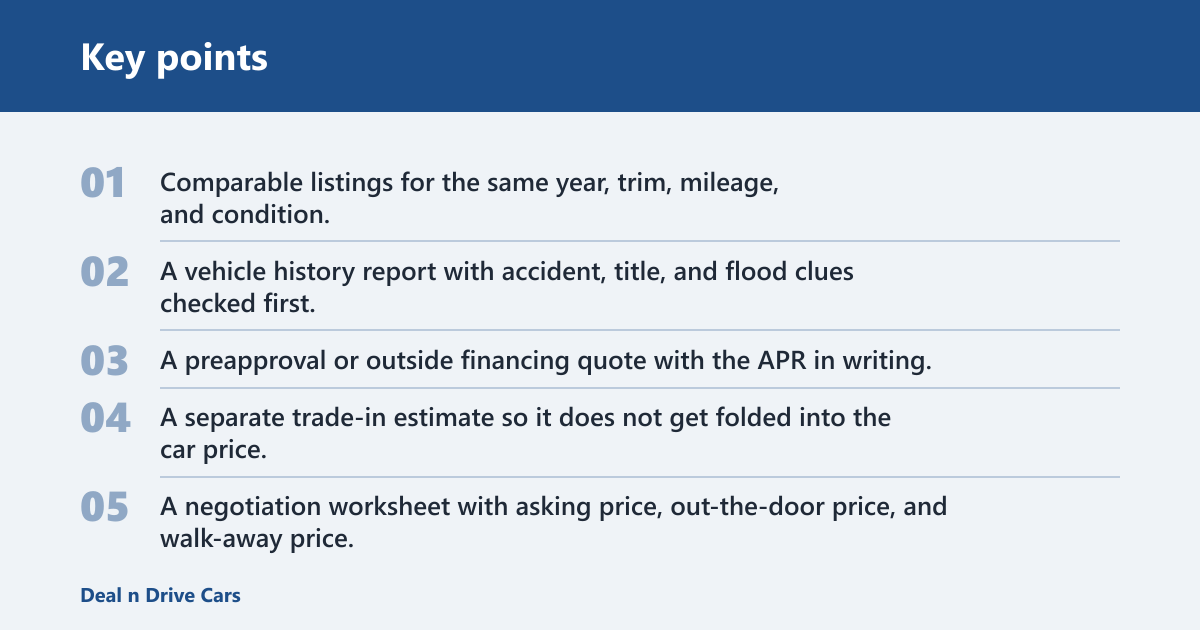
- Comparable listings for the same year, trim, mileage, and condition.
- A vehicle history report with accident, title, and flood clues checked first.
- A preapproval or outside financing quote with the APR in writing.
- A separate trade-in estimate so it does not get folded into the car price.
- A negotiation worksheet with asking price, out-the-door price, and walk-away price.
- A note on reconditioning clues such as tire wear, brake condition, and visible repairs.
- A fee checklist for documentation fees, add-ons, and dealer-installed extras.
| Price layer | What it includes | What to compare |
|---|---|---|
| Sale price | Vehicle price before taxes and fees | Advertised asking price, similar listings |
| Out-the-door price | Sale price plus taxes, fees, and dealer add-ons | Final number to compare across dealers |
| Total financed cost | Out-the-door price plus finance charges over time | APR, term, and lender fees |
- Find the market range for the exact year, trim, mileage, and condition.
- Check the vehicle history report before discussing price.
- Write down reconditioning clues, fee questions, and your maximum out-the-door number.
- Get a loan quote from outside financing if you plan to finance.
- Keep your trade-in separate from the purchase offer.
- Open with the out-the-door price you want to pay.
How used-car price negotiation works

Negotiate means to work out an agreement between parties, and Vocabulary.com defines negotiation as give and take. Dictionary.com also lists dealing or bargaining with others, arranging terms by discussion, and conducting or transacting business. That matters here because a dealership deal has more than one number.
The sale price is the vehicle price before taxes and fees. The out-the-door price is often the clearest comparison number because it includes taxes, dealer documentation fees, and any dealer add-ons. Total financed cost is different again, because APR changes what you pay over the loan term. Automotive News tracks dealer website retail pages for marketed price, notes an Average Marketed Price, and measures inventory in VIN-specific vehicles.
Why dealers focus on different numbers
Sale price is easy to advertise. Monthly payment is easy to soften. Out-the-door price is harder to hide, so use it as the anchor number. If the dealer pushes only the payment, ask for the full breakdown and compare the complete figure before you agree to anything.
A dealer saying a price is “fixed” is sometimes real and sometimes a tactic. It is more believable when the vehicle is aggressively priced, newly listed, or already below market. It is less believable when the car has been listed for weeks, shows signs of reconditioning, or sits in aged inventory.
How do I negotiate a used car price at a dealership?
Start with comparable listings, then make a written out-the-door offer based on a similar year, trim, mileage, and condition. Keep the trade-in, financing, and extras out of that first number. A clear offer backed by market evidence gives the dealer something concrete to answer.
Step-by-step process
- Confirm the sale price, fees, and taxes separately.
- Set your walk-away price before you visit the lot.
- Point to two or three comparable listings.
- Offer one out-the-door number, not a vague discount.
- Pause after the dealer counters.
- Leave if the deal stays above your limit.
Say your target is a similar Civic with moderate mileage, a clean history, and normal wear. If local listings for similar cars cluster lower and the tires are near replacement, that supports a lower offer. If the dealer has already priced it below market, room may be limited.
How much can you negotiate a used car price at a dealership?
The amount depends on the car’s market position, not a fixed rule. A vehicle priced above similar listings gives more room than one that is already aggressive. Inventory age, accident history, and visible wear can move the number too, while low-mileage, clean-title cars often leave less room.
What changes the room you have
- Market comps: same trim and mileage set the ceiling.
- Vehicle history: accident, title, or flood clues reduce value.
- Reconditioning: tires, brakes, detailing, and repairs affect dealer cost.
- Inventory age: older stock often gives more room than fresh arrivals.
- Condition: scratches, worn interiors, and warning lights matter.
Use a local asking-price range, then set your first offer below the middle of that range if the car has sat for a while. If it is already priced near the lowest comparable listing, ask for fee removal, a better APR, or a trade-in improvement instead of forcing the sale price down further.
Should I negotiate the out-the-door price or the sale price?
Negotiate the out-the-door price. It includes taxes and fees, so it is the true comparison number across dealers and deal structures. Sale price matters, but it can hide a high documentation fee, add-ons, or a finance structure that leaves the final amount higher than expected.
Why the out-the-door number wins
Two cars with the same sale price can cost very different amounts once fees and taxes are added. One dealer may use a lower advertised price with a large documentation fee. Another may list a higher sale price but fewer extras. The out-the-door figure shows the real gap.
A common first-timer mistake is agreeing to “$500 off” without seeing the final breakdown. That sounds like a win, then the dealer adds protection packages, a higher fee, or a higher APR. Ask for the full buyer’s order before you say yes.
How do I research a fair offer?
Use comparable listings with the same year, trim, mileage, and condition, then adjust for accident history, options, and visible wear. Vehicle history reports help support a lower offer when title, accident, or flood clues appear. Reconditioning clues matter because they reveal dealer costs the price may still need to cover.
How to read the evidence
- Compare mileage within a tight band, not a broad one.
- Match trim and drivetrain, since equipment changes value.
- Check photos for tire wear, brake dust, curb rash, and seat damage.
- Look for recent price drops or inventory age clues.
- Use the history report to discount accident or title issues.
Suppose three similar listings sit within 150 miles and one has fresh tires, one needs brakes, and one shows an accident record. Those are not equal cars, so the lowest price is not always the best deal. Adjust your target for condition before you make the offer.
How do I ask if a used car price is negotiable?
Ask directly and politely, then ask for the best out-the-door number if the answer is yes. A simple question keeps the discussion on price instead of personality. If the dealer says the listed price is firm, ask which part of the deal can still move.
Useful wording
“Is there room on the out-the-door price if I can show comparable listings?” works better than asking for a vague discount. “What is the best out-the-door number you can do today?” keeps the conversation focused. “Is the documentation fee fixed, or can you offset it elsewhere?” gets you to the right layer.
What should I negotiate after the car price?
After the vehicle price, check the documentation fee, add-ons, APR, and trade-in as separate lines. Dealer documentation fee is dealer-set, can differ widely, and is often only indirectly negotiable. Financing rate affects total cost, and a trade-in should be valued independently so it does not hide a higher car price.
Where the money often moves
- Documentation fee: ask whether it can be reduced or offset.
- Add-ons: decline items you did not ask for.
- APR: compare the dealer offer with your outside quote.
- Trade-in: get a separate appraisal and separate offer.
Dealer reserve may be built into the rate, so a lower advertised vehicle price can be paired with a more expensive loan. Compare the total financed cost, not only the payment. That keeps the deal honest.
Can you negotiate a used car price at a dealership if you’re paying cash?
Yes, but cash does not guarantee a lower sale price. It can simplify the paperwork and remove the loan discussion, yet the dealer may still hold firm on the vehicle price. Keep the conversation on the out-the-door number and do not let “cash buyer” become the main point.
How to keep cash from distracting the deal
Say you are ready to buy today if the out-the-door number works. Then ask for the same written breakdown you would want with financing. If the dealer tries to switch attention to payment, bring it back to sale price, documentation fee, and taxes.
How do I respond when the dealer says no?
Ask for the best out-the-door number, ask what part of the deal can move, and then use your walk-away price. Calmly leaving is often the strongest response when the dealer will not move on the right number. If the numbers change later, revisit the offer only with a written breakdown.
Fallback script
- “What is the best out-the-door price you can do today?”
- “If the sale price is fixed, can you move the fee, APR, or add-ons?”
- “If not, I need to stay at my walk-away number.”
- “Please send the full breakdown in writing.”
If that did not work, leave and compare the same vehicle at other stores. A dealer who wants the deal may call back with a better figure later. Return only if the out-the-door number changes in writing.
Common mistakes that ruin a used-car negotiation
Focusing only on the monthly payment is the biggest mistake. It lets price, term, and APR blend together. Mixing trade-in value with the purchase price does the same thing. Ignoring fees until the last page can also turn a good-looking deal into an expensive one.
What to avoid
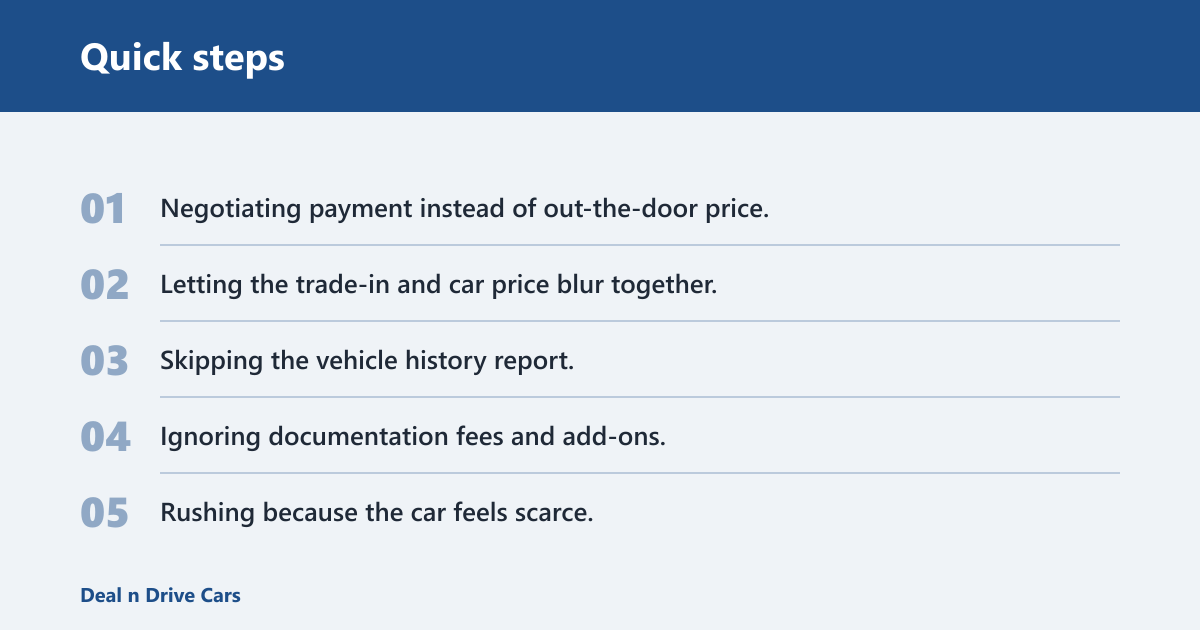
- Negotiating payment instead of out-the-door price.
- Letting the trade-in and car price blur together.
- Skipping the vehicle history report.
- Ignoring documentation fees and add-ons.
- Rushing because the car feels scarce.
- Forgetting to compare APR and outside financing.
Another mistake is treating every “non-negotiable” claim as final. Some are real, especially on sharp-priced cars. Others are a starting position. The proof is in the full breakdown, the comparables, and the dealer’s willingness to move on something other than the sticker price.
Prevention: save screenshots of comparable listings, history report notes, and the written buyer’s order before you sign. That makes it easier to compare later offers and spot changes in fees or financing.
How to negotiate a used car price at a dealership canada
In Canada, use the same structure: compare the out-the-door amount, separate taxes from vehicle price, and ask for the dealer’s full breakdown before agreeing. Taxes and fees can vary by province, so the final figure may differ even when two cars share the same sticker price. The same comparison rule still applies.
How to negotiate a used car price at a dealership reddit
Advice on forums often mixes good tactics with one-off stories. Use it for ideas, not for your final number. A better approach is to verify comparable listings, history, fee structure, and APR, then ask for the best written out-the-door offer from the dealer.
Frequently asked questions
How do I negotiate a used car price at a dealership?
Start with the out-the-door number, not the payment. Bring a few comparable listings, a history report, and a walk-away price. Then make one written offer and wait for the dealer’s counter in writing so you can compare the real total.
How much can you negotiate a used car price at a dealership?
The room depends on market comps, condition, inventory age, and repair needs. A car priced above similar listings gives more room than one already priced aggressively. Use the out-the-door figure to see whether the offer is actually moving.
Can you negotiate used car prices at a dealership if you’re paying cash?
Yes. Cash can simplify closing, but it does not force a lower price. Keep the discussion on sale price, documentation fee, and taxes, and ask for the full out-the-door number before you mention payment method again.
Should I negotiate the out-the-door price or the sale price?
Negotiate the out-the-door price. Sale price leaves room for taxes, documentation fee, and add-ons to change the real total. The out-the-door number is easier to compare across dealers and harder to misread.
What if the dealer says the price is not negotiable?
Ask for the best out-the-door number and ask which part of the deal can still move. If nothing changes, use your walk-away price and leave. Dealers sometimes change the number later when they know you are comparing other cars.
Which used car fees are negotiable and which are not?
Taxes are usually set by law, but dealer documentation fee, add-ons, and protection packages may move, be removed, or be offset with a lower sale price. Ask for each line separately so you can see which part is actually fixed.