What Should You Do the Day Before Buying a Used Car?
The day before buying a used car, confirm your financing, verify the title, VIN, and fees, book a pre-purchase inspection, and set one clear walk-away limit. Skip those checks, and you can end up with hidden accident damage, title trouble, unexpected fees, or a car sold before you finish. This guide covers the exact documents, calls, and decisions to make before you sign.
What should you do the day before buying a used car?
The day before, your job is to remove uncertainty. Confirm money, insurance, identity, and inspection timing before you see the car again, so tomorrow is a final check, not a rushed choice. For a private sale, ownership and finance checks matter most. For a dealer, the focus shifts to fees, VIN matching, and delivery paperwork.
Set your buy-or-walk-away rules
Used vehicles can hide accident damage, mileage tampering, or title issues that buyers may miss. Decide now what would make you stop the deal: mismatch on the VIN, unresolved finance, missing ownership papers, or an inspection that cannot be booked in time. That keeps the decision simple when the seller applies pressure.
Suppose the report shows a mileage gap of about 20,000 miles between records and the odometer today. That is not a small clerical issue. It is a reason to pause, ask for proof, and walk away if the answer does not make sense.
Separate private-sale and dealer prep
Private sales carry more title and finance risk, so you need stronger proof of ownership and clearer answers on outstanding loans. Dealer sales usually offer cleaner paperwork, but you still need to verify the VIN, fees, and any trade-in or delivery documents. Do not use the same checklist for both.
Make sure tomorrow is a confirmation, not a gamble
carVertical recommends checking a vehicle in five areas, starting with history before the car itself. That order matters because the report can filter out obvious bad fits before you spend time on a viewing, test drive, or negotiation. The right sequence is history, exterior/body, interior/electrics, engine/mechanics, then test drive.
Finish your money and insurance checks
Lock down financing, confirm insurance, and match the payment method to the seller’s rules before you travel. If you are paying cash, make sure the funds are available in the exact form the seller accepts. If you are financing, get the approval terms in writing and know the maximum amount you can spend.
-
Confirm financing today.
Get pre-approval or verify cash access before you leave home. If the car costs more than your approved amount, or the lender needs extra vehicle details tomorrow, the deal can stall at the worst moment.
-
Check your insurance start time.
Call or log in to get a quote and set the start date for the exact purchase day and time. Many buyers wait until after the sale, then discover they cannot drive the car home or register it the way they expected.
-
Match payment to the seller.
Ask whether the seller wants bank transfer, certified funds, or another method. Never assume a private seller and a dealer want the same process, especially if a finance company, logbook, or handover form is involved.
Used car day-before checklist
This checklist is for the night before, not the viewing itself. Use it to decide whether the car is still worth seeing, and whether you can complete the purchase without blind spots. If one item fails, treat that as a serious warning, not a minor delay.
| Task | Why it matters | Pass/fail criterion | Walk-away trigger |
|---|---|---|---|
| Financing status | Confirms you can pay without rushing or overstretching your budget. | Approval or cash access is confirmed in writing or through your bank. | No approved funding, or the amount is below the asking price plus required fees. |
| Insurance quote | Lets you drive or register the car on time if the sale goes ahead. | Cover can start on the purchase day and time you plan to take delivery. | No policy can start tomorrow, or the insurer will not cover the exact vehicle. |
| History report | Checks accidents, title issues, mileage history, theft flags, and finance status. | CARFAX, AutoCheck, or another report can help confirm that there are no unresolved red flags that would change the decision. | Any theft flag, title issue, unexplained mileage gap, or finance warning cannot be explained. |
| Seller identity | Reduces the risk of buying from someone who cannot legally sell the car. | The seller name matches the ownership document and the person arranging the sale. | Name mismatch, missing ID, or reluctance to show ownership proof. |
| VIN match | Ties the car to the report, paperwork, and stamped vehicle numbers. | The VIN matches the report, registration document, and visible or stamped numbers. | Any VIN mismatch, altered plate, or unreadable stamped number. |
| Inspection booking | Gives an independent mechanic time to catch engine, transmission, or safety issues. | A booked slot is confirmed before money changes hands. | No inspection slot available for a private sale or out-of-state purchase. |
| Paperwork to bring | Prevents delays and helps confirm the car’s identity and sale terms. | You have ID, payment method, insurance details, and any required registration forms. | You cannot complete the sale because a required document is missing. |
| Walk-away trigger | Stops emotional buying when a serious problem appears. | You can name one clear reason to stop, and you will follow it. | Any unresolved finance, paperwork mismatch, or inspection failure. |
What paperwork should you check before buying a used car?
Check the ownership document, history report, service records, and any required test paperwork before you visit or pay. The main goal is to confirm that the seller is allowed to sell the car and that the paperwork matches the vehicle in front of you. Compare every document against the VIN, odometer, and seller details.
Vehicle Registration Certificate or logbook
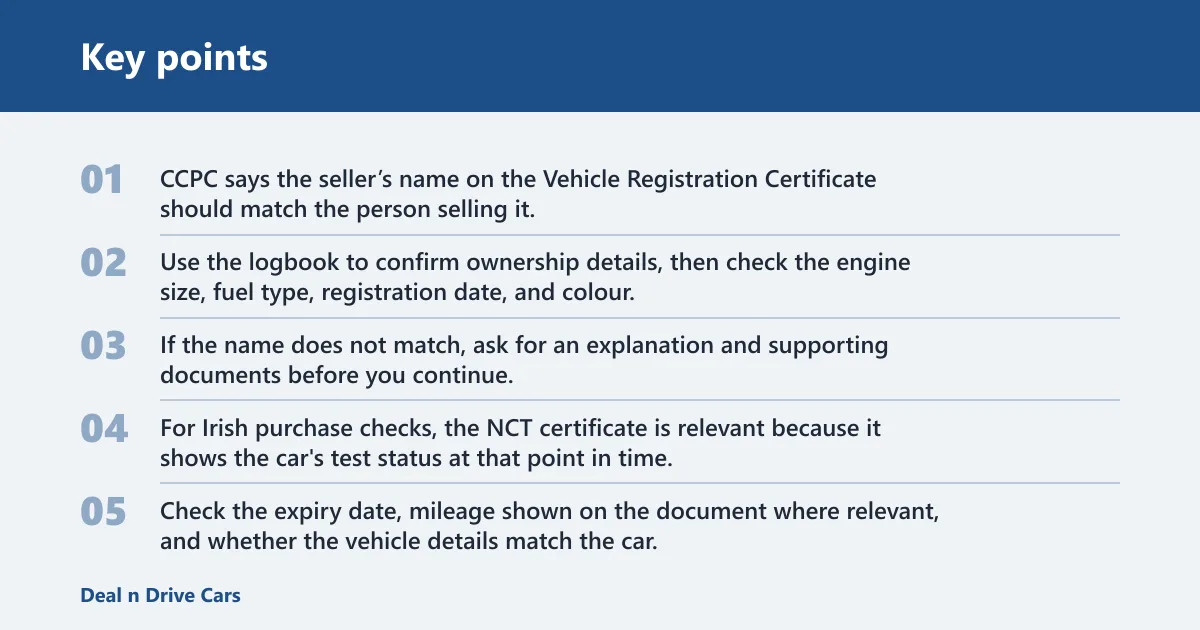
CCPC says the seller’s name on the Vehicle Registration Certificate should match the person selling it. Use the logbook to confirm ownership details, then check the engine size, fuel type, registration date, and colour. If the name does not match, ask for an explanation and supporting documents before you continue.
NCT certificate and other test paperwork
For Irish purchase checks, the NCT certificate is relevant because it shows the car’s test status at that point in time. Check the expiry date, mileage shown on the document where relevant, and whether the vehicle details match the car. A missing or inconsistent certificate is a warning sign, not a minor admin issue.
Service records, receipts, and maintenance history
Service records may show dealer and independent work, and they help you judge maintenance consistency. Look for oil changes, brake work, tyres, timing belt or chain notes where relevant, and repeated gaps in mileage between entries. A neat folder is useful, but a handful of dated receipts is more valuable than vague claims.
A common first-timer mistake is treating “full service history” as enough by itself. Ask for the actual receipts or digital service printouts, then compare the dates and mileages against the odometer and history report. A claim without records does not confirm anything.
VIN and odometer consistency across documents
Match the VIN on the car, the report, and the paperwork before you hand over money. Then compare the odometer reading against seller claims, service records, and the history report. The free gov.uk MOT history check shows mileage at every test back to 2005, which makes it useful for spotting a mismatch or possible clocking.
Odometer reading disputes are easier to catch when you check early. If the car shows 78,000 miles today but paperwork jumps from 62,000 to 91,000 without a clear reason, stop and ask for evidence. Where local records exist, compare against registration or inspection documents too.
Should you get a pre-purchase inspection before tomorrow?
Yes, if you can. An independent pre-purchase inspection is one of the best ways to catch engine, transmission, and safety issues before purchase, especially for private sales and out-of-state purchases. If you cannot get one in time, treat that as a risk factor and tighten your walk-away rule.
When an independent mechanic matters most
CCPC advises checking a car’s condition and mileage with a mechanic if possible. That advice matters most when the seller is private, the car is far away, or the history report raises questions. A mechanic can often spot leaks, worn suspension parts, warning lights, poor repairs, or signs that the car has been poorly maintained.
Why private sales need extra caution
Private sales can hide outstanding finance, and a seller with unresolved finance can lead to repossession by the finance company. carVertical also notes that Cat S and Cat N write-offs can be re-registered and sold, and those write-offs typically sell for 20 to 40 per cent less than undamaged cars. A lower price is not proof of a safe bargain.
What to do if you cannot get an inspection in time
If the seller will not wait for an inspection, the safest answer is often to walk away. The car may still be fine, but you would be buying without the one check most likely to reveal hidden engine or safety problems. If you must proceed, limit yourself to a deposit only if it is fully refundable in writing.
Picture a 10-year-old hatchback listed by a private seller two hours away. The report is clean, but the seller refuses a mechanic visit and wants cash the same day. That is a strong reason to stop, because the inspection timing fails before the sale does.
What should you bring with you tomorrow?
Bring the documents and payment needed to finish the sale, plus a written list of questions and walk-away triggers. You should arrive ready to confirm details, not to improvise them. Keep everything in one folder or digital note so you can move quickly if the car checks out.
Documents, payment, and ID
Bring your ID, insurance details, approved payment method, and any paperwork the seller asked for in advance. If the sale needs a bank transfer, confirm your limits and transfer timing. If it is a dealer purchase, bring any pre-approval paperwork and trade-in details if relevant.
Questions to ask the seller
Ask whether the car has ever been crashed, whether any finance remains outstanding, when the last major service was done, and why it is being sold. Then ask the same question a different way if the answer sounds vague. Clear answers are specific. General claims are not enough.
Your walk-away trigger list
Keep a short list of non-negotiables. Examples include a VIN mismatch, unresolved finance, missing logbook details, no inspection slot, or an odometer reading that does not fit the records. If one of those appears, you already know the answer.
-
Review the history first.
Read the report before you leave home and compare it with the seller’s listing. Failing this step can waste time on a car that already has an avoidable problem.
-
Check the paperwork stack.
Lay out the logbook, NCT certificate if relevant, service records, and VIN details. If one document is missing, ask for it now instead of hoping it appears tomorrow.
-
Prepare questions in writing.
Write down the finance, crash, mileage, and service questions you need answered. That keeps the conversation focused and makes it easier to notice evasive answers.
How do you avoid buying a used car with hidden problems?
A common approach is to use this order: history first, paperwork second, inspection third, and test drive last, which can help reduce the chance of missing hidden problems. Used vehicles can hide accident damage, mileage tampering, or title issues that buyers may miss, so each step is meant to expose a different risk. Do not skip ahead because the car looks clean.
Use the right sequence
Start with the vehicle history report before you visit the lot when possible. Then compare the VIN, seller identity, service records, and odometer readings. Only after those checks should you move to the test drive and physical inspection, because that order reduces false confidence.
Make the test drive the final check
The test drive should be the last practical step, not the first emotional one. Pair it with interior, body, and mechanical inspection so the results line up with the paperwork. If warning lights, braking noises, steering pull, or overheating appear during the drive, treat that as a stop sign.
Say your inspection booking falls through the night before a private-sale purchase. If the seller still wants full payment tomorrow, the safest move is to pause the deal until a mechanic can inspect it. That is better than buying a car with an unknown engine or transmission fault.
Frequently asked questions
Should I get a used car inspected before I go to the dealer?
Yes, if possible. An independent inspection is especially useful for private sales and out-of-state purchases, but it also helps with dealer cars that have a thin service history. It can expose engine, transmission, and safety problems that are hard to spot in a short viewing.
What questions should I ask the seller before buying a used car?
Ask whether the car has ever been crashed, whether any finance remains, when it was last serviced, and why it is being sold. Then compare the answers with the history report and paperwork. If the story keeps changing, treat that as a warning.
Do I need a vehicle history report before buying a used car?
Yes. A vehicle history report can check accidents, title issues, mileage history, theft flags, and finance status, and it is best used before you visit the car when possible. Examples include CARFAX and AutoCheck. It is a low-cost filter compared with the cost of a bad purchase.
Should I get financing before shopping for a used car?
Yes. Pre-arranged financing tells you what you can afford and prevents delays after you have agreed a price. It also makes it easier to spot add-on fees or prices that stretch beyond your limit. If you cannot confirm funding, you are not ready to buy.
What should I bring with me when I buy a used car?
Bring ID, payment access, insurance details, the paperwork you need to sign, and a short list of non-negotiable walk-away triggers. If the seller asked for anything specific, pack that too. The goal is to finish the sale without missing a required document at the last minute.
When to buy a used car
The right time to buy is when financing, insurance, documents, and inspection timing are all ready before the viewing. If those pieces are still moving, you are more likely to rush the decision. Buy when you can walk in knowing exactly what would stop the deal.
When to buy a vehicle
Buy when the car’s history, ownership, and condition are verified enough that you are confirming, not guessing. That means the seller identity matches the paperwork, the VIN lines up, and the test drive is only the final check. Timing matters less than readiness.
Should I wait to buy a car?
Wait if you cannot get a history report, cannot confirm ownership, or cannot book an inspection before payment. Waiting is also smart when the seller is pushing for immediate cash or the paperwork does not line up. A short delay is cheaper than a bad purchase.