How Soon Can You Drive a Used Car Home After Buying It?
You can usually drive a used car home the same day you buy it, but only after the sale is complete, payment clears, insurance is active if required, and the seller gives you legal registration documents or a temporary tag. Miss one step, and you can face fines, towing, or a car you cannot legally move. This guide lists the release checklist, state timing issues, and the documents you need before you leave.
What you’ll need
- Driver’s license or other government ID.
- Bill of sale.
- Title transfer papers or title assignment.
- Insurance card or binder, if your state, lender, or insurer requires it before pickup.
- Loan approval letter, if you are financing.
- Down payment funds and proof of income, if the lender asks for them.
- Temporary tag, transit permit, or inspection slip if the seller provides one.
- Payment method for taxes, fees, and registration charges.
Same-day drive-off checklist
| Purchase type | Required documents | Likely delay point | Can you usually leave today? |
|---|---|---|---|
| Cash at a dealership | ID, bill of sale, title transfer papers, proof of insurance if required, payment for taxes and fees | Waiting for title paperwork, registration paperwork, or a temporary tag | Yes, often, if the dealer can release the car and your state allows same-day paperwork |
| Financed dealer sale | ID, credit approval, income verification, down payment, insurance if required, signed retail contract | Lender funding, missing income documents, spot-delivery paperwork, or a lender condition | Sometimes, but not always; release depends on dealer and lender timing |
| Private-party purchase | ID, signed title, bill of sale, payment, any state transfer form, transit permit if needed | Missing title, lien release not cleared, or no permit for the drive home | Yes, if the title is valid and your state allows you to drive it home or to registration |
| Certified pre-owned dealer sale | ID, sale documents, insurance if required, financing papers if applicable, temporary tag if needed | Dealer inspection steps, prep time, warranty paperwork, or registration processing | Often yes, but CPO prep can add time before handoff |
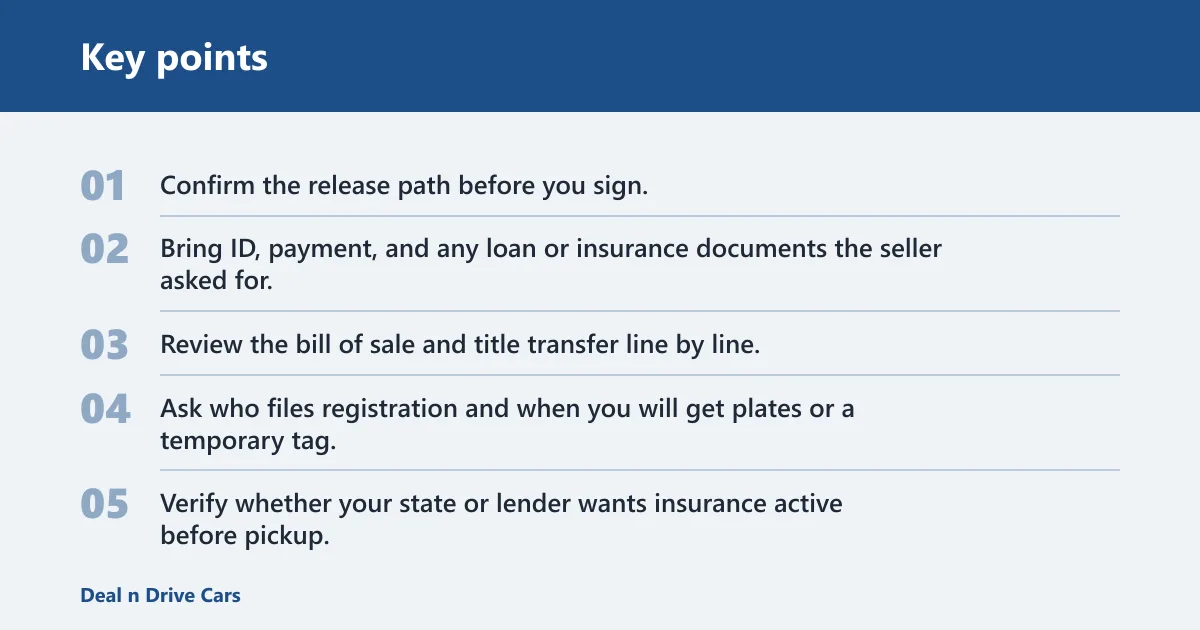
- Confirm the release path before you sign.
- Bring ID, payment, and any loan or insurance documents the seller asked for.
- Review the bill of sale and title transfer line by line.
- Ask who files registration and when you will get plates or a temporary tag.
- Verify whether your state or lender wants insurance active before pickup.
- Wait for the dealer to finish its release requirements, including any dealer prep or lender paperwork.
- Take the keys only after the tag, permit, or transfer papers are in your hand.
How soon can you drive a used car home after buying it?
Same day is common with a dealership and can happen in a private sale, but the timer starts after paperwork, payment, and release steps are finished. Cash deals are usually among the fastest used-car purchases. Financing adds the most timing risk because approval, income checks, and lender funding can slow the handoff.
Cash deal at a dealership
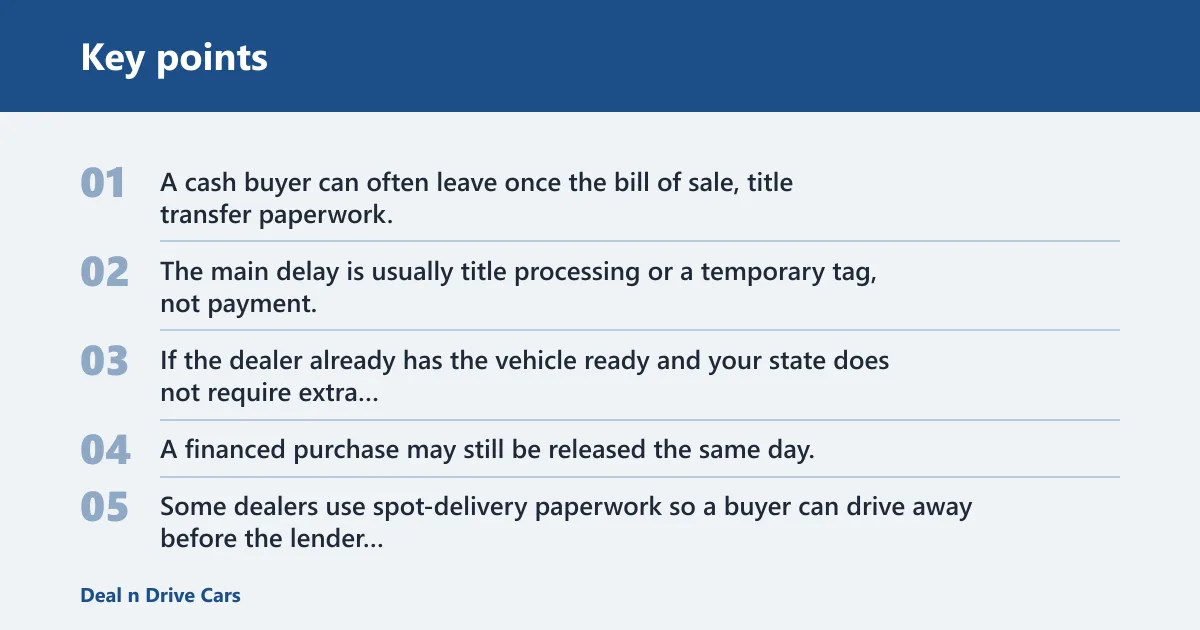
A cash buyer can often leave once the bill of sale, title transfer paperwork, and dealer release are finished. The main delay is usually title processing or a temporary tag, not payment. If the dealer already has the vehicle ready and your state does not require extra waiting, pickup can happen the same day.
Financed dealer sale
A financed purchase may still be released the same day, but the dealer may need final loan approval, income verification, and funding steps before handing over the keys. Some dealers use spot-delivery paperwork so a buyer can drive away before the lender sends funds, but that depends on the contract and the dealer’s risk rules.
Private-party purchase
Private sellers can be quick if the title is clean, the seller signs it correctly, and your state allows you to drive home with the signed transfer documents or a transit permit. If the title is missing, has an unreleased lien, or needs notarization, the handoff stops there.
Certified pre-owned purchase
A certified pre-owned vehicle is often a good deal and can bring added peace of mind because the program includes predelivery inspections and warranty coverage. It is not always faster, though. Dealer inspection, reconditioning, and CPO paperwork can add time before the car is ready to leave.
Do you need insurance before you leave?
Maybe, but not always in the same way everywhere. Some states require proof of insurance before registration or pickup; some lenders require coverage before they release a financed car; and some policies may provide temporary newly acquired auto coverage for a short period. Call your insurer, lender, and state DMV rules before you arrive.
What state minimum liability means here
If a state requires minimum liability coverage, the car cannot be driven legally until that rule is met, even if the sale is complete. The exact proof format varies. Some dealers want a card, others accept a binder from the insurer, and some want the policy effective date to match or precede pickup.
When a policy may already cover the new car
Many policies extend temporary coverage to a newly purchased vehicle for a limited period, but that window is policy-specific. Do not assume your old car is covered forever after the trade. Confirm the effective date with your insurer before you go to the dealership or meet the private seller.
Why the lender can add its own timing rule
If you finance the car, the lender may require insurance terms that are stricter than state law alone. That can include minimum liability limits, collision and comprehensive coverage, or proof that the policy will start before release. Ask the lender what it needs before you sign the contract.
Can a dealer release the car before financing is approved?
Sometimes yes, but only under the dealer’s delivery rules and the contract terms. Approval and funding are not always the same thing. A dealer may let you take the car under a spot-delivery arrangement while the lender finishes funding, but the dealer can also hold the car until the loan is fully set.
Loan approval versus funding
Approval usually means the lender has agreed in principle. Funding means the money is actually sent. A sale can sit between those two steps, which is why a buyer may think the deal is done while the dealer still waits for final lender confirmation.
How income verification and down payment slow the handoff
Missing pay stubs, a bank statement, or a larger-than-planned down payment can stop release until the lender has what it needs. If the deal depends on a trade-in payoff or equity transfer, that can add another delay. Finish those items before you schedule pickup.
What dealer trade-in timing changes
A trade-in can help the numbers, but it can also add title, payoff, and lienholder timing. If the trade-in still has a loan, the dealer may wait for payoff figures before finalizing the new contract. That does not always stop same-day delivery, but it can.
What can delay taking a used car home after purchase?

Paperwork gaps are the biggest delay. Missing title signatures, a lien release, an unpaid tax amount, or an insurer not yet active can hold the car. Dealer prep can also add time, especially on CPO vehicles or cars that need inspection, cleaning, safety checks, or temporary tags.
Paperwork and title problems
If the title is not signed correctly, if the VIN does not match the paperwork, or if the seller cannot produce the title, the sale may be paused. Registration timing matters too. Some states let the dealer file it later, while others require more before release.
Temporary tags and inspection delays
Temporary tags or transit permits can solve the drive-home problem when plates are not ready, but they are state-specific. Inspection rules vary as well. If your state requires a safety or emissions inspection before registration, that can turn a same-day pickup into a next-day pickup.
Dealer prep time on CPO vehicles
CPO programs require predelivery inspections, and that work can take time even when the car is already on the lot. The upside is better buyer confidence: the car has been checked, and the warranty coverage is part of the package. The downside is extra processing before release. (Caranddriver)
Say your dealer has a 2019 SUV ready at noon, but your insurer cannot issue the binder until 2 p.m. In that case, the sale may be complete, yet the handoff waits on the policy start time. Nothing about the car changed. The timing did.
Suppose a private seller hands over a signed title, but the back of the title still lists an old lien. That car may not be ready to drive home until the lienholder release is shown or the state accepts the transfer packet. A signature alone does not always end the delay.
What should you prepare so you can drive the car home today?
Start before you visit the seller. Bring ID, insurance details, payment, and any lender paperwork the dealer asked for. Ask for the exact release requirements in advance, including whether the dealer will issue a temporary tag and who files registration. That preparation is what makes same-day pickup realistic.
Research stage
Check the seller’s release process, not only the car itself. If you are financing, ask what the lender needs for funding. If you are buying private-party, ask whether the title is in hand and whether there is a lien. That prevents a wasted trip.
Comparison stage
Compare the sale path, not just the price. A slightly higher-priced car that is ready for release may be the faster choice if your deadline matters. A lower-priced car that lacks a clear title, permit, or lender path can cost you more time than money.
Dealership stage
Before you sign, ask three questions: what has to clear before release, who handles registration, and whether the car can leave with a temporary tag. If financing is involved, ask whether the contract is subject to final lender funding or a spot-delivery arrangement.
Handoff stage
At pickup, check the paperwork stack once more. You should leave with the bill of sale, title transfer documents or dealer receipt, any permit or temporary tag, and the next-step registration instructions. If one piece is missing, ask the dealer to explain when and how it will be delivered.
Common mistakes
One common mistake is assuming the sale and the pickup happen at the same moment. They do not always. Another is leaving without checking temporary tag rules or the next registration step. A third is skipping the title review because the car looks ready. Paperwork controls the release.
Do not assume financing approval means the car is funded. Do not assume insurance is in place just because your old policy exists. Do not assume a private-party signed title is enough in every state. Ask who files what, when it is filed, and what the law requires in your state.
Frequently asked questions
Can you drive a used car home the same day you buy it?
Usually yes, if the paperwork is complete, payment is accepted, insurance requirements are met, and the seller can legally release the vehicle. Cash purchases are often fastest. Financing, title problems, and temporary-tag issues are the most common reasons same-day pickup turns into a next-day handoff.
What has to be finished before you can leave the dealership with a used car?
The dealer normally needs a signed bill of sale, the right title transfer paperwork, payment or approved financing steps, and any state-required release items. If your state uses temporary tags, the dealer may need to issue one before you leave. Ask for the full release checklist before signing.
Do you need insurance before you can drive a used car home?
Often yes, but the exact rule depends on state law, the lender, and the insurer. Some policies extend temporary coverage to a newly acquired car, while others require a specific effective date before pickup. Confirm the start time and coverage level before you arrive to avoid a stalled handoff.
Can a dealership release a used car before financing is approved?
Sometimes a dealer can release the car under a spot-delivery arrangement, but that depends on the dealer’s contract and the lender’s process. Approval, funding, and final paperwork are not always the same step. If your deal depends on income verification or a larger down payment, expect more delay.
How long does the paperwork take when buying a used car?
Simple cash deals can move quickly once the documents are ready. Financed sales take longer because the dealer may wait for lender review, funding, and identity or income checks. Private-party paperwork is often shorter, but title errors, lien releases, and permit rules can add time at the last minute.
Is a certified pre-owned car faster to buy than a regular used car?
Not automatically. CPO cars can be a great deal and may offer added peace of mind because they go through predelivery inspections and usually include warranty coverage. That extra checking can help confidence, but it can also add prep time before the car is ready for release.