
How Do Mileage and Condition Affect a Used Car’s Fair Price?
A used car’s fair price starts with condition, then mileage: pay more for strong mechanical and cosmetic condition, then adjust for mileage in 10,000-mile bands against similar listings. Skip the visible wear and the “deal” can turn into repair bills fast. This guide gives a simple order for pricing and spotting overpriced cars.
Mileage or condition first?
Start with visible and mechanical condition, then use mileage as the second filter. That order matches how cars lose value. Wear, damage, and missing maintenance history can move price more than the odometer alone. After that, compare the car with similar listings in your local market.
A practical pricing method uses four core inputs: baseline market value, mileage adjustment, condition adjustment, and trim-demand adjustment. That keeps you from paying extra for a low-mileage car with worn tires, warning lights, or poor repair records.
Use mileage as the second filter
Mileage matters because it signals wear and tear, but it is only a proxy. Compare it with what is normal for the vehicle’s age and market, not as a stand-alone number. Carwow says UK cars typically drive 5,000 to 8,000 miles per year, and it advises multiplying car age by 10,000 miles as a rough benchmark.
That benchmark helps you spot outliers. A 6-year-old car with 28,000 miles sits below the rough 60,000-mile benchmark. A 6-year-old car with 90,000 miles sits above it. Either one can still be fairly priced if the condition, records, and local comps support it.
When a cleaner high-mileage car wins
Should you pay more for a cleaner car with higher mileage? Often, yes. A higher-mileage car with strong maintenance records, even tire wear, no warning lights, and clean accident history can be a better buy than a low-mileage car with neglected fluids, mismatched tires, or dashboard faults.
Suppose two same-year, same-trim sedans are listed locally. One has 42,000 miles, worn front tires, and a check-engine light. The other has 68,000 miles, full service records, and no visible faults. The second car can be the better value if the pricing gap is small enough to reflect the first car’s repair risk.
Mileage price impact matrix
Mileage can push price up or down, but the size of the move depends on the band, the service history, and whether the miles came from easy highway use or stop-and-go city driving. A low odometer reading does not guarantee a clean car, and a higher reading does not automatically make the car overpriced.
| Issue type | Price impact | Buyer action |
|---|---|---|
| Below typical mileage for age | Medium | Check service history and inactivity gaps before paying extra |
| Around typical mileage for age | Low | Use as a baseline and focus on condition |
| Well above typical mileage for age | High | Ask for a price cut if wear and records do not support the ask |
| Strong service records | Medium | Supports price confidence, especially at higher mileage |
| Weak or missing records | High | Inspect closely or walk away if price is not adjusted |
| Mostly highway use | Low | Can soften the impact of higher mileage if wear is light |
| Mostly city use | Medium | Expect more brake, tire, and suspension wear |
| Long inactivity gap | High | Inspect for seals, battery, brakes, fuel, and storage damage |
Service records by mileage band
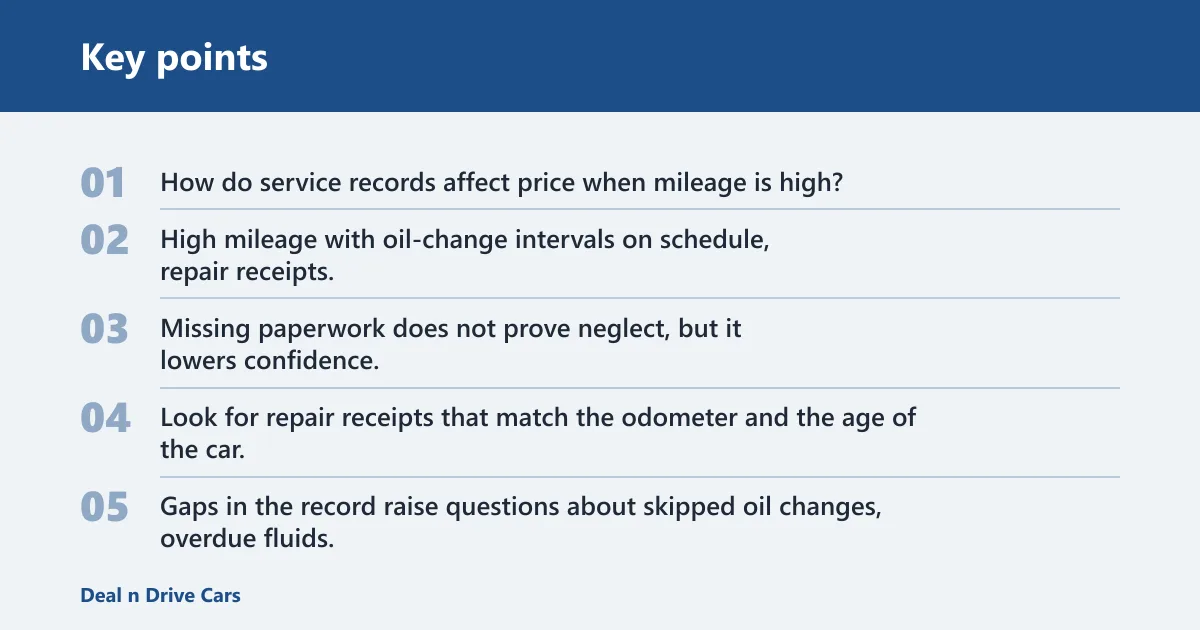
How do service records affect price when mileage is high? They matter more, not less. High mileage with oil-change intervals on schedule, repair receipts, and regular maintenance can support a stronger price than the same mileage with blank records. Missing paperwork does not prove neglect, but it lowers confidence.
Look for repair receipts that match the odometer and the age of the car. Gaps in the record raise questions about skipped oil changes, overdue fluids, and ignored warning signs. On a higher-mileage car, that uncertainty should trigger either a lower offer or a pre-purchase inspection.
City miles, highway miles, and idle time
Do city miles hurt value more than highway miles? Usually, yes. City use adds more braking, idling, steering, and heat cycles. Highway miles often mean steadier speeds and less wear on brakes and suspension, though they still count toward the odometer and the age-based benchmark.
Idle periods matter too. A car that sat for long stretches can have dried seals, weak batteries, flat-spotted tires, and rust on brake parts. Low mileage with long inactivity is not automatically a bargain.
What condition lowers value most?
Mechanical faults and warning lights often cut value the most because they point to immediate repair risk. Exterior damage, interior wear, and tire condition matter too, but they sit below a dashboard fault or a drivetrain issue when you are judging fair price. Separate visible wear from mechanical trouble.
Mechanical faults and warning lights
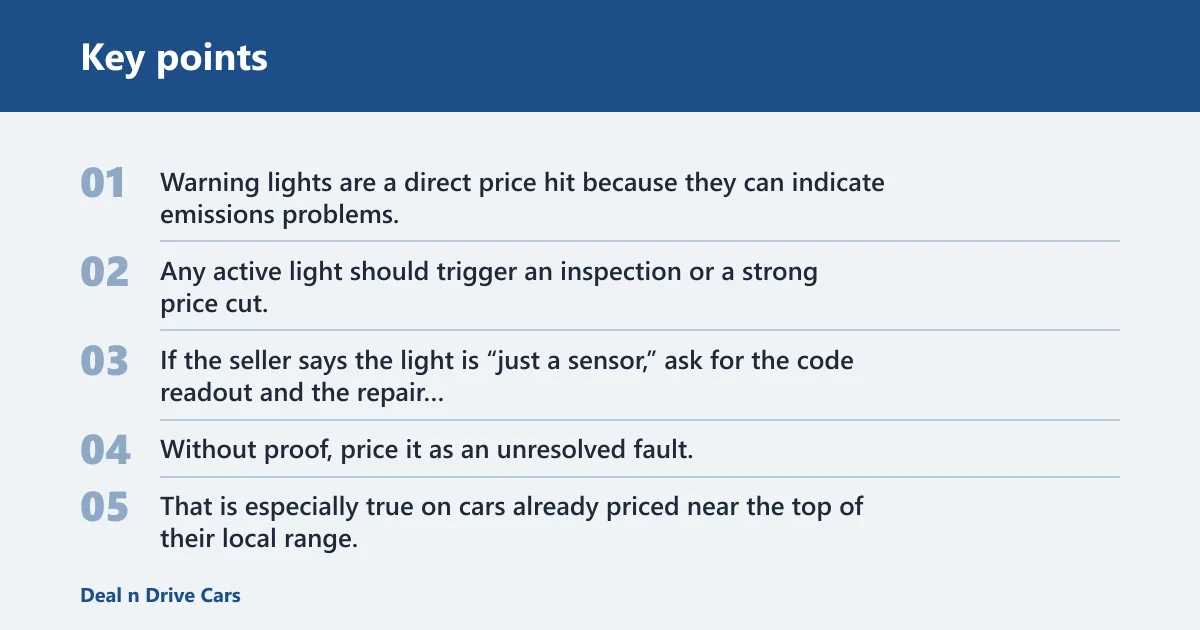
Warning lights are a direct price hit because they can indicate emissions problems, sensor faults, engine issues, transmission trouble, or ABS and airbag concerns. Any active light should trigger an inspection or a strong price cut, depending on the car and the seller’s documentation.
If the seller says the light is “just a sensor,” ask for the code readout and the repair receipt. Without proof, price it as an unresolved fault. That is especially true on cars already priced near the top of their local range.
Tires, brakes, and suspension wear
How do scratches, tires, and warning lights change the price? Tires and warning lights usually matter more than minor scratches. Bald or uneven tires can signal alignment problems, neglected rotation, or suspension wear. Worn brakes or a clunking suspension should reduce price, or trigger a walk-away decision if the estimate is large.
Picture a compact SUV with 57,000 miles, good paint, and a clean cabin, but front tires near the wear bars and a brake pulse on a test drive. That is not a cosmetic issue. Price it for immediate service, not for the odometer alone.
Cosmetic damage and interior wear
Exterior condition and interior condition still matter because they affect resale value and suggest how the car was treated. Scratched panels, dented bumpers, stained seats, cracked trim, broken switches, and torn bolsters can all justify a price cut, especially when several small issues stack together.
Visible wear should be judged against mileage and age. Light scuffs on a 10-year-old commuter are one thing. Heavy seat wear and faded controls on a low-mileage car suggest hard use, storage problems, or a rolled-back story that needs checking.
How service records change price
Service history can move price in either direction. A strong paper trail supports confidence, while missing records reduce it. For a high-mileage car, maintenance records can narrow the price gap because they show the car was kept on schedule and the seller can document key repairs.
What a strong paper trail supports
Maintenance records, oil-change intervals, and repair receipts tell you whether the car was cared for on a normal schedule. That matters most when mileage is high, because the odometer alone does not tell you whether the engine oil, coolant, transmission fluid, or brakes were serviced on time.
Receipts also help verify that the mileage on the odometer fits the service timeline. A car with regular records and no large gaps is easier to price than one with a blank folder and vague answers.
What missing records should trigger
Missing records should trigger skepticism, not panic. Ask for an inspection if the car otherwise looks clean. Walk away if the price assumes strong maintenance but the seller cannot show oil changes, major repairs, or routine service over a long stretch of ownership.
That caution matters more on older cars, where depreciation has already flattened and condition differences carry more weight. After the first few years, two similar cars can have very different prices based on care, not just mileage.
Depreciation and market context
Depreciation is steep early, then it slows. The first-year drop is usually the biggest, year two is still substantial, and after year five the curve tends to flatten. That means mileage has a different price effect on a newer car than on an older one in the same model line.
Same year, different trim, different price. The same year make model can vary widely by trim, drivetrain, options, and local demand. Price the car against similar listings by year, make, model, trim, drivetrain, and mileage band, then adjust for your market.
Seasonal demand and local market checks
Local demand matters. Body-style preference can push one version of a car above another in the same market, and seasonal demand can change the asking price for convertibles, AWD crossovers, or winter-ready cars. Seller type matters too, because private sellers and dealers often price and negotiate differently.
Compare the listing with nearby examples of the same year, make, model, trim, drivetrain, and mileage band. A car priced above local comps usually needs stronger condition, stronger records, or a clearer reason for the premium.
Mileage condition decision matrix
Use this matrix to turn what you see into action. The goal is not to find a universal fair number. The goal is to decide whether the listing needs a price cut, a closer inspection, or a hard pass.
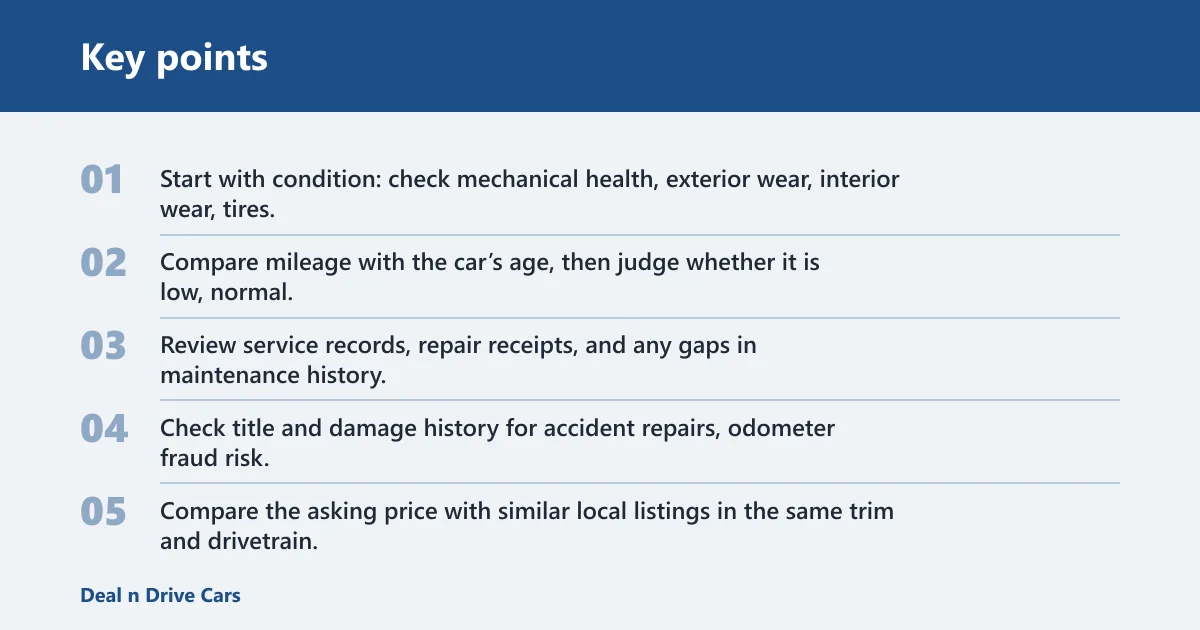
- Start with condition: check mechanical health, exterior wear, interior wear, tires, and warning lights.
- Compare mileage with the car’s age, then judge whether it is low, normal, or high for the market.
- Review service records, repair receipts, and any gaps in maintenance history.
- Check title and damage history for accident repairs, odometer fraud risk, and inactivity gaps.
- Compare the asking price with similar local listings in the same trim and drivetrain.
| Issue | Price impact | Likely action |
|---|---|---|
| Clean condition, typical mileage, complete records | Low | Compare to local comps and negotiate lightly |
| Clean condition, high mileage, strong records | Medium | Consider the car if the price reflects the miles |
| Rough condition, low mileage, weak records | High | Inspect closely or walk away |
| Active warning light or major mechanical issue | High | Require inspection and a price cut |
| Accident history with poor repair proof | High | Price conservatively or skip the car |
| Minor cosmetic wear only | Low | Use for negotiation, not for panic |
How to read the matrix on a listing
A price cut is justified when the issue is visible, documented, and likely to cost money soon. Require inspection when the car looks good but the records are thin or the mileage pattern is odd. Walk away when the car combines high wear, missing records, title concerns, or unresolved warning lights.
Suppose you are comparing two sedans at the same asking price, but one has 40,000 fewer miles and a cleaner service history. One has 74,000 mostly highway miles, service stamps, and clean panels. The other has 52,000 city miles, four mismatched tires, and no receipts. The higher-mileage car can be the better buy if the condition and records are stronger.
Frequently asked questions
How much does mileage reduce a used car’s price?
Mileage is often compared against the typical mileage for a car’s age and market, sometimes in roughly 10,000-mile bands rather than by a fixed rule. Use 10,000-mile bands as a rough guide, then compare the listing with similar local cars in the same trim, drivetrain, and condition.
Is a high-mileage car always cheaper than a low-mileage one?
No. A high-mileage car can cost more if it has better service records, cleaner condition, a stronger trim, or healthier local demand. A low-mileage car can still be overpriced if it has long storage gaps, worn tires, missing records, or mechanical faults.
What condition issues lower a used car’s fair price the most?
Active warning lights and mechanical faults usually lower fair price the most because they create immediate repair risk. After that come brake, tire, and suspension wear, followed by accident repairs, body damage, and interior wear. Cosmetic issues matter, but they rarely outrank unresolved mechanical problems.
How do service records affect price when mileage is high?
Strong service records support a higher price at high mileage because they show routine care and reduce uncertainty. Regular oil-change intervals, repair receipts, and no big gaps can soften mileage concerns. Missing records should reduce confidence and can justify a lower offer or an inspection.
Do city miles hurt value more than highway miles?
Usually yes. City miles tend to mean more braking, idling, and stop-and-go stress, while highway miles are often easier on brakes and suspension. Both count on the odometer, but the same mileage can carry different price pressure depending on how the car was used.
What mileage is good for a used car?
Good mileage is mileage that matches the car’s age, condition, and records. Carwow’s rough benchmark of age times 10,000 miles is a starting point, but a clean, well-maintained car above that line can still be a better buy than a neglected low-mileage one.