
How to Calculate Registration Fees Before You Buy a Used Car
Estimate used-car registration fees by adding your state’s base registration fee, title fee, plate transfer or new-plate fee, county surcharges, and any weight- or age-based charges. Miss one item, and your “affordable” car can jump by hundreds at signing. This guide shows how to build a state-by-state estimate before you buy, and how to separate fixed DMV fees from variable costs.
What registration fees include
Registration costs are usually a bundle, not one line item. The total can include the base registration fee, a title fee, sales tax, plate transfer or new-plate charges, and any local or inspection costs the state collects when you register the car.
Base registration fee
The base fee is the core DMV charge for putting the vehicle on the road. Some states set one flat amount, while others use a fee chart tied to class, weight, age, or model year. That is why two used cars with the same sticker price can have different first-year totals.
Title fee
The title fee is separate from registration. It pays for transferring ownership into your name, and many states treat it as a fixed or state-set amount. If the seller’s title is missing, damaged, or not signed correctly, that fee may not be the only cost you face.
Sales tax and local charges
Sales tax is often based on the purchase price, then adjusted for state and local rates. Some states collect it at title or registration, and some give used cars the same treatment as new cars. In a few states, trade-in credit or assessed value rules can change the amount you owe.
Temporary tags and inspection costs
Temporary tags or a drive-out permit can be separate from permanent registration. Inspection and emissions charges may also show up before the DMV will issue plates. If the seller removes the plates at sale, those temporary charges can become part of the true upfront cost.
Why your estimate changes by state
There is no single national formula. State DMV fee schedules differ, and local add-ons can shift the total again. Vehicle type, weight, timing, and renewal cycle can all move the number up or down before you ever reach the counter.
State DMV fee schedule
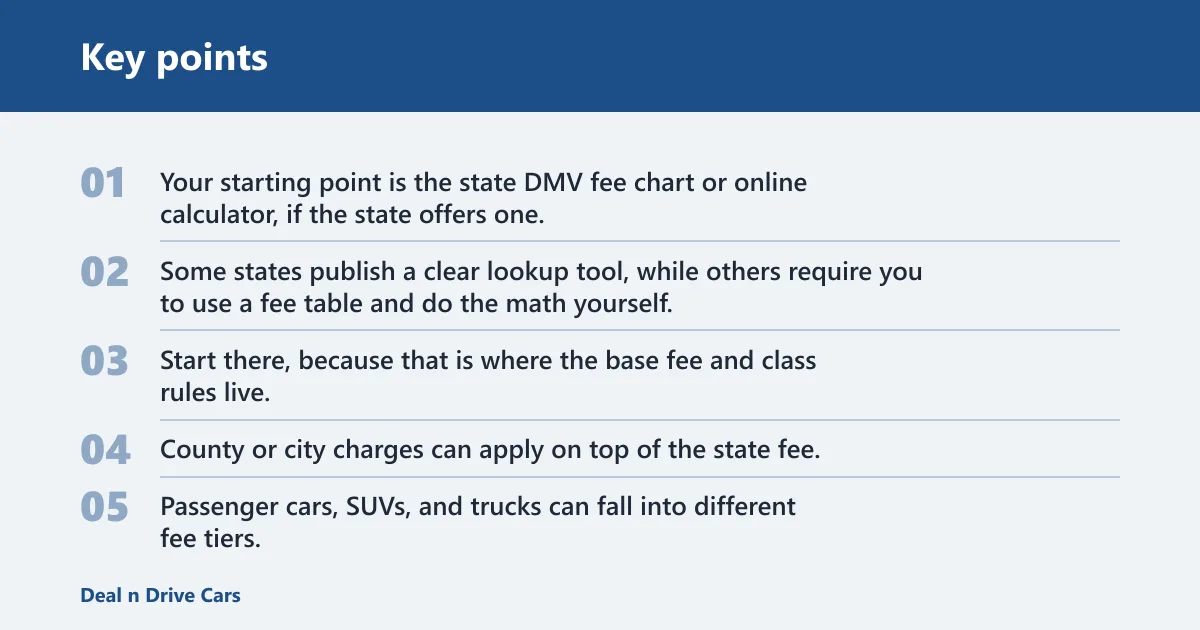
Your starting point is the state DMV fee chart or online calculator, if the state offers one. Some states publish a clear lookup tool, while others require you to use a fee table and do the math yourself. Start there, because that is where the base fee and class rules live.
County or locality add-ons
County or city charges can apply on top of the state fee. These local add-ons may be tied to where you live, where the car is garaged, or where it is first registered. That matters if you buy across county lines or move the car shortly after purchase.
Vehicle class and weight rules
Passenger cars, SUVs, and trucks can fall into different fee tiers. Some states use gross weight, curb weight, or a class label to set the amount. If you are comparing two used vehicles, a heavier SUV or pickup may cost more to register even when the sale price is lower.
Annual versus biennial renewal cycles
First-year cost and ongoing renewal cost are not the same thing. A state with annual renewal charges may collect a smaller annual fee more often, while a biennial state may ask for a larger payment every two years. Build the estimate for the first registration period, not just the next renewal.
What information do you need first?
You need the vehicle’s identity, the purchase price, and the state rules before the estimate will mean anything. The VIN, model year, body type, and where the car will be registered all affect the result, especially if the DMV uses weight or age tiers.
VIN and vehicle details
The VIN lets a DMV lookup tool identify the exact vehicle and narrow the fee estimate. It can confirm the body style, weight class, fuel type, and whether the car is eligible for a specific fee schedule. Without the VIN, you are guessing on the part that matters most.
Purchase price
The sale price is the usual base for sales tax, and in some states it can also affect assessed value calculations. Use the real purchase amount, not a target offer, because a $1,500 difference can change the tax line immediately. Add dealer add-ons only if they are part of the taxable amount in your state.
Model year and body type
Some states change fees by age or model year, so the same car can move into a different tier next year. Body type matters too. A sedan, SUV, and pickup may each land in a different class even when they share the same engine size or price range.
Seller location and timing
Where the seller is located can affect tax, local add-ons, and whether the car needs temporary tags before you can register it. Timing matters as well. If the title is not ready at closing, or if you buy out of state, registration can be delayed and late penalties can start to matter.
How do I estimate used car registration fees before buying?
Start with the DMV’s fee chart or calculator, then add tax, title, plate, and timing charges as separate lines. The goal is to build a first-year total before you negotiate, so you know the true out-of-pocket cost and can compare cars on equal terms.
-
Find the state fee schedule. Use the state DMV website, fee chart, or calculator if one exists. Pull the base registration amount, any class or weight tier, and any county or locality add-on that applies to your address.
-
Enter the VIN first. If the calculator asks for a VIN, use it. That helps the tool identify the correct vehicle type, weight class, and any age-based rule that could change the fee tier.
-
Calculate sales tax separately. Multiply the purchase price by the applicable state and local sales tax rate, then check whether your state collects tax at title or registration. Used cars are often taxable, but the rate and timing vary by state.
-
Add title and plate charges. Include the title fee, plate transfer fee if you are keeping plates, or new-plate fee if you are not. These are not the same as registration, and missing them is a common reason estimates come in too low.
-
Include temporary and testing costs. Add a temporary tag or drive-out permit if you need one, plus inspection or emissions charges when your state requires them before final plates. If the car cannot be registered the same day, these costs become part of the purchase price in practice.
-
Set aside a late-fee buffer. Add a small cushion for missed deadlines, document delays, or out-of-state paperwork. Late fees are state-specific, and even a short delay can turn a clean estimate into a higher total.
Registration estimate worksheet

Use this worksheet before you make an offer. Fill in the state and county first, then plug in the vehicle and purchase details. Keep first-year costs separate from annual renewal costs so you do not mistake a one-time bill for an ongoing expense.
| Field | Example entry | Estimated amount | Fixed or variable |
|---|---|---|---|
| State | Ohio | – | Variable |
| County | Franklin County | – | Variable |
| Vehicle type | 2018 SUV | – | Variable |
| VIN | Use full 17-character VIN | – | Needed for lookup |
| Purchase price | $14,500 | $14,500 | Variable |
| Estimated sales tax | State + local rate | $1,015 | Variable |
| Title fee | State-set title transfer | $20 | Usually fixed |
| Base registration fee | DMV class fee | $45 | Variable |
| Plate transfer fee | Keep existing plates | $0 | Depends on plates |
| Inspection/emissions | Required before plates | $30 | Variable |
| Temporary tag fee | 30-day permit | $20 | Variable |
| Late-fee buffer | Paperwork delay | $25 | Buffer |
| Best case total | All paperwork ready, no temp tag | $1,580 | Low estimate |
| Likely case total | Temp tag and inspection required | $1,630 | Most realistic |
| Worst case total | Delay, late fee, out-of-state title issue | $1,740 | High estimate |
Say your seller leaves the plates on the car and tells you registration will be “about $100.” If your state also charges tax on the $18,000 sale price, plus a title fee, new plates, and a temporary permit because the DMV appointment is two weeks out, the real first-year total can be several times higher.
Suppose you are comparing a compact sedan to a heavier SUV at the same dealership. The sedan may land in a lower fee tier, while the SUV triggers a higher class fee and a larger renewal amount. That difference can matter more than a small gap in asking price.
What extra costs can raise the total?
The biggest surprise costs are usually not the base registration fee. They are the items that appear because the car is used, the title is not cleanly ready, or the sale happens outside the normal DMV timing window.
Inspection and emissions
Some states require a safety inspection, emissions test, or both before registration. If the vehicle fails, you may need repairs before the DMV will issue plates. That can push your first registration bill far beyond the line item shown on the state fee chart.
Dealer paperwork or processing charges
A dealer may charge document or processing fees, and those charges can affect the amount you need at signing even if they are not DMV fees. Ask which costs are government charges and which are dealer charges. That split matters when you are budgeting for registration versus closing costs.
Out-of-state purchase timing
Buying out of state can add temporary permits, mailing delays, and extra title steps. If you need to drive the car home before permanent plates are issued, a drive-out permit may be required. A delay in paperwork can also create late-fee risk in the destination state.
Missing title documents
If the seller does not have the title, has an old lien, or made an error on the transfer paperwork, registration may stall. That can force you to pay for corrections, extra trips, or late penalties. It can also mean you cannot accurately estimate the final bill until the title problem is fixed.
How accurate are DMV calculators?
DMV calculators are useful, but they are only as accurate as the inputs and the current fee rules. They usually handle the main charge structure well, yet they can miss temporary tags, dealer paperwork, or title problems that appear after the sale.
What they usually get right
Online calculators usually handle the base registration fee, class or weight tier, and basic tax calculation if you enter the right purchase price and ZIP code. If the state offers a current fee chart, the estimate is often close for a clean in-state sale with no document issues.
What can change after purchase?
Anything tied to the actual closing can change the total. The VIN may place the car in a different class than you expected, the county may charge more than the city where the dealer sits, or the seller’s plates may be removed and force a temporary tag purchase.
When you still need a manual check
Use a manual fee chart check when the vehicle is bought out of state, the title is incomplete, or the state calculator does not show every local charge. If the state uses special weight rules, age-based formulas, or a registration renewal cycle that changes the first-year bill, confirm the result with the DMV before you sign.
Frequently asked questions
What information do I need to calculate car registration fees?
You need the VIN, purchase price, state, county, model year, body type, and whether the car is a passenger vehicle, SUV, or truck. Timing also matters because temporary tags, title delays, and late filing can change the final total. The more exact the inputs, the better the estimate.
What fees are included in vehicle registration costs?
Registration costs can include the base registration fee, title fee, plate transfer or new-plate fee, local surcharges, and sometimes inspection or emissions charges. Sales tax is often part of the out-of-pocket total too, but it is usually a separate tax line rather than the registration fee itself.
How do registration fees differ by state?
States use different fee schedules, local add-ons, and class rules. Some charge by weight or vehicle class, while others use flat rates or model-year formulas. Renewal timing also varies, so a state with biennial registration can have a very different first-year bill from one with annual renewal.
Do I need the VIN to estimate registration fees?
The VIN is not always mandatory, but it is the best way to narrow the estimate. DMV lookup tools use it to identify the exact vehicle, which helps with class, weight, and age-based fees. Without it, you may miss a tier change and underbudget the first-year cost.
Can I use a DMV calculator to estimate fees before purchase?
Yes, if your state offers one. A DMV calculator is the fastest way to estimate base fees and tax, but it may not include every local surcharge, temporary tag, or paperwork issue. Treat it as a planning tool, then confirm the result if the sale is out of state or time-sensitive.
What extra costs can make registration more expensive on a used car?
Inspection and emissions tests, temporary tags, dealer processing charges, late fees, and missing title documents are the common add-ons. A car that cannot be registered immediately can cost more on day one than a similar car with clean paperwork. Out-of-state sales can add even more delay and expense.
How accurate are online registration fee estimates?
They are usually accurate enough for budgeting when the vehicle, address, and purchase price are all known. They become less reliable when the car needs a temporary permit, has a title problem, or falls into a special class. For a used car, a manual DMV check still matters before you commit.