How Does a Car’s Age Affect Maintenance Costs?
Maintenance costs are usually lowest during warranty years, tend to rise after around 5 years as wear items start to appear, and often become much less predictable after around 10 years. Miss that shift, and a low-priced car can turn into a repair bill that beats the monthly payment. This guide lays out the three age phases, the parts most likely to wear, and how to budget before you buy or keep an older vehicle. (Consumerreports)
How age changes maintenance costs
Vehicle age affects maintenance through warranty coverage, wear, and the chance of age-related failures. New cars usually have lower annual maintenance costs than older ones, but mileage, service history, model design, and driving conditions still matter. A car serviced on time often ages better than one that has had skipped or delayed work.
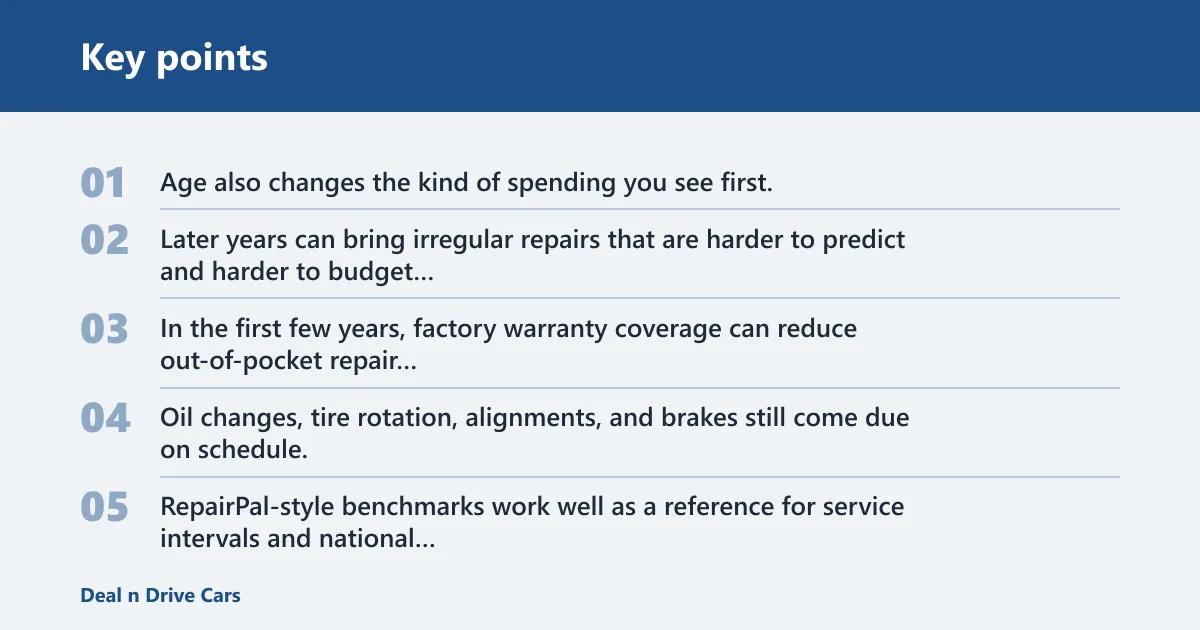
Age also changes the kind of spending you see first. Early costs are mostly scheduled service. Midlife brings more wear items. Later years can bring irregular repairs that are harder to predict and harder to budget around.
New-car years and warranty protection
In the first few years, factory warranty coverage can reduce out-of-pocket repair spending because some failures are covered. That does not mean maintenance disappears. Oil changes, tire rotation, alignments, and brakes still come due on schedule, and most warranties do not pay for routine service or wear items.
RepairPal-style benchmarks work well as a reference for service intervals and national averages, but they are not a universal bill. A compact economy car usually costs less to keep than an SUV or luxury model. Brand reliability matters too, and so does how the vehicle is driven.
Midlife wear and first repair spikes
After about 5 years, the first repair spikes usually show up. Battery replacement, brake pads, tires, and sometimes rotors begin to compete with ordinary maintenance. This is where age and mileage start to separate: a lightly driven 6-year-old car may need less than a heavily used 4-year-old one.
Suppose a 6-year-old compact sedan has full service records but is driven mostly in stop-and-go traffic. It may still be sound, but brakes, tires, and battery age faster under those conditions than they would on steady highway trips.
Older-car volatility and budget risk
After about 10 years, the cost pattern becomes less even. One year may be routine service only. The next may bring cooling-system work, suspension parts, or another age-related repair. That variance matters more than the average cost, because a single large repair can change the ownership math quickly.
CarVertical notes that maintenance costs vary for many reasons, including weight, and it warns that skipped oil changes can lead to engine replacement or overhaul. That is why age should never be read alone. Service history and mileage can move a car from manageable upkeep to high-risk ownership.
Car age maintenance table
| Age band | Routine maintenance | Common repairs | Reassess value versus upkeep when |
|---|---|---|---|
| 0–3 years | Oil changes every 7,500 to 10,000 miles or every year; tire balance and rotation every 7,500 to 10,000 miles or every year; fluid checks; wiper blades as needed. | Usually low repair exposure if warranty is active; occasional battery, tire, or brake service depending on use. | Warranty coverage is ending soon, or the vehicle needs repeated visits for the same issue. |
| 4–7 years | Oil changes, tire rotation, alignments, brake inspection, battery checks, cabin and engine air filters, wiper blades. | Brake pads, tires, battery replacement, alignment wear, starter or sensor issues, first cooling-system repairs on some models. | Repair estimates start clustering in the same year, especially if the car has inconsistent service records. |
| 8–12 years | All scheduled maintenance plus closer monitoring of fluids, brakes, suspension, cooling system, and seals. | Brake pads and rotors, battery, hoses, belts, wheel bearings, suspension bushings, alternator, A/C or coolant repairs. | One major repair approaches a large share of the car’s market value, or more than one system is failing at once. |
| 13+ years | Maintenance is still required, but inspections matter more because wear can spread across multiple systems. | Higher-variance repairs: cooling system, suspension, electrical faults, exhaust parts, oil leaks, transmission-related issues on some vehicles. | Repair bills are recurring, safety is slipping, or expected annual upkeep is close to the car’s usable value. |
What gets more expensive first?

The first costs to rise are usually wear items, not dramatic engine failures. Brake pads, rotors, tires, battery, and alignment work tend to appear before the biggest mechanical repairs. That order matters because it lets you budget in layers instead of waiting for a single large bill.
Brake pads, rotors, and tires
Brake pad replacement is listed every 30,000 to 50,000 miles, and rotors often follow if wear continues. Tires also age out over time, even if tread depth still looks acceptable. On a heavier SUV, those parts can cost more than on a compact car because the vehicle carries more mass and may use larger components.
A common mistake is to plan for gas and routine oil changes while overlooking how an older car may need pricier repairs and more frequent service. Then the car hits its first set of tires and front brakes in the same year. That is common on a vehicle entering midlife, especially if the driver does mostly city travel.
Battery, belts, and hoses
Battery replacement is listed every 4 to 5 years, and AAA says a new gas-car battery generally lasts three to five years. Heat, short trips, and long periods of sitting can shorten that life. Belts and hoses also become more failure-prone with age, even when they look fine at a glance. (AAA)
AAA also notes that EV traction batteries gradually lose capacity as they are charged and discharged, and climate can affect traction-battery longevity. For electric vehicles, that means age affects range and long-term planning in a different way than it does on a gas car.
Fluid service and alignment needs
Oil changes are listed every 7,500 to 10,000 miles or every year, and typical oil change cost is $160 to $188. Tire balance and rotation are recommended on the same interval. Those are routine items, but they matter more as a car ages because neglected maintenance can spread wear to other parts.
Fluid service can also change with age. For example, Mazda CX-5 coolant replacement is first due at 10 years or 120,000 miles. That schedule shows why age and mileage should be tracked together, not treated as the same thing.
Do older cars always cost more to maintain?
No. Older cars often cost more on average, but not always on your specific bill. A low-mileage older car with a solid maintenance record can be cheaper to keep than a newer car that has been neglected. Reliable models also age differently from problem-prone ones.
The right comparison is not age alone. It is age plus mileage, service history, model, drivetrain, and where the car lives. A well-kept older vehicle can be a sound buy. A newer but poorly maintained one can become expensive fast.
Low-mileage older cars
Age without use can be easier on some parts and harder on others. Rubber dries out. Fluids age. Batteries weaken. Still, a low-mileage car may avoid brake, tire, and suspension wear that a higher-mileage daily driver would already have faced. That can keep costs lower in the short term.
Reliable models versus problem-prone models
Model choice changes the maintenance curve. RepairPal average cost benchmarks are a useful comparison point, and over time some brands hold down ownership cost better than others. The same source lists Toyota at $5,996 as the cheapest brand to maintain over 10 years, which shows how much brand and model selection can matter.
Compact cars usually cost less to maintain than SUVs because tires, brakes, and some suspension parts are smaller and lighter. Luxury cars can bring higher parts prices and labor charges. Year-specific service schedules also matter, because the same model can have different maintenance needs by engine or trim.
City use, climate, and labor rates
City driving raises wear because of traffic, short trips, and repeated braking. Highway use is often easier on brakes and tires. Climate matters too. Heat can age batteries faster, while cold weather can make battery weakness show up sooner.
Labor rates are another reason age-based budgets vary. A car that needs the same repair in two different regions may produce very different invoices. That is why national averages are useful for planning, but local quotes still matter before you commit to a used car.
What should you budget for an aging car?
For many cars, a practical annual maintenance budget is about $400 to $1,200 per year, or roughly $34 to $167 per month. The lower end fits newer or well-kept vehicles. The higher end fits older cars, tougher duty cycles, and models with pricier parts or labor.
That budget should be split into two buckets. One is routine maintenance. The other is a repair reserve. If you treat those separately, you can see whether the car is still affordable or merely cheap to buy.
- Estimate routine service first using the owner’s manual and the vehicle’s age band.
- Add a reserve for wear items such as brakes, tires, battery, and wiper blades.
- Increase that reserve if the car has incomplete service records or late maintenance.
- Check repair pricing by make and model, not by age alone.
- Compare the yearly total against the car’s market value and your replacement plan.
Say your 9-year-old SUV needs tires now and brakes within the next year. That is not a crisis by itself, but it does mean your next 12 months may include more than oil changes. If the car also needs cooling-system work, the budget should rise fast.
Service history is a major filter. A car with documented oil changes, rotation intervals, and timely brake work is easier to forecast than one with gaps. That is why pre-purchase records matter as much as the odometer reading when you are comparing older used cars.
When should you rethink upkeep?
You should rethink upkeep when repair bills start to compete with the car’s value, when failures repeat, or when deferred maintenance has created a chain of problems. A single repair is one thing. Repeated repairs in the same year are a signal to step back and compare ownership cost with replacement value.
Repair bills versus market value
If a repair approaches a large share of the car’s current value, the decision changes. That threshold is not identical for every owner, but a car that needs a major repair and still has low market value deserves a hard look. Older cars often reach this point sooner because depreciation has already reduced the replacement value.
Repeat failures and deferred maintenance
Repeat failures can mean a deeper problem is being missed. Old tires, weak batteries, overdue fluids, and ignored warning lights can cause more than one repair to land at once. Deferred maintenance also makes it harder to predict what comes next, because one neglected item can stress another system.
Mileage, safety, and ownership horizon
When the car is nearing the end of your ownership horizon, even moderate repairs may not make sense. The question becomes whether the vehicle still feels safe, dependable, and worth another year of upkeep. If the answer is no, replacement may be the better financial move.
Frequently asked questions
How does a car’s age affect maintenance costs?
Age affects maintenance costs by moving a car from warranty-backed years into wear-item years and then into higher-variance repair years. Early on, routine service dominates. After about 5 years, brakes, tires, and batteries start to matter more. After about 10 years, repairs become harder to predict.
What maintenance gets more expensive as a car gets older?
Brake work, tires, batteries, belts, hoses, and suspension parts tend to rise first. Alignment needs can also increase if the car has worn steering or suspension components. On some models, cooling-system and electrical repairs become more likely as the vehicle passes into double-digit age.
How much does car maintenance cost yearly?
Average car maintenance costs range from about $400 to $1,200 per year. ConsumerAffairs estimates monthly maintenance at roughly $34 to $167. Where your car lands in that range depends on age, mileage, make and model, labor rates, and how well the schedule has been followed.
When does a used car start needing more repairs?
Many used cars begin to need more repairs after about 5 years, especially once warranty coverage fades and wear items start arriving together. The exact timing depends on mileage and care. A high-mileage 4-year-old car can act older than a low-mileage 7-year-old one.
How do warranties change maintenance costs on older cars?
Warranties lower early ownership costs because they can cover some repairs during the new-car years. As age and mileage rise, that protection fades and more of the risk shifts to you. Routine maintenance is still yours to pay, and many wear items are not covered even when the warranty is active.