Why Did My Car Registration Fee Increase?
A higher registration bill usually comes from one changed line item: vehicle taxes, weight or class, local surcharges, or late penalties. Compare last year’s renewal notice with this year’s notice, line by line, to find the exact cause. Missing that breakdown can leave you overpaying or disputing the wrong fee. This guide shows how to identify which charge changed, why it changed, and what to check before you pay.
How to compare line items on your renewal notice
Most increases come from a bill that includes more than the base renewal fee. If the total jumped, look for a higher tax assessment, a different vehicle class, added county charges, a plate fee, or a late penalty. The fastest fix is to compare the renewal notice with last year’s notice, line by line.
Base fee versus added charges
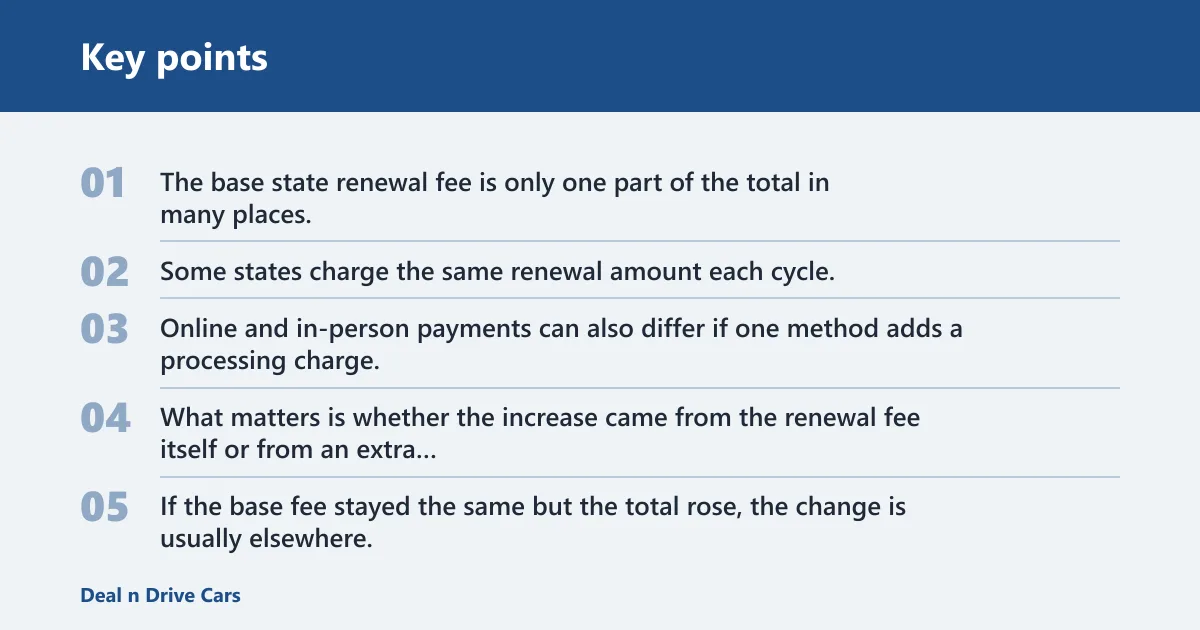
The base state renewal fee is only one part of the total in many places. Some states charge the same renewal amount each cycle, while others adjust the fee by vehicle type, registration period, or payment method. Online and in-person payments can also differ if one method adds a processing charge.
What matters is whether the increase came from the renewal fee itself or from an extra line on the bill. If the base fee stayed the same but the total rose, the change is usually elsewhere.
The fastest way to spot the real cause
Start with the renewal notice. Find the due date, VIN or plate reference, and each line item. Then compare the current notice with the last one and note which line changed in amount, not just which total is larger. That tells you whether the issue is tax, weight, local add-ons, or penalties.
A common mistake is assuming the higher renewal notice is a single charge instead of a mix of registration, local taxes, and added fees. Suppose the base renewal stayed at $45, but a county surtax rose by $18 and a late fee added $25. The total jumped by $43, yet the registration fee itself did not change at all.
Registration fee breakdown
Registration bills often combine several charges. The labels vary by state, but the pattern is usually the same: a renewal fee, a tax or value-based charge, a weight-based charge for some vehicles, local add-ons, and sometimes plate or inspection fees.
Base renewal fee
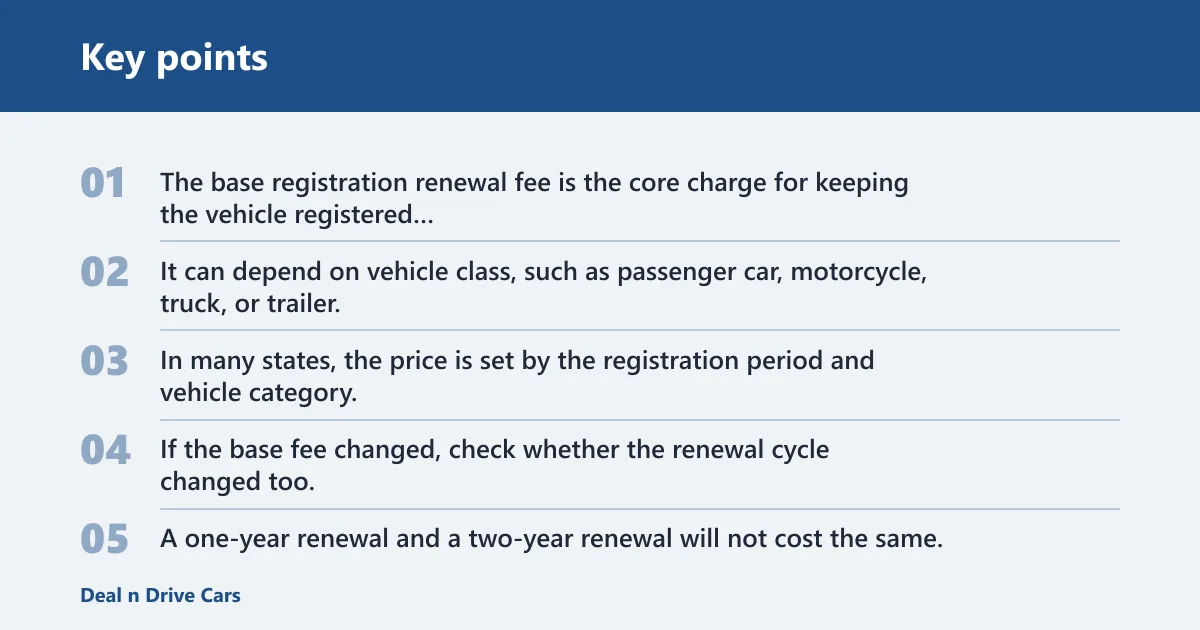
The base registration renewal fee is the core charge for keeping the vehicle registered for another cycle. It can depend on vehicle class, such as passenger car, motorcycle, truck, or trailer. In many states, the price is set by the registration period and vehicle category, not by the car’s market value.
If the base fee changed, check whether the renewal cycle changed too. A one-year renewal and a two-year renewal will not cost the same, and some states price online and in-person payments differently.
Value-based tax
An ad valorem or value-based vehicle tax is tied to the assessed value of the vehicle and may include a local tax component. Higher-value vehicles usually pay more. In places that reassess annually, the bill can rise even if the registration fee itself stayed flat.
This is one of the most common sources of confusion because it looks like a registration increase. It is really a tax tied to value, and it can change when the vehicle’s assessed value changes or when local tax rates move.
Weight-based charges
Some states use gross vehicle weight or weight brackets to set registration charges. That matters most for trucks, SUVs, vans, and commercial-style vehicles. A heavier vehicle can fall into a higher bracket even if it is the same model year as last year’s vehicle.
If the bill changed after a purchase or reclassification, check whether the vehicle was moved into a different weight category. A truck registered as a personal-use vehicle may be billed differently from a similarly sized SUV or a higher-weight truck class.
Local surcharges
County, municipal, district, and special assessment fees are added in some areas and not others. These can vary by zip code, county boundary, or taxing district. A move across a county line can change the bill without changing the vehicle itself.
Local add-ons are often easy to miss because they may appear as separate line items or short codes on the notice. If the renewal amount looks unfamiliar, compare the local charges on last year’s notice with the current one.
Plate and tag fees
License plate and tag charges appear when a new plate is issued, a plate is replaced, or a personalized or specialty plate carries an added premium. A normal renewal usually does not include a fresh plate fee unless something changed with the registration.
Special plates cost more in many states, and replacement plates can add another one-time charge. If your vehicle changed owners, moved counties, or needed a damaged plate replaced, the plate line can make the renewal look much higher.
Which bill line changed?
The line that changed tells you which office or record to check next. A renewal notice points to registration and tax items, a county tax notice points to assessed value or local charges, a plate invoice points to tag costs, and an inspection record points to testing fees or retests.
Renewal notice clues
Read the renewal notice first because it usually lists the due date, VIN or plate number, and the line-item breakdown. If one charge is marked separately from the base renewal fee, that is often the source of the increase. Make sure the address is correct, because a wrong address can delay notices and create late fees.
County tax notice clues
If the total rose because of a value-based tax, the county tax notice is the document to check. It should show the assessed vehicle value and the local tax component. A higher assessment or a changed local rate can move the total even when the state renewal fee does not change.
Plate invoice clues
Plate invoices matter when the bill includes a new issue, replacement, or specialty plate fee. They also matter when the vehicle has personalized tags. If the notice shows a one-time plate charge, that is usually not part of the regular annual renewal.
Inspection record clues
If your state requires emissions or safety inspection, the inspection record can explain a higher bill. Some states charge for the inspection itself, and failed tests can lead to retest costs. If the renewal notice mentions compliance or inspection status, check the inspection record next.
What changed with your vehicle?
Vehicle changes can raise the bill even when the fee schedule did not change. A higher assessed value, a different weight class, a recent purchase, or a county move can all change the total. If the vehicle itself changed, the bill often changes with it.
Vehicle value went up
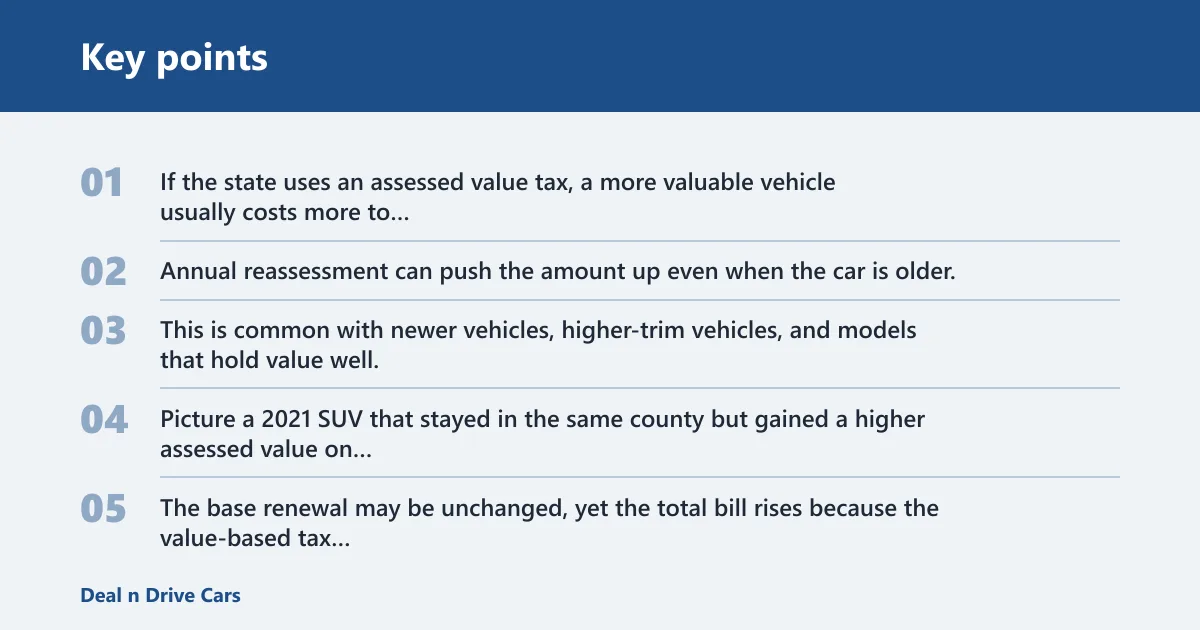
If the state uses an assessed value tax, a more valuable vehicle usually costs more to register. Annual reassessment can push the amount up even when the car is older. This is common with newer vehicles, higher-trim vehicles, and models that hold value well.
Picture a 2021 SUV that stayed in the same county but gained a higher assessed value on the current tax notice. The base renewal may be unchanged, yet the total bill rises because the value-based tax line rose.
Vehicle weight or class changed
Weight-based registration fees can shift when the vehicle class changes after purchase, title correction, or reclassification. Gross vehicle weight matters more than model name in these systems. A truck or SUV can land in a higher bracket than a passenger car, even with the same ownership date.
New purchase or title transfer
A recent purchase or title transfer can trigger first-time registration charges, county transfer tax, title work, or plate issuance. That is different from a normal renewal. If you just bought the vehicle, the bill may include ownership-change costs that will not repeat every year.
Suppose the car was bought last month and registered in a new county. The bill may include transfer tax, title fees, and a fresh plate charge together. That looks like a registration increase, but it is really a first-time registration package.
Address or county changed
Moving can change local surtaxes, district fees, and even the way a vehicle is taxed. If the registration address changed, compare the old and new county rules. A different taxing district can add or remove charges without changing the base renewal fee.
Could penalties have been added?
Yes. Late renewal fees, delinquency charges, back fees, and inspection-related penalties can raise the total quickly. These are often added after the due date, after a failed inspection, or after the vehicle falls out of compliance. They may also trigger a suspension risk if not paid.
Late renewal fees
Late fees often appear when the renewal deadline passes. Some states add a fixed penalty, while others charge by month or by the number of days overdue. If the bill arrived after the due date, the penalty timing is the first thing to check.
Delinquency or back fees
Delinquency fees and back charges can build when renewal is missed for more than one cycle or when an account was not updated on time. These charges are often separate from the base renewal amount. If there is a gap in registration history, that gap can explain the jump.
Inspection failure or retest charges
Inspection-required states may add emissions or safety inspection fees, and a failed test can lead to retest costs. Some systems also block renewal until compliance is shown. If the bill includes inspection language, check the inspection record and retest receipt before assuming the registration fee changed.
Registration bill decoder table
This table helps you map a line item to its likely cause, whether it repeats, and the next document to inspect. Use it as a quick diagnosis tool before you pay or dispute anything.
| Line item | Likely cause | Recurring or one-time | What to check next |
|---|---|---|---|
| Base renewal fee | Normal annual or cycle-based registration charge; can vary by vehicle class or renewal period | Recurring | Renewal notice |
| Value-based tax | Assessed vehicle value, local tax rate, or annual reassessment | Recurring | County tax notice |
| Weight-based fee | Gross vehicle weight bracket, truck or SUV classification, or state-specific weight schedule | Recurring | Renewal notice |
| County or municipal surcharge | Local add-on, district fee, or special assessment tied to where the vehicle is registered | Recurring | Renewal notice |
| Plate or tag fee | New plate issuance, replacement plate, personalized plate, or specialty plate premium | Often one-time; some premiums recur | Plate invoice |
| Late penalty | Missed deadline, delinquent account, or overdue renewal | One-time or repeating until paid | Renewal notice |
| Inspection fee | Required emissions or safety inspection, or a retest after failure | Recurring if required; retest is one-time | Inspection record |
| Title or transfer charge | Recent purchase, ownership change, county transfer tax, or first-time registration | One-time | Title paperwork |
Frequently asked questions
Why did my car registration increase?
The most common reason is that one line item changed: tax, weight, local surcharge, plate cost, or a late fee. Compare this year’s renewal notice with last year’s notice. The line that moved tells you whether the increase is a registration change, a tax change, or a penalty.
Why did my registration fee go up?
If the base renewal stayed stable, the rise usually came from an added charge. That can be a value-based tax, county fee, specialty plate premium, or overdue penalty. The renewal notice is the first document to check because it should show the fee split clearly.
Can vehicle value or weight make registration cost more?
Yes. Value-based tax rises with assessed vehicle value, and weight-based systems charge more for heavier vehicles or higher brackets. Trucks and SUVs are more likely than compact cars to land in a higher weight category. Check the county tax notice for value and the renewal notice for weight.
Does a county or city fee get added to registration?
Often, yes. Local add-ons, district fees, and special assessments can be included in the bill depending on where the vehicle is registered. These charges can change when you move counties or districts. Compare the local line items on the renewal notice from both years.
Are late fees, penalties, or tax changes included in my bill?
They can be. A renewal bill may include late penalties, delinquency charges, or a higher tax amount if the assessment changed. A tax increase is not the same as a late fee, so read the line labels carefully. If the notice is overdue, check the due date first.
Why did my renewal bill jump after I moved or changed vehicles?
A move can change county or municipal charges, and a vehicle change can move the car into a different weight, value, or plate category. A title transfer can add first-time fees too. Check the address on the renewal notice and compare it with the title and registration record.
Why has the Queensland car rego fee suddenly increased?
In Queensland, a higher rego bill can come from a changed registration fee, a revised CTP component, or another added charge listed on the renewal notice. Compare the current notice with the previous one and check whether the increase is in the fee, the insurance component, or another line item.