Do You Pay Registration Fees Every Year on a Used Car?
Yes, used-car registration fees usually repeat when you renew the registration, but the first year can also include one-time title, tax, or transfer charges at purchase. Miss the renewal date or confuse purchase fees with yearly fees, and you can face penalties, lose time, or get a bigger bill than expected. This guide separates first-year costs from recurring renewal charges and explains how state DMV rules change the total from state to state.
This guide is part of our Registration fees for a car: what you’ll pay and why series.
Do you pay registration fees every year on a used car?
Sometimes yes, sometimes no. In many states, vehicle registration fees recur when you renew, but the renewal cycle is not the same everywhere: some states bill yearly, while others bill every other year. The amount can also change after purchase because state DMV rules, vehicle details, and local add-ons can affect the bill.
What changes after the first year
The first bill on a used car often bundles several items together, while later bills usually focus on renewal only. That first purchase-time paperwork can include title, transfer, tax, and initial registration charges. After that, the recurring part is usually the registration renewal fee, which keeps your plates or tabs current.
Picture a buyer who picks up a used sedan and gets a large DMV bill at signing. Part of that bill may be the one-time transfer work, while the later renewal notice may only show the ongoing registration charge and any state or local add-ons.
What registration fees do I pay when I buy a used car?
At purchase, you may owe title, transfer, tax, and initial registration charges. Those are not all the same thing. The title establishes legal ownership, while registration is the state record that lets the car be driven legally with current plates or tabs.
Why the first bill can be higher
The first bill can look larger because it may combine one-time ownership paperwork with the first registration cycle. Some states also add local fees or calculate part of the registration amount using vehicle traits such as age, value, weight, or fuel efficiency. That is why two used cars can have very different first-year totals.
Suppose two buyers in the same state purchase different used SUVs. One is older and lighter, while the other is newer and heavier. Even if the sale price is close, the registration-related charges can differ because state formulas may use vehicle age, current value, or weight.
Vehicle registration renewal cycle
Registration renewal is often annual, but some states use a two-year cycle. Renewal notices usually arrive by mail, and many state DMV portals also show the amount due online. If your plates or tabs expire, the vehicle is not in current registration status and you risk penalties.
Annual renewal states
Some states renew every year. Washington renews vehicle license tabs annually. In those states, the renewal notice usually arrives before the expiration date, and the bill repeats on the state’s renewal schedule unless your vehicle, address, or insurance records trigger a change.
Every-other-year renewal states
Some states use a two-year cycle instead of annual billing. Oregon requires registration every two years. That means a used-car owner in Oregon should not assume a yearly renewal bill just because another state uses that pattern.
How renewal notices usually arrive
Renewal notices usually arrive by mail, though many state DMV systems also let you check the amount online. The notice often lists the renewal date, any late penalty risk, and the exact fees due. A current notice is the fastest way to separate recurring renewal charges from one-time purchase costs.
Registration fee decision table
This table helps you sort a DMV bill into one-time purchase charges, recurring renewal charges, and state-specific items. The note in the last column tells you when each one usually appears.
| Fee type | Is this fee recurring? | When it appears on the DMV bill |
|---|---|---|
| Title fee | No | One time at purchase or when ownership changes, because the title establishes legal ownership. |
| Transfer fee | No | One time at purchase when the used car changes owners or records move to your name. |
| Sales tax | No | Usually due at purchase, depending on state tax rules and the transaction structure. |
| Registration renewal fee | Yes | Annual or every-other-year renewal, depending on the state’s DMV schedule. |
| License tab renewal fee | Yes | Shows up when tabs or registration are renewed; these recurring charges often appear under this name. |
| Local surcharge | State-specific | May appear at purchase or renewal if a state, county, or local rule adds a separate charge. |
| Vehicle-based formula fee | Yes, but amount can change | Appears at renewal in states that use vehicle age, current value, weight, fuel efficiency, horsepower, or vehicle count in the formula. |
Why registration fees vary by state
Registration fees are handled through the state’s Department of Motor Vehicles, and rules vary by state. Some states use flat fees. Others use formulas. That is why the same used car can carry a very different renewal bill after title transfer, even when the vehicle itself has not changed.
State DMV rules and local surcharges
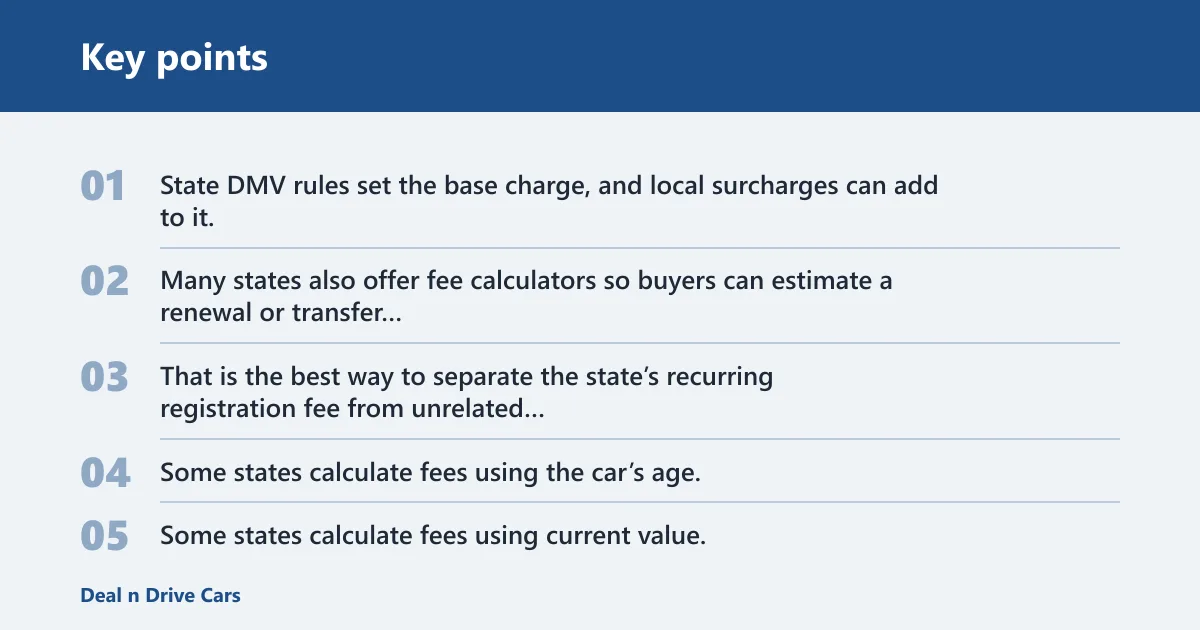
State DMV rules set the base charge, and local surcharges can add to it. Many states also offer fee calculators so buyers can estimate a renewal or transfer total before they sign. That is the best way to separate the state’s recurring registration fee from unrelated purchase charges.
Vehicle age, value, weight, and fuel efficiency
Some states calculate fees using the car’s age. Some states calculate fees using current value. Some states calculate fees using fuel efficiency. Some states calculate fees using vehicle weight. Some states calculate fees using horsepower. Some states calculate fees using the total number of vehicles registered to your name.
That means registration cost is not determined by timing alone. A newer used car can cost more to register in one state, while a heavier model may cost more in another. The renewal cycle may be annual or every other year, but the amount due can still change with the vehicle’s details.
Flat fees versus formula-based fees
A flat fee is easier to predict because it changes less with vehicle traits. A formula-based fee can rise or fall based on the car’s age, value, weight, or fuel efficiency. When you compare used cars, check whether the state uses a fixed amount or a calculation tied to the vehicle.
Do registration fees change after the first year of ownership?
Yes, they can. The recurring registration charge may stay similar from one cycle to the next, but it can also change if the state updates its fee schedule, if the vehicle’s value changes, or if the renewal formula depends on age, weight, fuel efficiency, or how many vehicles are registered to your name.
When the fee repeats
The recurring part of registration usually shows up every renewal cycle, whether that cycle is annual or every other year. If the car stays in your name and the registration stays active, expect a renewal notice and another bill when the due date comes back around.
When it does not repeat
Title fees are often one-time charges. They belong to the sale or ownership transfer. That is why a used-car buyer should read the DMV bill line by line instead of treating every charge as a yearly cost.
How to check your bill before you buy
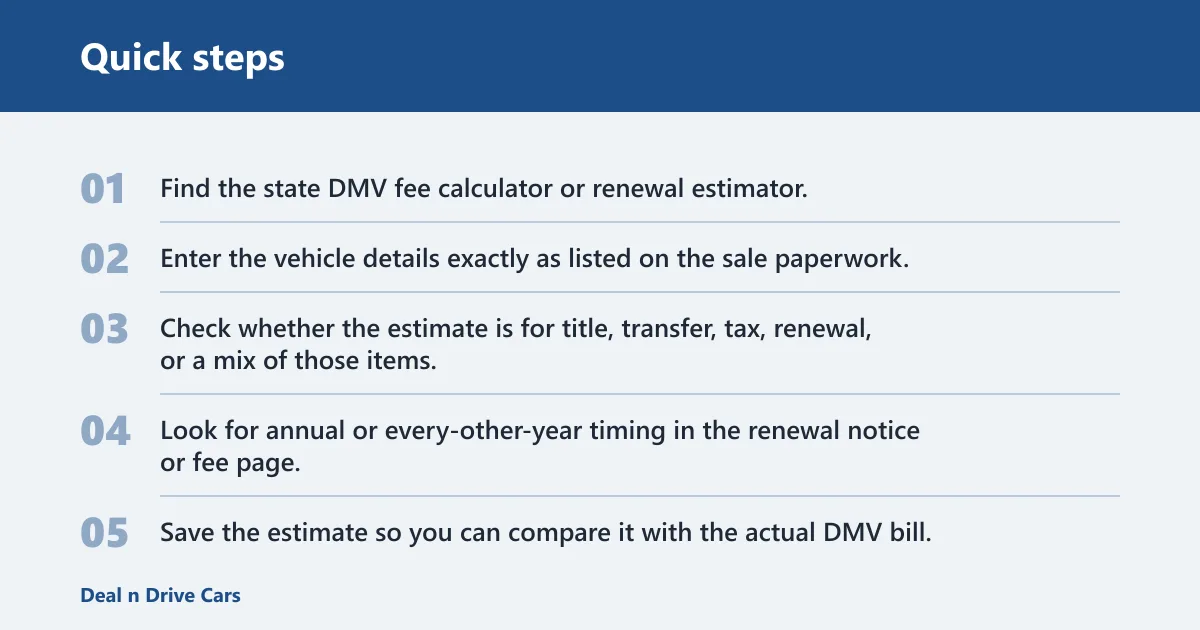
Use the state DMV fee calculator or renewal estimator before you sign. Enter the vehicle details the calculator asks for, including model year, value if required, and any plate or county information. Then compare that estimate with the purchase paperwork so you can see what is one-time and what will recur.
- Find the state DMV fee calculator or renewal estimator.
- Enter the vehicle details exactly as listed on the sale paperwork.
- Check whether the estimate is for title, transfer, tax, renewal, or a mix of those items.
- Look for annual or every-other-year timing in the renewal notice or fee page.
- Save the estimate so you can compare it with the actual DMV bill.
What happens if I miss my registration renewal deadline?
If you miss the deadline, you can face late fees, penalties, and in some places towing or impound risk. A car cannot legally be driven if registration has expired. The exact consequence depends on the state, but the risk rises as soon as the registration lapses.
Late fees and penalties
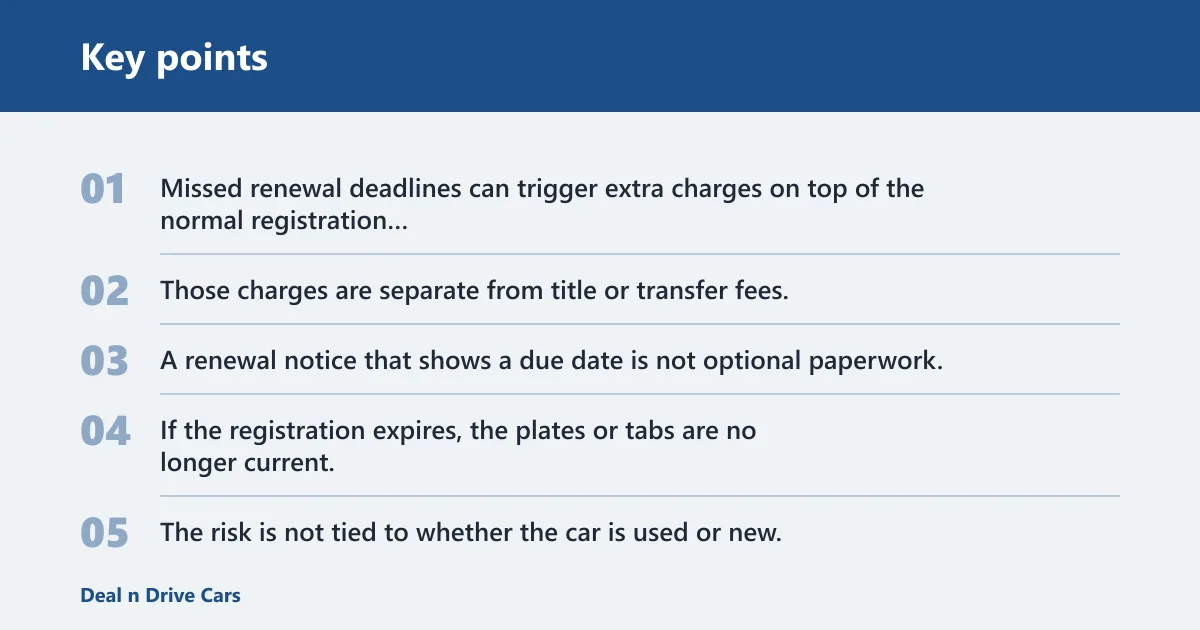
Missed renewal deadlines can trigger extra charges on top of the normal registration amount. Those charges are separate from title or transfer fees. A renewal notice that shows a due date is not optional paperwork; it is the point at which the registration must stay current.
Expired registration and legal driving risk
License plates are proof of registration. If the registration expires, the plates or tabs are no longer current, and driving the car can bring a stop, a ticket, or worse. The risk is not tied to whether the car is used or new; it is tied to whether the registration is active.
What to do after a lapse
Pay the renewal as soon as possible through the state DMV portal or office. Check whether the state wants proof of insurance or other documents before it will process the renewal. If the lapse was long enough to trigger a penalty, the DMV bill should show the extra amount before you complete payment.
A common first-timer mistake is assuming the sticker on the plate lasts as long as the car ownership itself. It does not. The registration cycle ends on the date printed on the renewal notice or DMV record, and the renewal bill is what keeps the car legal to drive.
Frequently asked questions
Are used car registration fees paid yearly or every two years?
Either can be true, depending on the state. Washington renews vehicle license tabs annually. Oregon requires registration every two years. The renewal notice from your state DMV is the best source for your exact cycle and due date.
Does car registration renew annually in every state?
No. Renewal is often annual, but some states use a two-year cycle. The state DMV sets the schedule, so you should check your renewal notice or fee estimator instead of assuming every used car follows the same timing.
How do I find out how much registration will cost before buying?
Use the state DMV fee calculator or renewal estimator before you buy. Enter the vehicle details and see whether the estimate includes purchase-time charges, recurring renewal charges, or both. That gives you a cleaner picture of your total used-car ownership costs.
Are renewal fees different from title and transfer fees?
Yes. Renewal fees are recurring ownership costs, while title and transfer fees are usually one-time charges tied to the sale or ownership change. Mixing them together is the fastest way to misread a DMV bill and overestimate what repeats each year.