How Much Should You Save for Used Car Maintenance Each Year?
Save about $100–$150 a month for an average used car: $600–$900 a year for routine service, $300–$700 for wear items, and $500–$1,000 as a repair buffer; older or high-mileage cars should be budgeted higher. If you skip routine care, small jobs turn into breakdowns, and one unscheduled repair can erase months of savings. This guide gives a simple formula by age and mileage, plus a clean split between service, wear, and surprise repairs.
Typical cost range
A practical annual reserve for a used car often lands around $1,400–$2,600 when routine maintenance, wear items, and unexpected repairs are separated out. Low-mileage cars can sit near the bottom of that range. High-mileage or older cars often need the top end or more, especially in the first year.
As a monthly sinking fund, that works out to roughly $120–$220. Putting money aside each month is easier than facing one brake job or battery replacement all at once.
Simple annual savings by mileage band
Use mileage first, then adjust for age and history. Higher mileage usually means more parts are near their service life, and that raises both expected maintenance spend and the size of the repair buffer.
| Mileage band | Routine maintenance reserve | Wear-item reserve | Emergency repair reserve | Total yearly savings | Monthly equivalent |
|---|---|---|---|---|---|
| Low-mileage used car | $500–$700 | $200–$400 | $300–$500 | $1,000–$1,600 | $85–$135 |
| Mid-mileage used car | $600–$900 | $300–$700 | $500–$1,000 | $1,400–$2,600 | $120–$220 |
| High-mileage used car | $800–$1,200 | $500–$1,000 | $800–$1,500 | $2,100–$3,700 | $175–$310 |
A low estimate becomes too low when the car is older, has patchy service records, or has not had recent wear items replaced. In those cases, move the annual total up, not down.
What belongs in a maintenance budget?

A maintenance budget should cover routine service and predictable wear items, while true failures sit in a separate repair fund. Oil changes, filters, brake inspections, tyre rotations, and fluid top-ups belong in the regular service line. Brake pads, tyres, batteries, wiper blades, and suspension components belong in the wear-item line.
That split matters. Routine maintenance is scheduled. Wear items are expected eventually. Repairs are surprises, and they should not be hidden inside the same bucket.
Routine maintenance items to include
- Oil and filter changes at the manufacturer interval
- Engine air filter and cabin filter replacements
- Brake inspections
- Tyre rotations and pressure checks
- Fluid top-ups and fluid changes when due
- Coolant, brake fluid, and transmission fluid service when scheduled
Manufacturer service schedules usually include both mileage-based and time-based items. That matters because some fluids age even when the car is driven lightly.
Wear-and-tear items to reserve
Wear items are not failures in the strict sense. They are parts that gradually lose life through use. Budget for brake pads, tyres, a battery, wiper blades, and suspension components such as struts, shocks, and bushings when the vehicle age and mileage point toward replacement.
Skip this line and the budget looks cheaper than it is. The bill shows up anyway, only later and often in a bigger lump.
What counts as a repair instead
Unexpected alternator failure, starter failure, a cooling-system leak, or transmission trouble belongs in the emergency repair fund. These costs are separate because routine service does not prevent every major breakdown.
That distinction keeps the budget honest. It also stops the regular maintenance line from being raided for a problem that should have its own reserve.
Mileage and age effects
Mileage and age both raise expected spending, but they do it in different ways. Mileage pushes parts toward replacement. Age raises the odds of time-based service, rubber deterioration, corrosion, and labour-heavy jobs that appear even on low-use cars.
Low-mileage used cars
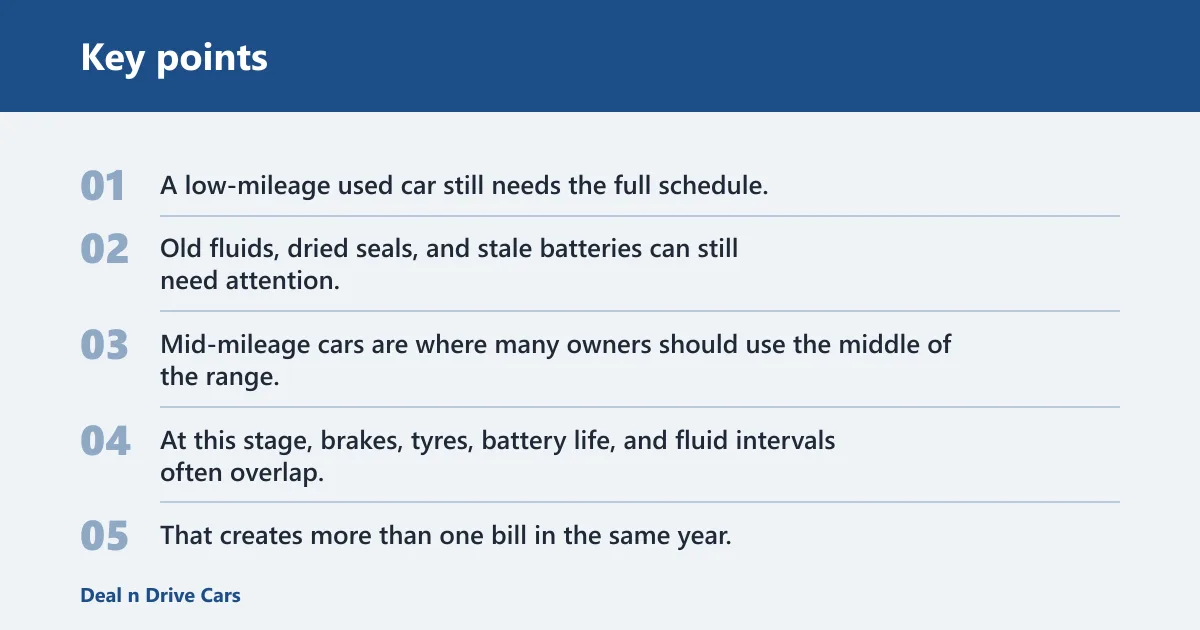
A low-mileage used car still needs the full schedule, but the wear-item reserve can stay lower if recent service records are complete. The main risk is age, not kilometres alone. Old fluids, dried seals, and stale batteries can still need attention.
Mid-mileage used cars
Mid-mileage cars are where many owners should use the middle of the range. At this stage, brakes, tyres, battery life, and fluid intervals often overlap. That creates more than one bill in the same year.
High-mileage used cars
High-mileage used cars deserve the largest buffer. More components are closer to end of life, and the chance of stacked repairs rises. Add more money for wear items and keep a larger emergency reserve because one failure can expose the next weak part.
Say your compact hatchback has 142,000 miles and no record of recent brake or coolant service. A reasonable plan is not the low-mileage number. It is closer to the high-mileage band, because the unknowns are part of the cost.
How much more for an older car?
Older used cars usually need a larger contingency, even if the mileage is not extreme. A practical rule is to move the total annual reserve up by 20% to 40% once the car is old enough that rubber parts, sensors, batteries, and seals are more likely to age out together. The first year often needs the biggest buffer of all.
First-year ownership costs
The first year of ownership often includes catch-up work: fluids that are due by time, filters, tyres, brake service, battery replacement, or overdue inspections. If service history is incomplete, the budget should assume some of that work will be needed soon, not later.
A common first-timer mistake is to budget only for oil changes and then find that the car also needs tyres and a battery within a few months. That is maintenance backlog, and it belongs in the first-year plan.
When older cars need a larger contingency
Older cars need a bigger emergency reserve when parts are harder to source, labour time rises, or several systems have the same age. Rubber hoses, suspension joints, and electrical parts can fail close together. That is why age matters even when the odometer is not extreme.
Why labour and parts frequency rise with age
Age affects both frequency and labour. The car may need more inspections, more fluid changes, and more small repairs. It may also take longer to service because old fasteners seize, brackets break, or one job reveals another issue nearby.
Service history and budget risk
Service records change the budget. Complete records lower uncertainty. Missing records, previous collision repair, or signs of deferred maintenance should raise the contingency. If the history is thin, assume the car needs more catch-up work than the seller disclosed.
Missing service records
If there is no clear proof of recent oil changes, brake service, tyre replacement, or fluid service, increase the annual reserve. A practical rule of thumb is to add about 25% to the wear-item reserve and another 10% to 20% to the emergency repair fund.
Accident history and prior ownership
Accident history does not automatically make a car a bad buy, but it can change the maintenance outlook. Repairs to suspension, alignment, cooling parts, or body hardware may show up later. Multiple prior owners can also mean the service pattern is harder to verify.
Signs of maintenance backlog
Look for overdue fluid changes, mismatched tyre wear, noisy brakes, torn suspension boots, weak battery starts, or warning lights that have been ignored. Those signs point to deferred work, which should be budgeted now rather than treated as a distant risk.
Used car budget worksheet
Use this worksheet to turn the annual reserve into three clear lines. The emergency repair fund should stay separate from routine savings and be kept in cash or a savings account so it is available when something fails.
| Budget line | Low-mileage used car | Mid-mileage used car | High-mileage used car |
|---|---|---|---|
| Routine maintenance reserve | $500–$700 a year / $42–$58 a month | $600–$900 a year / $50–$75 a month | $800–$1,200 a year / $67–$100 a month |
| Wear-item reserve | $200–$400 a year / $17–$33 a month | $300–$700 a year / $25–$58 a month | $500–$1,000 a year / $42–$83 a month |
| Emergency repair reserve | $300–$500 a year / $25–$42 a month | $500–$1,000 a year / $42–$83 a month | $800–$1,500 a year / $67–$125 a month |
- Start with the mileage band that fits the car.
- Add 20% to 40% if the car is older than expected for that band.
- Add another 25% to the wear-item reserve if service records are incomplete.
- Keep the emergency repair fund in a separate savings bucket.
- Review the budget after the first year and reset it to match the actual service pattern.
How to keep costs under control
Follow the manufacturer schedule first. Then use both mileage-based and time-based intervals, because some items are due by age even when the car is driven less. Regular inspections can catch tyre wear, brake wear, fluid leaks, and battery weakness before they become bigger bills.
To reduce costs without skipping important service, compare labour rates, ask for written estimates, and replace items before they cause secondary damage. A tyre rotation is cheaper than replacing unevenly worn tyres early. A fluid change is cheaper than a failed component worn out by neglected fluid.
Picture a sedan driven only 6,000 miles a year but parked outside for most of its life. The mileage looks mild, yet the battery, wiper blades, seals, and fluids can still age out. That is why time-based service belongs in the budget alongside mileage-based service.
Frequently asked questions
How much should I save for used car maintenance each year?
A solid target is $1,400–$2,600 a year for many used cars once you include routine service, wear items, and a repair buffer. Lower-mileage cars can sit below that, while older or high-mileage cars often need more. The right number depends on age, records, and how far the car has already lived.
What is a realistic monthly maintenance budget for a used car?
Plan on about $120–$220 per month for an average used car. That monthly fund should cover routine maintenance, expected wear parts, and a separate reserve for surprise repairs. If the car is older, has high mileage, or lacks service records, move the monthly number higher.
Does mileage change how much I should budget for maintenance?
Yes. Higher mileage usually means more wear items are nearing replacement and more repairs may appear in the same year. Low-mileage used cars can be budgeted lower, but they still need time-based service. Mileage should guide the budget, not decide it alone.
How much more should I save for an older used car?
Older used cars often need 20% to 40% more than a similar newer car because age raises the odds of fluid changes, rubber deterioration, and stacked repairs. If the car is older and the service history is thin, increase both the wear-item reserve and the emergency fund.
How much should I keep aside for unexpected car repairs?
Keep $500–$1,000 aside for an average used car, and more for high-mileage or poorly documented cars. That money should sit separately from routine maintenance savings. Cash or a savings account works best because repairs usually cannot wait for a later pay cycle.
What should I expect to spend in the first year of owning a used car?
Expect the first year to be heavier than later years if the service history is incomplete. You may need fluids, filters, tyres, brakes, a battery, or overdue inspections. A larger first-year reserve is sensible because catch-up work often appears quickly after purchase.