How Long Does a Dealership Take to Process a Used Car Sale?
A used-car sale at a dealership often takes about 1 to 3 hours when financing is approved and the paperwork is clean; cash deals can move faster, while lender checks, trade-ins, or missing documents can stretch it to a full day or more. Delays can add surprise wait time, delay delivery, and leave you signing under pressure. This guide breaks the sale into each handoff stage and shows where same-day delays usually start.
Used car sale timeline
The sale often moves through five handoffs: appraisal, financing, contract prep, signing, and post-sale funding and title work. The first four can often happen in one sitting if the file is clean. The last one often continues after you leave, especially when a lender, title clerk, or state registration office still has work to do.
| Stage | What the buyer must provide | Typical delay triggers | How to speed it up |
|---|---|---|---|
| Appraisal | Trade-in key, title or payoff account details, registration, mileage, ID | Missing title, lien payoff mismatch, unclear condition, extra keys or accessories not brought in | Bring the vehicle records, disclose payoff details early, and wait to discuss the trade until the new-car price is set |
| Financing | Income details, residence history, driver’s license, insurance info, consent for credit check | Soft-to-hard credit pull timing, lender verification, incomplete income data, payment method questions | Arrive with pre-approval, set your price cap before you shop, and avoid an early hard credit pull unless you are ready to buy |
| Contract prep | Buyer name, address, ID, trade-in details, chosen payment method, lender terms | Mismatch between buyer info and documents, missing insurance proof, dealer fee questions, title errors | Bring exact legal name and address, confirm insurance, and review the vehicle history report before negotiation |
| Signing | Final contract review, signatures, odometer and delivery forms, payment confirmation | Last-minute term changes, unanswered finance questions, confusion over add-ons or delivery timing | Read every form before the appointment and ask for the out-the-door figure before signing |
| Post-sale funding/title work | Nothing more at the counter, unless the dealer asks for a corrected document later | Lender funding review, lien release wait, title transfer filing, registration backlog | Give the dealer accurate documents up front and keep copies of every signed form |
What to have ready before you go
Bring a clear plan before you ever sit down at the desk. A dealership purchase should not happen on impulse. If you already know your budget, your max monthly payment, whether you are paying cash or financing, and which vehicles fit your needs, the sale can move in a straight line instead of circling back through choices. (Caranddriver)
Budget and max monthly payment
Set the total amount you can spend, then set a monthly cap if you plan to finance. Keep the conversation tied to the vehicle price and the full out-the-door amount, not just the monthly number. That helps you avoid surprises when taxes, fees, and optional products appear near the end of the deal.
Cash vs. finance decision
Decide ahead of time whether you will pay cash or use a loan. Cash usually cuts out lender approval steps, but it does not eliminate title work or document checks. Financing adds a credit review and lender paperwork, so you should expect more handoffs even when the car itself is ready to go.
Vehicle shortlist
Pick a short list of in-stock vehicles that actually match your needs. Dealership inventory affects speed because a car already on the lot can move to paperwork faster than one that still needs to be located, traded for, or transported. A dealership can try to sell whatever vehicle it has in stock, so stay focused on the cars that fit your shortlist.
Driver’s license and insurance details
Bring a valid driver’s license and insurance information. Dealers usually need identity verification before a test drive and again before contract prep, and they need the exact policy details to finish the sale. Keep copies handy, but do not hand over originals unless the dealer explains why it needs them.
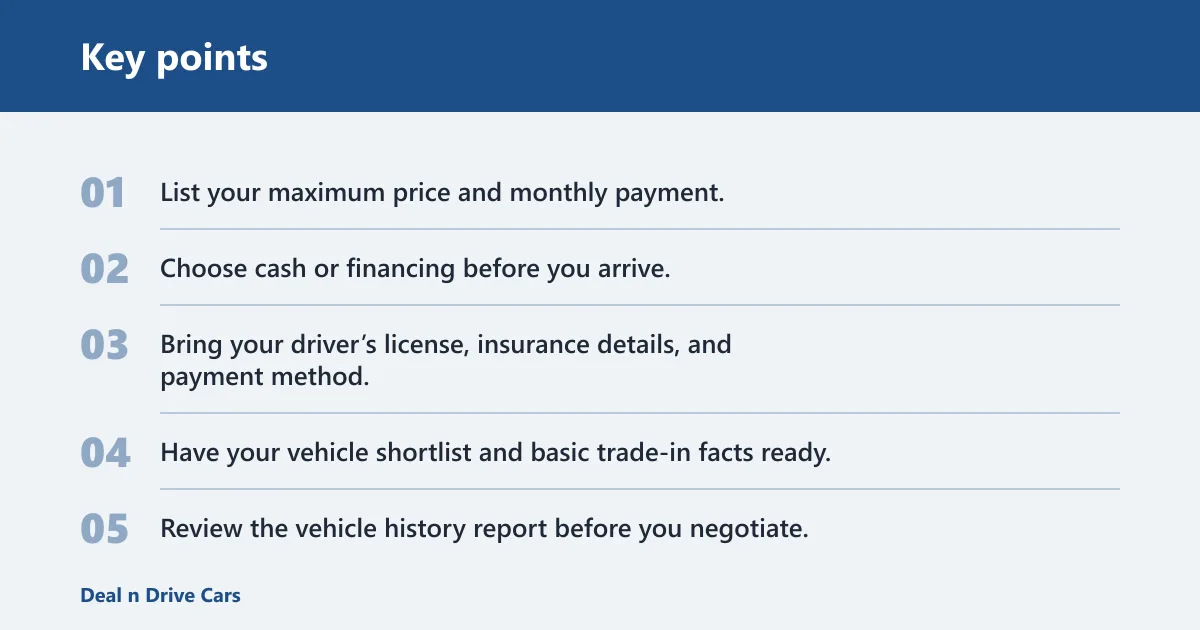
- List your maximum price and monthly payment.
- Choose cash or financing before you arrive.
- Bring your driver’s license, insurance details, and payment method.
- Have your vehicle shortlist and basic trade-in facts ready.
- Review the vehicle history report before you negotiate.
How long does a dealership take to process a used car sale?
For a clean, in-stock deal, the counter work can often finish in about 1 to 3 hours. Cash buyers and buyers with pre-approval usually move fastest. Same-day delivery is possible when the paperwork matches, the lender is ready, and the trade-in is simple or absent. The process slows when any one of those pieces needs extra verification.
Fast same-day deals
A same-day handoff is most likely when the vehicle is already on the lot, the buyer has a clear plan, and financing is either cash or already pre-approved. The finance desk still has to coordinate payment method details, verify identity, and prepare the contract. If everything lines up, the buyer can often leave after signing.
Deals that run into a next-day pickup
Next-day pickup becomes more likely when the lender needs time to review credit, the trade-in title is not ready, or the dealer is waiting on proof of insurance or a payoff figure. Some shoppers assume signing ends the wait, but that is not always true. Post-sale funding and title work can continue after the vehicle leaves the lot.
Why the clock starts and stops at different steps
The sale clock does not run in a single straight line. Appraisal may finish quickly, then financing adds a pause, then contract prep stops until a form is corrected. Picture a buyer with a clean in-stock sedan and a lender pre-approval: the desk work may move quickly. Now change only one factor, like a trade-in with a lien payoff, and the delivery can slip to the next day.
What paperwork slows down a used car sale at a dealership?
The slowest paperwork usually involves credit approval, title information, identity checks, and proof that the payment method is ready. The finance desk may still need to run a credit check eventually if you finance. You should not agree to a hard credit pull too early, because that can happen before the deal is close enough to justify it.
Credit check and loan approval
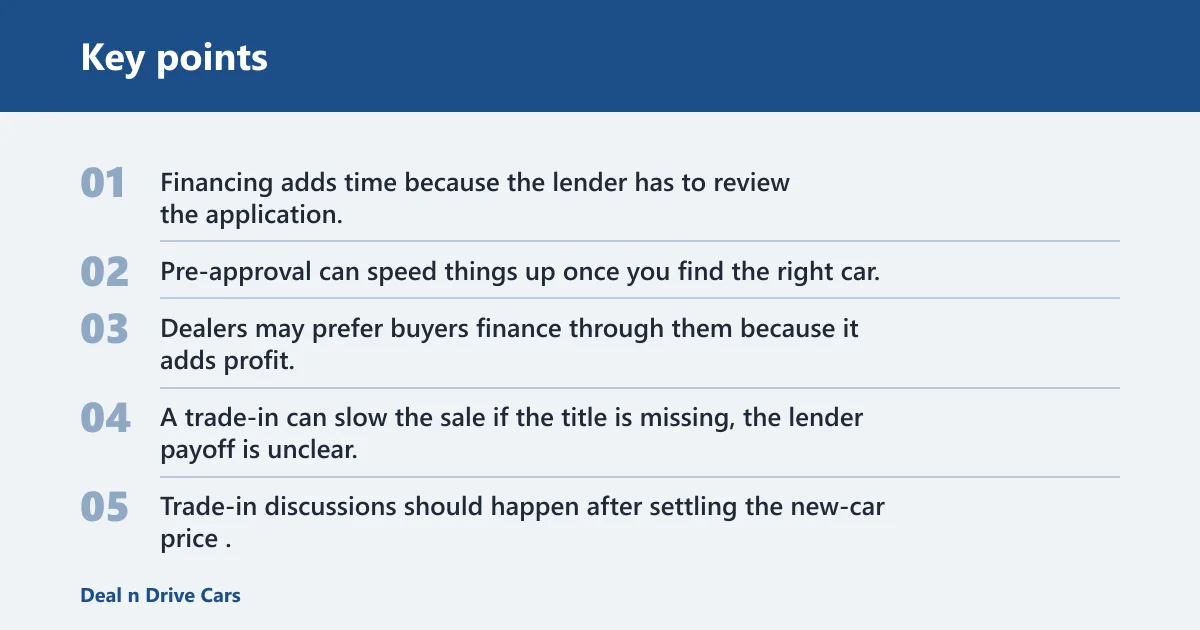
Financing adds time because the lender has to review the application, verify income and identity, and decide whether the terms fit the loan. Pre-approval can speed things up once you find the right car. Dealers may prefer buyers finance through them because it adds profit, so the finance desk may present several lender paths before the contract is ready.
Trade-in title and payoff details
A trade-in can slow the sale if the title is missing, the lender payoff is unclear, or the lien release has not arrived. Trade-in discussions should happen after settling the new-car price. That keeps the negotiation cleaner and lets the appraisal be used as a down payment or part of it without muddying the vehicle price discussion.
Proof of identity and address
Dealers need accurate buyer information for the contract and the title paperwork. If the name, address, or ID does not match across the forms, the desk has to stop and fix it. A driver’s license verification may also happen before the test drive. That is an identity check, not a reason to hand over original documents for longer than needed.
Insurance and payment method coordination
The finance desk also coordinates how the buyer will pay. That can mean cash, cashier’s check, bank transfer details, or dealer-arranged financing. If the payment method is unclear, the delivery can pause even after the buyer agrees to the price. The dealer cannot finish the handoff until the payment path is settled.
How financing changes the timeline
Financing usually adds steps, but it does not automatically mean a long delay. The main time cost comes from lender review, credit checks, and contract preparation. If you arrive with pre-approval and your documents are clean, financing may still fit inside the same-day window. If the lender needs more information, the sale can stretch out.
Pre-approval before you arrive
Pre-approval can shorten the process because it gives the finance desk a starting point. It does not guarantee instant approval, but it can reduce back-and-forth once you settle on a car. That is especially helpful when the dealership already has the vehicle in stock and the buyer is ready to move from appraisal to contract prep.
What the finance desk checks
At the finance desk, the staff usually checks credit, confirms income and residence details, and matches the loan terms to the vehicle price and payment method. They also prepare the contract for signing and may review optional products or dealer add-ons. Any mismatch here can stop the deal until the document is corrected.
When lender approval adds waiting time
Waiting grows when the lender wants more proof, the credit file is thin, or the dealer has to send the application out for a decision. Some shoppers expect a one-step approval, but that is not always how it works. A clean file can still wait for lender funding, especially if the lender closes later in the day.
Why cash sales usually move faster
Cash sales usually skip the lender approval stage, so there is less to verify before signing. That said, cash does not erase title work or dealer processing. The dealership still has to complete ownership paperwork, collect the correct payment, and file the transfer steps after the sale.
How trade-ins affect the sale clock
Trade-ins can help the deal, but they often create the biggest timing swings. The appraisal is part of the process, and it should happen before final paperwork is locked in. If the trade has a loan payoff or missing documents, the dealer may need extra time before delivery. A clean trade-in file is easier to fold into the deal.
When to discuss the trade-in
Bring up the trade-in after the new-car price is settled. That keeps the conversation from mixing vehicle price with appraisal value too early. If you discuss the trade before the main price is set, it becomes harder to see whether the offer is fair. It can also slow the sale if the desk has to rework numbers multiple times.
Appraisal before negotiation
The appraisal should give the dealer a value before the final negotiation wraps up. That number can become part of the down payment or reduce the amount financed. Suppose you are buying a used SUV and trading a sedan with a clean title. The appraisal may take only a short time. Add a lien payoff, and the desk may need more time to confirm the balance.
When a payoff or lien slows delivery
A payoff slows things when the dealer must contact the lender, confirm the exact amount, and wait for lien release timing. Until that file is clear, the dealership may hold the car or delay final delivery. The buyer can still sign, but the handoff may not finish until the title side catches up.
Title transfer and registration after signing
Signing does not mean the title and registration are finished. After the deal is signed, the dealer still has to complete ownership paperwork, file title transfer steps, and send the proper forms to the lender or state office. If the car is financed, the lien release and funding steps add more post-sale processing time.
Dealer ownership paperwork
The dealer has to transfer ownership from its inventory record to the buyer. That usually includes the contract, odometer statement, and state-specific title forms. A small paperwork error can push the file back into the queue, which is why clean information matters before you sit down to sign.
Lien release timing
If the car you are buying was previously financed, the dealer may need a lien release before the title can move forward cleanly. That document confirms the old loan is satisfied. If the payoff is still pending, the process can take longer even after the buyer has driven away.
Registration filing steps
Registration filing depends on the dealer’s process and the state’s timeline. Some dealers handle the filing quickly, while others send it to a processor or wait on state processing. That is why a buyer may have the car the same day but still wait for final plates or registration documents later.
Why post-sale work can take days or weeks
Post-sale work can stretch out because funding, title transfer, and registration do not all move at the same speed. The lender may fund the deal after it reviews the signed contract. The state may take longer to process the title. Those delays happen after the signing table, not before it.
When can you leave with the car the same day?
You can often leave the same day when the car is in stock, the paperwork is complete, the trade-in file is clean, and the payment method is settled. Cash or pre-approved financing helps. The deal is more likely to finish on the spot when the dealer does not need to wait on lender approval, title corrections, or insurance proof.
In-stock vehicle with clear paperwork
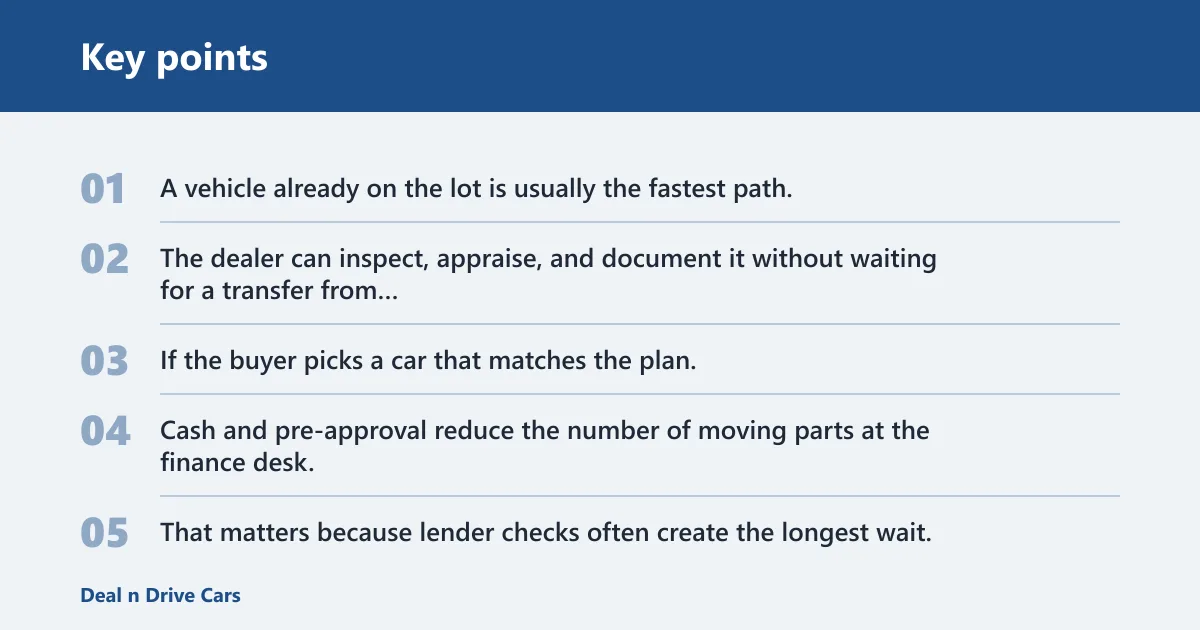
A vehicle already on the lot is usually the fastest path. The dealer can inspect, appraise, and document it without waiting for a transfer from another store. If the buyer picks a car that matches the plan, the sale can move from appraisal to signing without a long pause.
Cash or pre-approved financing
Cash and pre-approval reduce the number of moving parts at the finance desk. That matters because lender checks often create the longest wait. Pre-approval can speed things up once you find the right car, but the dealer still has to confirm the final contract terms and payment method before delivery.
Clean trade-in file
A clean trade-in file means the title is available, the payoff amount is known, and there is no lien release problem to untangle. That keeps the appraisal from turning into a paperwork chase. When the trade is simple, it can function as a down payment without holding up the rest of the deal.
Reasons the dealer may hold the car
The dealer may hold the car if the lender has not approved the loan, if the identity documents do not match, or if the trade-in payoff is still unresolved. Some dealers still use tactics to keep shoppers in the showroom, which can blur the line between a finished deal and a delayed one. Ask what is still pending before you assume you are done.
Frequently asked questions
Can I leave the dealership with a used car the same day?
Yes, often you can, but only if the vehicle is in stock, financing is already approved or unnecessary, and the trade-in file is clean. If the dealer still needs lender approval, lien release information, or corrected paperwork, same-day delivery may turn into next-day pickup. Signing alone does not guarantee immediate handoff.
What do I need ready to speed up a dealer sale?
Bring your driver’s license, insurance details, proof of address if needed, a clear budget, and a decision on cash versus finance. Have your vehicle shortlist ready too. Pre-approval helps if you are financing. A clean trade-in title or payoff information also keeps the process moving at the finance desk.
Does financing make a used car sale take longer?
Usually yes, because financing adds credit review, lender approval, and contract coordination. It does not have to be slow, though. Pre-approval can speed things up once you find the right car, and a clean file can still finish the same day. Delays happen when the lender needs extra verification.
How long does title and registration processing take after buying a used car?
That depends on the dealer, the state, and whether a lien release is needed. The buyer may take the car home the same day while title and registration continue behind the scenes. Some files finish quickly; others take days or weeks if a lender, state office, or payoff detail slows the chain.