Pre Purchase Inspection for a Used Car
A used-car pre-purchase inspection should follow a simple rule: verify paperwork first, then inspect for title, frame, flood, airbag, engine, transmission, and brake faults, and buy only if there are no deal-breakers and repairs stay well below the asking price. Skip that process, and you can inherit hidden crash damage, unpaid liens, odometer fraud, or four-figure repairs before your first oil change. This guide covers what gets checked, what to confirm before booking, typical costs, who should do it, and how to turn results into a buy, negotiate, or walk-away decision.
Editorial credentials and methodology: This article was prepared for used-car buyers by an automotive editorial team focused on title checks, private-party transactions, financing, and inspection-based negotiation. The guidance below follows the same workflow many independent inspectors use in practice: paperwork and VIN match first, cold-start observation second, exterior and underbody review third, scan tool check fourth, and road test last. Procedural references are aligned with NHTSA recall guidance, FTC used-car buying guidance, AAA buyer advice, NICB VIN fraud tools, and state DMV title and VIN verification rules.
What a pre purchase inspection includes
What the inspection should cover
A thorough pre-purchase inspection should follow a set sequence, not a quick lap around the car. Start with paperwork and ownership records, then inspect the body and structure, then move through mechanical systems, electronics, an OBD scan, and a road test.
The paperwork side should typically include title and VIN verification, registration review, seller ID matching, a vehicle history report, service records, and recall status. NHTSA instructs buyers to search open recalls by VIN before purchase, and the FTC advises used-car shoppers to review the Buyers Guide and vehicle history information before committing. State DMV guidance also treats title branding and VIN consistency as core fraud-prevention checks. A clean title matters: salvage, rebuilt, flood, and other brands change value, insurability, and risk.
The physical side should check paint mismatch, panel gaps, overspray, glass date mismatch, underbody condition, rocker panels, wheel arches, frame rails, leaks, tire wear, brakes, suspension, HVAC, warning lights, power features, and signs of water intrusion. AAA consumer guidance and many independent shop checklists recommend starting with a cold engine, then checking idle quality, then finishing with a road test so startup noise, smoke, warning lights, shift behavior, and brake feel can all be judged in the right conditions.
What it usually does not cover
Most pre-purchase inspections do not guarantee future reliability, predict every intermittent electronic fault, or replace a full teardown. A mobile inspection may also miss underside details if the car cannot be lifted, and some inspectors will not perform compression testing, battery-pack diagnostics, or module programming checks unless booked separately.
That matters with EVs, turbocharged cars, luxury models, and cars with advanced driver assistance systems. If the windshield was replaced on a car with lane-keeping or camera-based braking, ask whether calibration evidence exists. A clean test drive does not prove the camera was recalibrated correctly.
Why the inspection is one input, not the whole decision
An inspection report is best used with a simple rule. Reject provenance problems first. Reject structural rust, flood evidence, or major drivetrain faults next. Then total the realistic near-term repairs and compare them with the asking price.
A practical rule of thumb is the 10% line stated above: if immediate repairs rise past about 10% of asking price, the car shifts from easy buy to hard negotiation or exit. That is a decision tool, not a law, but it helps separate a $500 tire-and-brake conversation from a $3,000 to $6,000 transmission or cooling-system problem that can erase any deal value.
What should you check before paying for an inspection?
Before paying for an inspection, confirm seller cooperation, access to the car on a lift or safe flat surface, cold-start conditions, title and VIN consistency, history and recall results, and basic service paperwork. If the seller resists any of those steps, the inspection fee may be money spent on a car that should already be off the list.
Seller cooperation, access, and cold-start conditions
A seller should agree to an independent pre-purchase inspection. If a private seller refuses, limits where the car can go, insists on a fully warmed engine, or will not allow scan access, treat that as a risk signal. FTC used-car guidance and AAA shopping advice both support independent verification before purchase rather than relying only on the seller’s description.
For shop inspections, confirm that the car can be raised and road-tested. For mobile inspections, confirm safe parking, daylight, and enough time for a proper check. Same-day scheduling can help when a seller wants a fast decision, but speed should not replace access. If the inspector cannot see the underbody or observe a cold start, the report becomes less decision-grade.
Title, VIN, registration, and seller ID checks
Verify the VIN on the dashboard, door sticker, title, registration, and seller ID before booking the full inspection. State DMV agencies generally instruct buyers to compare the public VIN plate and title documents before transfer, and NICB’s VINCheck tool is commonly used to screen for theft and major insurance-loss records. Any mismatch can signal clerical error, swapped tags, stolen parts, or worse.
If the title holder is different from the seller, ask why before spending inspection money. If a lien appears and the payoff process is unclear, pause. Mechanical condition matters less if legal ownership is messy. For buyers comparing different transaction types, this is also where private seller risk differs from dealer paperwork: the burden of verification is usually higher with a private-party sale.
History report, recall lookup, and service records first
Use a vehicle history report before or alongside the physical inspection. FTC guidance encourages reviewing a vehicle history report when available, and state title agencies warn that branded or salvage histories affect both value and registration. Read the report for branding, registration history, odometer entries, and write-off or theft records.
Check open recalls before paying for a shop appointment. NHTSA’s recall lookup by VIN is the standard source for this step. Service records also matter because they back up mileage and condition claims; a car with claimed recent transmission service should have documents that match the date and mileage. If you are also sorting out the paperwork side, it helps to compare the service file with a broader used-car paperwork checklist before the appointment.
What is the difference between an inspection and a history report?
A history report checks recorded past events such as title branding, theft, write-off status, odometer entries, and some recall or registration data. A physical inspection checks the car you can actually buy for present faults, poor repairs, leaks, rust, tire wear, hidden water damage, and road-test symptoms that a database cannot show.
What a vehicle history report can reveal
A report may show salvage, rebuilt, flood, or lemon branding, prior registrations, and gaps between claimed and recorded mileage. It can also point to prior damage claims or auction movement, which helps explain paint mismatch or replaced panels found later in the physical check.
What it cannot do is prove the current repair quality. A rebuilt title with excellent paperwork still needs close structural review. A clean title also does not rule out unreported crash repair.
What only a physical inspection and test drive can reveal
A physical inspection is needed to look for fresh seam sealer, overspray in door jambs, cracked suspension bushings, sidewall bubbles, underbody rust, coolant seepage, or damp trunk lining. Only a test drive can reveal delayed shifting, brake pulsation, steering pull, wheel-bearing hum, or shudder under load.
Flood cars are a prime example. History can miss them. A physical inspection can catch water lines under carpet, corrosion in connectors, a musty smell, silt in spare-tire wells, or moisture in the trunk. NICB and state title agencies both caution that not every damage event appears in every database, which is why physical evidence still carries weight.
How to combine both into one decision
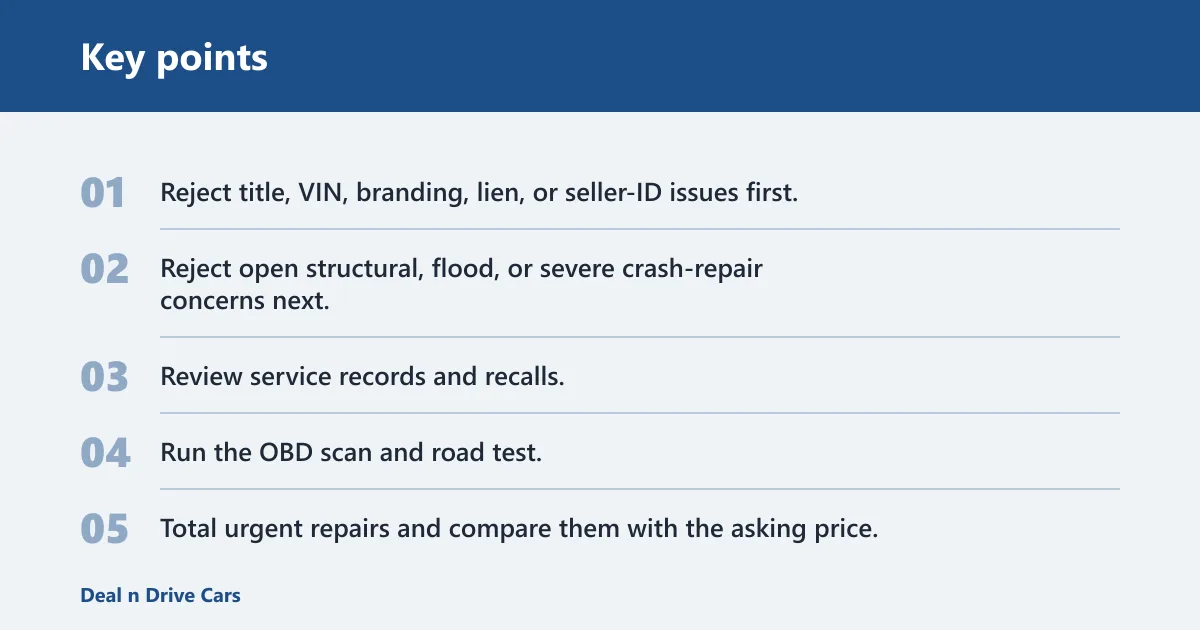
- Reject title, VIN, branding, lien, or seller-ID issues first.
- Reject open structural, flood, or severe crash-repair concerns next.
- Review service records and recalls.
- Run the OBD scan and road test.
- Total urgent repairs and compare them with the asking price.
Suppose a clean history report comes back first, but the inspection finds fresh weld marks on one frame rail and uneven front panel gaps. The report helps, but the physical evidence carries more weight. That car moves to walk-away territory because repair quality and structure matter more than a clean database entry.
Who should perform the inspection?
Independent mechanic inspection
For most buyers, the best value is a third-party independent mechanic inspection. It gives a broader mechanical, electronic, and road-test review than a seller-provided check, and it is less likely to be shaped by the sale itself.
An independent shop can often put the car on a lift, inspect for leaks and rust underneath, and perform a deeper scan. AAA buyer guidance routinely points shoppers toward an independent inspection before purchase. Report quality matters because you need clear findings you can price and negotiate from. A useful report should identify the symptom, likely cause, urgency, and whether the issue is routine maintenance or a likely multi-hour repair.
Mobile mechanic inspection
A mobile mechanic inspection is a convenience-first option. It works well when the seller will not release the car, the car is out of town, or you need a same-day screen before traveling. The trade-off is access: without a lift and full diagnostic gear, underbody and system depth can be limited.
Use mobile inspection to screen candidates, then move to a shop inspection if the car looks promising and expensive faults remain possible. That is especially sensible with performance cars, EVs, SUVs with air suspension, and luxury models packed with modules.
When a dealer inspection is not enough
A dealer inspection can be useful, but it should not be the only opinion on a car the dealer is selling. Consumer auto sources commonly place dealer or basic courtesy inspections below a full independent pre-purchase inspection for objectivity. Lower cost can make it a useful first pass, but independence matters more than price when the findings decide whether you buy.
Coordinating the inspection with a private seller
Arranging a pre-purchase inspection with a private seller requires proactive scheduling and firm boundaries to ensure unbiased results. You must book the appointment yourself at a neutral facility and cover the cost upfront, as the seller has no financial obligation. This article provides specific templates for requesting access, timing strategies to avoid rushing, and protocols for handling seller refusal. If a seller declines full access or attempts to influence the mechanic, treat that resistance as a critical red flag indicating potential hidden defects. arranging inspection logistics ensures you verify the vehicle’s true condition before committing funds, preventing costly surprises from concealed engine, frame, or flood damage that standard listings often omit.
How much does a pre purchase inspection cost?
Typical cost depends on who does the work and how deep the inspection goes. AAA and independent consumer auto guides commonly place pre-purchase inspections in roughly the $150 to $400 range for standard vehicles, while basic dealer inspections may be free or lower-cost. Mobile checks often fall within a similar range, but region, vehicle type, scan depth, and road-test access change the price.
Typical price ranges by inspection type
The most useful comparison is not cheapest versus most expensive. It is screening versus decision-grade inspection. A low-cost dealer or basic mobile check may confirm obvious faults. A shop-based independent inspection is better for underbody, leak, brake, suspension, and transmission risk.
What makes the price go up
Price rises with travel time, larger vehicles, luxury or performance models, EV battery-health review, scan-tool depth, and whether the inspector can use a lift. Out-of-state purchases may also need photo-heavy documentation because you are using the report instead of an in-person visit.
When the fee is justified and when it is not
The fee is usually justified when the car is worth buying if it checks out. It is less justified when the seller already failed the paperwork stage, refuses independent inspection, hides service history, or cannot provide a cold start. Do not spend inspection money to investigate a car that already missed the first filter.
A simple example: paying $250 for an inspection on a $12,000 sedan is sensible if the car has a clean title, matching VIN, and records. Paying that same fee on a car with an unsigned title, no cold start, and an evasive seller often produces the wrong kind of information too late.
When Is a Pre-Purchase Inspection Actually Worth It?
Not every used car requires a formal pre-purchase inspection, but skipping one can be costly. A $100–$250 PPI often uncovers hidden engine, transmission, or brake issues that private sellers or dealers might miss, preventing post-purchase repair bills that run into the thousands. It is especially valuable for private-party sales, older vehicles, and EVs with complex battery systems.
To determine whether your specific car, seller type, and budget justify the expense, review the detailed breakdown in pre-purchase inspections. This resource maps out exactly when a PPI pays off, which findings allow for price negotiation, and when they are a red flag to walk away entirely, ensuring you make a data-driven decision before closing the deal.
How do you inspect the car itself?
The physical inspection should move from outside to inside, then under the hood and underneath. Focus on signs that change the decision: poor crash repair, structural rust, fluid leaks, water intrusion, tire wear patterns, warning lights, and electronic faults that point to bigger repair bills than the listing suggests.
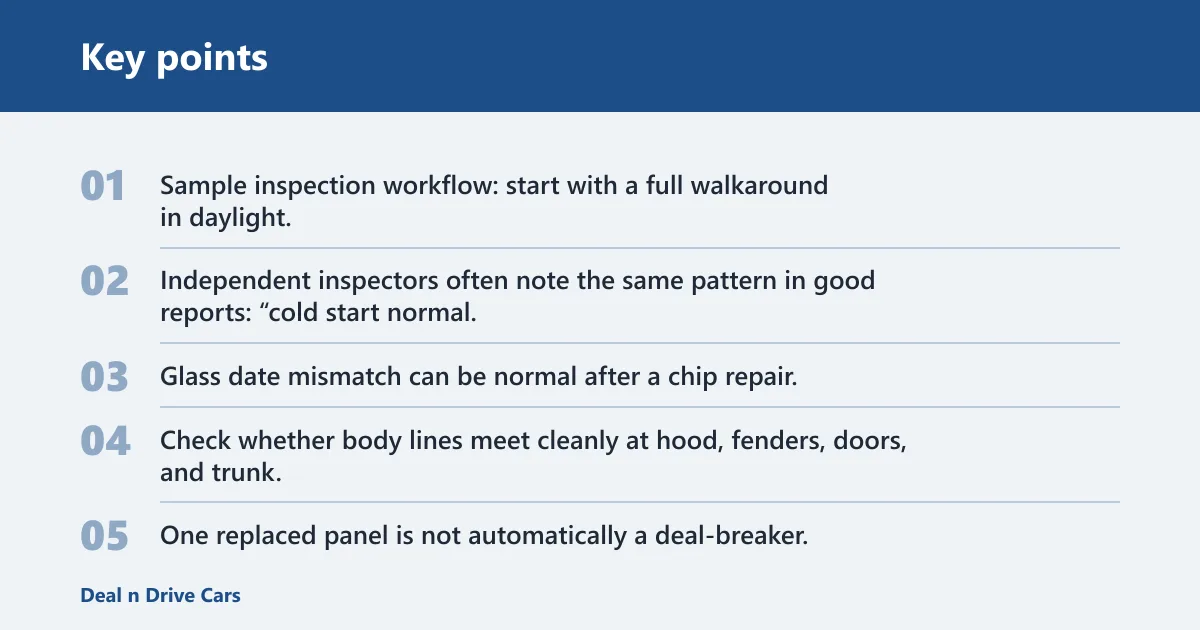
Sample inspection workflow: start with a full walkaround in daylight; compare VIN locations and title details; inspect glass, lamps, and body lines; open the hood before startup; start the engine cold and watch the dash; scan for active and pending codes; inspect tires and brakes; check cabin electronics and HVAC; then road-test at low and highway speeds. Independent inspectors often note the same pattern in good reports: “cold start normal, no warning lamps remain on, complete readiness monitors, straight braking, no driveline vibration,” or the opposite, such as “fresh undercoating on one rail, uneven front gaps, misfire pending, recommend structural and powertrain caution.”
Exterior, bodywork, glass, and signs of crash repair
Look for mismatched paint tone, sanding marks, overspray on seals, uneven panel gaps, missing fasteners, and headlights with different manufacturing dates. Glass date mismatch can be normal after a chip repair, but windshield replacement on ADAS-equipped cars raises a calibration question.
Check whether body lines meet cleanly at hood, fenders, doors, and trunk. One replaced panel is not automatically a deal-breaker. Poor alignment, buckled inner aprons, or airbag evidence can be. A concrete example: a front bumper respray with straight apron metal may be cosmetic; a respray plus wrinkled apron metal, shifted hood gaps, and an airbag light history points to a much riskier repair story.
Rust, underbody, frame rails, and structural concerns
Inspect rocker panels, wheel arches, jack points, suspension mounts, undercarriage, and frame rails. Fresh undercoating in isolated patches, crude welds, rippled metal, or repair marks should raise suspicion. Structural rust is generally a walk-away issue.
Picture a crossover that looks clean from ten feet away, but the lift shows flaking rust along rear frame sections and fresh black coating on one side only. That is not a negotiation item. It is an exit point because the metal itself is failing. By contrast, light surface rust on fasteners and exhaust hardware can be normal in many climates and may support only a modest discount.
Engine bay, fluids, leaks, tires, brakes, and suspension
Check for oil, transmission fluid, coolant, brake fluid, and differential leaks in the engine bay and underneath. Fluid leaks are a major red flag for hidden repair costs because the visible seep may only be the start, and access labor often drives the real bill.
Tires tell the truth about alignment and maintenance. Look for even tread wear, matching brand and type across each axle, sidewall bubbling, and abnormal inside-edge or cupped wear. DOT age can matter, especially when tread looks fine but rubber is old. NHTSA tire-safety guidance and consumer tire sources both warn that aging tires can be unsafe even with usable tread depth.
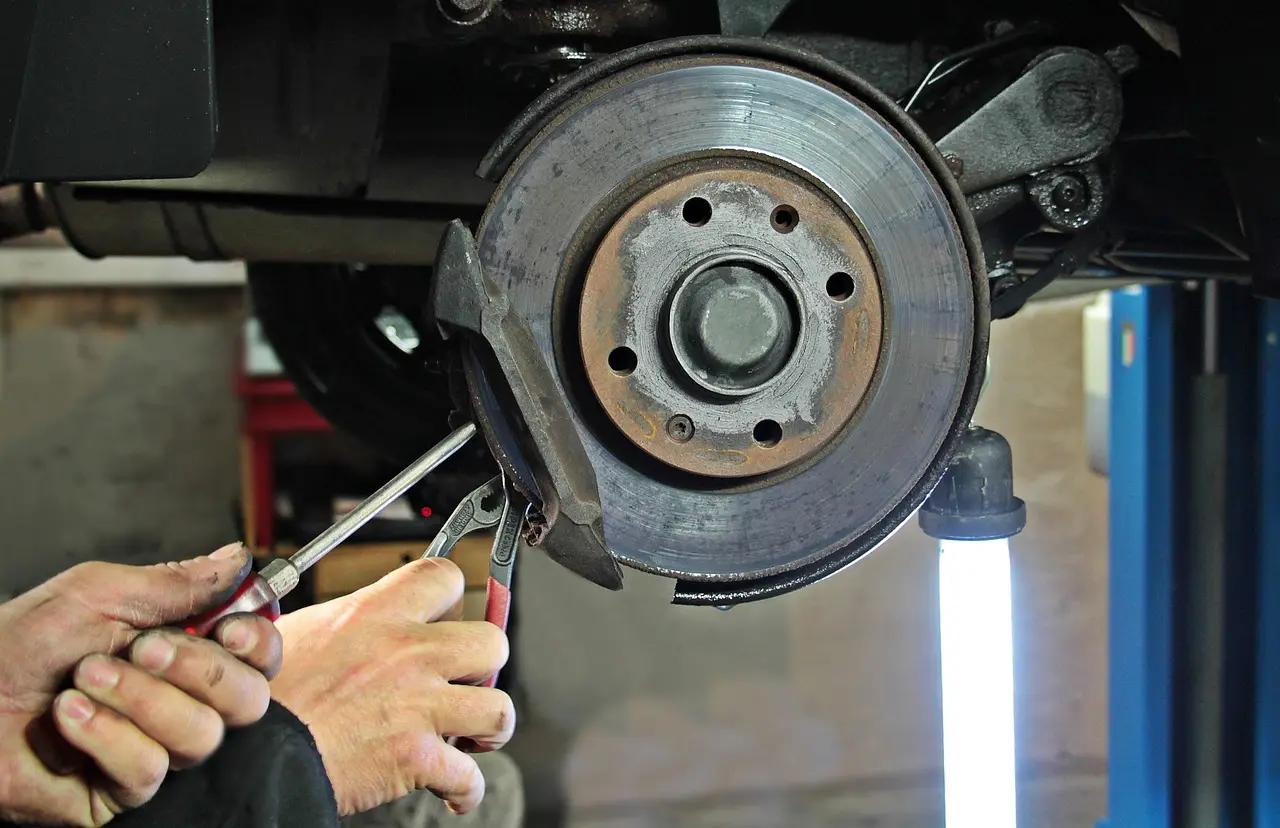
Brakes and suspension need more than a glance. Listen for clunks over bumps, note uneven ride height, and inspect for torn boots, cracked bushings, and wet shocks or struts. Mixed cheap tires and worn dampers often show up together on neglected cars. In real negotiations, this can change the math fast: four aging tires and front brake pulsation may mean a $1,000 to $1,800 first-month spend on an ordinary crossover, which is very different from a clean bill of health.
Interior, electronics, warning lights, and water intrusion
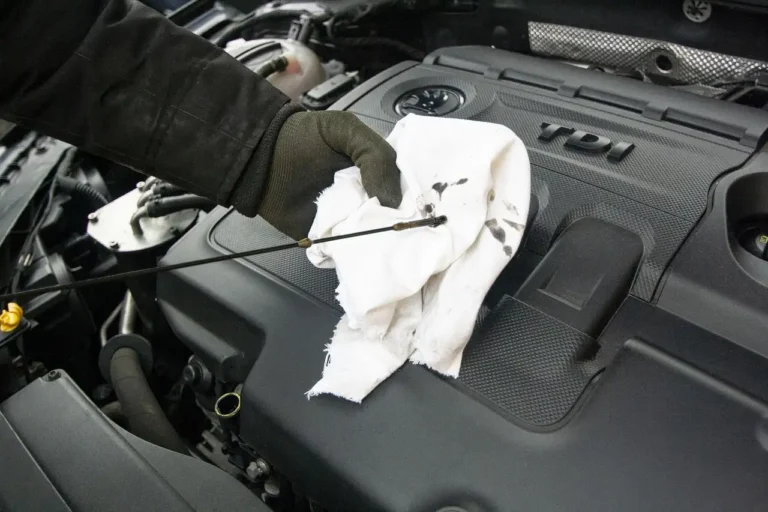
The quick check includes looking for dashboard warning lights. It should also cover power windows, locks, mirrors, seat functions, HVAC, infotainment, cameras, parking sensors, and keyless systems. AAA buyer checklists also emphasize a cold start and idle test, because warning lights and rough idle can appear only at startup.
For flood signs, inspect carpet edges, under-seat rails, trunk lining, spare-tire wells, and electrical connectors for rust, silt, or staining. A musty smell, damp carpet, or unexplained condensation inside lamps should push the car higher on the risk scale. NICB and state agencies both treat water damage and branding history as serious value and safety concerns.
EVs need extra checks: battery-health records if available, charge-port condition, coolant-system evidence, charging behavior, and any battery or drive-system warning state. A generic used-car inspection can miss those details, so confirm the inspector can assess the EV-specific systems.
What should be checked during the test drive and scan?
The test drive and scan should confirm how the car starts, idles, brakes, steers, shifts, and tracks under load, then check what the computers are reporting. You are looking for patterns, not single symptoms: active or pending fault codes, incomplete readiness monitors, repeated transmission faults, shudder, pull, vibration, and noises that return after a short drive cycle.
Cold start, idle quality, and dashboard behavior
Start the car cold if possible. Listen for timing-chain rattle, valvetrain noise, belt chirp, or long cranking. Watch the dash for warning lights that fail to illuminate during bulb check or stay on after startup. Rough idle, hunting idle, or exhaust smoke need explanation.
Braking, steering, shifting, pull, noise, vibration, and shudder
During the drive, check straight-line tracking, steering-centering, brake feel, ABS behavior, transmission shift quality, throttle response, and vibration at city and highway speeds. Shudder under acceleration can point to transmission, driveline, or engine-mount issues. Pulsation under braking often points to rotor variation or hub problems.
Say your short drive reveals a steady steering pull only when braking from 45 mph, while the rest of the drive feels normal. That single change narrows the likely issue toward brakes, alignment, or front suspension rather than a full drivetrain failure, which affects both urgency and negotiating power. In a less favorable scenario, a 2-3 upshift flare plus a returning transmission code after the drive often moves the car from “maybe negotiate” to “leave it.”
OBD scan results, pending codes, and readiness monitors
An OBD scan should check active and pending fault codes, freeze-frame data when available, and readiness-monitor status. FTC and consumer auto guidance support using diagnostic evidence alongside a test drive rather than relying on the dash alone. No active or pending powertrain fault codes is the target, and complete readiness monitors help show the system has not just been reset.
Recently cleared codes matter. If monitors are incomplete and the seller says the battery was disconnected yesterday, treat that as a possible code-clearing pattern until proven otherwise. Repeating transmission faults or engine-misfire codes that return after a short drive move the car quickly toward walk-away territory.
Patterns that move a car from negotiate to walk away
One old code with complete monitors and no symptom may be manageable. A cluster of powertrain codes, incomplete monitors, harsh shifting, and fluid seepage is different. Separate isolated maintenance items from converging evidence of expensive failure.
Inspection findings decision matrix
How the matrix works
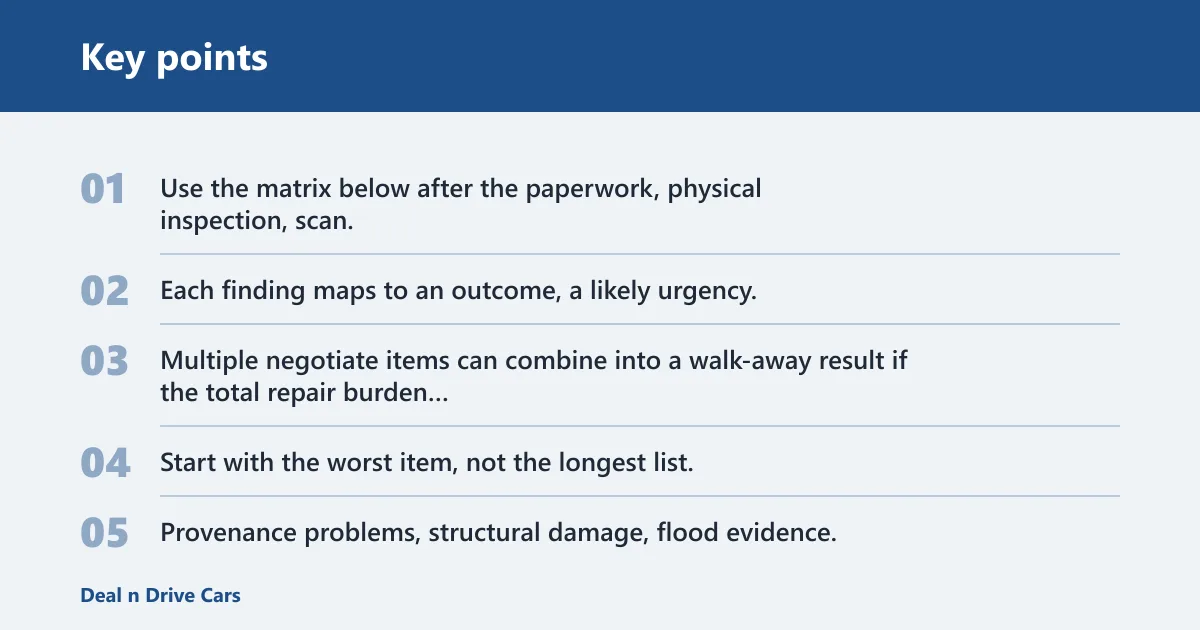
Use the matrix below after the paperwork, physical inspection, scan, and test drive are complete. Each finding maps to an outcome, a likely urgency, and how much bargaining power it gives you. Multiple negotiate items can combine into a walk-away result if the total repair burden gets too close to the asking price.
Twenty common findings and their urgency
| Finding | Outcome | Urgency | Negotiation position |
|---|---|---|---|
| VIN does not match title, registration, or seller ID | WALK AWAY | Immediate | None; provenance failure |
| Salvage, rebuilt, flood, or lemon branding undisclosed | WALK AWAY | Immediate | None unless you intentionally shop branded cars |
| Open recall on a safety-critical item with no repair plan | NEGOTIATE | Soon | Moderate; require fix before sale |
| No service records but car otherwise checks out | NEGOTIATE | Medium-term | Moderate; uncertainty discount |
| Single body panel repainted cleanly, no structural signs | BUY | Low | Low |
| Uneven panel gaps plus overspray and repair marks | NEGOTIATE | Soon | High; crash-repair quality risk |
| Fresh welds or ripples on frame rail or apron | WALK AWAY | Immediate | None; structure concern |
| Structural rust at frame, mounts, or rocker integrity points | WALK AWAY | Immediate | None |
| Surface rust only, no perforation or structural spread | NEGOTIATE | Medium-term | Low to moderate |
| Oil seepage at minor gasket area, no active dripping | NEGOTIATE | Medium-term | Moderate |
| Active transmission or coolant leak | WALK AWAY | Immediate | Very high, but often not worth pursuing |
| Brake fluid leak or severe brake pulsation | WALK AWAY | Immediate | None; safety issue |
| Even tire wear but old tires by DOT age | NEGOTIATE | Soon | Moderate; easy to price |
| Mismatched tires across one axle | NEGOTIATE | Soon | Moderate |
| Sidewall bubble or severe inner-edge wear | NEGOTIATE | Immediate | High; points to tire plus alignment or suspension |
| No active or pending fault codes, monitors complete | BUY | Low | Low |
| Pending engine code with incomplete monitors after recent reset | WALK AWAY | Immediate | None; code-clearing risk |
| Transmission fault code returns after drive cycle | WALK AWAY | Immediate | None |
| ADAS windshield replacement with no calibration proof | NEGOTIATE | Soon | Moderate to high |
| Musty cabin, damp trunk lining, connector corrosion | WALK AWAY | Immediate | None; flood evidence risk |
How to use the matrix in price negotiation
Start with the worst item, not the longest list. Provenance problems, structural damage, flood evidence, and major drivetrain faults end the deal. If the findings sit in the negotiate column, total the urgent repairs first and present those numbers before talking about cosmetic flaws.
If the total of near-term repairs stays comfortably below about 10% of the asking price, a fair discount may keep the car in play. If those repairs crowd or exceed that threshold, the car needs a deeper discount or a polite exit. If negotiation is the next step, a focused approach works better than a vague complaint list, especially when paired with a documented estimate and a plan for how to negotiate a used car price.
When should you walk away from the car?
You should walk away when the risk is legal, structural, flood-related, or drivetrain-heavy enough that no sensible discount fixes it. Title mismatch, seller refusal to allow independent inspection, structural rust, severe crash repair, flood evidence, active brake-fluid leaks, and repeated major transmission or engine faults are clear exit points.
Paperwork and provenance deal-breakers
Walk away for VIN mismatch, undisclosed branded title, unresolved ownership questions, hidden lien issues, or a seller whose ID does not line up with the title. Those are not tune-up problems. They are ownership and fraud risks. State DMV title-transfer guidance and FTC shopping advice both support stopping the transaction when ownership proof is not clear.
Structural, flood, and major drivetrain deal-breakers
Walk away for structural rust, bent or repaired frame sections, airbag deployment evidence without solid repair records, flood signs, heavy coolant or transmission leaks, harsh shifting with confirmed fault codes, or severe engine noise on cold start. These problems tend to stack labor, parts, and uncertainty.
Scenario differences: private seller, dealer, and out-of-state
With a private seller, refusal to allow inspection is a stronger warning because there is usually no return policy, no service department, and less paper trail. With a dealer, do not assume lower risk; verify the same title, history, scan, and inspection items anyway.
For out-of-state deals, use a mobile inspection as a first screen if needed, but reserve final commitment for a report with underbody photos, scan results, and a road-test summary. If the car cannot be cold-started, scanned, or raised, the distance itself becomes added risk. Buyers also tend to overlook the back-end cost of the deal here, so it helps to review used-car financing options and title-transfer steps before sending a deposit.
Frequently asked questions
What is included in a pre purchase inspection for a used car?
A proper inspection includes title and VIN checks, history and recall review, service-record review, body and structural inspection, tire and leak checks, interior and electronics checks, an OBD scan, and a test drive. It does not guarantee future reliability, but it should identify current deal-breakers and near-term repair costs. NHTSA recall lookup, FTC used-car guidance, and AAA buyer advice all support those core steps.
How much does a pre purchase inspection cost for a used car?
Common pricing depends on inspection type and depth. AAA and other consumer auto sources commonly place standard pre-purchase inspections around $150 to $400, while a dealer inspection may be free or lower-cost. Mobile inspections can be similar, but travel, vehicle complexity, and EV or ADAS review can raise the fee.
Is a pre purchase inspection worth it when buying a used car?
It is worth it when the car passes the paperwork stage and would be a strong candidate if the mechanicals check out. The fee is less about generic savings than about screening for structure, flood, transmission, brake, and fraud risks that can outweigh the purchase discount fast.
Can I arrange a pre purchase inspection with a private seller?
Yes, and a cooperative private seller should usually allow it. Set the appointment, confirm cold-start access, and decide whether the car can go to an independent shop or needs a mobile mechanic. If the seller refuses third-party inspection or scan access, that alone may justify walking away.
What should be checked during a test drive before buying a used car?
Check cold start behavior, idle quality, warning-light behavior, acceleration, steering-centering, braking feel, transmission shift quality, vibration, pull, shudder, and unusual noises. Pair the drive with an OBD scan so you can compare what the car does on the road with active codes, pending codes, and monitor status.
What is the best type of inspector for a used car pre purchase inspection?
For most used-car buyers, an independent third-party mechanic offers the best mix of objectivity and depth. A mobile mechanic is useful for convenience or distance, but may lack a lift or deeper scan gear. A dealer inspection can help, yet it should not replace an independent opinion on the seller’s car.
Can a clean vehicle history report replace a pre purchase inspection?
No. A clean history report does not confirm current mechanical condition or repair quality. It may miss unreported crash work, hidden corrosion, flood residue, worn suspension parts, or recently cleared fault codes. The safest process is to use the history report as a screen and the inspection as the deciding tool.
Should open recalls stop the sale?
Safety recalls should be checked by VIN through NHTSA before purchase, and unresolved recalls should be addressed before you treat the car as a routine buy. An open recall is not always an automatic walk-away item, but a safety-critical recall with no repair plan should at least pause the deal until the seller provides a documented fix.
What paperwork should match before money changes hands?
The VIN on the car should match the title and registration, the seller’s ID should make sense in relation to the title, and any lien payoff process should be clear before final payment. If you need the transaction side mapped out, reviewing a used-car paperwork checklist before the final meeting helps prevent last-minute title mistakes.
A strong used-car decision usually looks simple in the end: the title checks out, the seller cooperates, the recall search is clear or fixable, the inspection finds no structural or flood evidence, the scan is clean, and the repair total still leaves room in the deal. If any one of those pillars fails badly, walking away is often the smartest savings move available.