
How to Get Preapproved for a Used Car Loan
Get preapproved for a used car loan by checking your credit, collecting income and identity documents, and submitting applications to several lenders for a loan amount based on the car’s out-the-door price, not the sticker price alone. Skip that step, and you can come up short on taxes, fees, or dealer add-ons, or end up with a payment that strains your budget. This guide shows how to size the loan, what to bring, and how to compare offers before you shop.
What you’ll need
- Full legal name, Social Security number, and date of birth
- Recent pay stubs, W-2s, 1099s, or other income records
- Housing payment details such as rent or mortgage amount
- Target vehicle price and an estimate of taxes, title, registration, and dealer fees
- Down payment amount
- Trade-in title details and loan payoff balance, if you have one
- Desired loan term and monthly payment ceiling
- Questions about minimum and maximum vehicle age, mileage, and title status
How do you get preapproved for a used car loan?

Start by checking your credit, then collect your identity, income, housing, and vehicle details and submit applications to a few lenders. Used-car preapproval is a conditional approval with an estimated loan amount, interest rate, and monthly payment, and it often requires a hard credit inquiry.
Prequalification is different. It usually gives you an estimate of loan terms and usually does not require a hard credit check. That makes it useful for early comparison, but it is not the same as preapproval.
- Check your credit first. Review your scores and credit report for recent late payments, high balances, or errors that could affect your rate or approval amount. A hard inquiry may slightly lower scores, so it helps to know where you stand before you apply.
- Build the full price target. Use the car’s out-the-door price, which includes taxes, title, registration, and dealer fees. A sticker price alone can understate the amount you actually need.
- Gather your documents. Have your full name, Social Security number, date of birth, income details, housing payment, and desired loan details ready. Many lenders also ask for employer and residence information.
- Submit a few applications. Experian recommends applying with a few lenders. Compare a bank, a credit union, and an online lender so you can see different term, fee, and vehicle-limit rules.
- Review the conditional offer. Check the estimated loan amount, estimated interest rate, and estimated monthly payment. Confirm whether the approval covers taxes and fees or only the vehicle price.
Picture a buyer targeting a $19,000 used SUV. If taxes, title, registration, and dealer fees add $1,900, the loan need is closer to the out-the-door total minus the down payment and any trade equity, not $19,000 alone.
What documents do you need for used car loan preapproval?
Lenders usually want identity, income, residence, and loan-request details. Be ready to provide the basics up front so the application can be reviewed quickly and so the lender can calculate a realistic offer for your budget and the car you plan to buy.
Use this preapproval worksheet
| Input to collect | Example entry | Why it matters |
|---|---|---|
| Target vehicle price | $18,500 | Sets the starting point for the loan request |
| Estimated taxes and fees | $1,650 | Raises the amount needed beyond the sticker price |
| Down payment | $2,500 | Lowers the amount borrowed |
| Trade-in value | $6,000 | Can reduce the cash needed at closing |
| Payoff amount on trade | $4,900 | Shows whether equity or negative equity affects the deal |
| Desired term | 60 months | Changes the payment and total interest |
| Monthly payment ceiling | $425 | Helps keep the loan within budget |
| Income | $4,200 take-home per month | Lets the lender judge affordability |
| Housing payment | $1,300 rent | Part of the lender’s affordability review |
| Vehicle age, mileage, and title questions | 2017 model, 82,000 miles, clean title | Helps you avoid vehicles the lender will not finance |
How do you set a realistic used-car budget?
Start with your take-home pay, then set a monthly payment ceiling that fits the rest of your bills. A good affordability rule is 10% to 15% of take-home pay, but you still need to account for taxes, title, registration, fees, and the loan term you choose.
Use take-home pay to set a payment ceiling
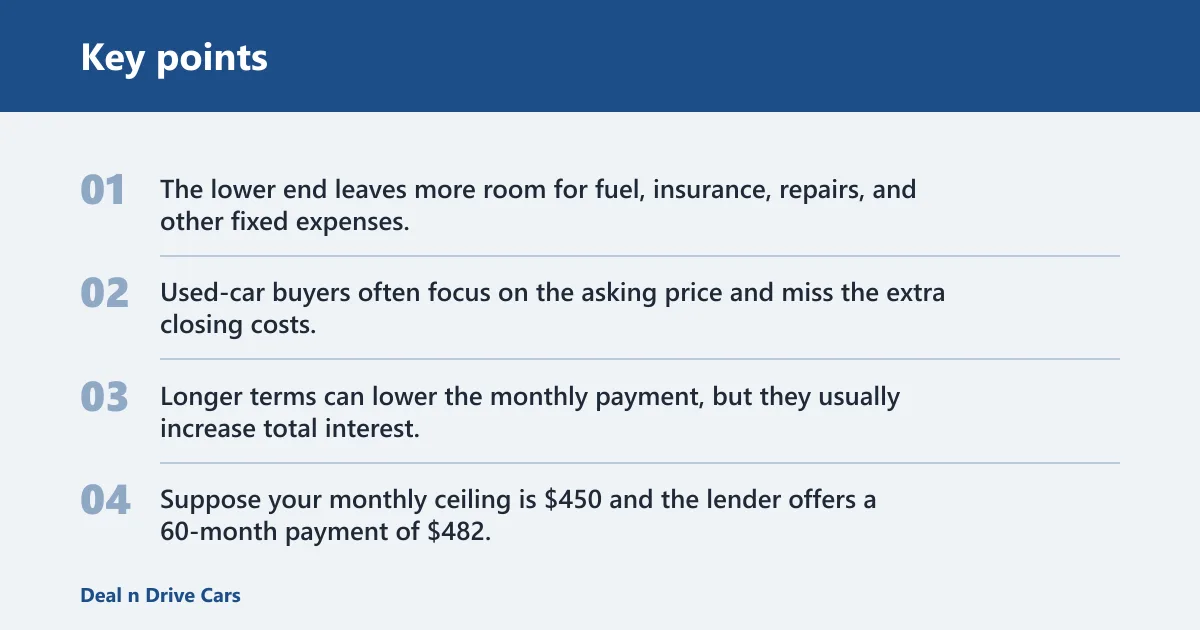
If take-home pay is about $4,000 a month, a 10% to 15% guideline points to about $400 to $600 for the car payment and related auto loan cost. The lower end leaves more room for fuel, insurance, repairs, and other fixed expenses.
Add taxes, title, registration, and dealer fees
Used-car buyers often focus on the asking price and miss the extra closing costs. Those charges are part of the out-the-door amount, and the lender may cap the loan based on that total or on the vehicle’s book value, whichever is lower.
Choose a term that fits the payment
Longer terms can lower the monthly payment, but they usually increase total interest. If the payment only works at 72 months, compare that result with a higher down payment or a lower-priced car before you sign.
Suppose your monthly ceiling is $450 and the lender offers a 60-month payment of $482. That is a sign to adjust the target price, add cash down, or shorten the shopping list before you get to the dealer.
What should you compare between offers?
Compare the rate and the rest of the loan terms. Look at the estimated monthly payment, loan term, total cost over the term, fees, and any limits on vehicle age, mileage, or title status. A low APR can still be a poor fit if the lender will not finance the car you want.
APR and estimated monthly payment
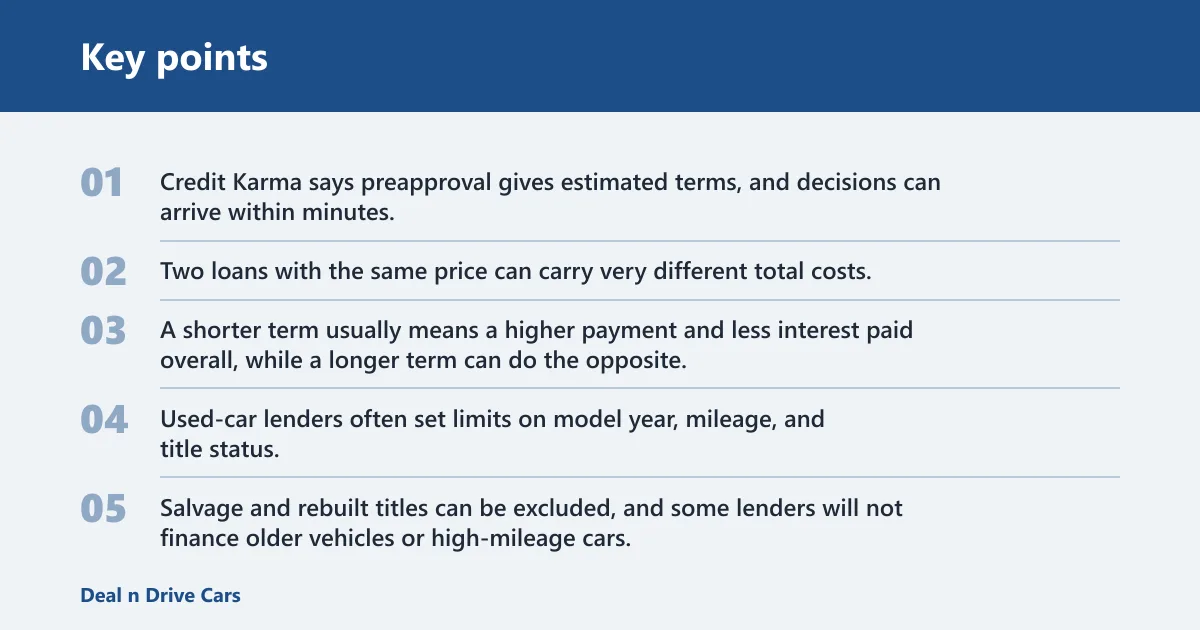
Credit Karma says preapproval gives estimated terms, and decisions can arrive within minutes. The payment estimate matters because it shows whether the loan fits your monthly budget after taxes, fees, and any trade payoff are included.
Loan term and total interest
Two loans with the same price can carry very different total costs. A shorter term usually means a higher payment and less interest paid overall, while a longer term can do the opposite.
Vehicle age, mileage, and title limits
Used-car lenders often set limits on model year, mileage, and title status. Salvage and rebuilt titles can be excluded, and some lenders will not finance older vehicles or high-mileage cars. Ask about those rules before you shop for a specific unit.
Trade-in treatment and payoff handling
If you have a trade-in, ask whether the lender wants the net equity amount or the full payoff figure. Positive equity can reduce the amount borrowed. Negative equity increases it, and rolling it into a new loan can push the payment beyond your target.
How many lenders should you apply to for preapproval?
Apply to a few lenders rather than one. That gives you a bank option, a credit union option, and an online option to compare against dealer financing. The goal is not to collect as many approvals as possible; it is to compare offers without wasting inquiries.
- Pick three starting points. A bank, a credit union, and one online lender are enough for many shoppers. That mix usually shows whether one lender is stricter on age, mileage, or title rules.
- Submit the same numbers. Use the same target price, down payment, term, and trade payoff with each lender. Matching inputs makes the offers easier to compare.
- Keep the timing tight. Rate-shop in a short window when possible so the credit impact is limited to the shopping period instead of spread out over weeks.
When comparing offers, use the same vehicle assumptions. A lender that approves a 2018 sedan with 70,000 miles may reject a 2015 SUV with 120,000 miles or a rebuilt title, even if the payment looks attractive on paper.
How do you keep credit inquiries under control?
Preapproval usually requires a hard credit inquiry, and that may slightly lower scores. The practical move is to keep your applications grouped together and avoid repeated hard pulls over a long stretch. If your credit needs repair, pause and fix the main issues first.
- Apply within one window. Finish your lender applications over a few days, not a few months. That helps keep rate-shopping activity grouped together.
- Use prequalification first if needed. Prequalification usually does not require a hard credit check, so it can help you screen lenders before you submit a formal preapproval request.
- Wait on new applications. If one lender’s offer is clearly outside your budget, stop and reassess instead of piling on more inquiries with the same weak profile.
A common first-timer mistake is to chase several quotes over several weeks. The offers become harder to compare, and the credit impact can stack up without improving the deal.
Common mistakes
The biggest error is treating the approval amount like the total you should spend. Another is ignoring taxes, title, registration, and dealer fees. Buyers also get tripped up by trade-ins with unpaid loans, or by shopping cars that fail a lender’s year, mileage, or title rules.
- Using sticker price instead of out-the-door price. Build your loan target around the full closing total.
- Skipping trade payoff math. Negative equity can turn a comfortable payment into an expensive one.
- Applying without checking vehicle limits. Ask about minimum and maximum model year, mileage caps, and title status before you visit the lot.
- Comparing only APR. Compare payment, term, fees, and vehicle restrictions together.
- Spreading applications too far apart. Keep inquiries grouped so rate shopping stays organized.
Preapproval can improve negotiating power because you already know your financing range. That is useful only if you keep the dealer from resetting the conversation around a higher payment or a longer term than you planned.
Should you get preapproved before shopping for a used car?
Yes. Getting preapproved before you shop gives you a firm starting point for the price range, helps you screen out cars that exceed lender rules, and makes it easier to compare dealer financing with outside offers. It also keeps the conversation focused on the actual out-the-door amount.
Use the approval as a ceiling, not a target. If the lender says yes to more than you planned, stick with your payment limit unless the car and the budget both justify moving higher.
Frequently asked questions
Does getting preapproved hurt my credit score?
Preapproval typically requires a hard credit check, and that may slightly lower your score. Keep applications grouped into a short shopping window and avoid repeated requests over time. Prequalification is different because it usually does not require a hard credit check.
How long does used car loan preapproval take?
Some lenders give decisions within minutes, while others need longer to review income or trade-in details. Timing depends on the lender and whether your documents are complete. Having your information ready usually shortens the process.
Can I get preapproved for a used car loan with bad credit?
Often yes, but the offer may come with a higher rate, a lower amount, or stricter vehicle limits. Focus on lenders that work with your credit range, and be ready to make a larger down payment or choose a lower-priced car.
What should I compare between preapproval offers?
Compare the estimated APR, monthly payment, loan term, fees, and any year, mileage, or title restrictions. Also check whether the lender’s amount covers taxes and fees or only the vehicle price. That difference can change the real cash you need at closing.