What Documents Are Needed for Auto Loan Preapproval?
For auto loan preapproval, start with a government ID, Social Security number or ITIN, proof of income, proof of address, and basic employment and housing details. Missing or mismatched documents can delay approval, lower your rate, or force a second application. This guide breaks the process into what you need to start, what a lender may ask for next, and what the dealer usually needs before funding.
What documents do you need to start?
Start with identity, contact, income, and basic vehicle information. Most lenders can begin a preapproval review with a government-issued ID, a Social Security number or ITIN, current address, employer name, job status, and an estimate of the vehicle you want, including price, model year, and whether it is new or used.
Basic personal details lenders ask
The first application stage usually asks for legal name, date of birth, address, phone number, and email. A lender may also ask if you rent or own, how long you have lived at your current address, and if you have other loans or credit accounts. Those details help the lender match your application to your credit file and contact you if anything needs verification.
Vehicle price and type
Even at preapproval, lenders often want a target vehicle range. They may ask for an estimated price, model year, and if you are shopping for new or used. Preapproval can apply to new or used cars, and monthly payment and APR can vary by down payment, loan-to-value percentage, and vehicle model year.
What lenders may ask for next
After the initial review, the lender may ask for proof of income, employment details, and debt information. That second round is where document requests often get more specific. A credit union may ask for the same basics as a bank, while an online lender may ask you to upload clear images or PDFs before it finishes the review.
Auto loan document matrix
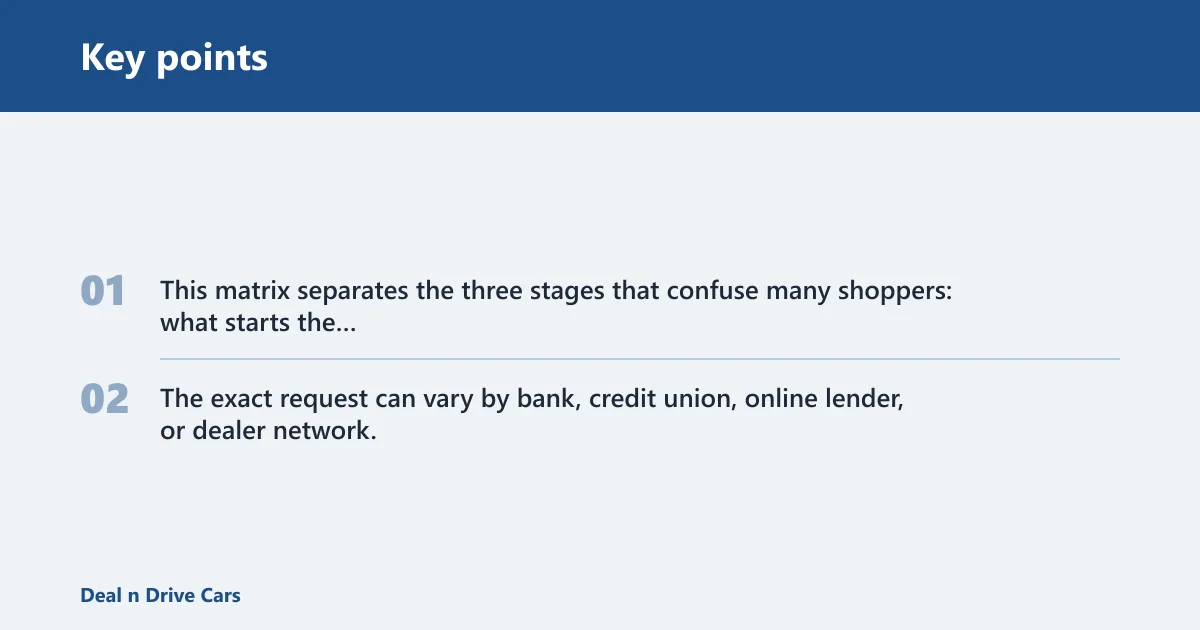
This matrix separates the three stages that confuse many shoppers: what starts the preapproval, what a lender may verify next, and what the dealer usually needs before funding. The exact request can vary by bank, credit union, online lender, or dealer network, so treat this as a practical checklist, not a universal rule.
| Document | When it is needed | Who typically asks for it |
|---|---|---|
| Government-issued ID, such as a driver’s license or other photo ID | Start; verification | Bank, credit union, online lender, dealer |
| Social Security number or ITIN | Start | Bank, credit union, online lender |
| Proof of income, such as pay stubs or W-2s | Verification | Bank, credit union, online lender |
| Tax returns or profit-and-loss records for self-employed borrowers | Verification | Bank, credit union, online lender |
| Employer name, job status, and length of employment | Start; verification | Bank, credit union, online lender |
| Proof of residence, such as a utility bill, lease, or mortgage statement | Start; verification | Bank, credit union, online lender |
| Alternative address proof, such as a bank statement or insurance statement when no utility bill is in your name | Verification | Bank, credit union, online lender |
| Monthly debt payments and open credit obligations | Verification | Bank, credit union, online lender |
| Down payment amount or estimated cash contribution | Start; verification | Bank, credit union, online lender, dealer |
| Vehicle details: estimated price, model year, new or used | Start; verification | Bank, credit union, online lender, dealer |
| Proof of insurance | Funding | Dealer, sometimes lender |
| Final purchase contract and VIN | Funding | Dealer |
| Personal references, when a dealer network requests them | Verification; funding | Dealer network |
| Co-signer ID, income, residence, and debt documents | Start; verification | Bank, credit union, online lender, dealer |
Do you need proof of income for auto loan preapproval?

Yes, often at some point in the process. A lender may start with your stated income, then ask for proof of income before final approval or before funding. Pay stubs work for many W-2 employees. W-2s and tax returns are common supporting documents, and self-employed borrowers are often asked for tax returns or other business income records.
Pay stubs, W-2s, and tax returns
For many salaried or hourly borrowers, the cleanest document is a recent pay stub. Lenders can use it to confirm pay frequency, employer name, and current earnings. W-2s help show annual wages, while tax returns give a broader view of income. If your pay changed recently, a lender may want more than one source.
Self-employed income documents
Self-employed borrowers may need tax returns, Schedule C details, bank statements, or profit-and-loss records. That is because a single pay stub does not exist for many independent workers. Suppose your income comes from contract work and seasonal jobs. A lender may accept the tax return first, then ask for current bank statements to verify cash flow.
What to send if your income changed recently
If you changed jobs, moved from part-time to full-time work, or started a new role, send the most current proof available and be ready for a follow-up request. A lender may want a recent offer letter, a first pay stub from the new employer, or updated employment verification. Recent changes matter because they affect repayment stability.
A common first-timer mistake is sending only one old pay stub when the lender asked for current proof. If the pay date has changed, or the employer name on the stub does not match the application, the lender may pause the file until the details line up.
Does preapproval require proof of address?
Often, yes. A lender may ask for proof of residence during preapproval or during verification, especially if your application address and credit file do not match. A utility bill, lease, or mortgage statement is common. If nothing is in your name, some lenders will accept an alternative document, but others will want a second check.
Utility bill and common alternatives
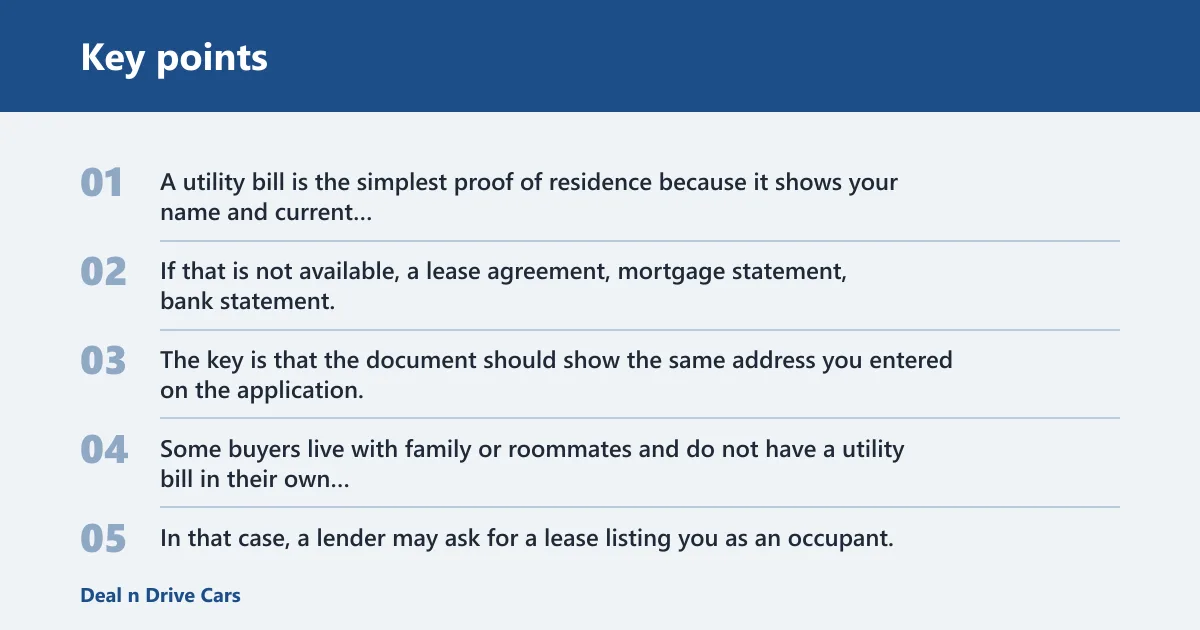
A utility bill is the simplest proof of residence because it shows your name and current address together. If that is not available, a lease agreement, mortgage statement, bank statement, or insurance statement may work, depending on the lender. The key is that the document should show the same address you entered on the application.
What to do if nothing is in your name
Some buyers live with family or roommates and do not have a utility bill in their own name. In that case, a lender may ask for a lease listing you as an occupant, a government mail piece sent to your address, or another supporting document. If you recently moved, bring both the new address proof and the prior address history if asked.
Residence checks by lender type
Banks and credit unions often verify address details during underwriting. Online lenders may ask you to upload the document after the initial application. Dealer networks may also check address information again before funding. The request is not always the same across lenders, so a missing utility bill does not always block preapproval, but it can slow verification.
What changes with a co-signer?
A co-signer adds a second applicant to the file, so the lender may ask for identity, income, address, and debt documents from both people. That means the co-signer may need a government ID, proof of income, proof of residence, and monthly debt information. The lender uses both credit profiles and both repayment pictures.
Co-signer ID and income documents
The co-signer’s documents are usually the same type as the primary borrower’s. A lender may want a photo ID, recent pay stubs or tax returns, and current employer information. If the co-signer is retired, the lender may ask for pension, retirement account, or benefit statements instead of payroll records. The request depends on how that person earns income.
Co-signer address and debt information
The co-signer may also need to prove residence and list monthly debt payments. That helps the lender calculate debt-to-income ratio for both applicants. Picture a buyer with thin credit history and a parent co-signer. The lender may ask the parent for a utility bill and a recent statement showing car payments, credit card minimums, or student loan payments.
How a lender may verify both applicants
Some lenders verify the primary borrower first and then move to the co-signer. Others review both at the same time. If the co-signer’s documents are incomplete, the application may stall even when the main borrower is ready. The safest move is to gather the same core items for both applicants before submitting the file.
What the dealer usually needs before funding
Dealer funding usually happens after preapproval, not before. At that stage, the dealer may ask for proof of insurance, final vehicle details, and any items tied to the contract. Auto Credit Express says customers may need a valid driver’s license at the dealership, and proof of income, proof of insurance, and personal references may also be requested there.
Proof of insurance
Do not treat insurance as a universal preapproval requirement. It is often a dealership closing item. The dealer may want proof of insurance before you drive away, especially once the final VIN is set. That request can come after preapproval because insurance applies to the specific car, not just the loan estimate.
Final vehicle details
The dealer usually needs the exact vehicle tied to the contract, including the VIN, trim, purchase price, and whether the car is new or used. That final step matters because terms can change when the actual vehicle differs from the one used in preapproval. U.S. Bank notes that monthly payment and APR vary by down payment, loan-to-value percentage, and vehicle model year.
Dealer-specific items, including references
Some dealer networks request personal references, but that is not standard across all lenders. Treat it as a dealer-flow item, not a universal preapproval document. If asked, give names and contact details that are accurate and current. A missing reference list does not always stop preapproval, but it can hold up the closing file with certain dealers.
Frequently asked questions
What documents do I need for auto loan preapproval?
Start with a government-issued ID, your Social Security number or ITIN, proof of residence, proof of income, employment details, and an estimate of the car you want. Some lenders ask for debt information and a down payment estimate right away. Others verify those items after the first review.
Will I need a driver’s license for preapproval?
Many lenders ask for a government-issued ID during preapproval, and a valid driver’s license is a common form. The same source says customers may need a valid driver’s license at the dealership. If you do not have one, another government photo ID may work, but the lender may set different rules.
Does auto loan preapproval require proof of address?
Frequently, yes. A utility bill, lease, mortgage statement, or similar document can help confirm your current address. If nothing is in your name, the lender may accept an alternative document, but the exact rule depends on the bank, credit union, online lender, or dealer network.
Can I get preapproved with just basic personal information?
Sometimes, yes for the first screen. A lender may start with your name, contact details, housing status, employer information, and desired vehicle range. That does not mean the file is finished. Income, address, and debt details are often requested before final approval or funding.
What income details do lenders ask for on an auto loan application?
Lenders usually ask for employer name, job title or status, length of employment, income amount, and pay frequency. They may also ask if income is salary, hourly, commission, retirement, or self-employed. If the numbers do not line up with your documents, expect a follow-up request.
Do I need insurance before auto loan preapproval?
Usually no. Proof of insurance is more often a dealership closing item than an early preapproval requirement. The same source says proof of insurance may be needed at the dealership. The dealer may want the policy bound before funding the loan and releasing the vehicle.
What extra documents are needed at the dealership after preapproval?
At the dealership, the most common additions are proof of insurance, the final purchase contract, and the exact vehicle information. Some dealer networks may also ask for a driver’s license, proof of income, and personal references. Those requests are more about final funding than the original preapproval decision.