Bad Credit Auto Loans: How to Get Approved and Pay Less
Getting preapproved before shopping, keeping the loan to about 60 months or less, and putting about 10% down if possible are commonly used steps that may improve approval odds and help reduce total interest on a bad-credit auto loan. Miss those basics, and a high APR, long term, and dealer add-ons can add thousands to the bill and increase the odds of another missed payment or repossession. This guide shows you how to tighten up your application, compare lenders, choose the lowest-cost loan structure that still works, and plan the right time to refinance.
Treat bad-credit financing as two separate calls. First, build the strongest approval file you can with score, income, debt-to-income ratio, vehicle choice, and cash down. Second, once approval is on the table, cut total cost by controlling APR, term, amount financed, and refinance timing.
Those choices overlap, but they do different jobs. A 72-month term may help approval by lowering the monthly payment, though it can also increase total interest. A larger down payment can improve approval odds and pricing at the same time. The key is knowing which lever helps you get approved, and which one makes that approval cheaper.
What credit score do you need for a bad credit car loan?

There is no single minimum score for approval. Auto lenders approve and price by credit tier, income, debt load, vehicle risk, and down payment, so two borrowers with the same score can get very different results. Experian tracks auto-loan originations down to a 300 credit score, which shows financing exists far below prime, though usually with steep rates and tighter terms.
How the score tiers usually work
Auto lending usually groups borrowers on a 300-850 scale into five broad bands: deep subprime, subprime, near prime, prime, and superprime. Lenders may use a FICO Auto Score, a base FICO score, VantageScore, or an in-house model, so the exact cutoffs can shift a bit by lender.
- Deep subprime: roughly below 500
- Subprime: roughly 500-600
- Near prime: roughly 601-660
- Prime: roughly 661-780
- Superprime: roughly above 780
The practical checkpoints matter more than the labels. Around 500, many borrowers are limited to subprime specialists, some dealers, and a short list of banks or credit unions. Around 600, more lenders may open up, but pricing is still usually expensive. Around 660, the file starts moving out of the riskier near-prime range. Around 780, borrowers generally reach top-tier pricing.
What APR should you expect by tier?
Used-car rates are usually higher than new-car rates for the same borrower because the vehicle itself is riskier collateral: older, worth less, and more likely to create loan-to-value problems. Rate averages also change by lender type, mileage, model year, and the amount financed.
For used cars, one cited table lists 21.77% APR for deep subprime and 19.42% for subprime. NerdWallet cites used-car averages of 21.62% for deep subprime and 19.10% for subprime. Auto Credit Express says lower-credit borrowers may pay rates between 9% and 22%. Below the mid-600s, NerdWallet says lenders scrutinize borrowers more closely, which lines up with how approval and pricing tighten.
For new cars, the pattern is the same even when the exact rate is lower: superprime and prime borrowers usually get the best rates, near-prime pays more, and subprime or deep subprime pays the most. New-car bad-credit loans can still be expensive, but the APR is often lower than on a used-car loan because the collateral is newer and easier for the lender to value.
How do you get approved for a bad credit auto loan?
Approval usually improves when you show steady income, ask for a payment that fits your debt-to-income ratio, choose a lender-friendly vehicle, and bring cash down. Build the file before you apply: organize income proof, reduce the amount financed, and avoid applying for vehicles that stretch your budget or fall outside lender age and mileage rules.
Build the cleanest application first
Lenders judge more than score. They want income that is steady enough to support the payment, housing and identity information they can verify, and a vehicle that fits their collateral rules. A thin file can still get approved, but a messy file gets declined faster.
Debt-to-income ratio is the share of gross monthly income already committed to debt payments. Lenders use it to decide whether the new car payment fits. Exact caps vary, but the core question is simple: after existing debt, rent or mortgage, and other obligations, does the requested car payment still work on paper?
Proof of income matters because documented earnings can offset a weak score. Bring recent pay stubs, year-to-date earnings, and evidence of steady employment income instead of relying on a verbal pay estimate. If overtime or commission is irregular, expect lenders to discount it or ask for a longer income history.
Match the car and loan amount to the file
Vehicle choice affects approval more than many shoppers expect. A smaller loan amount lowers lender risk. Mainstream models with cleaner history reports are easier to finance than older luxury cars, high-mileage trucks, or vehicles with salvage history.
Suppose your gross monthly income is $3,800 and you are choosing between a $24,000 SUV and an $18,000 sedan. If the lender is already uneasy about your score, the lower amount financed can be the difference between approval and denial, even before rate shopping starts.
Down payment also works as a compensating factor. For lower-credit borrowers, a down payment of about 10% to 20% often improves approval odds and pricing because it lowers the loan-to-value ratio and monthly payment. Zero-down options do exist for bad-credit buyers, according to Auto Credit Express, and Crediful lists lender options with minimum scores of 400 and at least one lender with down payment as little as $0 or $500. But 0 down usually means higher risk of negative equity and more interest paid.
What if there is a repossession or recent lates?
A prior repossession is a real underwriting problem, not a minor blemish. Approval odds depend on how recent it was, whether there are open late payments now, and whether the rest of the file shows recovery.
Compensating factors that matter most are straightforward:
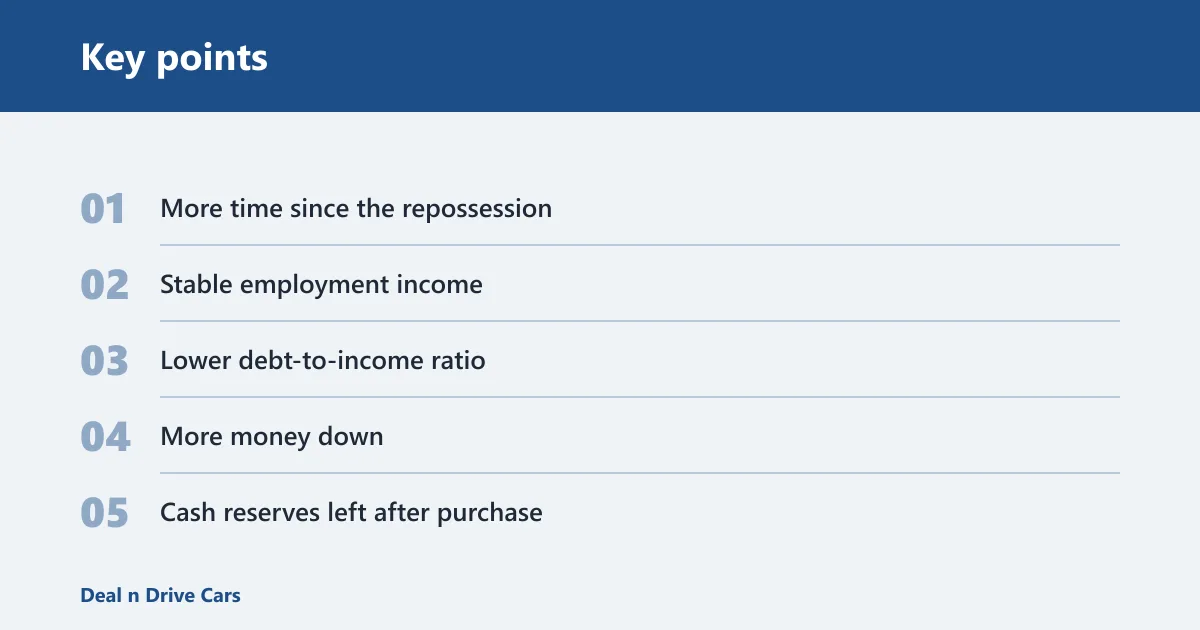
- More time since the repossession
- Stable employment income
- Lower debt-to-income ratio
- More money down
- Cash reserves left after purchase
- A cheaper, lender-friendly vehicle
Picture a borrower with a repo two years ago, steady payroll income, and 15% down on a modest used sedan. That file is materially different from a borrower with a repo six months ago, no down payment, and a request for a high-mileage SUV.
Which lenders should you check first?
Start where approval odds and pricing are most likely to meet in the middle. For many shoppers in the 550-660 range, that means credit unions and online prequalification first, then dealer-arranged financing for comparison. Buy-here-pay-here is usually the last resort because it often carries the highest cost and weaker credit-building value.
Credit unions
Credit unions are often a strong option for used-car buyers in the 550-660 band. They can price lower than many subprime dealers, and some membership-based lenders are more flexible on thin files when income and down payment are solid.
That does not mean every credit union will be cheapest. Membership rules, collateral limits, vehicle age caps, and mileage caps can rule out some cars. Still, for borrowers who are close to near-prime or upper subprime, credit unions are often the first place to check.
Online loan marketplaces
Online marketplaces are useful because many offer soft-pull prequalification. That lets you compare likely terms from multiple lenders without walking into a dealership blind or triggering the same kind of hard-credit application right away.
Soft-pull offers are not final approvals, but they give you a benchmark. Note the APR, term, max loan amount, estimated down payment, and any lender fees. Then compare those numbers against dealer financing instead of focusing only on the monthly payment.
Dealer-arranged financing, banks, and buy-here-pay-here
Dealer-arranged financing can work when a dealer has access to lenders you cannot easily reach on your own. It can also cost more if the rate is marked up or if the deal is packed with GAP, service contracts, or other add-ons that inflate the amount financed.
Banks can be worth checking, but many are less flexible than credit unions for weaker files. Captive lenders tied to a new-car brand may offer special programs, though those often favor stronger credit.
Buy-here-pay-here stores use in-house financing and may approve buyers whom standard lenders decline. That is why they exist. They are also often the highest-cost route, and some do not report to all three credit bureaus, which weakens the credit-rebuilding benefit of making payments on time.
What documents do lenders ask for?
Lenders usually want proof that you are who you say you are, live where you say you live, and earn enough to support the payment. The core package is proof of income, identity, residence, and insurance, with extra vehicle details or references added when the file is weaker or the loan is a refinance.
Income and employment proof
Bring recent pay stubs, year-to-date earnings, and any lender-requested proof of steady employment income. If pay varies, be ready for extra documentation such as bank statements or a longer pay history.
Self-employed borrowers usually face more scrutiny because income is harder to standardize. Expect requests for tax returns, bank statements, or both. The lower the score, the more carefully lenders tend to verify income.
Identity, residence, insurance, and vehicle information
- Driver’s license or other government ID
- Proof of residence, such as a utility bill or lease
- Proof of insurance, sometimes before funding
- References, if requested
- Vehicle details for direct lending or refinance, such as VIN, mileage, year, make, model, and payoff information
A common first-timer mistake is showing up with only a driver’s license and a screenshot of pay. If the lender then asks for year-to-date income and proof of residence, the deal slows down or falls apart while the car remains on the lot.
How can you pay less on a bad credit auto loan?
You pay less by attacking total cost in this order: lower the amount financed, keep the term tight, add down payment, compare lender offers by APR and fees together, and strip out add-ons that do not justify their price. A lower payment alone does not mean a cheaper loan.
Control the amount financed before rate shopping
The cheapest dollar of interest is the one you never borrow. A lower vehicle price, more down payment, no overpriced add-ons, and a realistic trade-in value all reduce the amount financed before APR ever enters the discussion.
That matters because every extra financed dollar is charged interest for the full term. GAP, service contracts, theft products, and dealer accessories may be worth considering in some cases, but they should be priced separately and judged one by one, not hidden inside a monthly payment quote.
Choose term by total interest, not payment alone
The same source says 72 months is average for lower-credit borrowers. That longer term can help approval because the monthly payment drops. It also tends to raise total interest, keep the loan underwater longer, and make later refinancing harder if the vehicle depreciates quickly.
If the budget allows it, 60 months or less is usually the better target. The monthly payment is higher than at 72 months, but the total interest is often much lower. For many bad-credit buyers, that trade is worth making.
Use down payment strategically
A 10% to 20% down payment often improves the file twice: it lowers lender risk and cuts the amount financed. Zero-down offers can help if cash is tight and approval is still possible, but they are not cost-neutral.
With 0 down, more of the purchase price and fees are financed, so interest starts on a larger balance. That increases negative-equity risk if the car depreciates faster than the loan balance falls.
Compare the full offer, not one field
When comparing offers, line up these fields side by side:
- APR
- Term length
- Amount financed
- Required down payment
- Lender fees
- GAP and service-contract cost
- Any dealer add-ons rolled into the loan
- Prepayment penalty, if any
The best offer is the one with the lowest workable total cost, not the smallest monthly payment on paper.
Loan cost worksheet
Use this worksheet in two passes. First, test whether the deal is likely to get approved: score tier, income, DTI, vehicle price, and down payment. Second, test whether the structure is cheap enough to keep: APR, term, amount financed, fees, and a refinance path if the starting rate is high.
Bad credit auto loans worksheet
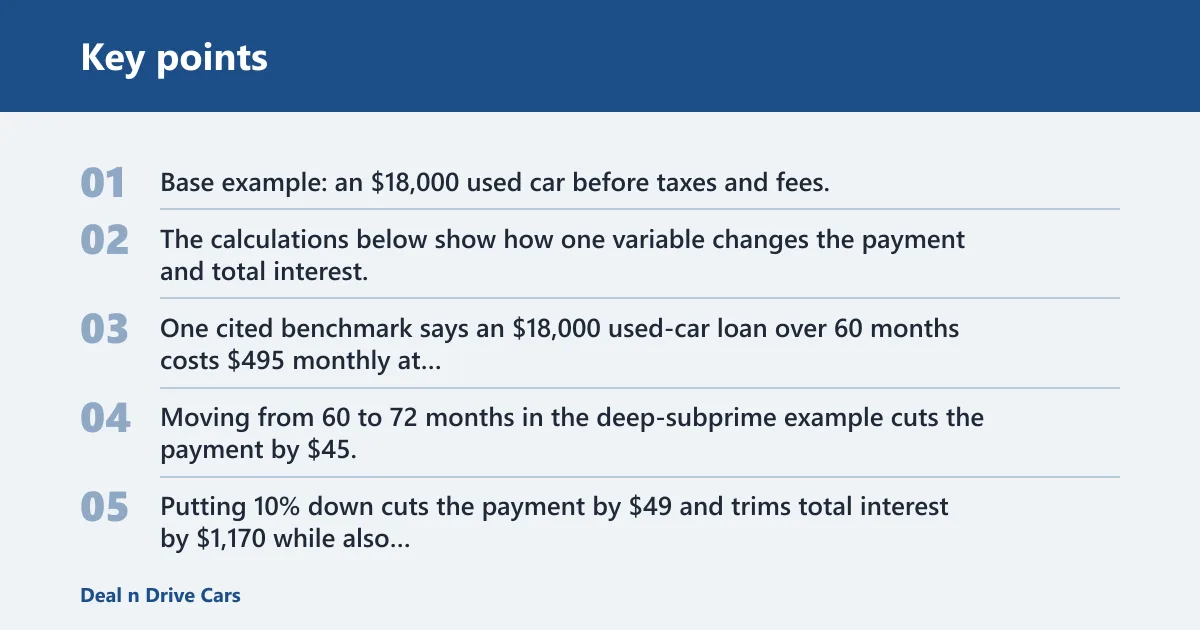
Base example: an $18,000 used car before taxes and fees. The calculations below show how one variable changes the payment and total interest. One cited benchmark says an $18,000 used-car loan over 60 months costs $495 monthly at deep-subprime pricing, using a used-car APR of 21.77%.
| Scenario | Amount financed | APR | Term | Monthly payment | Total interest |
|---|---|---|---|---|---|
| Deep subprime benchmark | $18,000 | 21.77% | 60 months | $495 | $11,700 |
| Same loan, shorter term | $18,000 | 21.77% | 48 months | $565 | $9,120 |
| Same loan, longer term | $18,000 | 21.77% | 72 months | $450 | $14,400 |
| Deep subprime with 10% down | $16,200 | 21.77% | 60 months | $446 | $10,530 |
| Subprime example | $18,000 | 19.42% | 60 months | $471 | $10,284 |
| Near-prime example | $18,000 | 12.00% | 60 months | $400 | $6,000 |
Read the table in a specific order. Moving from 60 to 72 months in the deep-subprime example cuts the payment by $45, but adds $2,700 in total interest. Putting 10% down cuts the payment by $49 and trims total interest by $1,170 while also lowering lender risk.
Bad credit auto loans table
| Profile | Score checkpoint | Typical lender mix | What usually helps most |
|---|---|---|---|
| Deep subprime | Below 500 | Subprime specialists, some dealers, limited credit-union options | More down payment, cheaper car, clean income proof, lower DTI |
| Subprime | 500-600 | Credit unions, online lenders, dealer-arranged financing | 10% down, 60-month term target, soft-pull offer comparison |
| Near prime | 601-660 | Credit unions, banks, online lenders, dealer financing | Rate shopping, fee control, refinance fallback if initial rate is high |
Bad credit auto loans checklist
| Item to improve | Why it matters | Done |
|---|---|---|
| Check score range and tier | Sets realistic lender targets and likely APR band | Yes or no |
| Gather pay stubs and year-to-date earnings | Supports affordability review and income stability | Yes or no |
| Calculate monthly DTI with the proposed payment | Prevents applying for a payment the file cannot support | Yes or no |
| Set a vehicle price cap before shopping | Keeps the amount financed inside lender comfort zones | Yes or no |
| Save 10% down if possible | Improves approval odds and lowers total interest | Yes or no |
| Get soft-pull prequalification offers | Creates a rate benchmark before visiting a dealer | Yes or no |
| Review repo or late-payment timeline | Helps decide whether to apply now or wait | Yes or no |
When should you refinance a bad credit auto loan?
Try refinancing after 6-12 months of on-time payments if the score has improved, the loan balance is falling faster than the car’s value, and better lenders are now available. Refinancing helps most when it cuts APR by a meaningful amount without stretching the term so far that the interest savings disappear.
What should improve first?
The strongest refinance setup combines several small gains: no new lates, a slightly better score, lower balance, and cleaner payment history. Even a modest score move can matter if the original loan was priced in deep subprime territory.
Say your starting loan is 21.77% on a used car and six months of on-time payments move the file from deep subprime toward subprime or near prime. The refinance may not produce prime pricing, but even a few percentage points can cut future interest if the remaining term stays reasonable.
What to verify before applying
- Current payoff amount
- Estimated vehicle value and equity position
- Whether the car still meets age and mileage limits
- Whether the new lender charges fees
- Whether the lower payment comes from a lower APR, a longer term, or both
If the new loan only lowers the payment by restarting a long term, the refinance may not help enough. The goal is lower remaining total cost, not simply another smaller monthly number.
What if you are denied or the offer is too expensive?
Do not send the same weak file to every lender. Find the actual failure point, fix that issue, and reapply where the profile fits. The main remedies are better income proof, a cheaper vehicle, more down payment, a broader lender mix, or more time to rebuild before trying again.
Follow the denial decision path
- If income could not be verified, gather better pay documentation and reapply.
- If the payment failed DTI, lower the price cap or add down payment.
- If the vehicle was too old, high-mileage, or hard to finance, switch cars.
- If the rate is extreme, compare credit unions and online lenders before accepting.
- If the file includes a recent repo or current lates, consider waiting and rebuilding.
- If appropriate and fully understood, consider a co-signer with stronger credit.
When waiting is smarter than forcing a deal
If the only available option is a very long term at a very high APR with expensive add-ons, walking away can be the cheaper move. A few months of cleaner payment history, extra cash down, and tighter vehicle selection may open far better offers than taking the first approval available.
Frequently asked questions
Should I get a bad credit auto loan from a credit union or an online lender?
Check both. Credit unions are often strong in the 550-660 range, especially for used vehicles, but online lenders can beat them on some files. Use soft-pull prequalification online to set a benchmark, then compare it with a credit-union offer before visiting a dealership.
How much down payment do I need for a bad credit car loan?
Zero-down offers do exist, but 10% to 20% down is usually the better target for lower-credit borrowers. That down payment lowers the amount financed, improves approval odds, and reduces interest paid. It also lowers the chance of going upside down early in the loan.
What APR should I expect with bad credit on a car loan?
Used-car APRs for weaker credit are often high. One cited table lists 21.77% for deep subprime used loans and 19.42% for subprime, while NerdWallet cites 21.62% and 19.10%. Actual offers vary by lender, vehicle age, down payment, income strength, and overall risk.