
Auto Preapproval: How It Works and How to Get It
Auto preapproval is a lender’s conditional offer that may state the loan amount, APR range, term, and any requirements after a hard credit check; many letters last about 30 to 60 days. Skip it, and you can lose rate-shopping power, overpay on APR, or let a dealer payment quote hide thousands in extra cost. This guide explains what lenders check, how credit inquiries are treated, which documents to gather, how to use a preapproval letter at the dealership, and what to do if you’re denied.
An auto loan preapproval is a conditional lender commitment, not final loan approval. The lender usually reviews your credit score, income, existing debt, and identity details, then issues a letter stating the maximum amount you can borrow, an estimated rate, a term, and an expiration date.
That letter gives the shopping process structure, but it should not become permission to spend up to the lender maximum. Taxes, registration, dealer fees, add-ons, negative equity, and any down payment assumptions can push the real out-the-door cost past what the letter supports.
What lenders look at before issuing a preapproval
Most lenders review the numbers that drive repayment risk. That usually means your credit history, current monthly debt, stated income, housing payment, and basic identity details such as name, address, and Social Security number.
Income verification often means recent pay stubs, W-2s, or tax returns, depending on how you are paid. Employment verification may also be required, along with proof of identity and residence. The lender is deciding whether the proposed payment fits your full monthly obligations.
What a preapproval letter should include
Read the letter like a term sheet, not a sales note. At minimum, it should show the lender name, borrower name, maximum borrow amount, estimated APR or APR range, loan term, expiration date, and any conditions still outstanding.
Many letters also include vehicle restrictions. Those can cover model year, mileage, minimum loan amount, franchise-dealer-only limits, private-party exclusions, or valuation caps tied to the chosen vehicle.
Why the lender maximum is not your shopping budget
The approved amount is the ceiling the lender may support under stated assumptions. It is not the number that protects your monthly budget or total finance cost.
Turn the letter into an out-the-door budget instead. Subtract taxes, title and registration, dealer documentation fees, any service contracts or products under consideration, and any negative equity from a trade. What remains is the target vehicle price.
Suppose the letter allows a higher amount than planned, but the chosen car also carries high registration fees and a gap between trade value and trade payoff. The payment can still move outside the safe range even though the vehicle price looked fine at first.
For a broader breakdown of lender review items beyond the letter itself, see auto loan preapproval and compare those requirements with your current debt, income stability, and planned down payment before you shop.
Strategic timing for credit pulls
Strategic timing determines the efficiency of your credit application process. soft versus hard pull decisions hinge on whether you are still researching rates or committing to a vehicle. Prequalification typically uses a soft credit check, allowing you to estimate monthly payments without affecting your score. This phase is ideal for comparing dealership offers and setting initial budget boundaries.
Preapproval shifts the process to a hard inquiry, verifying debt-to-income ratios and documentation to lock in specific terms. Transitioning from prequalification to preapproval only when you are ready to purchase prevents unnecessary credit inquiries. This staged approach preserves your credit score during the research phase while providing the stronger bargaining power needed for the final purchase negotiation.
How does auto preapproval work?
Auto preapproval typically involves application, lender review, letter issuance, and final underwriting after a vehicle is chosen. The lender checks credit, income, debt, and identity, then gives a conditional approval with estimated terms. The deal is not final until the vehicle and borrower details clear full review.
Application stage
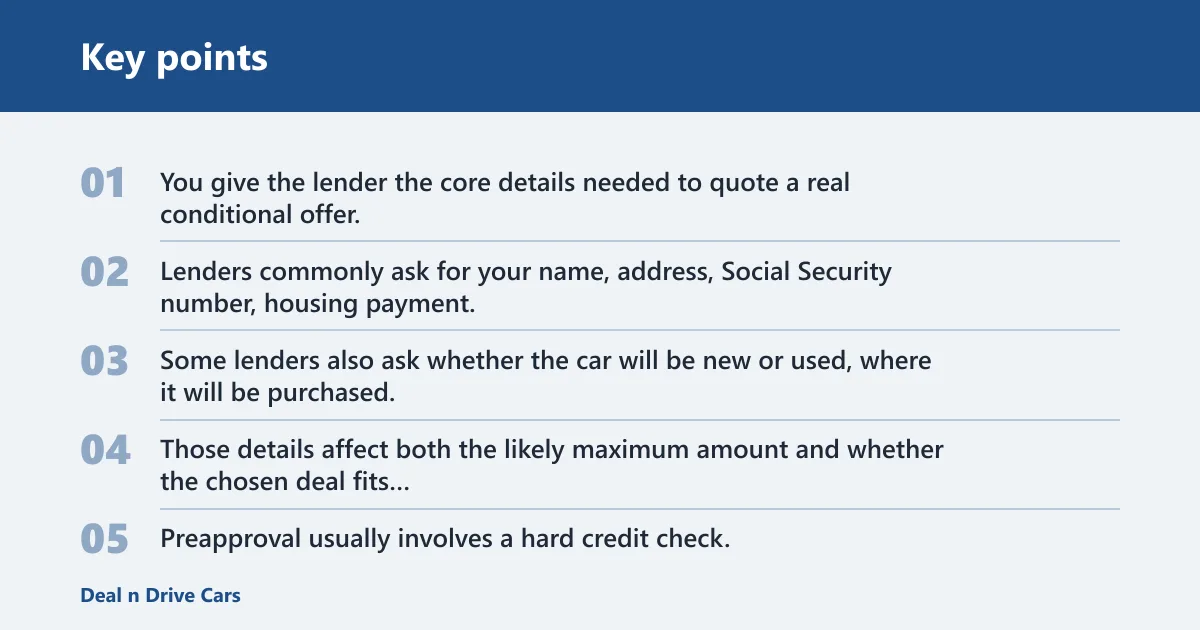
You give the lender the core details needed to quote a real conditional offer, plus the rough loan request. Lenders commonly ask for your name, address, Social Security number, housing payment, employer, income, and the amount you want to finance.
Some lenders also ask whether the car will be new or used, where it will be purchased, the expected down payment, and whether there is a trade-in. Those details affect both the likely maximum amount and whether the chosen deal fits lender rules later.
Lender review stage
Preapproval usually involves a hard credit check. A hard inquiry can lower a credit score by a few points, but the effect is generally small and temporary. For many borrowers, that tradeoff makes sense because the lender is making a stronger conditional commitment than a soft-pull estimate. Consumer guidance from the CFPB and FICO supports that hard inquiries may affect scores, while focused rate shopping for the same kind of loan is generally treated more favorably than scattered applications over time.
The lender may review credit score, income, and existing debt, then compare those inputs with internal underwriting rules. If any detail needs support, the file can pause for documents instead of moving straight to a letter.
Letter stage
If the file passes preliminary review, the lender issues the preapproval letter. Preapproval can take from a few minutes to a couple of business days, depending on whether the lender needs manual review or extra income verification.
The letter should state the estimated APR, maximum amount, loan term, and expiration date. It may also list conditions, such as submitting updated pay stubs, completing employment verification, or choosing a vehicle that meets age and mileage rules.
Final underwriting after the vehicle is chosen
Final approval happens after you select a specific vehicle and the lender sees the buyer’s order. This is where many shoppers miss the difference between preapproval and completion.
The lender can still verify valuation, title status, mileage, seller type, and whether the final structure matches the original application. Preapproval does not guarantee final loan approval, so a deal can be rewritten if the car or borrower details changed.
What is the difference between prequalification and preapproval?
Prequalification is usually an early estimate based on a soft credit check, while preapproval is a stronger conditional offer that usually requires a hard inquiry. A soft check does not affect your score. For dealership negotiations, preapproval carries more weight because the lender has reviewed more of the file. That distinction aligns with common consumer explanations from the CFPB and major lenders, which treat prequalification as less binding and preapproval as a more developed credit decision.
Soft pull versus hard pull
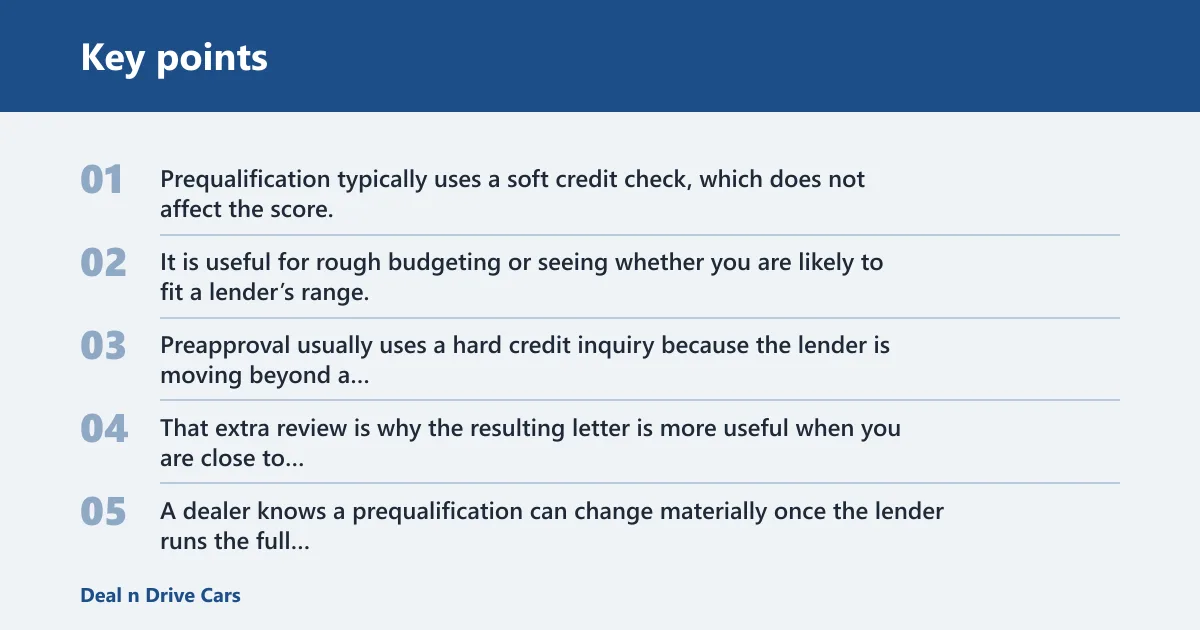
Prequalification typically uses a soft credit check, which does not affect the score. It is useful for rough budgeting or seeing whether you are likely to fit a lender’s range.
Preapproval usually uses a hard credit inquiry because the lender is moving beyond a rough estimate. That extra review is why the resulting letter is more useful when you are close to purchase.
Why prequalification is weaker at the dealership
A dealer knows a prequalification can change materially once the lender runs the full file. That makes it less persuasive as a negotiation tool.
A preapproval letter is stronger because it reflects a conditional lender commitment with a real amount and estimated rate. It is still not a guarantee, but it is much closer to a financeable offer.
When prequalification is still useful
Prequalification makes sense when you are early in the process, rebuilding credit, or expecting major changes before shopping. It gives directional information without adding a hard inquiry too soon.
If the plan is to visit dealers soon, preapproval is usually the better next step. It gives a firmer ceiling and a better negotiating position.
If your main concern is the score impact of moving from a soft estimate to a full application, the detailed comparison in hard credit inquiry context is most useful right before you start formal lender applications.
Does auto preapproval hurt your credit score?
Auto preapproval usually triggers a hard credit inquiry, and a hard inquiry can lower your score by a few points. For most borrowers, the effect is small and temporary. The bigger risk is poor timing: scattered applications outside a rate-shopping window can create extra pulls without giving you useful comparison power.
Why most preapprovals trigger a hard inquiry
Lenders are taking on more risk at the preapproval stage than at prequalification. They need a fuller look at your credit file before stating a maximum amount and estimated APR.
That is why most lenders treat preapproval as a hard-pull event. It is normal, and you should plan for it rather than assume every early loan quote is score-neutral.
How the rate-shopping window helps
Credit scoring models commonly treat multiple auto loan inquiries made in a focused shopping period more favorably than widely spaced applications. The exact treatment can vary by model, but the practical rule is simple: group serious loan applications close together when you are ready to buy. FICO’s consumer guidance explains that multiple auto-loan inquiries within a shopping window are generally counted more like a single inquiry for scoring purposes, though the exact window can vary by model.
That lines up with the common timing advice to apply within 30 to 60 days of buying. It keeps the preapproval relevant and reduces the chance that the letter expires before you can use it.
When another hard pull can happen later
A second hard inquiry can occur if the original letter expires, if you apply with additional lenders later, or if the dealer submits the credit application to multiple finance sources after you request dealer financing.
Say your first preapproval is issued too early, then the vehicle search drags on past the validity window. A fresh application may be required, and the lender can reassess the rate, amount, and conditions using the updated credit file.
What documents do you need for auto preapproval?
Most lenders ask for proof of identity, residence, income, employment, and current debt obligations. Common documents include pay stubs, tax returns when needed, a driver’s license or other ID, and address details. Self-employed or variable-income borrowers should expect more follow-up because income verification is less standardized.
Income verification
Pay stubs are the common starting point for salaried or hourly workers. Tax returns are often requested when income is variable, self-employed, commission-based, or supported by multiple sources.
Employment verification may be required even if pay stubs are current. Lenders want to confirm that the job still exists and that the stated income matches the application.
Identity and residence documents
You may need proof of identity and residence. That can include a government-issued ID, current address, and contact information.
Residence details matter because housing payment is part of the debt review. A file can change if the application understates rent or mortgage obligations.
Debt and housing details
List current monthly debt obligations carefully. Auto lenders review existing debt because it affects payment capacity and may reduce the approved amount.
If there is a trade with a loan balance, include the payoff information early. Negative equity changes the transaction size and can break an approval that looked fine before the trade was added.
Extra paperwork for self-employed or variable-income applicants
Borrowers with irregular income should prepare for more document requests, not necessarily a denial. Bank statements, longer income history, or signed returns may be needed to support the stated monthly earnings.
A common first-timer mistake is applying with estimated income from a busy month while leaving out seasonal swings or business expenses. The lender then recalculates usable income, and the preapproved amount drops before you reach the store.
How much can you get preapproved for?
The maximum preapproved amount depends on credit profile, verified income, existing debt, down payment, and the requested term. Lenders are sizing a payment against your financial profile, not telling you what to spend. The smart move is to convert that cap into an out-the-door budget before shopping.
How lenders size the maximum
The lender starts with your ability to support a monthly payment, then adjusts for credit risk and loan structure. Higher income, lower debt, stronger credit, and more down payment generally support a larger approval at a better estimated rate.
Loan term also matters. Extending the term can raise the amount a lender will allow, but it can also increase total interest paid and may not fit your target ownership plan.
Converting the loan cap into a shopping number
Use the letter backward. Start with the maximum financed amount, then subtract cash items and financed extras that will appear on the contract.
- Start with the maximum amount on the preapproval letter.
- Subtract taxes, title, registration, and dealer documentation fees.
- Subtract any negative equity rolled in from a trade.
- Subtract optional add-ons if they may be financed.
- Add the planned down payment only after confirming the lender assumed it.
- The remaining figure is the safer target vehicle price.
Why add-ons and negative equity break the math
Many finance surprises are not rate problems. They are structure problems. A deal that fits at vehicle price can fail once products, fees, and trade shortfall are added.
Picture a used SUV priced within the loan cap, but you also roll in a prior loan shortage and accept two store products. The financed amount can exceed the lender’s valuation limit, forcing a bigger down payment or a different car.
Preapproval readiness matrix
| Scenario | What to prepare | What can trigger a hard pull | Likely lender response | What to verify on the letter before shopping | Dealership negotiation leverage |
|---|---|---|---|---|---|
| Strong credit | ID, address, recent pay stubs, employer details, debt list, planned down payment | Formal preapproval application with SSN and requested loan amount; later dealer submission if comparing store financing | Fast conditional approval, wider amount range, stronger estimated APR and term options | APR estimate, maximum amount, term, expiration date, any down payment assumption, whether new and used vehicles are both allowed | High; you can negotiate vehicle price first and use the outside offer as a benchmark without revealing full credit details |
| Thin credit file | ID, address, income proof, longer job history if available, housing payment details, possible co-borrower information | Moving from prequalification to full preapproval; reapplying if a co-borrower is added | Conditional approval with lower cap, shorter term choices, or added document requests; manual review is more likely | Whether proof of income or residency is still outstanding, whether a co-borrower is required, and whether the letter covers dealership or franchise purchases only | Moderate; enough to compare offers, but less forceful if conditions remain open |
| Used-car buyer | ID, income proof, debt list, target price range, and a shortlist of model years and mileage ranges | Submitting a specific used-vehicle deal after general preapproval; applying with another lender if the first has age or mileage limits | Approval may depend heavily on vehicle age, mileage, seller type, minimum loan amount, and valuation cap | Model-year limits, mileage limits, private-party rules, franchise-only restrictions, valuation cap language, and expiration date | Moderate to high if the vehicle fits lender rules; weak if the letter leaves key used-car restrictions unstated |
| Bad-credit buyer | ID, address, recent pay stubs, tax returns if needed, proof of residence, trade payoff, and a realistic down payment plan | Any full credit application; another pull if the file is resubmitted after missed payments or changed debts | Higher estimated APR, lower amount, shorter validity, more conditions, or denial pending proof of income or residence | Exact conditions outstanding, required down payment, term, vehicle restrictions, and whether the approval can be reduced after income verification | Limited but still useful; gives a floor for comparison and can stop you from judging deals only by monthly payment |
How long does auto preapproval last?
Auto preapproval often arrives in minutes to a couple of business days, and most pre-approvals last about 30 days. The best timing is usually within 30 to 60 days of buying. Apply too early, and the letter may expire before you choose a vehicle or complete final underwriting. That general timing matches many lender disclosures, although some lenders set shorter or longer expiration periods.
Best timing for the application
The timing goal is simple: close enough to shopping that the letter is current, but not so late that you are standing in the showroom without a finance benchmark. Applying within 30 to 60 days of purchase is the practical middle ground.
That window also helps when comparing lender offers. You can gather a few serious approvals close together, then shop the car while those terms are still live.
What to do if the letter expires
Do not assume the lender will just extend the old terms. Some will refresh the file; others require a new application and a new credit review.
If the search is dragging, check the expiration date before negotiating any deal. It is better to update the file before signing than to learn in the finance office that the original rate or amount no longer applies.
What can change during the validity window?
The letter can change if income drops, debt rises, payments are missed, or application details prove inaccurate. The vehicle choice can also change the deal if it violates age, mileage, valuation, or seller restrictions.
Preapproval is powerful because it gives clarity and control, but only if the underlying facts stay stable until final underwriting.
How do you use a preapproval at the dealership?
Use preapproval as a benchmark, not as your opening speech. Verify the letter first, negotiate the vehicle price and total out-the-door cost next, then compare the dealer’s financing offer against your outside terms. That approach keeps negotiating power with you and avoids exposing more financial detail than necessary.
What to verify on the letter before you shop
- Borrower name matches current ID.
- Lender name is clearly stated.
- Maximum amount is shown.
- Estimated APR or APR range is stated.
- Loan term is stated.
- Expiration date is still valid.
- Vehicle restrictions are listed, including age, mileage, seller type, and valuation limits if any.
- Down payment assumptions are clear.
- Any remaining conditions are listed, such as proof of income or employment verification.
Negotiate price first
Start with the vehicle price and out-the-door figure, not the monthly payment. A payment-focused discussion makes it easier for a dealer to offset a high APR with a longer term.
You do not need to hand over every page of the preapproval letter at the start. State that outside financing is available and ask the dealer to beat the rate or improve the full finance package.
Compare dealer financing against the outside offer
Dealer financing can still win. A store-arranged loan may beat the outside preapproval on rate, term, rebate eligibility, or lender incentives.
Compare the same structure: amount financed, term, APR, required down payment, and whether any rebate depends on using the dealer’s lender. A lower rate can be offset by hidden products or a longer term, so compare the full contract.
When it makes sense to accept the dealer loan
Accept the dealer’s loan if the numbers are clearly better after matching the same vehicle, term, and out-the-door amount. If the dealer beats the APR but adds products or changes the term, the offer is not actually better.
The preapproval remains useful even if it is not used for final funding. It gave you a real comparison point before the paperwork stage.
If you are using outside approval mainly to protect yourself during a more difficult credit situation, the preparation steps in loan inquiries and bad-credit application planning can help you avoid unnecessary resubmissions in the finance office.
What can go wrong after preapproval?
Several things can go wrong after preapproval: the amount can be reduced, the estimated APR can rise, the lender can ask for more documents, or the file can be denied after verification. Borrower changes and vehicle-specific issues are the usual causes, and both can appear late in the process.
Borrower changes that can alter the offer
New debt, missed payments, a lower credit score, reduced hours, job changes, or inaccurate application details can force the lender to revise the approval. Even a small change matters if the original file was close to the lender’s cutoff.
If something changes, tell the lender before signing a buyer’s order. It is easier to restructure early than to rebuild the deal after the finance contract is printed.
Vehicle-specific problems
A chosen vehicle can fail the lender’s rules even when you are fully acceptable. Common issues include excess mileage, older model year limits, private-party restrictions, salvage or title problems, minimum loan amount rules, or a price above the lender’s valuation cap.
This matters most for used-car buyers. A clean preapproval for a general amount does not guarantee that every used vehicle on a lot can be financed under that approval.
How to recover if the deal is denied or rewritten
First, identify whether the problem is borrower-based or vehicle-based. That decides the next move.
- If the issue is income or debt, prepare updated documents, add down payment, reduce the price target, or consider a co-borrower if appropriate.
- If the issue is the vehicle, switch to a car that fits the lender’s age, mileage, and valuation rules.
- If the issue is rate or term, compare another lender within the same shopping period rather than accepting the first rewritten offer without review.
When a preapproval can stay soft
If you want to compare auto lenders without stacking unnecessary credit pulls, this article explains when preapproval can be handled with a soft inquiry and when a hard inquiry is more likely. It breaks down the difference between soft and hard pulls, how lender policies change by application stage, and where the credit hit can happen in the process.
That matters because one hard inquiry can be manageable, but several separate pulls can add noise to your credit file if you are not careful. The article also shows how rate-shopping rules may help when you apply with multiple lenders, so you can shop more confidently while keeping your credit impact as low as possible in auto preapproval rules.
Frequently asked questions
Can I get preapproved for a used car loan?
Yes, but used-car preapproval needs more checking than a new-car deal. Lenders may limit vehicle age, mileage, minimum loan amount, seller type, or the amount financed relative to valuation. Before shopping, confirm that the letter allows the kind of used vehicle and seller you plan to use.
Is auto preapproval worth it before shopping for a car?
Usually, yes. It gives a real benchmark for amount, estimated rate, and term before dealership finance discussions begin. The main caution is timing: applying too early can leave the letter expired, and borrowers expecting near-term income or credit changes may want to wait until those changes settle.
Can I compare dealer financing against my preapproval?
Yes. That is one of the strongest uses of preapproval. Compare the dealer’s offer against the outside letter using the same amount financed, term, APR, down payment, and total out-the-door cost. Dealer financing can be better, but only if the full structure beats the outside offer.
What happens if my credit changes after preapproval?
If credit, income, or debt changes after preapproval, the lender can revise the amount, estimated APR, or conditions, and final approval can fail. Missed payments, new credit accounts, job changes, or inaccurate application details are common triggers. Keep the credit profile stable until the loan is finalized.
What documents do I need for auto loan preapproval?
Most lenders ask for proof of identity, proof of residence, income documents such as pay stubs or tax returns, employer information, and current debt obligations. Some also require employment verification. Self-employed and variable-income borrowers should expect added document requests before the lender issues final terms.
How much can I get preapproved for on a car loan?
The amount depends on credit score, income, existing debt, down payment, and the requested term. The lender’s maximum is only a cap, not a recommended spend target. Build the shopping budget from the out-the-door total after taxes, fees, trade shortfall, and optional products are accounted for.
Can you get denied after auto preapproval?
Yes. Auto preapproval is conditional, so final underwriting can still deny the loan if your income cannot be verified, your debt increased, your credit changed, the vehicle fails age or mileage rules, the title has problems, or the deal no longer fits the lender’s valuation limits. A denial after preapproval does not always mean the borrower is unfinanceable; sometimes it means the specific vehicle or contract structure failed lender rules.
How many lenders should I apply to for preapproval?
A small, focused group is usually enough. Many shoppers compare two to four serious lenders within a tight shopping period so they can benchmark APR, term, fees, and vehicle restrictions without spreading applications out for weeks. The goal is comparison power, not collecting the largest number of letters.
Can a dealer beat a preapproval rate?
Yes. Dealers sometimes have access to captive finance incentives, promotional APRs, or lender programs your outside bank or credit union does not match. The safe way to compare is to hold the vehicle, term, down payment, and out-the-door amount constant so the lower advertised rate is not offset by added products or a longer term.
Resolution and next steps
Auto preapproval is usually worth getting when you are close to buying because it gives you a real financing benchmark, stronger negotiating leverage, and a clearer out-the-door budget. The remaining caution is simple: treat the letter as conditional, verify its restrictions before shopping, and keep your credit and income picture stable until final underwriting is complete.
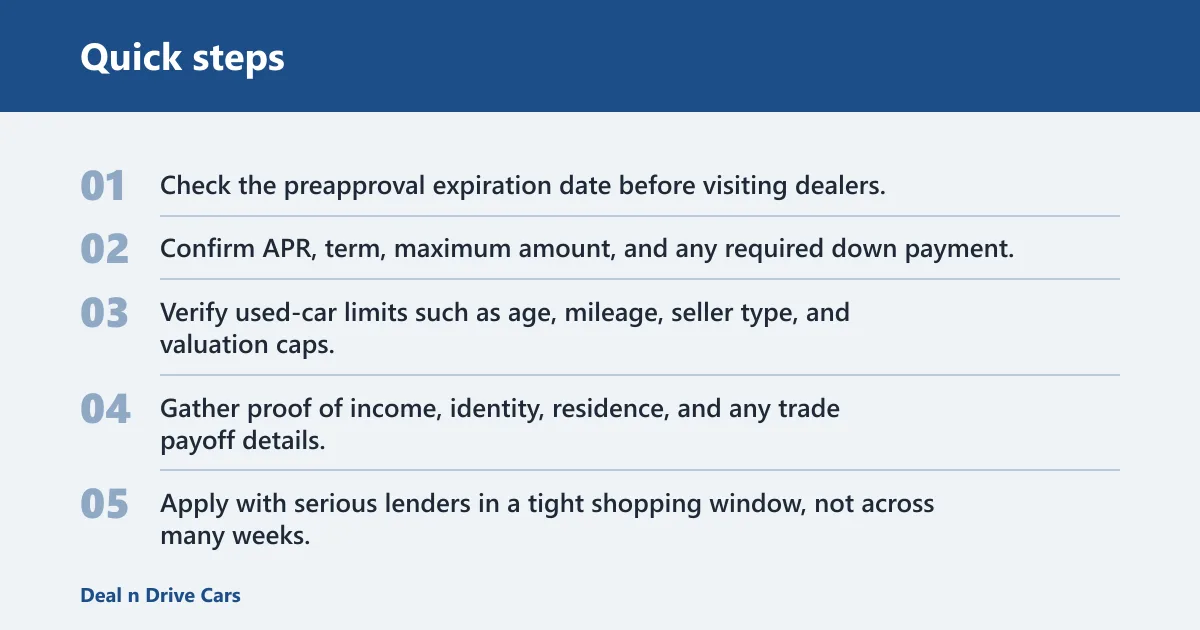
- Check the preapproval expiration date before visiting dealers.
- Confirm APR, term, maximum amount, and any required down payment.
- Verify used-car limits such as age, mileage, seller type, and valuation caps.
- Gather proof of income, identity, residence, and any trade payoff details.
- Apply with serious lenders in a tight shopping window, not across many weeks.
- Negotiate vehicle price and out-the-door cost before discussing monthly payment.
- Compare any dealer offer against the same amount financed, term, and total cost.
- Avoid new debt, missed payments, or job/income surprises until the loan is finalized.
- If the deal is rewritten or denied, determine whether the issue is your file or the vehicle, then adjust the structure before signing anything.
Sources
- Consumer Financial Protection Bureau (CFPB), consumer guidance on auto loans, preapproval shopping, and credit applications.
- Federal Trade Commission (FTC), consumer guidance on auto financing and dealership loan comparisons.
- FICO, consumer explanations of hard inquiries and rate shopping treatment for auto-loan inquiries.
- Major bank and credit union preapproval disclosures describing conditional approval status, expiration periods, and final underwriting requirements.