Maintenance vs Repairs: What Belongs in Your Car Budget?
Put oil changes, filters, brake pads, tires, and fluids in maintenance or wear-item lines, and reserve about 1% to 2% of your car’s value each year for true repairs. Mix those buckets together, and you either underfund emergencies or overpay for routine upkeep. This guide shows a simple framework for sorting each expense into planned maintenance, wear-item replacement, or a real repair.
| Decision factor | Maintenance | repairs | Winner | Best-fit example | Why this bucket |
|---|---|---|---|---|---|
| What triggers the cost | Scheduled service, mileage intervals, or planned replacement | Warning light, noise, vibration, failure, damage, or corrosion | Maintenance for planned costs; repairs for breakdowns | Oil change, tire rotation | It is predictable and time- or mileage-based. |
| Budget timing | Monthly line item or mileage-based reserve | Separate emergency fund for diagnosis and fix | Maintenance for predictability | Monthly service reserve | The cost is expected before the work is due. |
| Price certainty | Usually easier to estimate ahead of time | Often needs diagnosis before pricing | Maintenance | Scheduled filter change | The price is easier to plan because the task is known in advance. |
| Effect of delay | Delays can raise later costs or shorten part life | Delays can create safety risk or strand the car | repairs for urgency, Maintenance for planning | Brake service, warning-light repair | One bucket handles preventive upkeep; the other handles failure. |
| Best fit | Oil changes, tire rotations, filters, fluid checks | No-start problems, suspension failures, body damage | Depends on the symptom | Routine service vs breakdown fix | The symptom tells you whether it is scheduled care or a failure. |
Maintenance vs repairs: the budget split
Maintenance is planned service that keeps wear in check and reduces the chance of a roadside failure. Repairs fix a problem after a part fails, gets damaged, or starts warning you with a light, noise, smell, or vibration. The budget split works best when you keep those purposes separate.
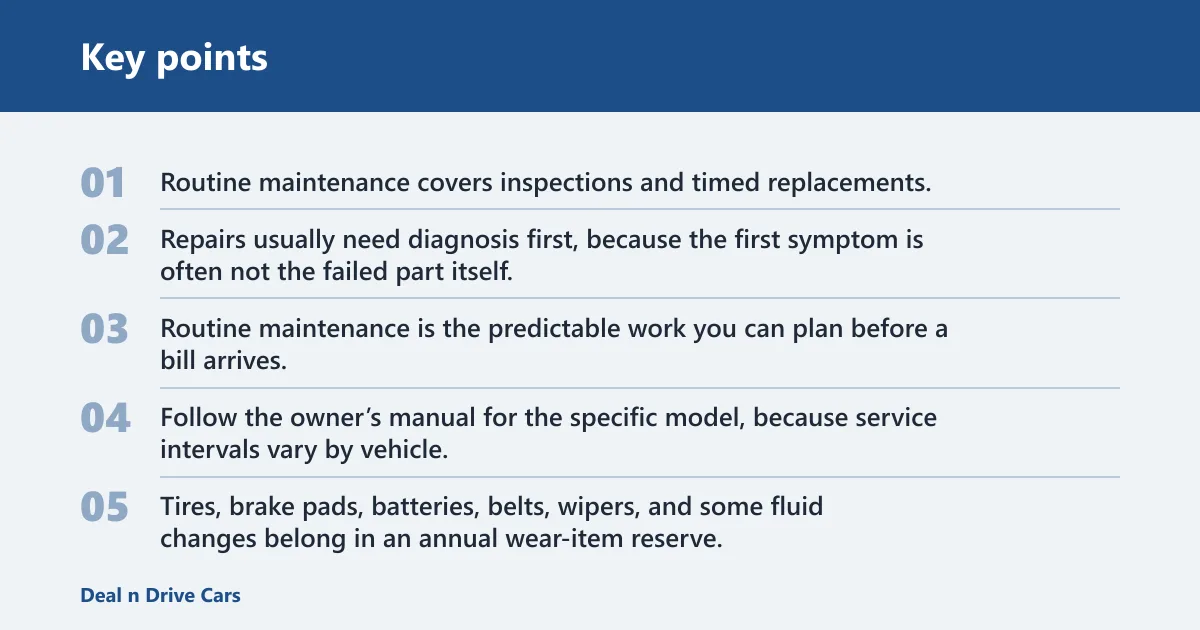
Routine maintenance covers inspections and timed replacements. Repairs usually need diagnosis first, because the first symptom is often not the failed part itself. That is why a used-car budget should have three lanes, not one blended bucket.
What counts as routine maintenance
Routine maintenance is the predictable work you can plan before a bill arrives. Oil changes, tire rotations, fluid checks, cabin filters, and scheduled inspections belong here because they follow mileage or time, and they help prevent costly breakdowns. Follow the owner’s manual for the specific model, because service intervals vary by vehicle.
Common maintenance timing is easy to track. Routine oil changes can be scheduled every 5,000 miles, tire rotations are recommended every 3,000-5,000 miles in one source, and a cabin air filter should be changed every 12 months or 12,000 miles.
What counts as a repair
Repairs are failure-driven. A battery that will not hold a charge, a suspension part that is clunking, or a body panel bent in a curb strike belongs in the repair fund because the cost appears after something has gone wrong.
Repairs often need diagnosis before pricing. A warning light, slow cranking, grinding brakes, pulling, or a no-start complaint can point to more than one part, so the bill usually starts with inspection time before the final fix is known.
Where wear items fit
Wear items sit between the two buckets. They are predictable enough to budget ahead of time, but they are not monthly maintenance in the same sense as oil changes. Tires, brake pads, batteries, belts, wipers, and some fluid changes belong in an annual wear-item reserve.
That reserve keeps bigger but expected bills from wrecking your monthly budget. It is the right place for parts that age out, wear down, or lose performance with mileage even when the car still drives.
Which car costs belong in monthly maintenance?
Monthly maintenance should cover the small, scheduled, recurring jobs that keep the car safe and healthy. Think of this bucket as the steady cash flow for inspections, fluids, and short-interval service. It should be easy to estimate and easy to track, and it works best when it sits beside a separate monthly maintenance plan rather than inside your repair fund.
Oil changes and filters
Oil changes belong in maintenance because they are planned service. Routine oil changes can be scheduled every 5,000 miles, and one example price places them around $35-75. Filters fit here too when they are scheduled by mileage or time rather than by failure.
Cabin air filters are a good example of a planned replacement. A cabin air filter should be changed every 12 months or 12,000 miles, so it belongs in the monthly maintenance plan even though the actual purchase happens less often.
Tire rotations and fluid checks
Tire rotation is classic maintenance. It is recommended every 3,000-5,000 miles in one source, and 5,000-7,500 miles in another, because regular rotation helps extend tire life and even out wear. The exact interval depends on the manufacturer’s schedule and the tires on the car, so the manual should control the final timing.
Fluid checks also fit here. Monthly checks of coolant, brake fluid, and transmission fluid help catch low levels early and can prevent overheating or component failure. The cost is small, but the damage from skipping them can be large.
Inspections and small scheduled services
Inspections belong in this bucket when they are routine, not fault-finding. A vehicle health check averages £41.27 on FixMyCar, which is the kind of planned service that works well as a monthly or quarterly allocation rather than a surprise expense.
Suppose a compact car is due for an oil change at 5,000 miles and a cabin filter at 12 months. The owner can budget those as planned maintenance, while anything uncovered by the inspection gets moved to the repair or wear-item side only if the shop finds a failure.
What should go in your annual wear-item reserve?
The annual wear-item reserve is for parts that wear out on age or mileage, even when there is no sudden failure. It is separate from monthly maintenance because these costs arrive less often, but they are still predictable enough to plan for.
Brakes and brake fluid
Brake pads belong in the wear-item reserve, not in the emergency fund, because they wear with use. Brake pads can cost up to $300 per axle, plus labor, and warning signs include squeal or grinding. Brake fluid also belongs here when service is due on interval rather than failure.
Brake fluid changes are worth planning for because old fluid can affect pedal feel and braking performance. The average cost of a brake fluid change booked on FixMyCar is £89.92, which makes it easier to reserve money ahead of time.
Tires and alignments
Tires belong in the wear-item reserve because tread wears down with mileage and age. Wheel alignment is a gray-area item, but in budget terms it usually sits near the wear-item side when the job follows uneven wear, pulling, or a pothole hit.
The average cost of wheel alignment booked on FixMyCar is £38.83. If a curb strike or pothole causes the need, the alignment may move toward the repair fund; if it is part of normal tire care, it stays in the wear-item reserve.
Battery, belts, and wipers
A battery is a wear item with repair-like symptoms. A quality car battery can cost upward of $250, and slow cranking, corrosion, or dim lights are clues that the battery or charging system may need attention. Because diagnosis may also point to the alternator or cables, budget a little room for testing.
Windshield wipers belong in the reserve too. Windshield wipers can run $50-61 for parts and labor, and they should not be deferred because visibility is a safety issue. Belts fit this same reserve when age or mileage makes replacement likely.
When does a car expense belong in the repair fund?
Put an expense in the repair fund when it is sudden, failure-driven, or caused by damage. That includes warning lights, no-start problems, suspension failures, corrosion, and body-related fixes. This fund should also cover diagnosis, because many repairs cannot be priced accurately until the car is inspected.
Warning lights and no-start problems
A warning light is not a maintenance reminder. It means the car needs diagnosis, and the final repair may be one part or several. A no-start complaint belongs here too, especially when the battery, starter, alternator, or cables could be involved.
When the car will not start, budget for the diagnostic fee first, then the actual fix. That keeps the emergency fund realistic and prevents the owner from counting only the part price while forgetting the inspection time that comes before it.
Suspension and steering repairs
Suspension work often lands in the repair bucket because it can be wear-driven, impact-driven, or both. Suspension checks are suggested every 15,000-30,000 miles, and signs such as clunks, uneven tire wear, or pulling can mean a repair is needed after inspection.
Wheel alignment can sit in the middle, but broken struts, worn shocks, or damaged steering parts are repairs. If the issue came after a pothole strike or curb hit, treat it as repair work unless the shop says it is only routine adjustment.
Damage, corrosion, and body-related fixes
Body damage belongs in the repair fund because it is not routine upkeep. Rust repair, broken trim after impact, or suspension damage from road debris are failure or damage costs, not scheduled service.
A common first-timer mistake is calling every post-incident bill “maintenance” because the car still runs. If the cost came from impact, corrosion, or a part breaking before its scheduled interval, it is a repair even if the shop also finds worn items at the same visit.
Car budget classification table
This table sorts 20 common car expenses into the right bucket before the bill arrives. Use the trigger to decide where the cost belongs, then pick the timing rule that matches how the expense shows up.
| Expense | Bucket | Trigger | Likely timing | Budget by | Why this bucket |
|---|---|---|---|---|---|
| Oil change | Monthly maintenance | Scheduled service | About every 5,000 miles | Mileage | It is a repeat service that is planned in advance. |
| Engine oil filter | Monthly maintenance | Paired with oil service | At oil change interval | Mileage | It is replaced with routine service, not after failure. |
| Tire rotation | Monthly maintenance | Planned tire care | Every 3,000-5,000 miles or 5,000-7,500 miles | Mileage | It extends tire life and follows a schedule. |
| Fluid check | Monthly maintenance | Routine inspection | Monthly or at service visits | Monthly | It is a recurring check meant to catch issues early. |
| Cabin air filter | Monthly maintenance | Planned replacement | Every 12 months or 12,000 miles | Annually or mileage | It is due on time or mileage, not because of a breakdown. |
| Vehicle health check | Monthly maintenance | Preventive inspection | At scheduled checkup | Annually | It is a planned inspection to catch wear before failure. |
| Brake pads | Annual wear-item reserve | Wear, squeal, or grinding | As thickness drops | Mileage | They wear with use and are expected to need replacement. |
| Brake fluid change | Annual wear-item reserve | Service interval | When due on schedule | Annually | It is interval-based service with predictable timing. |
| Brake rotors | Annual wear-item reserve | Wear or pulsation | Often with pad replacement | Mileage | They are wear parts that often age out alongside pads. |
| Tires | Annual wear-item reserve | Tread wear or age | When tread is low or age limit nears | Mileage | Tires wear down gradually and should be budgeted ahead. |
| Wheel alignment | Annual wear-item reserve | Uneven wear or pulling | After tire wear or a road impact | Annually or event-based | It is often preventive, unless damage pushes it into repairs. |
| Battery | Annual wear-item reserve | Age, slow crank, corrosion | Often after several years of use | Annually | It is a predictable wear item even though it can mimic a repair. |
| Wipers | Annual wear-item reserve | Streaking or poor clearing | Seasonal or yearly | Annually | They are consumable safety items that need periodic replacement. |
| Belts | Annual wear-item reserve | Age or cracking | During service inspection | Mileage | They are inspected on schedule and replaced before failure. |
| Diagnostics for warning light | Emergency repair fund | Check-engine or other warning light | As soon as the light appears | Per event | The problem is not yet identified, so it needs inspection first. |
| No-start diagnosis | Emergency repair fund | Engine will not start | Immediately | Per event | The car has stopped functioning and needs fault-finding now. |
| Suspension repair | Emergency repair fund | Clunk, pull, or damaged part | After inspection | Per event | The issue may involve impact damage or a failed component. |
| Alternator or charging system | Emergency repair fund | Battery warning, dim lights, charging loss | When test results show failure | Per event | The failure affects starting and charging, so it is urgent repair work. |
| Puncture repair | Emergency repair fund | Road debris or nail damage | After tire damage | Per event | It is an unexpected damage bill rather than planned tire wear. |
| Body or corrosion repair | Emergency repair fund | Impact or rust damage | After damage appears | Per event | It is damage recovery, not regular maintenance. |
How age and mileage change your budget
Age and mileage both push costs upward, but they do it in different ways. Higher mileage raises wear-item spending because parts reach their service limits sooner. Age raises the odds of seals, rubber, batteries, and electronics failing even if the odometer is not extreme.
Higher-mileage cars
A higher-mileage car needs a larger wear-item reserve and a larger repair fund. Tires, brakes, suspension parts, and batteries may all come due closer together, so a single monthly maintenance line is not enough to cover everything.
The practical move is to keep the scheduled service line steady and raise the repair reserve as the car ages. That way the owner does not confuse expected wear with a surprise failure.
Older cars with deferred maintenance
An older car with skipped service needs a bigger catch-up budget. Deferred maintenance often turns into repair work because worn parts, old fluids, or overdue filters can lead to larger failures later.
Say a used sedan has 92,000 miles, a weak battery, and a brake squeal. The battery and brakes belong in the wear-item reserve, but if the car also shows a charging warning light, the diagnostic and alternator check move into the repair fund.
Driving conditions that raise costs
Potholes, stop-and-go traffic, short trips, heavy loads, and extreme weather all raise costs. They shorten tire life, strain brakes, and make batteries work harder, so both maintenance and repair reserves should be larger than they would be for gentle use.
Road impacts deserve special attention. A wheel alignment after a pothole hit may look like routine service, but if the impact bent a steering or suspension part, the bill shifts into repairs immediately.
How much should I set aside for routine car maintenance each month?
Set aside enough to cover planned service by mileage and time, then add a separate reserve for wear items and repairs. The monthly maintenance line should pay for oil changes, rotations, inspections, and filters without forcing you to borrow from the emergency fund. If you are building the budget from scratch, start with a monthly maintenance plan and then layer the other buckets underneath it.
- That list becomes your monthly maintenance target.
-
Separate wear items.
Move brakes, tires, batteries, wipers, and brake fluid into an annual reserve. These costs are predictable enough to plan, but they should not crowd the monthly service line. -
Add a repair sinking fund.
Keep a separate fund for surprise failures, no-start problems, warning lights, and damage. Older or higher-mileage cars usually need more here because diagnosis and repair are more likely to arrive together.
Sizing the repair sinking fund
Use the repair fund for true surprises, not scheduled service. A common rule of thumb is to reserve 1% to 2% of the car’s value each year for repairs. That works best as a separate sinking fund, because it is meant to cover diagnosis plus the fix.
For a newer, lower-mileage car, the lower end may be enough. For an older car, a car with a rough service history, or one that sees harsh roads, the higher end is safer because failure risk rises and parts age together.
When to separate diagnostics from repairs
Diagnostics should become their own budget line when the car shows a no-start, warning light, grinding, pulling, or charging symptom and the final problem is still unknown. In those cases, the shop usually needs inspection time before it can name the part and price the repair.
That matters because the owner may otherwise budget only for the failed part and forget the first bill. A diagnostic line keeps the emergency fund honest and helps avoid surprises when the car needs testing before any fix is approved.
Choose Maintenance if…
Choose Maintenance if the cost is due by miles or months, the job is planned, and the car is still operating normally. Oil changes, tire rotations, fluid checks, cabin filters, and routine inspections belong here because they are scheduled care, not failure recovery.
- the service is on a mileage or time schedule
- the car has no warning light, noise, or vibration tied to the bill
- the work is preventive rather than corrective
- the price can usually be planned before the appointment
Choose repairs if…
Choose repairs if the car has a warning light, a noise, a no-start problem, impact damage, corrosion, or a part that has already failed. Brake work after grinding, suspension work after a pothole strike, charging-system diagnosis, and body fixes all belong in the repair fund.
- the cost starts with a failure, not a schedule
- the car needs diagnosis before the final price is known
- the problem came from damage, corrosion, or a sudden symptom
- the issue can leave the car unsafe or unable to drive
Frequently asked questions
What counts as maintenance versus repairs in a car budget?
Maintenance is planned service such as oil changes, rotations, filters, inspections, and fluid checks. Repairs fix a failure or damage after a warning light, noise, vibration, corrosion, or impact. The clean split is timing: scheduled work goes in maintenance, while symptom-driven work goes in repairs.
What repair costs should I keep an emergency fund for?
Keep money aside for no-start problems, warning-light diagnosis, suspension failures, alternator or charging issues, body damage, corrosion repair, and other failures that do not have a fixed schedule. Those costs often need inspection first, so the emergency fund should cover diagnosis as well as the final fix.
Should oil changes, brake pads, and tires be in maintenance or repair budget lines?
Oil changes belong in maintenance because they are scheduled service. Brake pads and tires fit better in an annual wear-item reserve because they wear out on mileage and age, even though they are not surprise repairs. If damage or failure is involved, the expense moves to repairs.
How do mileage and age change what I should budget for repairs?
Higher mileage usually means more wear-item spending and a larger chance of parts failing close together. Age raises the odds of battery, rubber, seal, and electronics problems even if the odometer is not extreme. Older or higher-mileage cars should carry a bigger repair reserve than newer cars.
When should I plan for diagnostics instead of the repair itself?
Plan for diagnostics whenever the problem is symptom-based and not yet identified, especially for a no-start, warning light, grinding noise, pulling, or charging issue. The shop may need inspection time before it can name the part to replace, so the budget should include diagnosis as its own line.