Can You Get an Auto Loan for a Private Seller Car?
Many banks, credit unions, and online lenders will finance a private-party car if the vehicle, title, and seller documents meet their rules, though some may cap the loan-to-value at about 80% to 100%. Miss a title step or funding deadline, and the deal can stall, add fees, or fall apart after you’ve already agreed on a price. This guide explains approval steps, funding flow, lien and title handling, and the red flags that stop a private-sale loan from closing.
How private-party loans verify title and lien status
Yes. A private party auto loan is built for a used car bought from an individual seller, not a dealership. The lender usually wants the VIN, title details, and seller information before final approval, then pays the seller or lienholder and sets up monthly repayment after the title shows the lender as lienholder.
What lenders usually finance private-party purchases
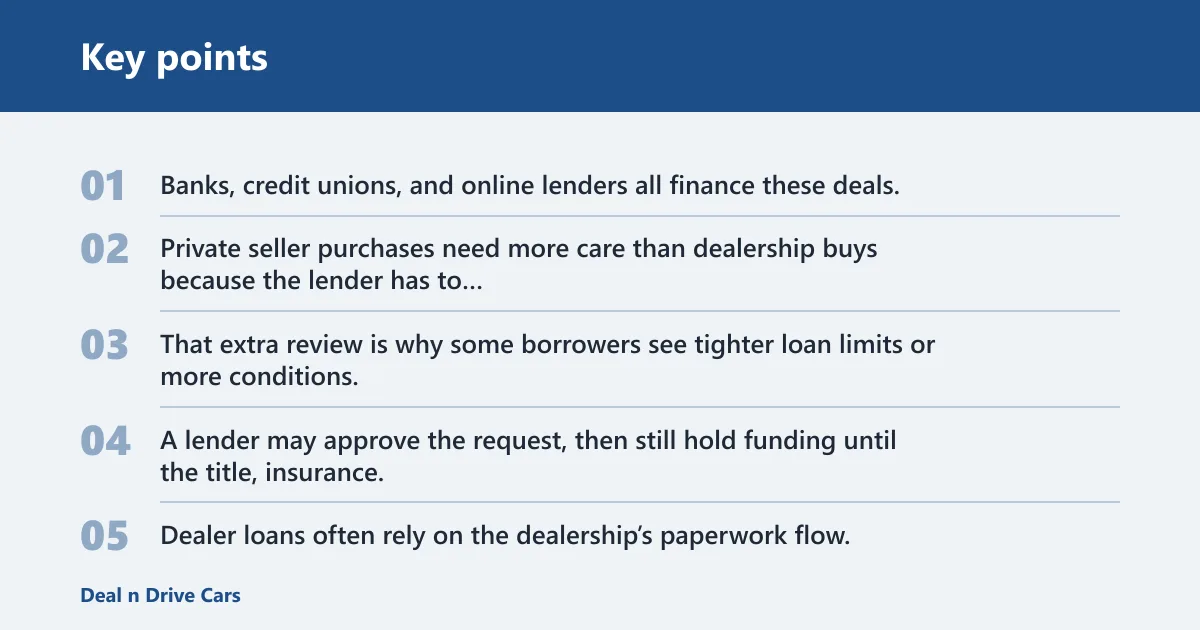
Banks, credit unions, and online lenders all finance these deals, but the paperwork load is heavier than with a dealer. Private seller purchases need more care than dealership buys because the lender has to confirm ownership, title status, and payoff timing before money moves.
That extra review is why some borrowers see tighter loan limits or more conditions. A lender may approve the request, then still hold funding until the title, insurance, and purchase records line up.
Why private sales need more document checks than dealer sales
Dealer loans often rely on the dealership’s paperwork flow. Private sales do not. The lender has to verify the seller can legally transfer the car, that no hidden lien remains, and that the vehicle matches the VIN and title records.
If the title is missing, branded, or signed wrong, the loan can be delayed even after approval. The lender is not just lending against a price tag. It is lending against a specific car with a specific title trail.
When a private seller loan is a bad fit
This kind of loan is a poor fit when the seller cannot produce clear title information, the payoff amount is uncertain, or the vehicle’s title status is messy enough that the lender will not fund. Salvage or branded titles can work with some lenders, but the approval path is narrower and slower.
If you need same-day possession with no room for title follow-up, a private-party purchase can be risky. The deal depends on documents arriving in the right order, not on verbal promises.
How does a private party auto loan work?
The process starts with preapproval, moves to a specific car, and ends with final underwriting once the lender checks the VIN, title, seller details, income, and insurance. After approval, the lender funds the deal by paying the seller or the seller’s lienholder, then you repay the loan monthly.
Preapproval, vehicle selection, and final approval
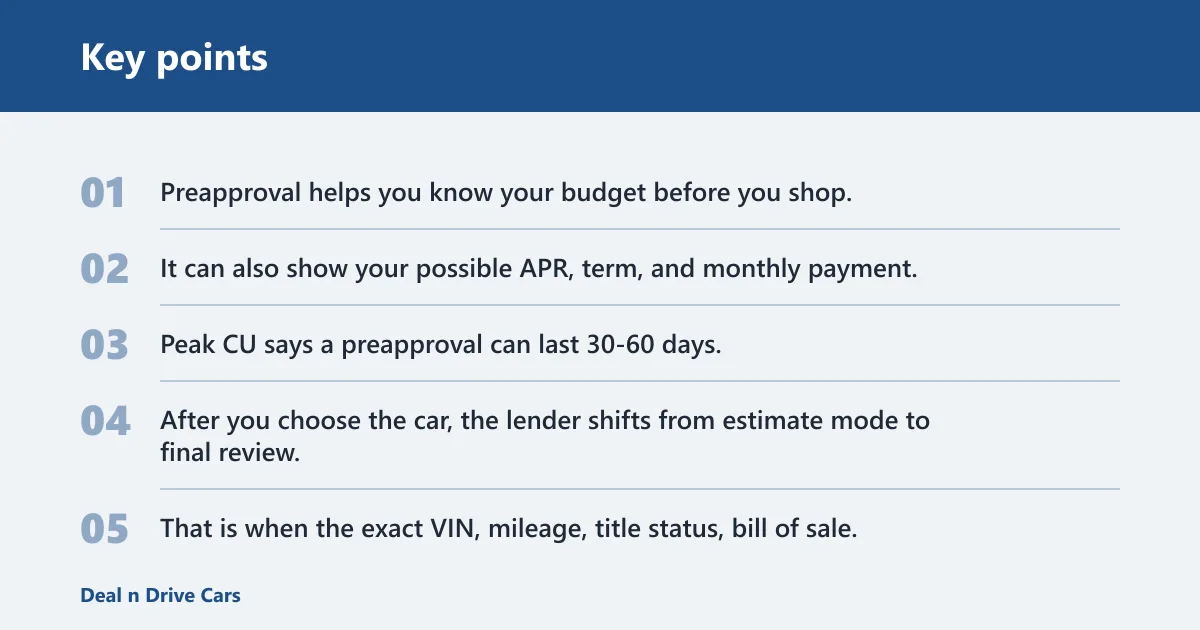
Preapproval helps you know your budget before you shop. It can also show your possible APR, term, and monthly payment. Peak CU says a preapproval can last 30-60 days, and it may ask for a basic description of the car before issuing the estimate.
After you choose the car, the lender shifts from estimate mode to final review. That is when the exact VIN, mileage, title status, bill of sale, and insurance proof matter.
How funds move to the seller or lienholder
The lender pays the seller or lienholder, not you in most cases. For a clean-title deal, funds may go to the seller after final approval and closing paperwork. If the seller still owes money, the new lender or closing agent may pay the existing lienholder directly first.
This is the step that causes the most surprise. Approval is not the same as funded. The lender still has to clear the title path before the money leaves.
Why timing matters before you take possession
Do not assume you can drive away before funding clears. Some deals close cleanly the same day, but others wait on payoff confirmation, insurance activation, or DMV processing. If you take possession too early, you may be holding a car that is not yet fully transferred in your name.
Say your lender needs the seller’s lien release before it releases funds. If that release arrives late in the afternoon, pickup may slip by a day even though the loan itself was approved. That delay is common and avoidable only when everyone plans the handoff.
What lenders need before they fund the loan
Most lenders want enough detail to verify the car, the seller, and the borrower’s ability to repay. That usually means the VIN, title information, bill of sale, proof of income, proof of insurance, and identification. The exact order can vary, but the lender will not fund a private sale without title and identity checks.
VIN, title details, and seller identity
The guide says to ask for the VIN to check history. Lenders use it to verify vehicle identity and match the car to the title and history record. They also need the seller’s name to match the title holder or listed lienholder path.
A title that does not match the seller’s ID is a warning sign. The lender may stop the file until the mismatch is explained.
Proof of income and proof of insurance
Proof of income supports the lender’s decision that you can repay. Insurance proof is usually required before funding, and the policy typically must be in place for the specific vehicle. If the insurance binder is incomplete or lists the wrong car, funding can pause.
That is one reason private sales close more slowly than dealer deals. The lender is checking the car, the borrower, and the coverage at the same time.
Bill of sale and purchase price confirmation
The bill of sale documents the purchase terms and supports DMV transfer. It also helps the lender confirm the agreed price and any taxes or fees that affect the final loan amount. If the bill of sale omits the VIN, price, or seller signature, the closing file may bounce back.
Private seller loan closing checklist
This checklist shows the documents that keep a private-party loan moving and the failure points that most often stop funding. Use it as a closing map, not a shopping list. A clean file can still fail if the title path is wrong.
| Required document | Who provides it | Most common failure point |
|---|---|---|
| VIN and vehicle description | Seller and buyer | VIN on the title does not match the car, or the description is incomplete |
| Signed title | Seller | Missing seller signature, missing buyer line, or title name mismatch |
| Bill of sale | Buyer and seller | Missing price, date, VIN, or signatures |
| Proof of income | Buyer | Outdated pay stub, incomplete bank statement, or unreadable file |
| Proof of insurance | Buyer | Policy is not active for the car at funding time |
| Government ID | Buyer | Expired ID or name mismatch with loan application |
| Payoff statement and lien release | Seller’s lender | Payoff amount changes before funding or release arrives too late |
| Clean-title car package | Seller | Title looks clean but has an old lien or missing reassignment line |
| Active lien package | Seller and seller’s lender | Payoff check is short, or lien release is not ready when funds are due |
| Missing title or out-of-state title file | Seller and DMV, sometimes lender | State rules require extra forms, duplicate title request, or notarization |
Clean-title car
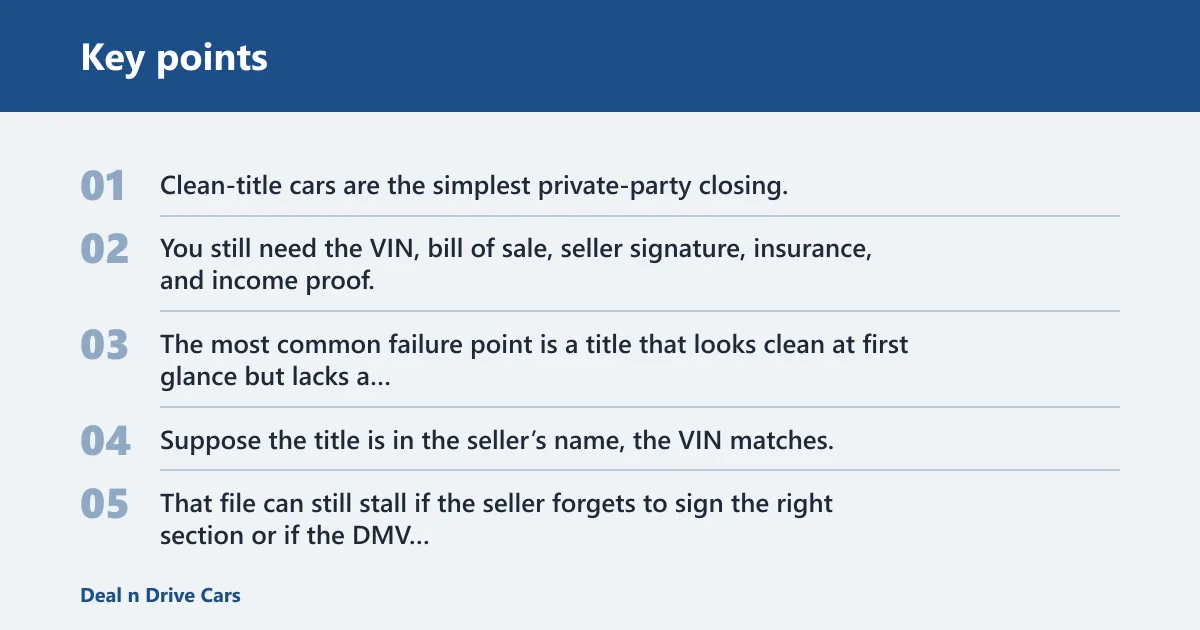
Clean-title cars are the simplest private-party closing. You still need the VIN, bill of sale, seller signature, insurance, and income proof, but there is no payoff chain to manage. The most common failure point is a title that looks clean at first glance but lacks a correct assignment or has a hidden issue in the record.
Suppose the title is in the seller’s name, the VIN matches, and the bill of sale is signed. That file can still stall if the seller forgets to sign the right section or if the DMV requires a separate transfer form.
Active lien
Cars with an active lien are common in private sales. The lender will usually need the seller’s payoff amount, the lienholder’s payment instructions, and the timing for lien release. The most common failure point is a payoff that changes after the lender issues the check.
If the payoff is short by even a small amount, the title cannot clear. That can delay the transfer until the seller covers the gap or the lienholder confirms the balance is settled.
Missing title, salvage, or out-of-state title
These are the deals that fail most often at the last step. A missing title can stop funding until a duplicate is obtained. A branded or salvage title may be allowed by some lenders, but only under stricter rules. An out-of-state title may need extra DMV steps before transfer.
The key risk is not the label alone. It is whether the lender can verify ownership and record its lien in time.
Do you need the title before you apply?
No, not always. A lender can often start with title details instead of the paper title, then ask for the actual document before funding. But if the title is missing, damaged, or not transferable, the deal can slow down or stop at closing.
When a lender can start with title details instead of the paper title
Some lenders will review the VIN, seller identity, and title status before the paper title is in hand. That can help you get preapproved while you are still shopping. Final funding still depends on the proper title being ready for transfer.
Why a missing title can stop funding
A missing title is more than an annoyance. It blocks the lender from confirming that the seller can legally transfer ownership. If the seller must request a duplicate title, the closing date can move by days or longer, depending on the DMV.
How a lien release changes the process
When the seller has paid off the old loan and can show a lien release, the deal is easier to close. The title can then move through transfer without waiting on another lender’s payoff department. That said, the release still has to match the title record and the seller’s name.
What happens if the seller still has a loan on the car?
If the seller still owes money, the buyer’s lender usually routes part of the funds to the existing lienholder. The old lender then issues a lien release after the payoff clears. This can work smoothly, but only if the payoff amount, lender instructions, and timing are lined up before closing.
How payoff to the existing lender works
The buyer’s lender may send funds directly to the seller’s lienholder and any remaining balance to the seller. That protects both sides and helps ensure the old lien is removed. The exact order depends on the lender and the title state.
Why lien release timing can delay closing
Title release timing can be the weakest link in the file. If the payoff check is not enough, or the old lender needs more time to process the release, the new lender may hold funding. The car can be sold on paper, yet still be trapped in title limbo.
What to verify before you meet the seller
Ask for the payoff quote, the lienholder name, and the exact title mailing method if the lender uses one. Confirm whether the seller can bring a current payoff statement and whether the existing lender accepts same-day payoff verification. Those checks reduce last-minute surprises.
Are private seller loan rates higher than dealer loans?
They can be. APR depends on the lender, the vehicle, the title situation, and your credit profile, and private-party pricing is sometimes less favorable than dealer financing. A strong borrower may see a narrow gap, while a weaker credit tier may see a wider one.
How APR usually compares across lender types
Dealer loans may be promoted with special rates, but those offers are not always available on private-party sales. Private-party loans can carry a higher APR because the lender may take on more manual review and title risk. That does not mean every private-party offer is worse, only that comparison matters.
Why credit tier affects private-party pricing
Credit tier can change the APR far more than the sale type. Borrowers with stronger credit often get the most competitive private-party pricing. Thin-credit or first-time buyers may see stricter terms, a shorter loan, a larger down payment request, or a co-signer requirement.
How to compare offers without getting distracted by monthly payment alone
Compare APR, term, total finance charge, and any fees. A lower monthly payment can hide a longer term or a higher total cost. The best comparison is the full loan, not the payment by itself.
Can you get preapproved before you find the car?
Yes. Preapproval is one of the best ways to set a budget before you shop, and it can be useful even before you pick a specific seller car. It gives you a rough approval range and tells you what price range the lender may accept.
What preapproval tells you
A preapproval can show your possible APR, term, and monthly payment. It can also reveal whether the lender expects more documentation for a private sale than for a dealer purchase. That helps you avoid cars that are outside the lender’s comfort zone.
How long preapproval usually lasts
The same source says a preapproval can last 30-60 days. That window gives you time to shop, compare cars, and finish the purchase without starting from zero. Once it expires, the lender may need fresh income or credit review.
What changes after you pick a specific car
After you choose the car, the lender rechecks the VIN, title status, bill of sale, insurance, and payoff details if there is an active lien. The loan amount may also change if the car’s price, taxes, or lender fee structure differ from the preapproval estimate.
A common first-timer mistake is treating preapproval like a funded loan. It is not. It is a conditional path to funding, and the title file still has to close cleanly.
Frequently asked questions
Can you get an auto loan for a private seller car?
Yes. Many banks, credit unions, and online lenders finance private-party purchases if the car, title, and seller documents pass review. The lender will usually want the VIN, title details, proof of income, insurance proof, and a bill of sale before it funds the loan.
What documents do I need for a private seller car loan?
Expect to provide the VIN, title details, bill of sale, proof of income, proof of insurance, and ID. If the seller still owes money, the lender may also ask for a payoff statement and lien release instructions before it will fund the deal.
Do lenders pay the private seller directly?
Often, yes. The lender may pay the seller or the seller’s lienholder directly, depending on whether the title is clean or still has an active lien. That setup helps the lender protect its interest and keeps the title transfer aligned with the funding process.
What happens if the private seller still has a loan on the car?
The buyer’s lender usually pays the existing lienholder first, then handles any remaining balance according to the closing instructions. The deal can still work, but the payoff quote and lien release have to line up before funding. If they do not, the closing can slip.
Do I need the title before applying for a private party auto loan?
Not always. A lender can often start with the title details and VIN, then wait for the paper title before funding. If the title is missing or not transferable, though, the loan may stall until the seller resolves that issue with the DMV or lienholder.