Can You Get a Bad Credit Auto Loan with No Down Payment?
Yes, you can get a bad credit auto loan with no down payment, but approval is harder and the loan usually costs more. Pick the wrong deal and you can end up upside down, paying more interest, or locked into a payment that squeezes your budget. This guide explains when $0 down can work, what lenders check, and when cash or equity is the safer move. Federal guidance has also warned that auto lending can turn risky when the loan amount is too high relative to the vehicle’s value and the borrower’s ability to repay, which is why payment size matters as much as approval.
What lenders look at before approving
Yes, but the answer depends on the lender, the vehicle price, and how strong the rest of your file looks. A subprime auto loan often means a credit score below 600, a higher APR than a prime loan, and closer review of income and employment. Some special finance lenders may still fund 100% of the purchase price. That said, credit scores are only one part of the decision: major bureau and scoring-model education resources consistently show that lenders sort borrowers into broad tiers, and borrowers in the lower tiers usually face tighter terms. See the Experian credit score ranges and the Federal Reserve’s consumer credit reporting overview for context on how those tiers are commonly viewed.
What zero down really means
Zero down or 100% financing means the lender funds the full amount of the car purchase, often plus taxes and fees depending on the deal. That lowers the cash barrier at signing, but it also raises the monthly payment and the lender’s risk. The balance starts higher, so equity builds more slowly. In practical terms, a $0 down structure is most manageable when the loan amount is already modest and the vehicle is priced below the top end of what the lender will allow for the borrower’s file.
When lenders are most open to $0 down
Lenders are most open to $0 down when the vehicle price is modest, the borrower has steady income, and the credit file shows some repayment history. A strong file can help, but approval is still tied to payment size and debt load. Income alone does not erase a weak score or unstable history. In practice, many lenders become more comfortable when the borrower has at least several months on the job, a consistent bank-deposit pattern, and a vehicle payment that leaves room inside the monthly budget.
Why approval and affordability are not the same thing
A lender may approve a loan that still stretches your budget. That is the trap with no down payment. The monthly bill can be high enough to pressure other expenses, and a long term can hide that pressure while increasing total interest paid. Approval is only the first hurdle. CFPB guidance on auto finance also emphasizes that borrowers should compare the total cost of the loan, not just the payment, because loan structure can change the long-term cost dramatically.
What lenders check before they approve $0 down
Lenders review more than a score. They check whether your income is steady, whether your current debt already takes a large share of your pay, and whether your residence and job history suggest you can keep making payments. Many special finance lenders also want proof of recent bank deposits and current employment. For soft-pull language, lenders commonly describe prequalification as an estimate that does not affect your credit score; for example, major auto lenders and finance platforms describe prequalification as a soft inquiry before a full application and hard pull.
Credit score and credit file depth
A score under 600 is often treated as subprime or credit-challenged. Still, the score is only one piece of the file. Thin credit, recent late payments, a prior repossession, or a bankruptcy can make zero down harder even when the score itself looks slightly better than another applicant’s. A borrower with a thin file and a 590 score may be viewed very differently from a borrower with the same score but several active tradelines and no recent delinquencies.
Income stability and debt load
Underwriting often centers on payment-to-income and debt-to-income pressure. If your current bills already claim too much of your income, a lender may reduce the amount financed, ask for cash down, or steer you toward a cheaper vehicle. Strong income helps most when it is predictable and leaves room for the car payment. In that sense, income is a support factor, not a substitute for credit history, and it usually matters most when the payment stays comfortably within the lender’s affordability limits.
Employment, residence, and bank deposit history
Frequent job changes, short time at an address, or irregular deposits can weaken a $0 down file. Some lenders want to see that your pay is coming in on schedule, not only that the gross income looks high enough on paper. Consistent deposits can matter as much as the pay stub itself. A lender may be more comfortable with six months on the job and steady direct deposits than with a larger salary that has only been in place for a few weeks.
When zero down is realistic
Zero down is most realistic when the car is priced to fit the lender’s risk band, the borrower has steady income, and the file does not show fresh red flags. It can also be realistic when trade equity reduces the amount financed enough that the lender treats the deal like a smaller loan, even without cash at signing. Typical approvals are easier when the requested amount stays in a lower, more manageable band rather than pushing toward the upper end of a subprime lender’s comfort zone.
Stronger income with steady deposits
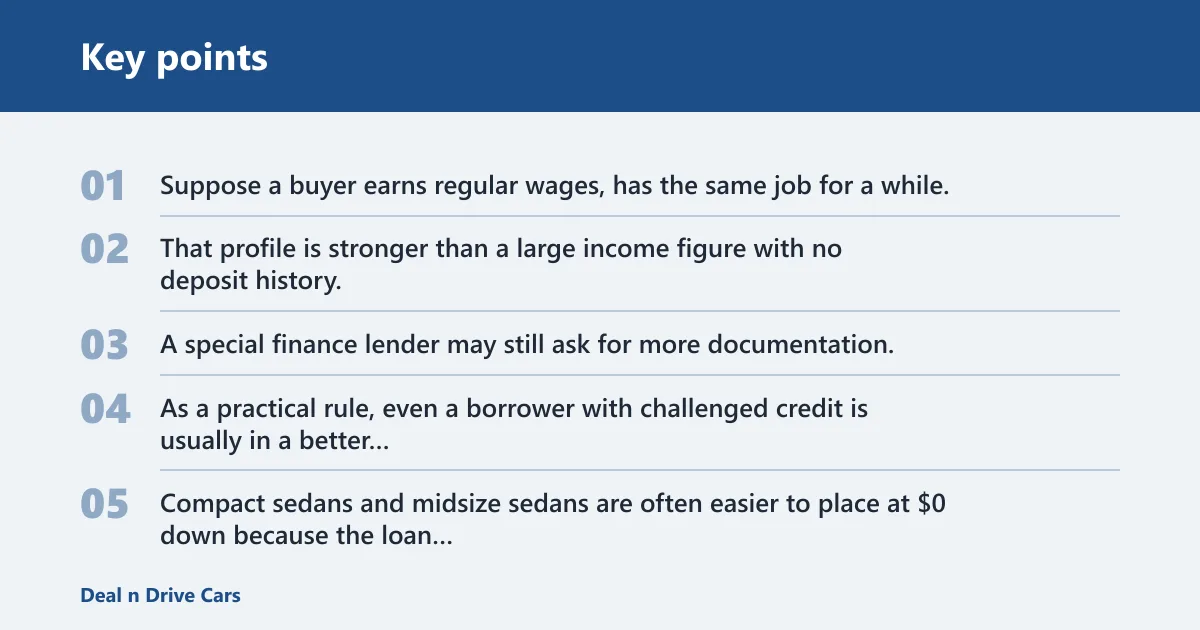
Suppose a buyer earns regular wages, has the same job for a while, and can show bank deposits that line up with the pay schedule. That profile is stronger than a large income figure with no deposit history. A special finance lender may still ask for more documentation, but the deal is easier to underwrite. As a practical rule, even a borrower with challenged credit is usually in a better position if the file shows stable work, a predictable pay cycle, and enough after-tax income to support the proposed payment without crowding out essentials.
Cheaper vehicle price bands
Compact sedans and midsize sedans are often easier to place at $0 down because the loan amount stays lower. Low-mileage used vehicles can also fit better than newer or larger units. A lower price band reduces the lender’s exposure and makes the monthly payment more manageable for the borrower. In many subprime deals, the “safer” target is not the newest car but the one that keeps the total financed amount and monthly obligation in a range the lender can support.
Trade equity that covers part of the deal
Trade-in value can function like a down payment if the vehicle has equity. That equity reduces the amount financed and can improve approval odds without cash from your savings. It is not required in every program, but it can be a useful substitute when you have little money available. If the trade is paid off or nearly paid off, the lender may treat that equity as a meaningful credit enhancement; if the trade is upside down, the opposite can happen.
Bad credit auto loan decision table
Use this table as a quick lender-decision guide. The goal is not only to ask, “Can I get approved?” It is also to ask, “Should I take $0 down, bring some cash, use trade equity, or choose a cheaper car?”
| Approval scenario | Credit profile | Income stability | Vehicle price band | Likely down-payment expectation | Risk level |
|---|---|---|---|---|---|
| Scenario 1 | Under 600, thin file, no recent major derogatory event | Steady wages and regular deposits | Lower-priced compact or midsize sedan | May accept $0 down or only modest fees due at signing | Moderate |
| Scenario 2 | Under 600, prior late payments, but recent recovery | Stable job, manageable debt load | Low-mileage used SUV at a middle price band | Often expects some cash, trade equity, or a lower-priced unit | Higher |
| Scenario 3 | Under 600, recent bankruptcy or repossession | Income present, but file is still rebuilding | Cheaper used sedan | Frequently expects cash down, trade equity, or stricter terms | High |
| Scenario 4 | Under 600, thin file, unstable work history | Irregular income or short residence history | Mid-price SUV or newer used vehicle | Often requires cash down or a different vehicle choice | Very high |
How to read the table before you apply
If your profile resembles Scenario 1, $0 down is at least plausible. If it looks like Scenario 3 or 4, approval may still be possible, but the lender is more likely to ask for cash, trade equity, a cheaper vehicle, or stronger proof of income. The higher the risk level, the less likely zero down becomes. A useful rule of thumb: the weaker the credit file, the more the lender wants to see one or more offsets such as cash, trade equity, short loan terms, or a lower-priced car.
Can income make up for a low credit score?
Income can help, but it does not replace credit. Lenders still cap how much of your income can go toward a car payment, especially in subprime files. A high paycheck with unstable deposits, high existing debt, or a long commute payment already in place may still fail the lender’s math. Put simply, the lender wants proof that the income is both real and durable, not just large on paper.
What documents help with special finance underwriting
Bring pay stubs, W-2s, 1099s, income statements, and recent bank deposits if you have them. Lenders commonly use these documents to verify that the income is current and stable, and many prequalification tools are designed to start with a soft pull before any full application. If you are paid hourly or self-employed, clean deposit history can matter more than a single pay period. A consistent bank record helps show that your income is recurring rather than temporary.
When a cosigner may help, and when it may not
A cosigner can sometimes improve approval odds or rate, but it is not always required. That said, a cosigner may not fix weak income, unstable housing, or a vehicle choice that is too expensive for the file. If the main problem is payment size, adding a cosigner may help only if the combined profile still supports the requested amount.
Picture a shopper with a lower credit score, steady pay, and a few months of bank deposits. A lender may still approve a cheaper sedan with no down payment if the payment stays inside the lender’s limit. Switch that same shopper to a newer SUV, and the deal can fail on payment size alone. In other words, the vehicle choice can matter as much as the credit score.
What vehicle types are easiest to finance with little or no money down?
Smaller, lower-priced used vehicles are usually the easiest fit. Compact sedans, midsize sedans, and low-mileage used vehicles often create a smaller loan amount and a lower payment. SUVs can still work, but only when the payment fits the lender’s cap and the borrower’s budget. Vehicle age matters too: older units may be easier on price but harder on lender comfort if they are high mileage or outside the lender’s age limits.
Compact sedans and midsize sedans
These vehicles are often the easiest targets for bad credit buyers with no savings because the starting price is usually lower than larger SUVs or trucks. That matters. A lower price can mean a smaller loan, a lower payment, and less chance that the lender will demand cash at signing. For many lenders, these are the first units to consider when the goal is to keep the financed amount in a conservative range.
Low-mileage used vehicles
Low-mileage used vehicles can be attractive in special finance because they often hold value better than older, higher-mileage units. Lenders like that buffer. The car still needs to be priced within the borrower’s payment range, though, or the extra value will not solve the approval problem. A cleaner vehicle history can help, but it does not offset a payment that is too large for the borrower’s budget.
SUVs when the payment fits the budget
Family-friendly SUVs are on some special finance menus, but the issue is affordability. If the SUV pushes the payment too high, the lender may require money down or ask you to choose a less expensive vehicle instead. A lender that is comfortable with $0 down on a sedan may still ask for cash on a larger SUV because the risk is higher and the loan balance is larger.
Should you bring a small down payment instead?
Often, yes. Even a small down payment can lower the amount financed, reduce the monthly bill, and make the deal easier to approve. It can also cut the total interest paid over the life of the loan. If you have trade equity, that may be the better substitute for cash.
How a small amount changes the deal
A small down payment does three things at once. It lowers the loan balance, reduces lender risk, and can help prevent immediate negative equity. That does not make the loan cheap, but it can improve the payment enough to keep the car workable month to month. In many files, a modest amount down can be the difference between an approval with workable terms and an approval that looks affordable only on paper.
When trade-in equity is the better substitute
If you do not have cash, a trade-in can still reduce the amount financed. That is especially useful when your current vehicle has equity and you need to keep the cash in your account for insurance, registration, or emergency reserves. Negative equity is different; it can make approval harder, not easier. A positive equity trade can serve the same purpose as a cash down payment from the lender’s perspective, even though it comes from the vehicle rather than savings.
When waiting to save cash is the smarter choice
Waiting makes sense when your file has several weak points at once: thin credit, unstable work, prior repossession, or a vehicle target that is too expensive for your budget. Saving a modest amount can shift the deal from high risk to workable. A slightly better file can also widen your lender options. If the right vehicle is not available at a payment you can handle, waiting may be cheaper than locking in an oversized loan.
A common first-timer mistake is chasing the biggest approval instead of the safest payment. A zero-down offer on a roughly $24,000 SUV can look attractive until the monthly payment arrives. A cheaper sedan with a small down payment may leave more room in the budget and less chance of being upside down early.
Short comparison: when $0 down helps, hurts, or loses to a small down payment
| Option | Best when | Worst when | Why it works or fails |
|---|---|---|---|
| $0 down is smart | The vehicle is inexpensive, income is steady, and the payment stays comfortably inside budget | The borrower is stretching into a high payment or a larger SUV | Preserves cash at signing while still keeping the loan manageable |
| $0 down is a trap | The borrower is already tight on cash and the payment leaves no room for repairs, insurance, or life expenses | The loan balance is high and equity will build slowly | Can create immediate negative equity and budget pressure |
| Small down payment is better | The lender wants a lower balance or the payment needs to drop a little to fit the file | The borrower has no savings and must keep every dollar liquid | Reduces the amount financed and often improves approval odds |
Simple yes/no pre-application screener
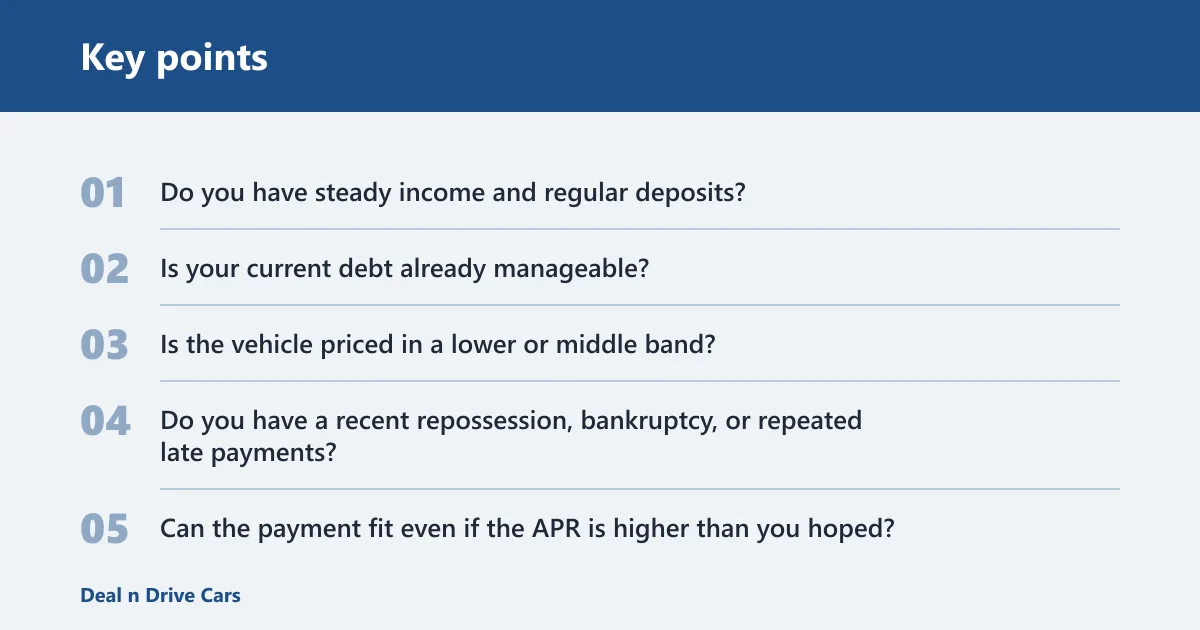
- Do you have steady income and regular deposits? Yes is a better sign for $0 down; no usually means a cash-down or cheaper-car conversation.
- Is your current debt already manageable? Yes supports approval; no can push the lender to lower the loan amount or ask for money down.
- Is the vehicle priced in a lower or middle band? Yes improves the odds of $0 down; no usually makes the lender more cautious.
- Do you have a recent repossession, bankruptcy, or repeated late payments? Yes often makes $0 down much harder; no gives you a cleaner starting point.
- Can the payment fit even if the APR is higher than you hoped? Yes means the deal may be workable; no means the car is probably too expensive.
- Do you have trade equity or a small amount of cash available? Yes can reduce risk; no means the lender may rely more heavily on your income and credit file.
Frequently asked questions
Can you get a bad credit auto loan with no down payment?
Yes, it is possible, especially with a special finance lender that accepts challenged credit. Approval is still less certain than with stronger credit, and the loan may carry a higher APR, a larger payment, or stricter vehicle limits. Zero down is a possibility, not a guarantee.
Is zero down realistic if my credit score is under 600?
It can be, but only in the right file. Under 600 is often treated as subprime, so lenders usually want stronger income, steady deposits, and a cheaper vehicle. Thin credit, recent repossession, or unstable employment can push the lender toward cash down or a different car.
Do lenders approve bad credit car loans based on income instead of score?
Income matters a lot, but it does not replace credit. Lenders usually check payment-to-income and debt-to-income limits, along with job stability and deposit history. A strong paycheck can help, but it rarely fixes a weak file on its own.
Can I get approved with bad credit and no trade-in?
Yes, if the rest of the file is strong enough. A trade-in is helpful, but it is not required in many programs. Without one, lenders may rely more heavily on your income, your payment history, and the vehicle price you choose.
Will a no-down-payment car loan have a higher APR?
Often, yes. No down payment raises lender risk, so the rate can be higher than a deal with some cash or equity. That higher APR can also increase total interest over the life of the loan, especially if the term is long.
What documents help if I’m applying with bad credit and no savings?
Have pay stubs, W-2s, 1099s, income statements, and recent bank deposits ready. Those documents help the lender verify that the income is current and stable. If you are paid hourly or self-employed, clean deposit history can matter more than a single pay period.