Is $500 Enough for a Used Car Down Payment?
Yes, $500 can work on the lowest-priced used cars, or when trade-in equity and a flexible lender fill the gap. On a more expensive car, that same cash can mean a higher monthly payment, more interest, or a loan denial. This guide shows where $500 fits by price band, how lenders judge it, and what other cash you may still need.
What $500 down really buys
A down payment is cash applied at purchase. It can come from money you bring, trade-in value, or both. A larger down payment lowers the amount financed, which can reduce the monthly payment and total interest, and it can also lower the loan-to-value ratio.
The car’s price changes the answer fast. $500 is a much bigger slice of a $5,000 car than of a $15,000 one. On a used-car loan, the same dollar amount can matter at one price band and barely move the numbers at another.
How a trade-in changes the math
If your trade-in has positive equity, that equity can count toward the down payment and may replace part of the cash you would otherwise bring. Negative equity does the opposite. It adds to the amount financed unless you pay it off another way.
Picture a $7,500 used car with a $1,500 trade-in and no loan balance on the trade. Your effective down payment is $2,000, even if only $500 is cash. That can move the deal closer to a lender’s minimum target.
Used car down payment benchmarks

Used-car down payments often center around 10%, but that is a benchmark, not a fixed rule. A common target is about 10% to 20% of the vehicle’s purchase price. Some lenders will finance more, and some will ask for more, depending on credit, vehicle age, and risk.
For example, a $25,000 used car with a 10% down payment would require about $2,500 upfront. That is a very different target from a lower-priced car, which is why the purchase price matters so much.
The common 10% target
Experian says a good used-car down payment is typically around 10%. Auto Credit Express also says the recommended down payment is 10% on a used car. Those numbers match what many lenders treat as a practical floor for standard financing.
That floor can move. Credit score, vehicle age, loan term, and dealer program all affect the amount you need. A lower score may lead a lender to require at least 10% down, while a stronger file may qualify with less.
When lenders ask for more
Some subprime auto loans set a higher bar. Auto Credit Express says many subprime lenders still require at least $1,000 or 10% of the vehicle’s selling price. That means $500 may fall short even before taxes and fees are added.
CIBC says its car loan can finance up to 100% of the cost of a new or used vehicle, and its minimum loan amount is $7,500. CIBC also says the vehicle can be up to 10 years old. Those details show how lender rules can shape the deal even when no single down-payment rule applies.
How credit score affects the floor
Credit score changes both the cash required up front and the APR. Weaker credit can bring a higher interest rate, and a larger down payment may help offset some of that risk for the lender. It can also reduce the chance of owing more than the car is worth later.
For bad credit, $500 may still help, but it may not be enough on its own.
Is $500 enough for a used car?
$500 is enough only in the cheapest price bands, or when trade-in equity and lender flexibility make up the gap. At midrange prices, it gets thin. At higher prices, it is usually too small to satisfy a typical 10% target, a subprime minimum, or the dealer’s risk standard.
Cheapest price bands where $500 can work
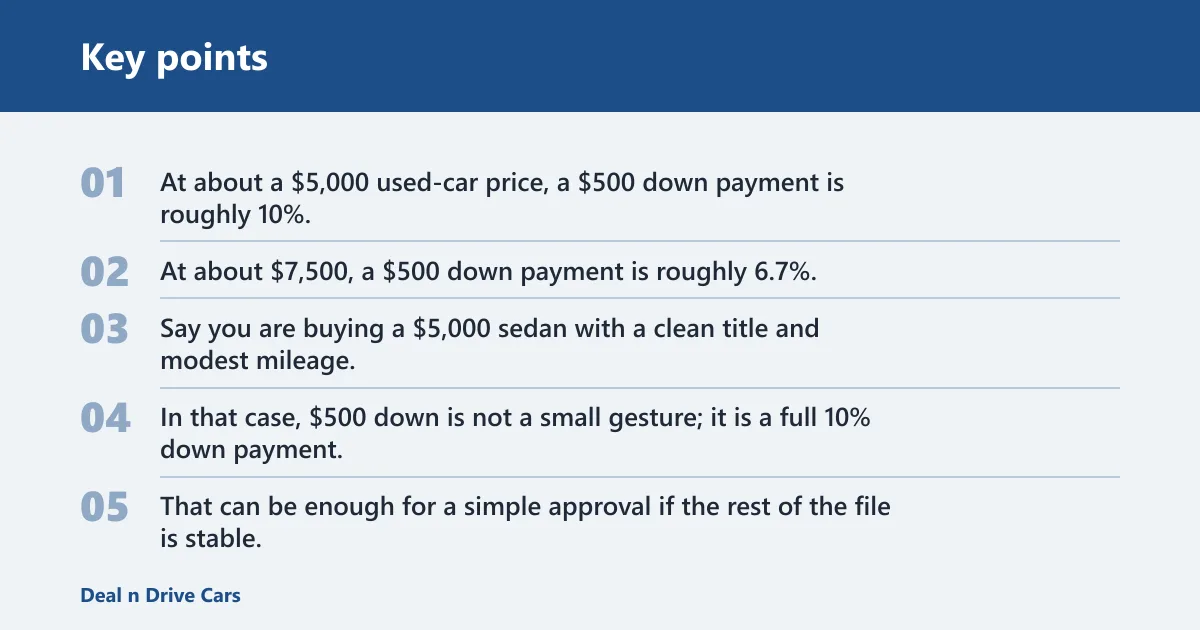
That hits the common benchmark. At about $7,500, a $500 down payment is roughly 6.7%, which may be below a common target and leave little room for fees.
Say you are buying a $5,000 sedan with a clean title and modest mileage. In that case, $500 down is not a small gesture; it is a full 10% down payment. That can be enough for a simple approval if the rest of the file is stable.
Middle price bands where $500 is thin
At about $10,000, a $500 down payment is roughly 5%. At about $15,000, it comes out to roughly 3.3%. Those levels may still be accepted in some programs, but they are often below what lenders want for a used vehicle, especially if the buyer has weak credit or limited income.
That is where approval can become sensitive to the rest of the file. A steady income, lower debt, and a trade-in with positive equity may keep the deal alive. Without those supports, $500 is usually too light.
Higher price bands where $500 is too small
At about $20,000, a $500 down payment is roughly 2.5%. That is far from the usual 10% used-car target. On a vehicle at that price, the lender may see a high loan-to-value ratio, which raises negative-equity risk if the car loses value faster than the loan balance falls.
For a higher-priced used SUV or truck, $500 rarely changes the underwriting picture by itself. You usually need more cash, a trade-in with real equity, or a lender that is willing to finance a larger share of the deal.
$500 down payment reality check
This table shows what $500 means at common used-car price points. It also shows whether it meets a 10% target and how much financing risk that can create. The lower the percentage, the more likely you are to need extra cash, trade-in equity, or a more flexible lender.
| Used-car price | $500 as a percentage | Meets 10% target? | Likely financing risk |
|---|---|---|---|
| $5,000 | 10% | Yes | Low |
| $7,500 | 6.7% | No | Medium |
| $10,000 | 5% | No | High |
| $15,000 | 3.3% | No | High |
| $20,000 | 2.5% | No | High |
The table is only part of the answer. A low down payment does not erase taxes, title work, registration, dealer fees, or repair needs. Those costs can make a deal look affordable on paper and still strain your budget at signing.
| Extra cash item | Why it matters | What to plan for |
|---|---|---|
| Taxes and registration | Added to the out-the-door price | Budget separately from the down payment |
| Title and dealer fees | Raises signing cost | Ask for the full out-the-door total early |
| Repair buffer | Used cars may need immediate work | Keep extra cash after purchase |
Will $500 help with bad credit?
Yes, but only in the right range. For bad credit, $500 can show commitment and may help a lender see the deal as less risky. Still, many subprime lenders want at least $1,000 or 10% of the vehicle price, and APR can stay high even with cash down.
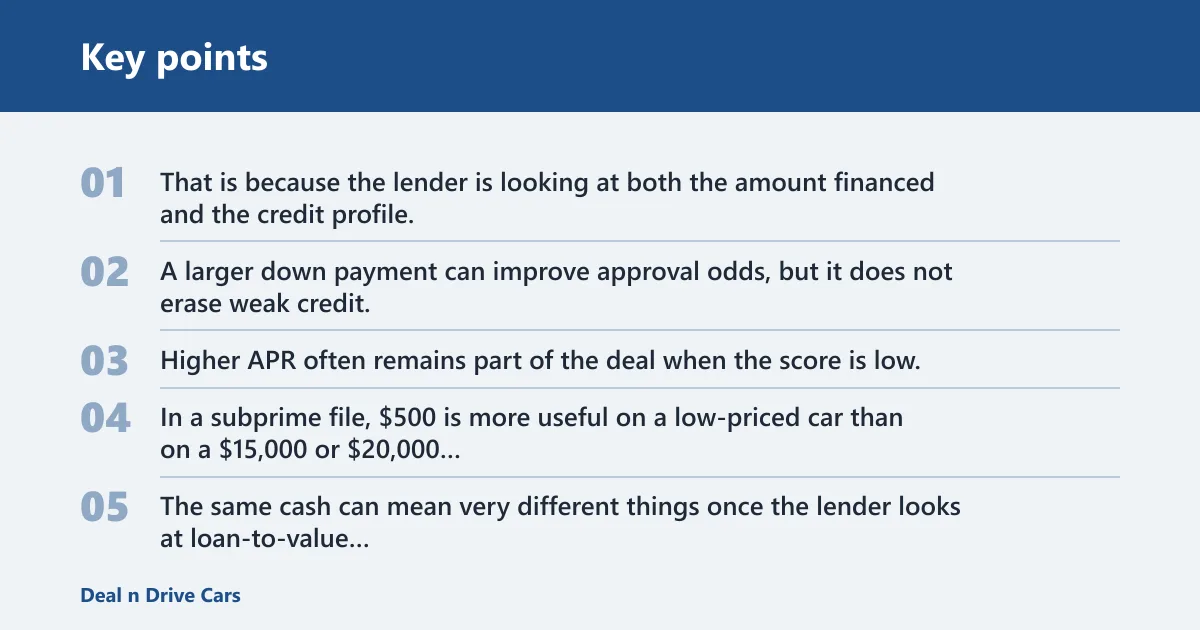
That is because the lender is looking at both the amount financed and the credit profile. A larger down payment can improve approval odds, but it does not erase weak credit. Higher APR often remains part of the deal when the score is low.
The same cash can mean very different things once the lender looks at loan-to-value ratio and payment stress.
Why APR can stay high even with cash down
APR reflects lender risk as well as credit quality. If the score is weak, the lender may still price the loan aggressively even when the down payment is acceptable. A lower principal helps, but it does not fully replace a stronger credit file.
A smaller loan balance can still reduce total interest compared with a higher amount financed. That is one reason a larger down payment can help, even when the APR does not move much.
Can a trade-in replace cash?
Yes, if the trade has positive equity. Trade-in value can count toward the down payment, and that can reduce the cash you need to bring. If the trade is worth less than what you owe, though, it cannot fully replace cash and may add to the loan balance.
A trade-in with real equity can turn a borderline deal into an acceptable one. A trade with negative equity usually does the opposite. The lender still sees the total amount financed, not just the cash you hand over.
Positive equity vs. negative equity
Positive equity means the trade is worth more than the remaining loan balance, if any. That extra value can offset part of the purchase price. Negative equity means you owe more than the vehicle is worth, which can create a higher loan-to-value ratio on the next loan.
Only positive equity helps the down-payment side of the math. Negative equity is a cost, not a contribution.
How much cash to keep back
Do not use every dollar for the down payment. Used cars can need immediate work, and you still have taxes, registration, and fees to pay. A healthy emergency fund matters because the purchase should not leave you with an empty checking account and no repair money.
That reserve becomes more important when the car is older or when the lender already pushed you toward a higher APR. A tight budget plus an unexpected repair can make a manageable payment hard to keep up with.
- Get the out-the-door price first, not just the sticker price.
- Add taxes, registration, title work, and dealer fees to the total.
- Check whether your trade-in has positive equity.
- Compare the down payment to a 10% used-car target.
- Hold back money for repairs and emergencies.
Say your $500 down payment gets you approved on a $7,500 hatchback, but the tires are near the wear bars and the inspection finds a brake job coming soon. The payment may fit, yet the first month can still strain your budget if you spent every spare dollar at the dealership.
That is why the better question is rarely, “How little can I put down?” The better question is whether you can leave the lot with enough cash still available to cover the first surprise.
Frequently asked questions
Is $500 enough for a used car down payment?
It can be, but only on the cheapest used cars or when trade-in equity and lender flexibility fill the gap. At $5,000, $500 equals 10%. At $10,000 or more, it is usually too small to meet a common used-car benchmark on its own.
How much down payment for a used car?
A common target is about 10% to 20% of the purchase price. The same source says a good used-car down payment is typically around 10%, and Auto Credit Express also points to 10% for used cars. Some lenders will ask for more, especially with weaker credit.
What percent down payment for a used car is typical?
About 10% is a common benchmark for a used car. That said, it is not a fixed rule. Lender program, credit score, vehicle age, and the total price can all shift the actual percentage you need to bring.
Can I buy a used car with only $500 down?
Yes, in some cases. $500 can work on a lower-priced vehicle, and some lenders may accept it if your credit and income are strong or if a trade-in adds equity. It is much less likely to work on a midrange or higher-priced used car.
Will a $500 down payment help if I have bad credit?
It may help, but it may not be enough. APR may remain high even with cash down.
Can you get a used car loan with no down payment?
Sometimes, yes. The same source says its car loan can finance up to 100% of the cost of a new or used vehicle. Still, zero-down financing is not the norm for every buyer, and it can mean a higher loan-to-value ratio and a larger monthly payment.
Does putting down $500 lower my monthly payment?
Yes, but the effect depends on the car price, APR, and loan term. A lower amount financed usually lowers the payment and total interest, but $500 may only make a modest difference on a pricier used car. It helps more when the purchase price is low.