What Are Good Websites to Buy Used Cars Near Me?
The best used-car websites near you are Autotrader, CarGurus, Cars.com, Carvana, and local dealer sites. Start with three local listing sources, then pick the one that fits your budget and risk tolerance. Skip that step and you can overpay, miss mileage or title issues, or waste time on cars that are far away or already sold. This guide ranks the main site types by buyer fit and gives a simple way to choose the right one in your area.
Best used-car sites by buyer type

Budget buyer
Start with price-ranked dealer listings on CarGurus, Autotrader, and Cars.com, then compare nearby marketplace ads for local comps. That order shows where the lowest asking prices sit before you take on private-seller risk or travel time.
For sub-$5,000 shopping, price transparency matters more than polished photos. Use CarGurus deal labels as a first pass, then verify the same model, trim, mileage, and title status on nearby listings before you contact anyone.
Family buyer
Prioritize dealership inventory and certified pre-owned pages with mileage, trim, and accident-history filters. That narrows the search to vehicles with clearer records, and certified pre-owned programs add inspected vehicles, warranties, and financing options.
For a family car, the right site is the one that makes it easy to compare safety-minded details. Look for history reports, service notes, and dealer reviews before you spend time on a long list of similar SUVs or minivans.
First-time buyer
Use sites with dealer reviews, visible fees, and strong return or inspection support. Cars.com and CarGurus help you compare sellers, while dealer websites and certified pre-owned pages usually cut paperwork surprises and make the checkout path clearer.
A first-time buyer needs fewer unknowns. If the listing leaves out title status, accident history, or fee details, keep shopping instead of asking later.
Private-sale hunter
Use Facebook Marketplace first, then local classifieds and nearby marketplace-style listings, because those channels have many private sellers. They can sometimes bring lower prices, but they may offer limited buyer protection, so a pre-purchase inspection matters.
Private-sale shopping works best when you stay local and move fast. If the seller will not share a VIN, service history, or a meeting place for inspection, skip the listing.
Online-only buyer
Compare Carvana listings and their seven-day return policy, plus the reconditioning guarantee shown on the specific vehicle page. Vroom should not be on your current shortlist for used-car purchases, because its consumer used-car sales business shut down in 2024.
If you want delivery and less in-person friction, online retail can fit well. Still, check the exact listing for title status, fees, shipping terms, and whether the vehicle is available in your area before you reserve it.
Used-car site decision matrix
Freshness cue: used-car platform policies, fees, and inventory change often. Recheck the exact listing, return terms, and history report before you pay a deposit or schedule pickup.
| Site type | Local inventory depth | Price transparency | Private-seller access | Buyer protection | Return policy | Inspection risk |
|---|---|---|---|---|---|---|
| CarGurus | 4 | 5 | 1 | 3 | 2 | 3 |
| Autotrader | 5 | 4 | 1 | 3 | 2 | 3 |
| Cars.com | 5 | 4 | 1 | 3 | 2 | 3 |
| Facebook Marketplace | 4 | 2 | 5 | 1 | 1 | 5 |
| Carvana | 3 | 4 | 1 | 4 | 5 | 2 |
| Certified pre-owned pages | 3 | 3 | 1 | 5 | 3 | 1 |
| Independent dealership sites | 4 | 3 | 1 | 4 | 2 | 2 |
| Vehicle history reports | 1 | 5 | 1 | 5 | 1 | 1 |
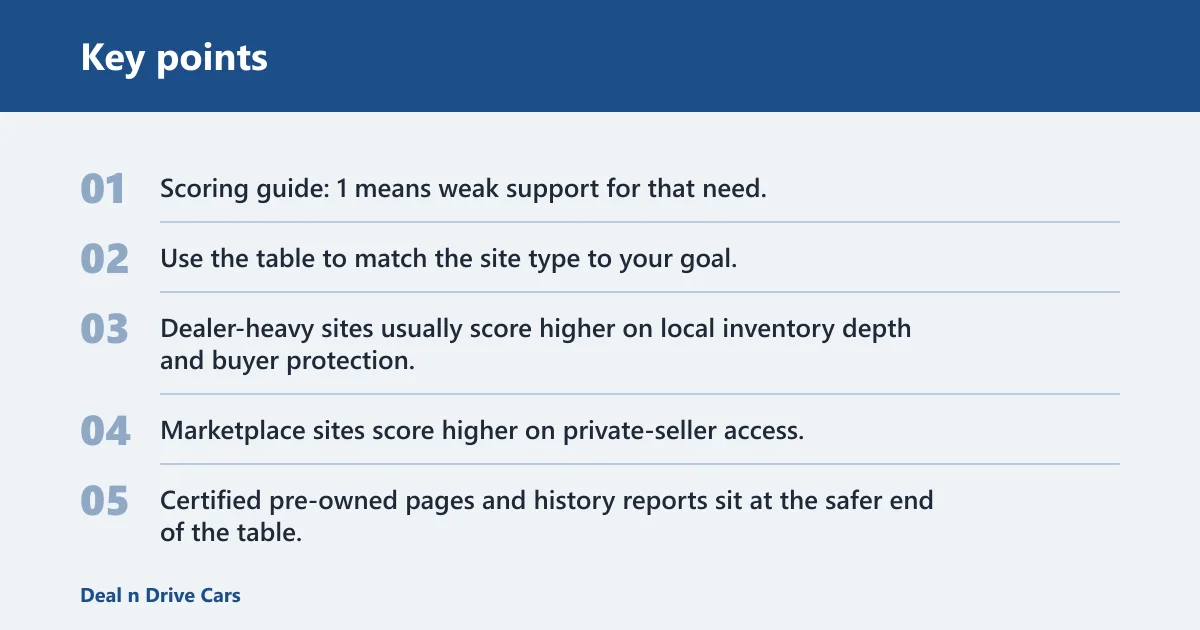
Scoring guide: 1 means weak support for that need, and 5 means strong support for that need. Use the table to match the site type to your goal, then verify the exact listing before you decide.
Dealer-heavy sites usually score higher on local inventory depth and buyer protection. Marketplace sites score higher on private-seller access, but that also pushes inspection risk to the buyer. Certified pre-owned pages and history reports sit at the safer end of the table.
Which websites show the most nearby listings?
CarGurus, Cars.com, and Autotrader often surface broad nearby search results for comparison shopping. CarGurus is often useful for market-based deal labels, while Cars.com can add dealer reviews and filters for mileage, trim, accident history, and distance.
Autotrader works well when you want dealer-heavy inventory with strong distance and price filters. That makes it useful for shoppers who want to stay close to home without giving up model variety.
How to tighten the search area
- Set your ZIP code and a realistic radius first.
- Filter by price, mileage, body style, and model year.
- Add trim and accident-history filters so the results stay comparable.
- Sort by distance, then by price, then by mileage.
- Save or set alerts for the exact model and price band you want.
Say your budget is $12,000 and you want a midsize sedan within 25 miles. A radius filter plus mileage and accident-history filters will remove most mismatched ads before you spend time reading each listing.
What are the safest websites for buyers?
Certified pre-owned pages, dealer sites, and vehicle history reports are the safest starting points for most buyers. Certified pre-owned listings usually include inspected vehicles, warranties, and financing options, while dealer sites make physical inspection and paperwork review easier before you commit.
History reports matter on every platform, including dealer inventory and private listings. Check accidents, title brands, odometer readings, and ownership records before you contact the seller or arrange a test drive.
Where buyer protection is strongest
Carvana offers a seven-day return policy and a reconditioning guarantee on the specific listing, which lowers some of the friction of buying online. Still, title status and availability vary by vehicle, so confirm the exact listing rather than assuming every car follows the same terms.
Independent dealerships can also work well if you want to inspect the car in person and negotiate on the spot. That route gives you more direct control over the vehicle and the paperwork, but it still needs a history report and a careful walkaround.
How to compare prices and filters
Use CarGurus as a starting point for market-based deal labels, then compare the same model against Autotrader, Cars.com, and nearby dealer sites. The goal is not to trust one score blindly. It is to see whether a listing is priced in line with similar cars nearby.
Market indexes are used to explain seasonal used-car price patterns, and used-car prices tend to peak in spring and summer and soften in late autumn and early winter. That does not make every listing cheaper in winter, but it does help you decide when to push harder on price.
A simple comparison workflow
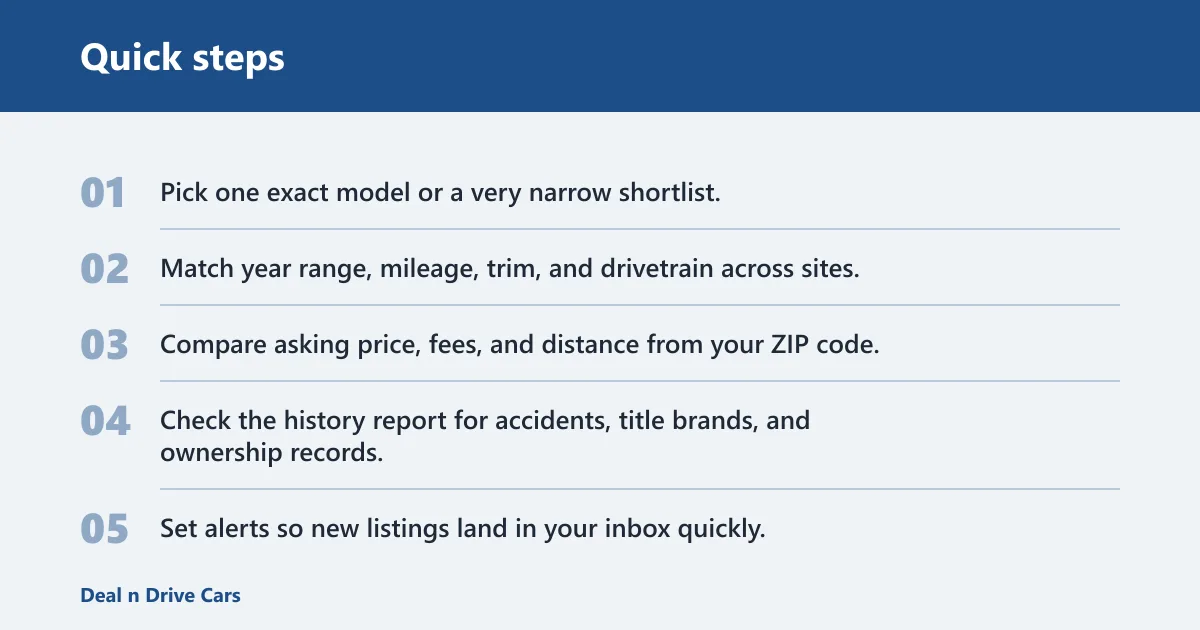
- Pick one exact model or a very narrow shortlist.
- Match year range, mileage, trim, and drivetrain across sites.
- Compare asking price, fees, and distance from your ZIP code.
- Check the history report for accidents, title brands, and ownership records.
- Set alerts so new listings land in your inbox quickly.
A common first-timer mistake is comparing a base trim with a loaded trim and calling one “cheaper.” Trim changes the price for a reason, so keep the feature set aligned before you judge value.
Vehicle history and inspection checks
Before you contact a seller, read the history report and look for accidents, title brands, odometer readings, and ownership records. That step helps you catch issues that do not always show up in the headline or the first few photos.
Private-sale listings need the most caution. Plan a pre-purchase inspection, verify the VIN on the car matches the listing, and ask for service records if the seller has them.
What to confirm before you go
- VIN matches the listing and the history report.
- Accident and title history are disclosed clearly.
- Odometer reading fits the model year and mileage pattern.
- Any fees, reconditioning notes, or warranty terms are visible.
- The seller will allow an inspection before money changes hands.
If a listing looks good but the seller refuses a pre-purchase inspection, walk away. That is true for marketplace ads and dealer inventory alike.
Frequently asked questions
What are good websites to buy used cars near me?
Autotrader, CarGurus, Cars.com, Carvana, and local dealer sites are commonly used starting points for nearby used-car shopping. Use CarGurus for market-based deal labels, Cars.com for dealer reviews and filters, and Autotrader when you want broad dealer-heavy inventory with distance controls.
What are the best websites to buy used cars?
The best site depends on your buyer type. For broad comparison shopping, start with CarGurus, Autotrader, and Cars.com. For online delivery, Carvana is the clearest current option. For lower-risk shopping, certified pre-owned pages and dealer sites are the safer route.
What is the best used car website near me?
The best used-car website near you is the one that matches your risk tolerance and budget. If you want the most local inventory, use Autotrader or Cars.com. If you want deal labels and comparison help, start with CarGurus and then verify nearby listings elsewhere.
Which used car websites are legit for buyers?
CarGurus, Autotrader, Cars.com, Carvana, dealer sites, and certified pre-owned pages are all legitimate places to shop, but each has different protections and risks. Facebook Marketplace is also legitimate as a marketplace, though it has zero buyer protection and needs the most caution.
How do I compare used car sites in my area?
Compare the same model across three nearby sources, then align year, mileage, trim, price, and distance. Check the history report for each listing, set alerts for your target range, and use CarGurus only as a starting point, not a final verdict on value.
Should I buy from a dealership website or marketplace?
Choose a dealership site if you want more paperwork support, in-person inspection, and a clearer path for financing or trade-in discussions. Choose a marketplace if you want private-seller access and lower asking prices, but plan for more inspection work and less protection.