Price Negotiation for a Used Car: How to Pay Less
Methodology note: The worksheet estimates below use a conservative midpoint approach. Price deductions were set from the lower end of commonly quoted retail repair ranges, then checked against market pricing guides and local fee schedules. Out-the-door examples use a sample 7% sales-tax rate and typical title/registration charges only to show how the math works; your state and county numbers may differ. For guide values, compare the exact trim, mileage, and condition in KBB, Edmunds appraisal tools, and NADA Guides.
Start by anchoring your offer to the market, not to a round number. Use KBB, Edmunds, and NADA for the exact year, trim, mileage, and condition, then adjust for inventory pressure, time on lot, and visible defects. A car that has sat for 45 to 60 days, especially in a trim with slower local demand, usually gives you more room than a fresh listing on a high-demand model. Walk in without evidence and you are guessing; walk in with comps and a repair sheet, and the seller has to answer the numbers.
What you’ll need before you negotiate
- KBB Fair Purchase Price for the exact year, trim, mileage range, and condition
- Edmunds True Market Value (TMV) for the same specification set
- NADA Guides pricing for wholesale and market-level context
- VIN report showing listing history, mileage patterns, and local supply data
- Vehicle history report from Carfax or AutoCheck (accident, title, ownership count)
- Pre-approved loan letter from your bank or credit union with rate and term stated
- Written out-the-door quote template from the seller or dealer
These tools turn a vague haggling session into a documented deal review. You are not asking the seller to “be fair.” You are comparing the asking price to the market, then checking whether the car and the paperwork justify any premium.
Should you negotiate the out-the-door price or sale price?
Negotiate the out-the-door price. That total includes the vehicle price plus taxes, title, registration, and dealer charges. A $22,000 sticker can become $24,800 after tax and fees, depending on your state and county. The Federal Trade Commission warns shoppers to focus on the total amount due, not just the monthly payment or the advertised price FTC.
Government charges such as sales tax, title transfer, and registration generally are not negotiable. Dealer-added charges such as documentation fees, reconditioning fees, accessories, and service-contract add-ons often are. The more complete the number on paper, the fewer places the deal can drift.
Fee stacking is where many deals get distorted. A $3,500 discount can disappear behind a $1,200 doc fee, a $500 prep charge, a $400 protection package, and a $300 fabric guard. An itemized quote exposes that move before you sign.
A common mistake is agreeing to a sale price and only learning the final total in the finance office. The dealer may keep the vehicle price where it is and make up margin in fees or products. Asking for the out-the-door total up front keeps the conversation honest.
Negotiate in eight steps
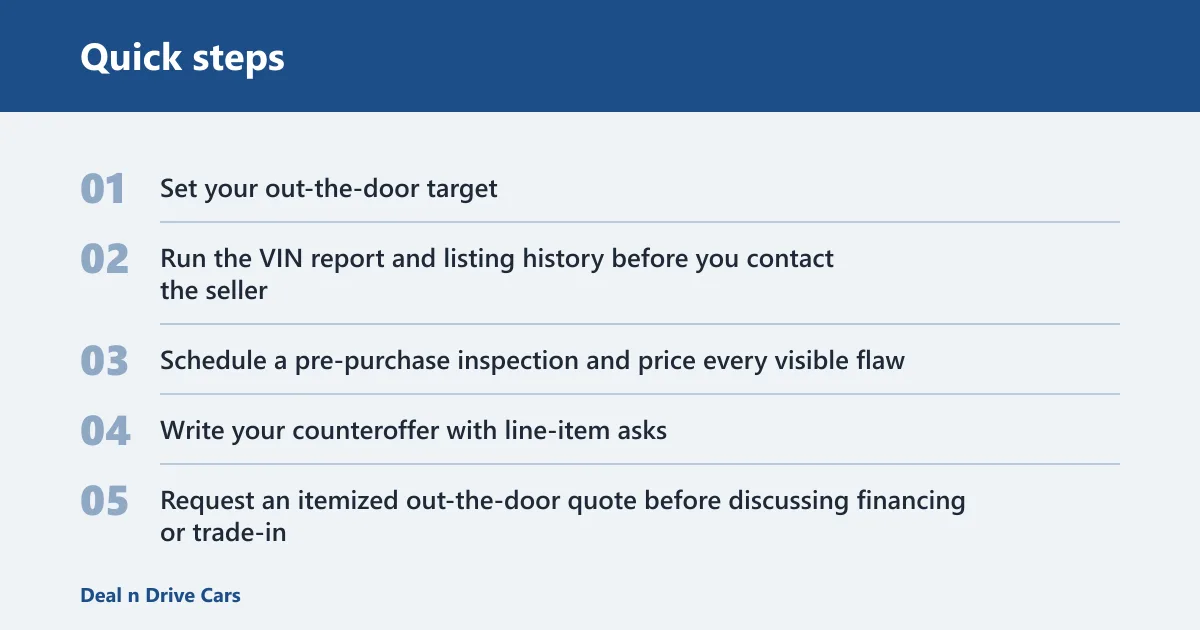
- Set your out-the-door target. Pull KBB Fair Purchase Price, Edmunds TMV, and NADA Guides for the exact VIN. Cross-reference the three and anchor to the lowest credible market band, not the asking price. For a fair-condition car with average mileage, a practical target is often near the middle of those guides; for clean-condition inventory with strong local demand, expect less movement. If the listing has been live for 30+ days, price drops have already started, which strengthens your position.
- Run the VIN report and listing history before you contact the seller. Check whether the price has changed over time, how many times the listing appeared across platforms, and whether mileage readings are consistent. A price that fell from $24,500 to $22,900 over six weeks signals pressure. A mismatch in mileage or title history is a reason to slow down, not speed up.
- Schedule a pre-purchase inspection and price every visible flaw. Have a trusted mechanic perform the PPI. A pre-purchase inspection typically costs about $100 to $200, depending on market and shop, and it can prevent much larger repair surprises Consumer Reports. Tires at 3/32 inch tread are close to replacement, and brake pads at 2 mm are usually near the end of service life. Use written repair estimates for each item before you negotiate.
- Write your counteroffer with line-item asks. Do not send one blanket number. List each deduction with the source and dollar amount. Attach the PPI report, the KBB and Edmunds printouts, and the VIN history summary. Specifics are easier to approve than vague complaints.
- Request an itemized out-the-door quote before discussing financing or trade-in. Ask the dealer to break down vehicle price, tax, title, registration, doc fee, and any add-ons. If the dealer only talks about monthly payment, pause. The Consumer Financial Protection Bureau notes that a lower monthly payment can hide a longer term or higher overall cost CFPB.
- Negotiate the vehicle price first, then attack fees and add-ons. Once the vehicle price moves, turn to the documentation fee, any reconditioning charge, and prepaid products. Dealer holdback is typically a manufacturer-to-dealer reimbursement built into the pricing structure, often around 2% to 3% of MSRP depending on the brand, though exact terms vary by manufacturer and model Edmunds. That does not mean a dealer must discount, but it helps explain why some deals still have room.
- Lead with the combination of comps and defects. Bring your loan approval letter to the dealer so financing does not hijack the price conversation. A pre-approved loan lets you compare the dealer’s rate against your bank or credit union without committing to their financing. Keep the focus on the vehicle number first.
- Set a walk-away number and leave if the total cannot reach it. Your walk-away point should be the maximum out-the-door price you calculated in Step 1, plus the unavoidable government charges in your area. If the total cannot get there after you present evidence, end the conversation. Another used car will come along.
How do you negotiate a used car price with a dealership?
Lead with the combination of comps and defects. Present your KBB, Edmunds, and NADA figures alongside the PPI report and the VIN history. Dealers are used to price pressure, but a written packet gives them something concrete to work with. It is harder to dismiss a line item than a vague objection.
When the dealer says the car is already discounted or advertised as no-haggle, move to the fee stack. Ask for the documentation fee, reconditioning charge, and any add-ons to be explained line by line. If the vehicle price will not move, the fees often become the better target.
A common first-timer mistake is letting a finance-office upsell erase the savings you fought for. You agree to a $21,500 out-the-door deal, then an extended warranty, key protection, and a tire package add $1,000 or more before you sign. The best defense is simple: review every number before you initial anything.
Dealer holdback matters in the background, not as a magic coupon. It is a manufacturer reimbursement that helps preserve dealer margin, but it is not the same thing as free discount money. Knowing it exists helps you understand why some managers can move on price while still protecting the store’s margin.
How do you negotiate a used car price with a private seller?
Verify three things before you make an offer: the title is in the seller’s name and free of liens, the mileage on the odometer matches the history report, and the seller’s identity aligns with the registration records. A private sale skips the documentation fee and finance-office upsell, but it also skips dealer oversight. You gain simplicity and lose some protection.
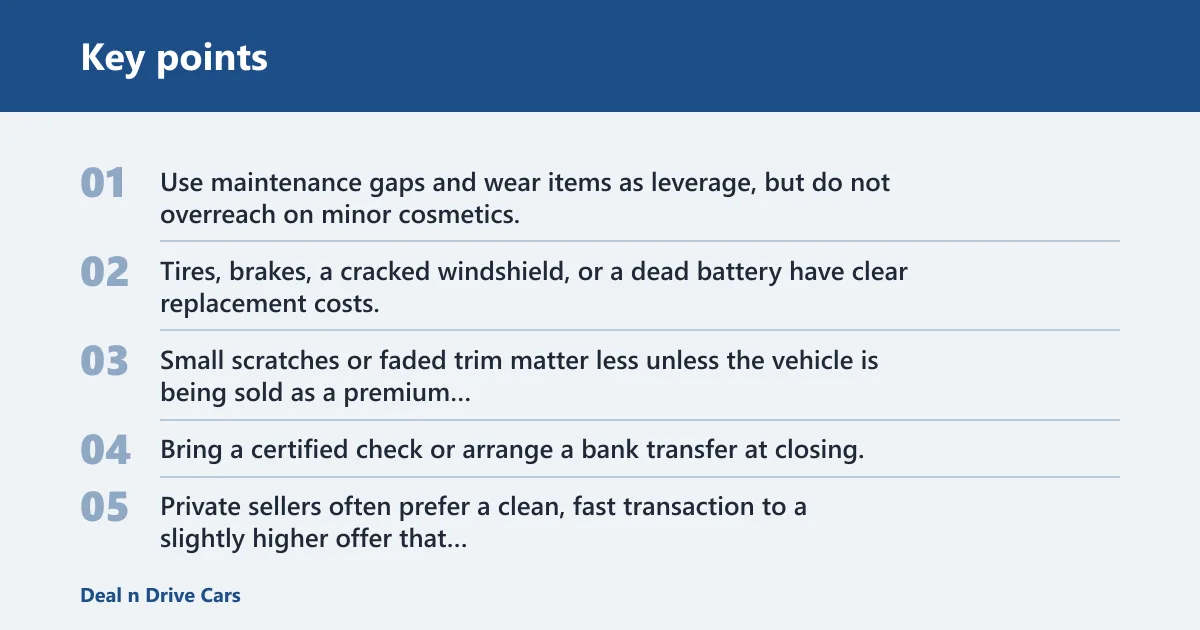
Use maintenance gaps and wear items as leverage, but do not overreach on minor cosmetics. Tires, brakes, a cracked windshield, or a dead battery have clear replacement costs. Small scratches or faded trim matter less unless the vehicle is being sold as a premium example.
Cash-equivalent payment helps. Bring a certified check or arrange a bank transfer at closing. Private sellers often prefer a clean, fast transaction to a slightly higher offer that comes with delays or uncertainty.
Write a firm offer contingent on inspection and clean title. Specify the out-the-door amount, the inspection deadline, and the condition that the title transfers without liens. If the seller accepts, sign a bill of sale with both parties’ information, the VIN, the agreed price, and the date. If the inspection changes the math, renegotiate or walk away.
Picture a buyer looking at a 2018 sedan listed privately for $18,500. The CARFAX report shows one owner and no accidents, but the last service record is stale and the tires are near replacement. The buyer submits an offer of $17,200, pointing to a pending service bill, tire replacement, and a gap versus comparable local listings. The seller counters at $17,900, and the buyer accepts because the car still fits the market band.
Price negotiation worksheet

Use this template to turn evidence into a dollar request. Fill in each row with what you found, where you found it, how much it is worth, and the exact deduction you are asking for.
| Issue Found | Evidence Source | Estimated Dollar Impact | Exact Ask |
|---|---|---|---|
| Front brake pads at 2 mm | Pre-purchase inspection report, page 2 | $380 | -$380 |
| Rear brake pads at 3 mm | Pre-purchase inspection report, page 2 | $290 | -$290 |
| All-season tires at 3/32 inch tread | PPI measurement, VIN listing photos | $720 | -$720 |
| Minor scratches on driver door | Pre-purchase inspection photos | $150 | -$150 |
| One prior accident reported | Carfax report, Accident History section | $500 | -$500 |
| Documentation fee exceeds state average | Dealer invoice comparison, state fee schedule | $300 | -$300 |
| Prepaid paint sealant not requested | Invoice line item review | $250 | -$250 |
| Price above KBB Fair Purchase Price by $900 | KBB valuation for VIN, condition, mileage | $900 | -$900 |
| Price above Edmunds TMV by $600 | Edmunds TMV for VIN, region, condition | $600 | -$600 |
| Dealer holdback margin (context only) | Industry standard: 2–3% of MSRP | $500 (contextual) | Not a direct ask |
Out-the-door target calculator
| Line Item | Amount |
|---|---|
| Asking price | $24,000 |
| Total deductions from worksheet | -$3,890 |
| Target vehicle price after deductions | $20,110 |
| Estimated sales tax (7%) | $1,408 |
| Title and registration fees | $285 |
| Remaining negotiable dealer fees | -$300 |
| Final out-the-door target | $21,503 |
| Walk-away maximum (target + 5%) | $22,578 |
Adjust the calculator for your own numbers. Replace the asking price, update the deductions with your actual worksheet items, and compute your own target. The walk-away maximum should stay within your highest credible market value after unavoidable government fees are added.
Can you negotiate a used car price before seeing it in person?
Yes, with limits. Request the VIN, a recent vehicle history report, a copy of any available inspection report, and a detailed out-the-door quote before you visit. Use the VIN to run your own history check and pull market comps. If the seller will not provide the VIN or the written quote, that is already useful information.
Once you have the VIN and comps, you can send a preliminary counteroffer based on listed features, reported condition, and market data. When you arrive for the inspection, adjust your offer up or down based on what you find in person. The first offer sets the frame.
What if the dealer says the price is not negotiable?
Shift the conversation to the out-the-door total and attack the fee line items. If the vehicle price is locked, ask for the documentation fee to be reduced or removed, for prepaid products to be deleted, and for any reconditioning charge to be explained. A firm price on the window sticker does not always mean every line in the contract is fixed.
If the dealer will not move on price or fees, walk away. No single car is worth paying above your target just because the conversation went longer than expected. Used-car inventory changes quickly enough that patience usually beats pressure.
Which used car fees are negotiable and which are not?
Non-negotiable fees typically include state sales tax, county or municipal surcharges, title transfer fees, and registration charges. These are set by government authority and the dealer has no power to change them. Dealer-added fees include documentation fees, reconditioning or preparation charges, dealer-installed accessories, prepaid maintenance plans, and add-on products such as paint sealants, fabric protectants, and key fob insurance. Some states cap documentation fees by law; for example, California limits the documentary fee to $85, while Florida adjusts its cap annually California DMV Florida Highway Safety and Motor Vehicles.
What mistakes ruin a used car price negotiation?
- Negotiating the monthly payment instead of the out-the-door total. A lower payment can hide a longer term or a higher interest rate. The CFPB advises shoppers to compare the total cost, not just the payment CFPB.
- Skipping the pre-purchase inspection. A $100 to $200 inspection can uncover repairs that are far more expensive than the inspection itself Consumer Reports.
- Bundling trade-in, financing, and vehicle price into one conversation. Separate the numbers so each one can be judged on its own merits.
- Agreeing to add-ons at the last minute. Extended warranties, protection packages, and service contracts are often the easiest place for the dealer to rebuild margin.
- Accepting an as-is sale without pricing the risk. If a seller insists on as-is, subtract the likely repair cost from your offer instead of hoping for the best.
- Failing to set a walk-away number. Without a ceiling, the seller controls the pace and you absorb the pressure.
Frequently asked questions
How much can you negotiate on a used car price?
There is no universal percentage. The better rule is to price the car by market band and inventory pressure. A clean car in a high-demand trim with low days on lot may only move a little, while a slower-selling model, an older color or trim combination, or a car with a repair history often gives you more room. Use KBB, Edmunds, and NADA to define the band, then tighten it with the PPI and local listing comparables.
How do you ask if a used car price is negotiable?
Ask directly in writing: “Is the out-the-door price negotiable, and can you provide an itemized quote including all fees, taxes, and add-ons?” A yes or no answer tells you quickly whether the conversation is worth continuing. If the response is vague, treat the listing as firm until proven otherwise.
Sources
- KBB
- Edmunds appraisal tools
- NADA Guides
- FTC
- CFPB
- Consumer Reports
- Edmunds
- California DMV
- Florida Highway Safety and Motor Vehicles