How to Negotiate a Used Car Price with a Private Seller
Start with a calm offer about 10% below your ceiling, then adjust for inspection findings, market comps, and title history. If the seller will not meet fair-market range, walk away. Weak negotiation can leave you paying retail money for hidden problems. This guide shows how to use inspection results, comps, and title or history issues to build a private-seller script that protects your budget.
This guide is part of our Price negotiation for a used car: how to pay less series.
What you need before you offer
A private seller is one person negotiating one car, so the asking price is only a starting point. There are usually fewer fees than at a dealership, but the real target is market value after condition, mileage, and history adjustments. Set your limit first, then build your offer around evidence.
- Your maximum budget, written down before you meet.
- A common rule of thumb is about 3 comparable listings with the same year, make, model, mileage band, and trim when possible.
- A vehicle history report with VIN-based damage, title, odometer, and legal or financial status checks.
- A test-drive checklist for road noise, brake feel, steering feel, highway behavior, city driving, and transmission smoothness.
- Cashier’s check or other safe payment method you can verify with the seller before meeting.
- Pen and paper, or a notes app, for exact defects and price points.
- Set your ceiling before you message the seller.
- Collect comparable listings and note the lowest realistic asking prices.
- Pull the vehicle history report using the VIN.
- Bring a checklist and inspect every item you can verify.
- Use the test drive to confirm any noise, pull, shudder, or brake issue.
If the seller wants $12,500 and your ceiling is $12,000, a 10% opening offer from your ceiling would be about $10,800, and you can add back value only if the car is cleaner than the comparable listings and history report suggest.
Private seller negotiation worksheet

This worksheet turns common findings into a calm offer. Use the issue, then choose the tier that matches how serious it is. Cosmetic wear belongs near the bottom. Safety, title, or odometer problems belong near the top of the deduction scale, and some can justify ending the deal rather than lowering the price.
| Issue found | Typical value impact tier | Exact sentence to use in the offer |
|---|---|---|
| Cosmetic wear: paint wear, interior stains, missing mats, dash cracks | Low deduction | “I like the car, but the visible wear puts it below the cleaner comps, so I’m adjusting my offer to $[number].” |
| Maintenance gaps: overdue fluid service, worn filters, missed records | Low to medium deduction | “Because the service history is incomplete, I need room for the catch-up maintenance and I’m offering $[number].” |
| Tires or brakes near replacement | Medium deduction | “The tires/brakes are close to replacement, so I’m subtracting that cost and offering $[number].” |
| Accident history with repaired damage | Medium to high deduction | “The history report shows damage, so I have to price this below comparable clean-title cars at $[number].” |
| Title issue, odometer mismatch, or financial/legal problem | Walk away unless fully resolved in writing | “I can only move forward with a clean title and consistent mileage history, so I’m passing unless that is corrected first.” |
| Walk-away threshold: seller refuses fair-market range after verified flaws | Exit | “I respect your position, but I’m not comfortable going above my number, so I’m going to pass.” |
How much can you negotiate on a used car private seller?

Negotiation range depends on demand, condition, and local comps. On a private sale, the asking price often sits above market value, so your room to move comes from similar listings, mileage, trim, transmission, and the car’s actual condition. Safety problems and title issues matter far more than worn mats or a small dash crack.
Use market value as the anchor
Research the fair market value of similar vehicles, then compare the seller’s price against lower-priced ads with the same year, make, model, mileage, trim, and transmission where possible. A lower-priced comparable listing is stronger if it is still active and close in condition, rather than a faded ad from months ago.
Adjust for condition and mileage
High mileage and visible wear reduce value, while options can add value if they are real and documented. A cleaner car can justify a firmer offer. A rougher one should not price like a garage-kept example just because the seller says it is “well loved.”
Separate cosmetic issues from safety issues
Rust, paint wear, stains, missing mats, and dash cracks support a modest deduction. Tire wear, brake wear, steering problems, and transmission issues justify a larger reduction because they affect repair cost and risk. If the car has a title problem or odometer mismatch, the better move is often to stop negotiating.
A common first-timer mistake is arguing hard over a scuffed bumper while ignoring that the vehicle history report shows an odometer inconsistency. The bumper is a price issue. The mileage mismatch is a deal issue.
How to build your counteroffer
Start with comparable listings, then convert each verified flaw into a specific adjustment. Do not ask for “a better price.” Give one number, one reason, and one calm sentence. That keeps the discussion on evidence instead of emotion.
Start with comparable listings
Take the lowest realistic comparable price and work from there. If the seller’s asking price is above several similar ads, that gap is your first source of room to negotiate. If the seller’s car has more miles, older tires, or a weaker history report, the offer should move lower, not higher.
Convert defects into a price adjustment
Use the defect to justify the number, not to argue for its own sake. For example: “The tires and front brakes need attention, so I’m offering $9,700 instead of $10,300.” That sentence ties the reduction to a repair need and a concrete price, which is easier to accept or decline.
Make one specific number, not a vague discount
Say the exact amount you are willing to pay. If the seller counters, answer with a second exact number or end the deal. Vague phrases like “Can you come down some?” invite an endless back-and-forth with no anchor.
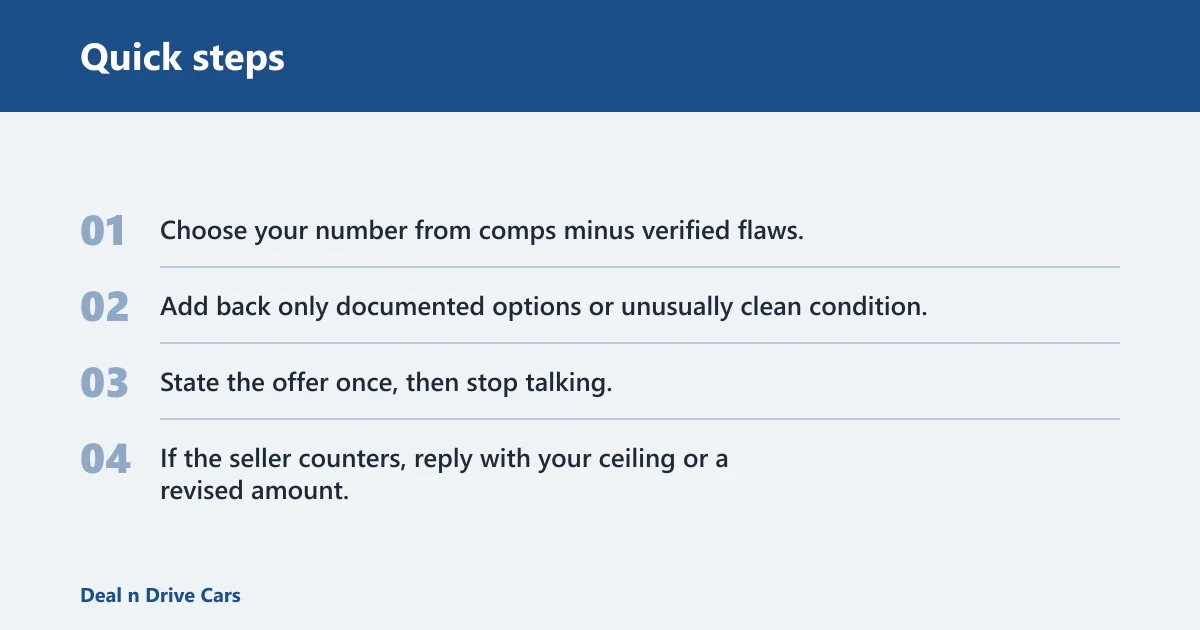
- Choose your number from comps minus verified flaws.
- Add back only documented options or unusually clean condition.
- State the offer once, then stop talking.
- If the seller counters, reply with your ceiling or a revised amount.
What should I say when negotiating with a private seller?
Say that you have compared similar cars, reviewed the history report, and noted any inspection items. Keep the tone calm and specific. A private seller is more likely to respond to a short, factual offer than to pressure or praise that sounds insincere.
Opening offer script
If you can meet that, I’m ready to move forward.”
Counteroffer script
“I understand your price, but the tires/brakes/history report change the value for me. I can go to $[number], and that would be my limit.”
How to mention repairs without sounding hostile
Focus on cost, not blame. Say, “The brake pads are close to replacement,” not “You neglected the car.” Say, “The dash crack and seat stains lower the value,” not “The car is in bad shape.” That phrasing keeps the seller from feeling attacked.
Say your test drive revealed a wheel vibration at 60 mph and a slightly soft brake pedal. You do not need to debate the cause. Mention the symptoms, then tie them to a specific deduction and a single offer number.
What if the private seller says the price is firm?
A firm price is still a negotiation, unless the seller truly will not move. Your job is to decide whether the car fits your market range and risk tolerance. If the seller will not respond to evidence, do not chase the car past your ceiling.
When to stand your ground
Stand your ground when your offer is supported by comps, the history report, and visible defects. If the seller’s number is still above fair market value after those adjustments, hold your line and say so once.
How to respond to other-buyer claims
“That may be true, but my offer reflects the car’s mileage, condition, and history. If it is still available later, feel free to call me at my number.”
When to walk away
Walk away if the seller refuses to discuss clean title status, odometer history, or obvious safety items. Walk away if the seller pressures you to pay before title transfer steps are clear, or if the payment method feels unsafe. As-is liability is real, and it belongs in your decision.
Common mistakes to avoid
Most bad deals start before the first offer. Buyers often negotiate off one listing, skip the history report, or treat minor wear as if it were the same as a title problem. Private-party negotiation works best when you separate price cuts from deal-breakers.
- Negotiating before checking the car: inspect first, then name a number.
- Using one listing as proof: compare several similar vehicles.
- Chasing tiny cosmetic flaws while ignoring title or odometer risk.
- Forgetting payment and title-transfer timing: confirm both before money changes hands.
- Offering a vague discount instead of one specific price.
- Acting rushed when the seller says there are other buyers.
Do your research before negotiating. Check similar listings, the vehicle history report, and the car’s condition before you say a number. Know the fair market value from active ads with matching year, make, model, mileage, trim, and transmission. Use those listings as your pricing guide. Inspect the car for visible defects. Get a vehicle history report. Set a maximum budget. Use the test drive to uncover issues. Make a specific counteroffer. Be ready to walk away.
Frequently asked questions
Should I mention repairs when negotiating a used car price?
Yes. Mention only verifiable repairs or wear items, such as tires, brakes, stains, rust, or dash cracks. Tie each item to a price adjustment. That keeps the conversation grounded in cost instead of criticism and gives the seller a clear reason for your offer.
Can I negotiate a used car price after a test drive?
Yes, and that is often the best time because the test drive can expose road noise, brake feel, steering feel, highway stability, city behavior, or transmission smoothness issues. Write down exactly what you felt, then turn each item into a specific deduction before making your counteroffer.
What documents or history report should I use to negotiate?
Use the VIN-based vehicle history report, the title status, odometer history, and any proof of service the seller can show. Vehicle history reports can include damage and title information, along with odometer readings. If the paperwork is incomplete or inconsistent, price the risk lower or walk away.
How do I avoid overpaying for a used car from a private seller?
Set your budget first, compare several similar vehicles, and use the lowest realistic market number as your anchor. Then subtract for high mileage, visible wear, maintenance gaps, and history issues. Do not ignore payment fraud risk or title-transfer timing, because both can turn a fair deal into an expensive mistake.
When is the best time to make an offer on a private seller car?
Make the offer after you have the history report, the inspection notes, and the test-drive results. If the seller did not publish a price, wait for the opening offer first. If a price is posted, make your counter only after you have enough facts to justify it.
How much can you negotiate on a used car private seller: there is no universal number?
There is no universal number. The practical answer is the gap between asking price and fair market value, plus any deduction for mileage, condition, or history issues. If the seller refuses to close that gap and the title or payment terms are unclear, the right move is to walk away.